Economy Size Crosby
Mr. Music (1950) To Keep a Star Franchise Going
Paramount was economizing, and how. The war boom was past, and
time had come to tighten belts. Para prexy Barney Balaban sent commandments
from New York:
$1.5 million the limit for feature budgets. 1948 initiated the policy, enforced
by production head, and known penny-pincher, Henry Ginsberg. Notable directors
Frank Capra, William Wyler, and Leo McCarey had lately signed on and were
incensed. How could you make passable pics with so little money? Cecil B.
DeMille was exempt for fronting his spectaculars over and above the $1.5
Paramount kicked in, loaning banks good for balance and assuring C.B.'s
half-ownership of negatives. Samson and Delilah was done on these terms and
stood out like a rose among release schedule thorns for a 1949-50 season.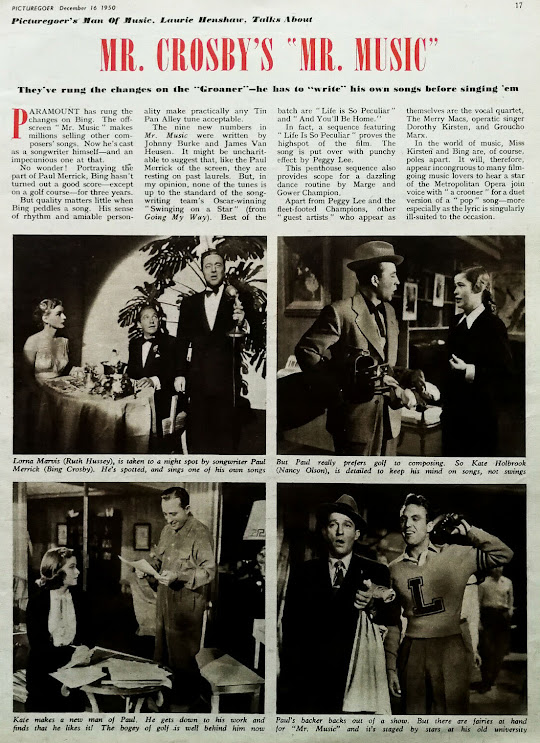
Paramount hosted sales delegates at a 3/49
gather to cheerlead upcoming product, of which Mr. Music was inked for
September start. Bing Crosby addressed the crowd via phone hookup from Frisco
and made "an eloquent (twenty-minute) plea for all-out cooperation between
studio workers, production execs, and sales representatives," most of whom
were en masse to lend eye and ear. A studio party followed at the
commissary to which 350 attended, including whatever Paramount
stars were within town limits. Such conclaves were crucial and attendance was
compulsory. It was understood that Crosby was Number One among Para personalities, but that wouldn't loosen the purse
for Mr. Music, ultimately finished at negative cost of $1.7 million, an
overage, but no worse than those for Copper Canyon ($1.7) and Let's Dance
($2.10 and being done concurrently). Balaban's $1.5 ceiling was more hope than
realization, and would be raised in accordance with realities to $1.75 million
by December 1949, optimism maintained thanks to lowering of studio overhead
from 32% of a year before to 27% in 1949.

Mr. Music had nearly a year's wait before
release. In ahead for April 1950 was Riding High, starring Bing Crosby and
directed by Frank Capra. Then there was a major reissue of Going My Way set for
July 4 launch, with new advertising accessories and circulation through late
summer and fall. Paramount had to guard against
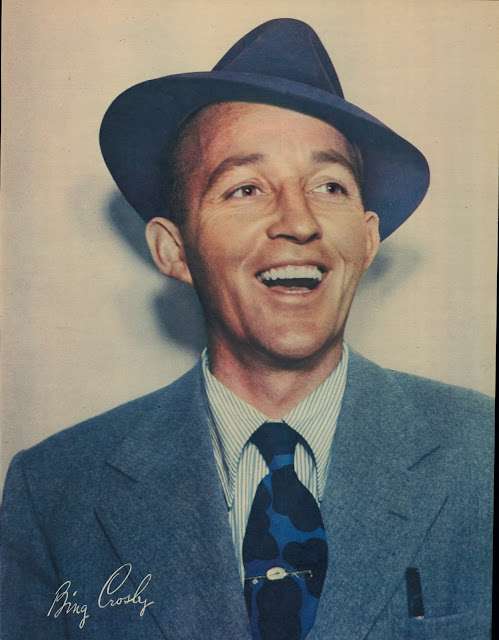
overexposure of Crosby just as later was case with Elvis Presley. Still, Bing's twentieth anniversary "as a star"
was just ahead, said Variety, and toward celebration of that, Paramount teamed with CBS and Decca, "Crosby's
home base network and waxery," with bally keyed to Mr. Music, the star's
forty-second picture and set to open 12/20/49 in New York. "Bingsday"
was recognized via radio specials, disc promotions, and covering of Mr. Music
tunes by other artists including Frank Sinatra, Vic Damone, and Perry Como.
Variety reviewed Mr. Music well ahead of release
in August 1950. "Cliché elements" were noted, but might have been
expected. It was the songs that drew closer evaluation, ones by Johnny
Burke and Jimmy Van Heusen getting an appreciative nod though lacking
"at-first catchy quality." Crosby's relaxed style had over time
cornered him into playing idlers, thus first halves spent just waking his
characters up, in this case a songwriter who'd rather play golf than compose.
There's edge to Crosby here when others get
too close. Charles Coburn and love interest Nancy Olson try getting him off the
duff to at-times hostile response, Bing's Broadwayite an almost forerunner to
his Frank Elgin in The Country Girl. Mr. Music was reprise of Accent On Youth,
which was May-December themed but now less an issue between Crosby and Nancy
Olson. He was 46 to her 21 when Mr. Music was made, and maybe age difference
registers not so much thanks to Olson seeming older than ingénues she'd play,
thus congenial with comparative old-timers like Bing.


Griff checks in with memories of MR. MUSIC:
ReplyDeleteDear John:
I wish I had some interesting comment to make about MR. MUSIC. After all, it's one of several films based (however loosely) on Samson Raphaelson's play "Accent on Youth" (probably most famously adapted as BUT NOT FOR ME, with Gable, Lilli Palmer and Carroll Baker) and is one of three features directed by character actor/comic Richard Haydn.
But although I possess a copy of this Crosby musical, I have never actually watched the whole movie. I have, however, looked at the Groucho/Bing number, "Life is So Peculiar," many times.
Regards,
Griff
Somehow I'm always surprised to see how many major films were shot in black and white, some with widescreen formats, and all the way into the 1960s. Was there a tipping point when color was nearly mandatory and B&W was mainly for arty fare and/or lowest-level cheapies? Certainly by the late 60s, when networks were mainly color and it meant a lot of money in the inevitable television sale.
ReplyDeleteWhen "A Hard Day's Night" debuted on NBC, they replaced the peacock with a modest animated penguin and an announcer telling us the movie was presented in "lively black and white".
Apropos of nothing, recalling that Dean Martin played a lazy writer in "Bells Are Ringing", taking over the role created by Charlie Chaplin's son Sydney on Broadway. It echoed some of his early films where he played a loafer or rat who needed Jerry Lewis to turn him around; here it was Judy Holliday.
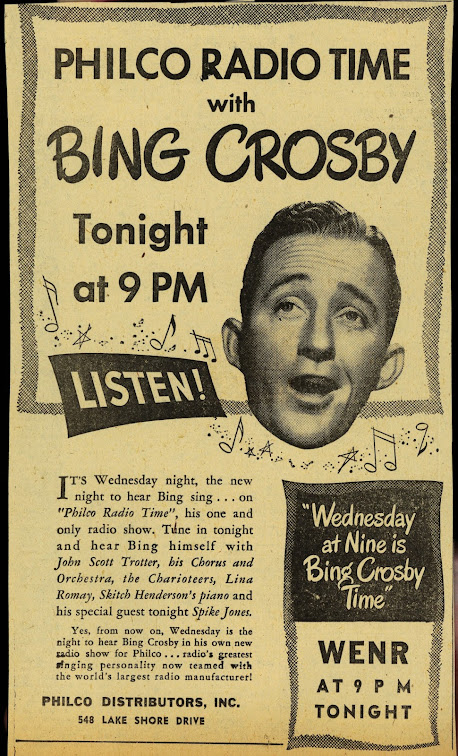
I wonder how close to reality this role came for Bing (I've not seen the movie, nor do I recognize any of the songs listed in the newspaper ad you've reprinted) as he was known to be an avid golfer.
ReplyDeleteIn "The Country Girl", which I saw many years ago, he also takes a role which in some ways may reflect some aspects (as if in a distorted fun house mirror) of his own life; he was doing his "Road" movies with Bob Hope during the 1940s/1950s too, so Bing may have taken his solo projects as an opportunity to develop a less silly side of/for his public persona.
I sometimes wish that Hope had done something similar; I still think that Hope would have made a great Blofeld as a continuing character across the Bond series - after all, didn't the character of Blofeld actually became an object of comedy in his final appearance in that series with Roger Moore?
Even without ever watching it, I always thought this movie gave off a low budget vibe just from the stills.
ReplyDeleteThank you, Mr. Benson! I thought I was the only one who remembered The NBC Penguin introducing A HARD DAY'S NIGHT. I was very disappointed when NBC rebroadcast the film sometime later and didn't include the penguin.
ReplyDeleteI had completely forgotten about the penguin on that broadcast.....of course, we still had a black-and-white set at that point but it was very amusing after all the "living colour" intros we had to sit through....by the time of the rebroadcast, we were all coloured-up,tech-wise, and someone in the room made some comment about the new set going wrong so soon....
DeleteThe NBC Penguin opening, in a not very good copy, can be seen here: https://youtu.be/eK75N-zS1JY.
ReplyDeleteI kinda like this picture.
ReplyDeleteI was a huge fan of Bing's since my earliest boyhood -- something slightly out of sync with my generation. The first concert I ever went to was when Bing played the Uris in New York in 1976. I was 14 and never forgot it.
I think of myself as fairly young ... but I realize that I'm one of a dwindling number of fans who can say they saw Crosby in person.
MR MUSIC is interesting as Groucho's belated return to Paramount, though of course without his Brothers.
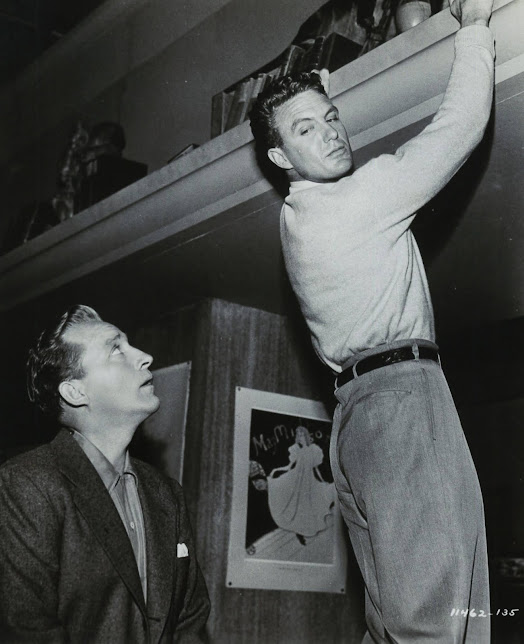
ReplyDeleteCraig Reardon checks in with reflections on Robert Stack:
ReplyDeleteI was privileged to see or meet or make up many of the people who populate your grand posts. I see Robert Stack pictured in another one here about Bing Crosby's unremembered (by me, anyway) "Mr. Music", for example. I met Stack on one of Merv Griffin's talk show tapings, MANY years back. What a gent, and what a pleasure to chat briefly with him. No airs! Just a truly nice guy. A striking contrast with his frequent poker faced seriousness in many roles, if not most of them.