Classic movie site with rare images (no web grabs!), original ads, and behind-the-scenes photos, with informative and insightful commentary. We like to have fun with movies!
Archive and Links
grbrpix@aol.com
Search Index Here


Tuesday, January 31, 2006


Jean Simmons Challenges The Code


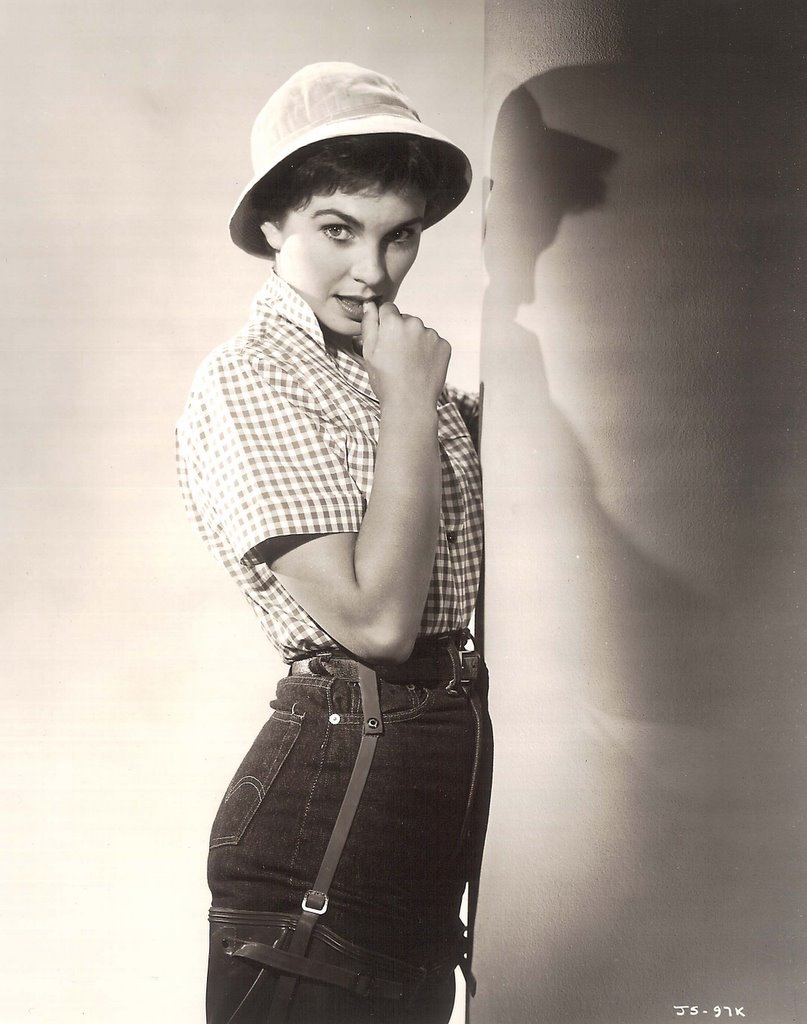
Today is Jean Simmon’s 77th birthday, and as it happens, we just ran across these stills from an admittedly obscure Metro pic she did with Paul Newman in 1957, Until They Sail. The thing that got our attention, and hopefully yours as well, is how even publicity shots were, by that time, really beginning to challenge the Production Code. Needless to say, this pose on the bed promises something the movie itself will not deliver, but it does forecast the sixties breakdown of the Code that would finally usher in the adoption of the Ratings System. Beautiful But Dangerous was the RKO working title for which kittenish Jean appears here in her fishing get-up. The picture was ultimately retitled and released in 1954 as She Couldn’t Say No, and it was a real time waster for Jean and co-star Bob Mitchum (as a country doctor!). Why they put these two to work in a lame comedy like this instead of another noir like Angel Face is anyone’s guess.


HOUSEKEEPING ALERT


We’ve heard from a number of readers wanting another installment of Gary Cooper, and that’s good, as we’ve got lots more neat images we’d like to upload --- so keep checking by, cause we expect to have it up within the week. There’ll also be another Star Scrapbook feature, as we’re digging into more of the collection that yielded the Clara Bow images we used last week. Seems this guy was a Paulette Goddard enthusiast as well, and we found some great stuff there, so keep watching.


Some of our friends in Cyberspace have given Greenbriar a nice boost lately (we’re only a month old this week), and we’d like to acknowledge their kindness.
CLASSIC MOVIES is Brad Lang’s terrific resource for news and updates on all things relating to vintage movies, and well worthy of a place on your favorites list. Same goes for IN THE BALCONY, whose moderator, Laughing Gravy, gave us our very first link. Gravy’s got DVD news (he stays on top of the classic announcements), a message board, and lotsa fun stuff. Mike Keaney’s Film NOIR site is a good place to lose yourself in any number of fascinating dark alleys. We found some great stuff here. LIBERTAS bills itself as "a forum for conservative thought on film", and they’ve got a real appreciation for the classics (nice TCM updates with images) as well as an eagle-eye for contemporary Hollywood machinations. THE THIRD BANANA is a celebration of unjustly neglected comedians, and it’s great. They did a piece a few months ago on a what if … teaming of Charlie Chaplin and El Brendel that’s just about the cleverest thing I’ve ever read. Finally, Tim Lucas and his Video WATCHBLOG are a Greenbriar must each morning, sure as Frugal Breakfast. He did a Gordon Scott essay recently that is hands down the best thing I’ve ever read on that most underrated actor, and just last week, I enjoyed some import DVD German westerns that I picked up as a direct result of his insightful review. Thanks Tim. I’d never have discovered these without ya!


Monday, January 30, 2006


Monday's Glamour Starter --- Joan Leslie


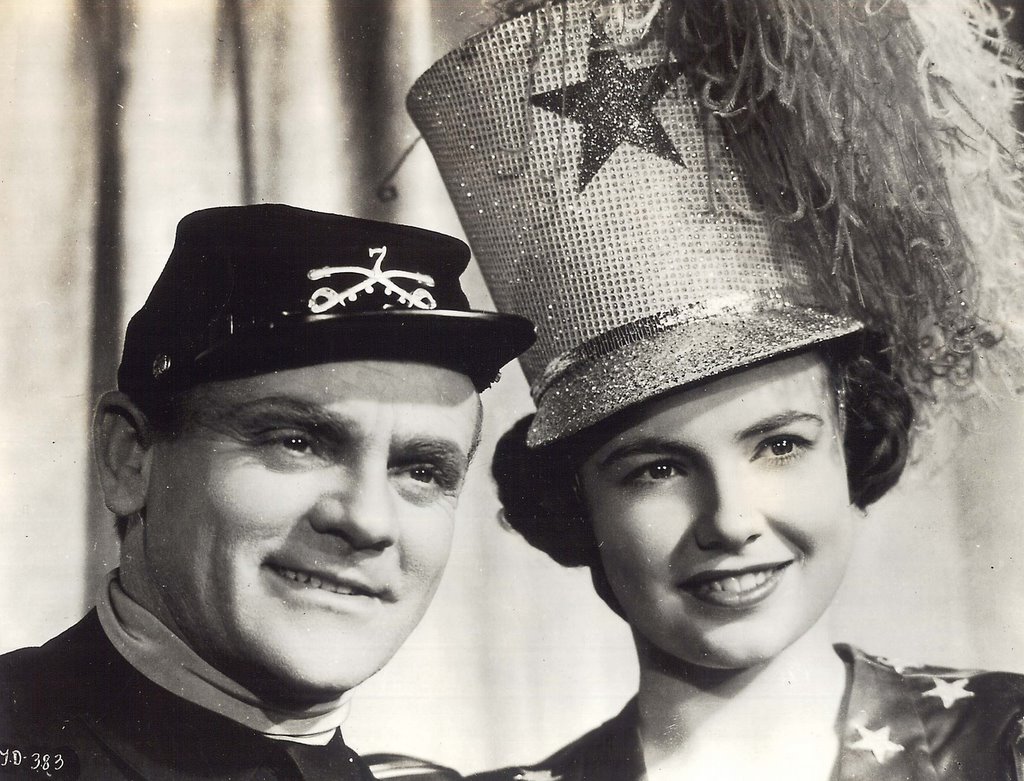
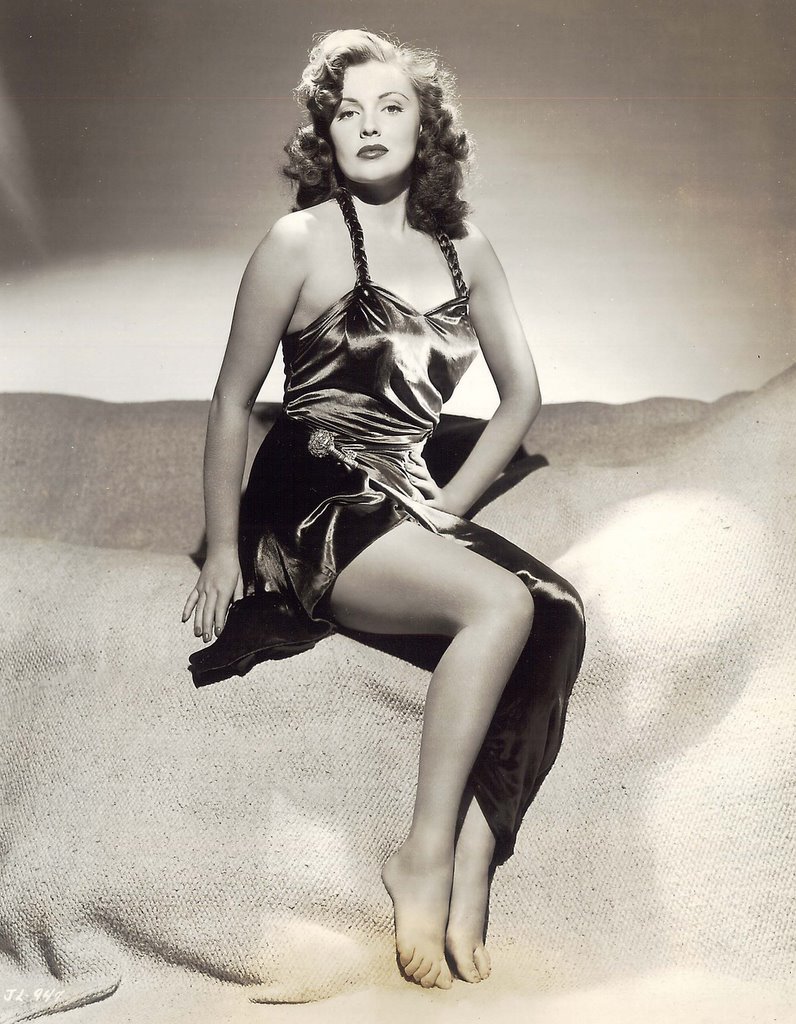
Why Joan Leslie for Glamour Starter when we could have picked Hedy Lamarr (and she’s coming, by the way), or Jane Russell, or any number of obvious choices? Well, it’s because we think she’s cute, and because we do try to avoid the obvious here at the Greenbriar. Besides, we really admire the way Joanie handled her life after she got out of the star business, but more on this anon. As it happens, she just had a birthday --- turned 81 this past Thursday --- and get this --- Joan Leslie was born the same day as Paul Newman --- I mean the very same day!! Really freaked me out to learn this. She seems older than Hud. I had this image of Paul in his knickers watching Joanie with Bogart in High Sierra, and dancing with Cagney in Yankee Doodle Dandy, his feet just barely touching the floor of the little grindhouse where he grew up.


The amazing thing about Joanie is the fact that she was only sixteen when she stepped before the camera with Mad Dog Earle, and only fifteen when she was signed to do High Sierra. Her backstory was a familiar one for those days. She and her sisters seem to have taken every singing, dancing, and overall precocity award to be had around Detroit in the early thirties, till old man Depression hit, and suddenly Dad was out of a job, and desperation was just around the corner. It’s easy to be glib about a thing like this now, but you gotta admire the way these people persevered in the face of such odds. Tough breed, those crash veterans. One of the precocious sisters eventually opened a few Hollywood doors, and suddenly Joan was in, doing a Camille kid-bit, and even scoring a
momentary on-set acknowledgement from Garbo herself (the self-same Garbo who turned down Basil Rathbone’s request for an inscribed photo when they made Anna Karenina together --- we can never forgive anyone doing a thing like that to our Basil). Anyway, Joan ended up at WB, where the star build-up went into high gear before the ink dried on her first contract. She says Bogie himself did the High Sierra test with her. What a pro. He could have stayed home that day, fought with Mayo, and left the gig to John Ridgely or Dane Clark, but Bogart was nothing if not a dedicated actor, and to top that, he even forbade swearing on the set in deference to little Joanie. Reminds us once again that Bogart was basically a Victorian at heart. Question is, why did they keep letting that squirrelly Mayo Methot onto the lot to torment this poor man? Joan’s not the first interview to mention that in connection with Bogart tensions during a shoot. Always jealous of the leading ladies, hovering around the set … this guy really needed somebody stationed at the door! There’s a fantastic Warners short Joanie did in that first year called Alice In Movieland, where she plays a variation on her own climb-to-stardom story (a lot like Fox’s terrific Stardust with Linda Darnell). It’s an extra on the DVD with The Sea Hawk, and worth the price of the disc by itself. As for the Warners career, it ended up in a courtroom when Joan turned twenty-one. She wanted out, and eventually made the break, but smiling Jack L. got the word around that she wasn’t a "team player", so some lean years followed, first with Eagle-Lion, then at Republic. I remember having a 16mm network print of an old TV show once where she did a shampoo commercial. The happy ending came with a good marriage, kids that turned out well, and a dress design business. Joan Leslie does a lot of festivals and screenings as well. It’d be great to meet her someday.


These stills really point up the scattershot, schizo madhouse that was the WB publicity mill (that scene from It’s A Great Feeling with the flacks at work does have a near-documentary flavor!). First Joan’s the earnest schoolgirl taking lessons on the set. Now, pardon our cynicism here, but this sure looks like a phony-baloney- let’s-just-barely-comply-with-child-labor-laws set-up to us. Joan says the kids had to pull three hours a day, usually in fifteen-minute increments. You don’t get many Phi Beta Kappa keys on a schedule like that! No wonder so many former child actors come off like Mortimer Snerd when they’re interviewed (not Joan though --- she was really bright, and both her kids became college professors!). The insanely stupid pose with the turkey might well have called the whole movie star idea into question for Joan, especially since this hungry gobbler looks as though he’s getting ready to share something pretty "fowl" with his co-star (they say turkey bites hurt). Watch out, Joanie, or you’ll end up like Old Yeller! Hard to blame him though, as we might well have made the same selection from the menu had we been there! Our personal favorite is the pouty pose, mainly because we just generally go for pouty poses. The one with Cagney needs no explanation. We are ashamed to say it’s the first still of James Cagney that we have uploaded on this site. No excuse for that, as we think he’s great, and we do intend to redeem ourselves on that account in weeks to come. Finally, the sultry pose. This was done for Janie Gets Married, the kind of vehicle that made Joanie start ringing up lawyers. She’s better at pouty, don’t you think? We do.


Sunday, January 29, 2006


Born This Day In 1880 --- W.C. Fields


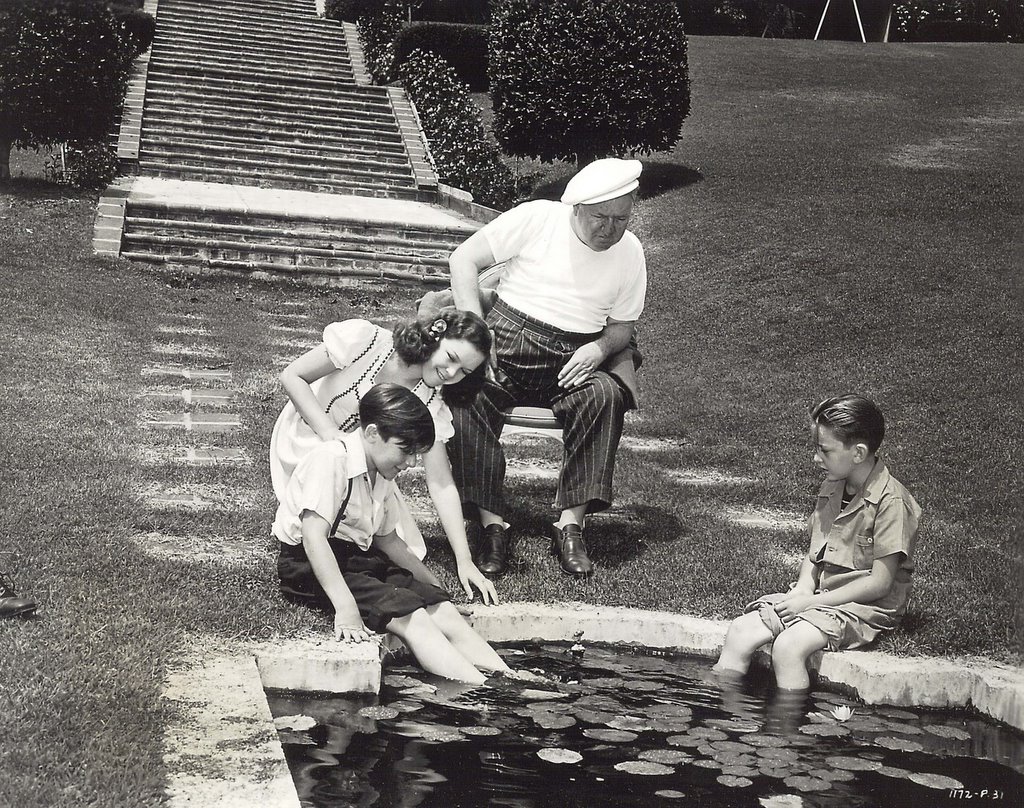
The death of Lou Costello’s toddler son is a well-known Hollywood tragedy. Less familiar, even to some of his fans, is a similar incident which was visited upon W.C. Fields on March 15, 1941, when the two and a half year old son of actors Anthony Quinn and Katherine DeMille (Quinn states in his memoirs that the child was actually three at the time) wandered across the street from his grandfather’s home, fell into Field’s backyard fish pond, and drowned. According to Anthony Quinn’s recollection, he and the family were visiting Cecil B. DeMille that Sunday afternoon, and somehow the boy had gotten separated from his nanny. Fields kept a little sailboat in the pond, and that’s presumably what attracted him. Emergency personnel worked over the child for several hours, but it was hopeless. In the aftermath of the incident, Fields "went into retreat for three or four days", and wouldn’t talk to anybody (see the outstanding James Curtis Fields bio HERE for more detail). Of course, the parents never got over it, as Anthony Quinn recounted, and this would further erode the already weak underpinnings of their marriage. Fields never wanted to go near the pond again.


The still shown her was what led to our recounting of this sad story, as it shows the pond very shortly before the incident of 3/15/41. W.C. Fields had entered into agreement with Universal to star in a comedy based upon his screenplay entitled The Great Man. Toward that end, he was persuaded by studio executives to include parts in his story for singing ingenue Gloria Jean and a pair of particularly loathsome flash-in-the-pan moppets, "Butch and Buddy". This pact was made on January 9, 1941, according to Curtis (folks, this excellent research is his, not mine!). As filming did not begin until July 7, 1941, we will assume that this publicity still was made sometime between January 9 and March 15, the date of Christopher Quinn’s death. That range seems fairly certain, as I don’t think there is any way that Fields would have submitted to this particular sitting after the date of the tragedy. The Great Man was completed that summer and later released as Never Give A Sucker An Even Break. The woman in the striking portrait by photographer Eugene Robert Richie is Christopher’s mother, Katherine DeMille, who did have an interesting, though short-lived, acting career during the thirties. You may remember her in Call Of The Wild, The Black Room, and several of her father’s pictures. There’s a chilling postscript to their marriage in Anthony Quinn’s book, which we won’t recount here, but suffice to say, this too is a highly recommended read, along with the Curtis/Fields volume.


Saturday, January 28, 2006


Gary Cooper's Stalking Big Game


I’ve always liked actors who brought a bit of themselves to their roles, allowing us a glimpse of the real person behind the part they’re playing. Some would say this is limiting, that an actor in such circumstance is merely "playing himself". Gary Cooper was dismissed in this way, as was John Wayne, Clark Gable, Cary Grant, and others. This strikes us as a glib putdown of some very complex individuals in extraordinary circumstances who were, in their own distinctive way, living out the drama of their personal lives on the screen. After you’ve read a little about these people, you realize just how heavily coded their performances are, particularly those stars who enjoyed (and that may not be the most appropriate word) successful careers both before, and after, World War Two. Each of them constructed a screen personality over periods of time, the "himself" critics referred to. Wayne was no natural cowboy. He didn’t care for horses at all, and stayed away from them when he wasn’t working. Grant was anything but the suave figure he projected on screen, often tormented by the contradiction between image and reality. Gable and Cooper seem a little closer to the images they maintained, and it’s for that reason I find these two infinitely fascinating, particularly Gary Cooper, whose androgynous beauty mask would transform itself into a virtual roadmap of the actor’s private anguish as each performance revealed the stress of age, career concerns, and domestic conflicts eating away at him.


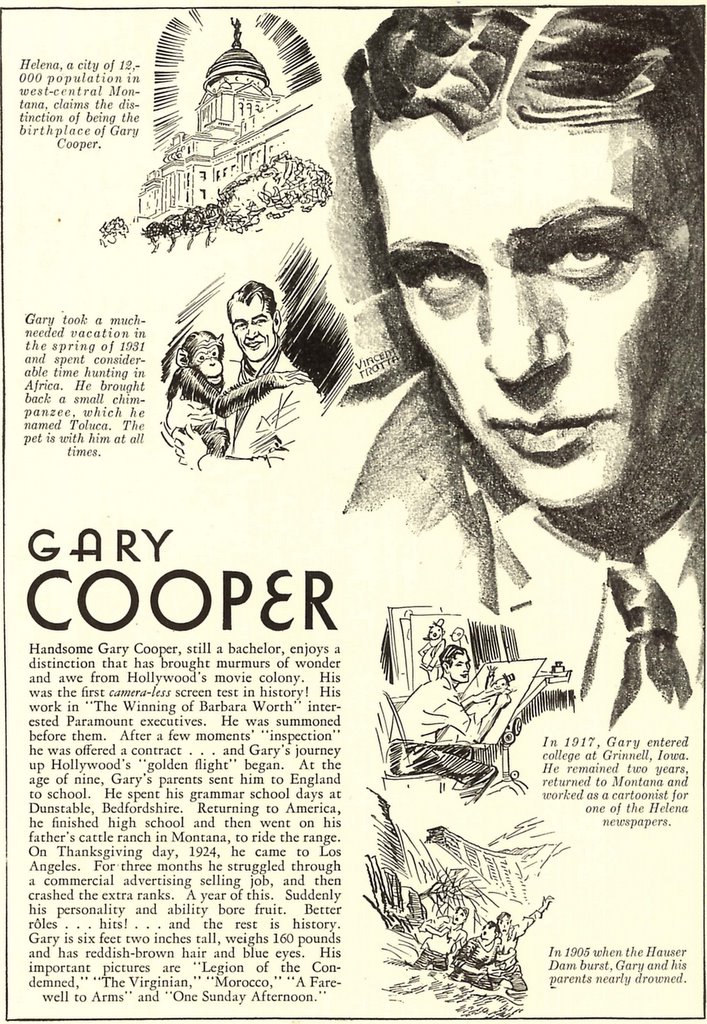
This first art montage is typical of what Don Lockwood would later call studio "banana oil". So is this hunting display, although the essence of it is true. Coop did actually go on safari, and did indeed hunt and kill big game, but it’s doubtful he "set off for Africa before the studio directors could stop him". That’s something contract players did not do. Actually, Bwana Coop was, in many ways, as mama-dominated as Miss Charlotte Vale herself, for it was Mrs. Alice Cooper (not to be confused with a 70’s rock singer who distinguished himself by being a fan of The Creature From The Black Lagoon) who ran off Gary’s hot tamale mistress, Lupe Valez, an act of maternal interference that led to a nervous breakdown for her boy (that plus the fact that Paramount was working him 16-18 hours a day). Coop was already worn to a frazzle in the wake of affairs with Clara Bow, Evelyn Brent, and who knows how many others (well, just look at the pictures of this guy --- he really needed all those wild animals to fight off the babes!). That "vacation" the fan mags referred to was actually an extended rehab for overwork and exhaustion (yeah, and in the wake of Clara and Lupe, poor spent youth needed some R&R). Mama actually considered taking Boy out of the movies altogether, and repairing to the family ranch back in Montana (just so there’s no doubt about one thing, the Coopers had serious money, so that manure-shufflin’, up-from-the-starving-extra-ranks palaver was, well, just so much manuro). What she didn’t anticipate was Coop’s choice for a vacation destination --- hitting all the high spots among various decadent European playgrounds and getting himself tied up with a jet-set adventuress (thirteen years his senior!) named Dorothy di Frasso, who would later land on the FBI’s Hit Parade for her subsequent liaisons with Bugsy Siegel and a coterie of known Nazi operatives. That little adventure on the continent led to the African excursion referred to on the fan page. When Coop returned stateside, he was hale and hearty, pet monkey "Toluca" in tow, along with enough stuffed carcasses to open his own furrier.


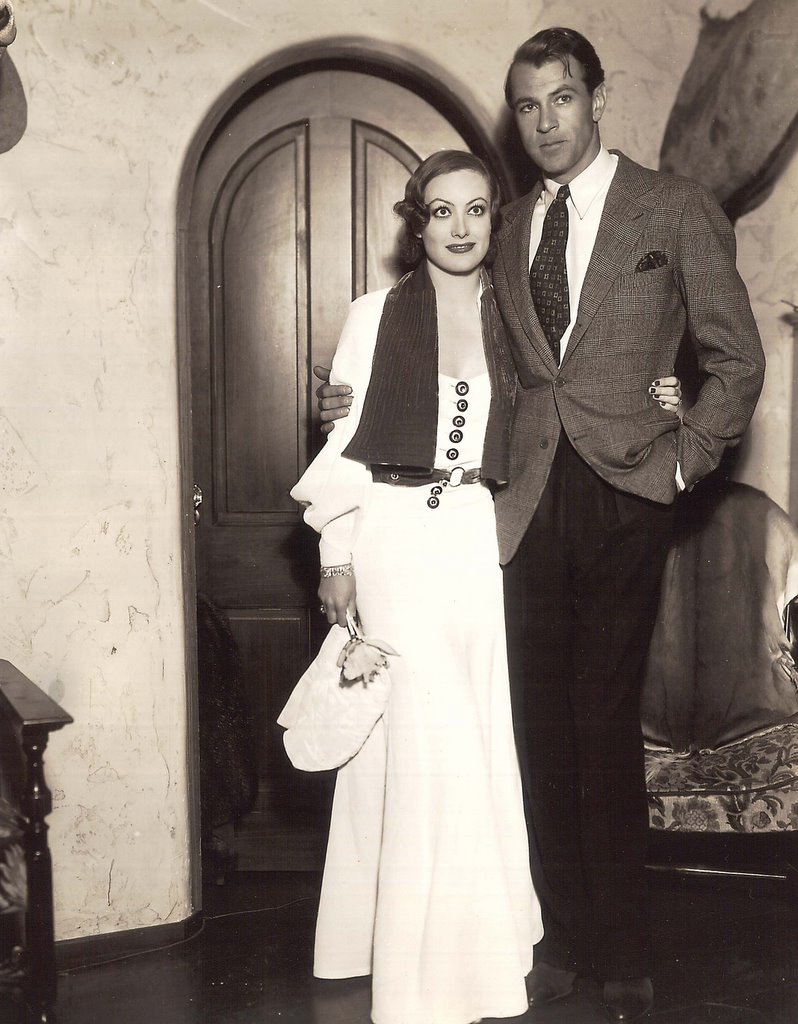
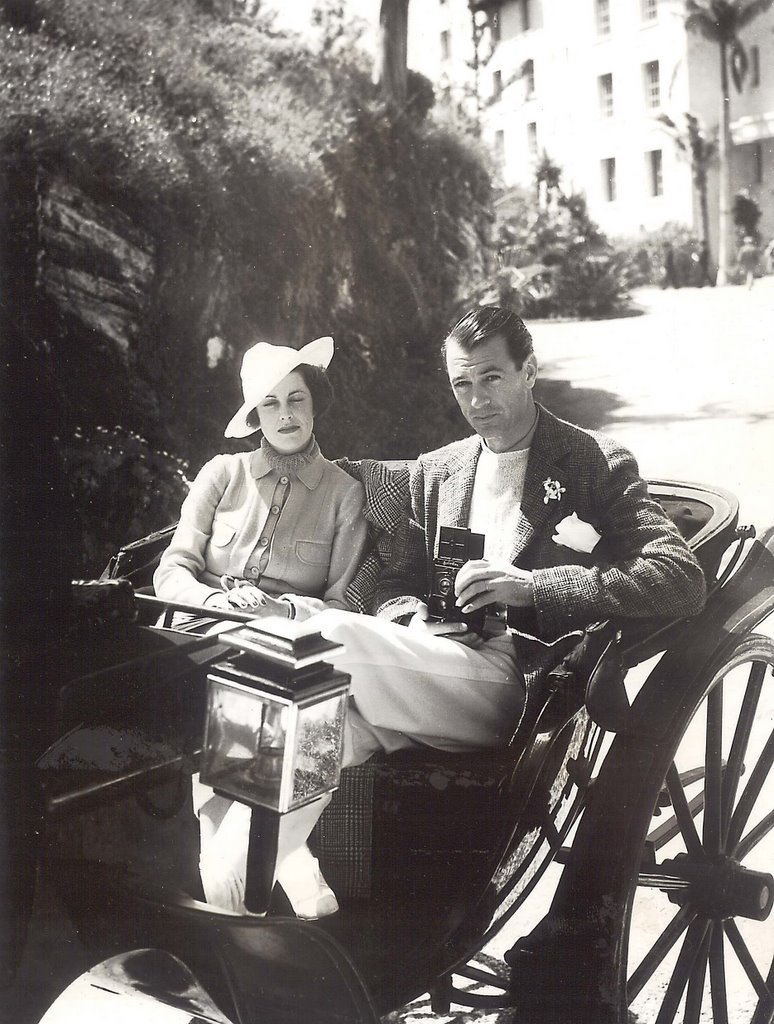
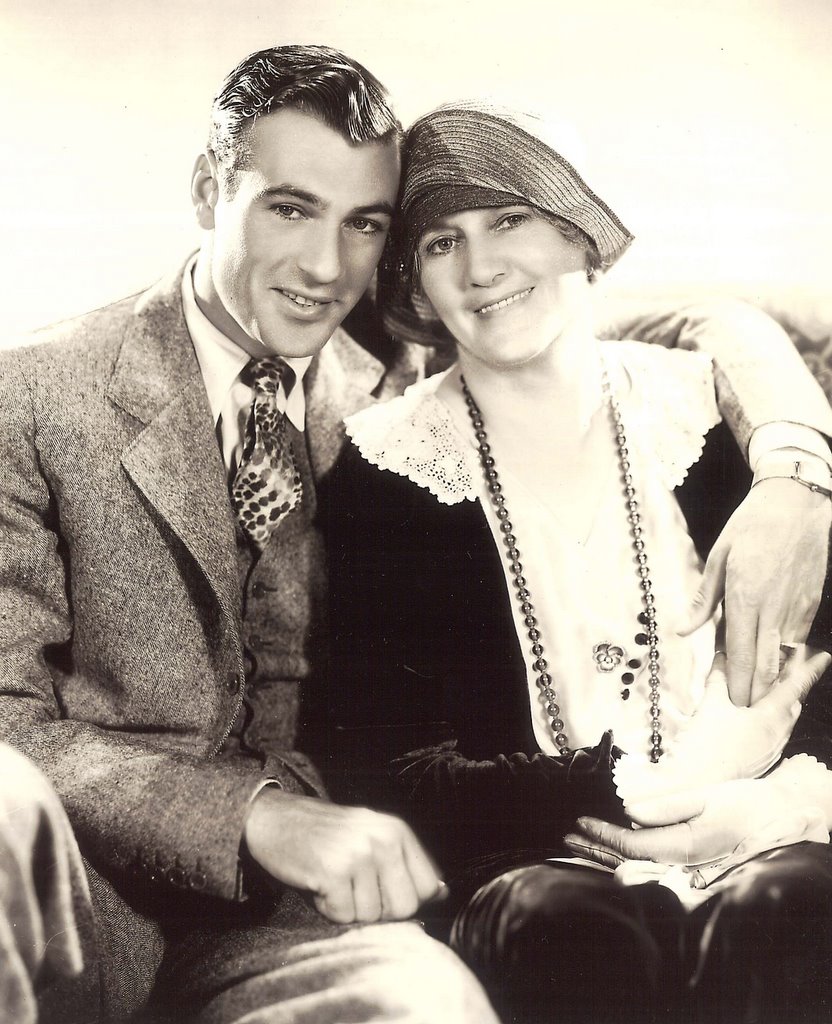
The glossy pics shown here offer a pretty fair glimpse of the eternal tug-of-war among Coop’s feminine influences. First there is Mother. Seems amiable enough, "except when crossed" (to quote Dr. Pretorious). The photo was taken for a compulsory Mother’s Day just-plain-folks sitting at Paramount in 1936. By then, the wandering boy had been subdued and brought into the corral by the lady sharing his carriage ride, Sandra Shaw, former social lioness, and now Mrs. Gary Cooper. We’re struggling for the proper word to describe Coop’s expression in this shot. Sheepish? Bored? Thinking about Lupe? In all the pics we’ve seen of that couple, she looks, well, commanding. After all, they say every boy ends up marrying his mother. Looks like Coop was no exception. The third shot is fairly typical of Gary Cooper on Wolf Patrol. That private party where this was taken was just so much African landscape for the lanky lothario, and it looks like he’s spotted his quarry in comely Joan Crawford (alright, maybe she was never comely, but we like the word). The general posture of these two give a pretty good indication of what’s going to happen within the next hour in some tinsel-town love nest of undetermined (and hopefully discreet) location. Master director Raoul Walsh used to tell how Coop would zero in on a girl by going into his aw-shucks, timid-boy-needs-a-mommy routine while the girl would search for his wandering eyes (always with the head tilted and looking down at his shoes) in an effort to "reach" him. Upon her success in bringing him out of his shell, the two would adjourn to the actor’s dressing trailer, where Coop would take over the instruction. As Walsh had witnessed this routine on so many occasions, he always knew "when the snake was getting ready to strike".


Of course, this was only the first stage of the Cooper drama. Things got more than a little hard after the war, and we’ve got some images from that period that we think are pretty dramatic. If there’s interest in more Gary Cooper, we’d be glad to go for a Part 2. Let us know, readers!


Friday, January 27, 2006


Kennel Ration For Movie Stars


Those merry pranksters at Universal-International really cooked up a good one to promote their alleged 1964 comedy, Wild and Wonderful. Why not finagle all the big stars presently working on the lot to drop by and be photographed with this particularly hideous dog that U-I has tapped to share marquee honors with should-have-known-better-than-to-star-in-this Tony Curtis? "Monsieur Cognac" was the animal’s name, and according to our imdb crib sheet, this was his only screen credit. As for Tony Curtis, he’d just completed Forty Pounds Of Trouble for Universal, and so presumably could not be humiliated any further with this. A few years later, he’d be Boston strangling to erase the memories of things like this, but the damage was done, and Tony’s career descended faster than we kids in the sixties could go on a backyard "Slip ‘n Slide". In the meantime, however, Universal brought in some major star power to jump start Monsieur Cognac’s screen career, and incidentally, to give us a glimpse of what even big-name players in those days were willing to do in order to promote, or maintain, a studio berth. Who’d imagine that Cary Grant would submit to something like this, well into his elder statesman in the industry status, and only two years away from retirement? Based on what we’ve read about Grant, he was a surprisingly good sport when it came to gags like this, and a review of the trade magazines, even into the sixties, reveals that he was very much a team player when it came to promotion and publicity (especially when he owned a big piece of his starring features). I’ve seen any number of stills with exhibitors and exchange men smiling broadly as they pose in local theater lobbies with accommodating, man-of-the-people Cary Grant. No doubt about it, showmen in the field considered Cary one of the good guys. We have to assume from this pic that he’s getting story input for Father Goose from Monsieur Cognac. Watching that hard-sit movie today, we can still detect Cognac’s paw prints all over the script.


Now we have Kirk Douglas letting his hair down with what appears to be a stuffed Monsieur Cognac (his taxidermied double, perhaps?). We suspect Kirk had just finished For Love Or Money at this point, and might have been hanging around the lot trying to shore up another deal with Lew Wasserman. We also figure old Kirk for more than a little impatience with stupidity like this, but business is business, and I bet that if we showed him this picture today, he’d have absolutely no memory of it (loved your Ragman’s Son, Kirk!). Suppose one of you high-powered industry insiders e-mail this to him, and let’s see if he remembers it. Maybe Kirk has some cool anecdotes he’d share with us about what it was like to work with Monsieur Cognac.


Here’s poor Greg in his Captain Newman, M.D. uniform, it’s painfully obvious that Cognac has just put his nose in the man’s crotch, and Greg is determined that it will not happen again (just think, if this had been a year sooner, Peck would be wearing one of his Atticus Finch suits --- wouldn’t that be great?). If I were a psychiatrist, or psychologist, or just the good old family doctor (to quote Scottie Ferguson), I’d comment on Greg’s body language here, and conclude that this man needs some therapy, or maybe he just needs to get away from this smelly dog! Would it be indelicate to speculate as to the possibility of Monsieur Cognac having attempted to hunch Mr. Peck’s leg just before this still session began? It would explain a lot.


Thursday, January 26, 2006


One "Yes" Vote For Harold --- And A Mystery Photo

This word just came via a posting at the Buster Keaton Yahoo group (link HERE). Ultimate Harold Lloyd enthusisast and historian Annette Lloyd has been in conversation with Harold's grandaughter about the possibility of another DVD collection devoted to the great comedian. Believe it or not, there's still lots of good stuff left, even after that incredible set we got in 2005!

Memo To The Harold Lloyd Trust --- Please consider this posting a resounding YES in favor of that plan, and we encourage readers to visit Annette Lloyd's new blog
HERE in order to cast your vote for Harold. They're looking for feedback over there, so don't be shy! Oh, and here's a photographic P.S. for Lloyd experts --- can any of you help us identify this mystery still? The back caption merely says "Harold Lloyd Visits the Set", but what set? And who are those two gals with him?


Call For Judy Garland Fans


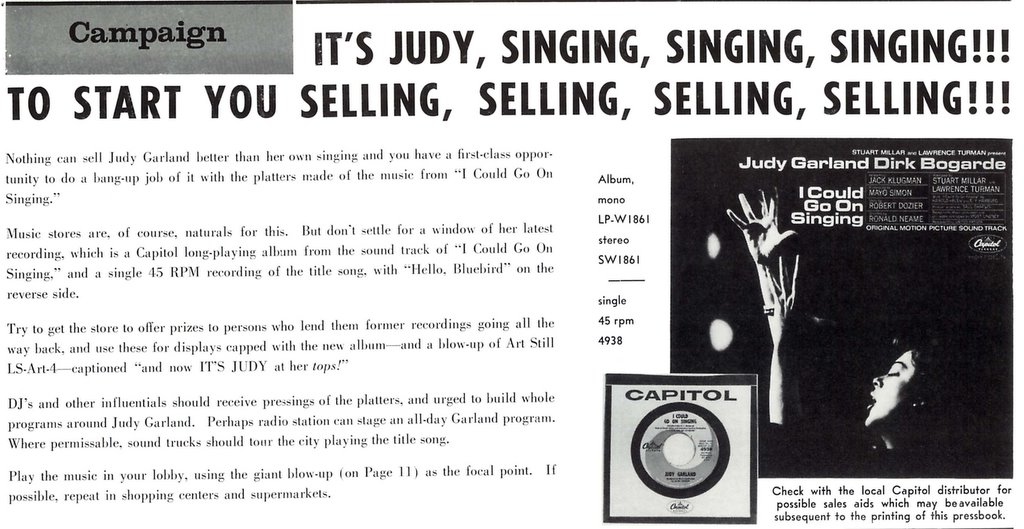
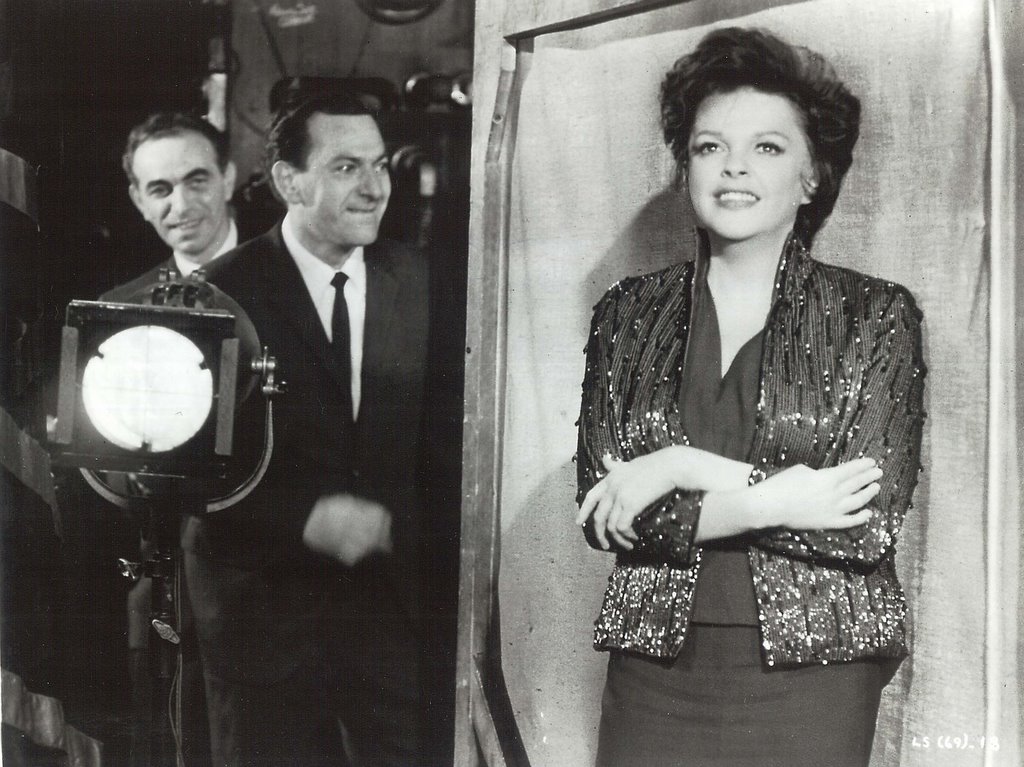
Judy’s always been a hard sell with straight men. In fact, not only do straight men generally dismiss (if not dislike) Judy, they tend to prefer that their friends do so as well. Here are variations on that sentiment as they have been expressed to me over the years ---- "I’m not exactly a fan of Judy Garland, are you?" (always with a bit of an edge to it) ---- "I don’t like Judy Garland! You don’t, do you?" (as though the continued friendship may hinge upon your answering properly). Must real men conceal their pleasure in Judy? Must we renounce her in order to qualify as heterosexuals? The conflict only deepened for me when I brought the issue before my girlfriend this morning. "Too hard", said she, "… not feminine… you’d never want to take her home to meet the family". Well, there’s an understatement to be sure, but what’s the Judy cult coming to when even the sisterhood turns against her? So, we pose this query to our readers --- what do you really think of Judy Garland? For myself, I pondered that weighty matter today as I watched I Could Go On Singing for the first time.


This was Judy’s last feature ("sadly", as Maltin’s TV review says), and it was released in 1963, six or so years prior to her death. It’s surprisingly plush for a star who’d not had a hit movie in nearly a decade, and I enjoyed it a lot more than I expected to. Of course, Judy sings her lungs out, but I found all that less interesting than the drama, and she’s really good with the drama (plus, I didn’t think the songs were all that hot). Say what you like, but this woman could act. She had a spontaneity that’s really effective when it isn’t going overboard, and I found her a lot more restrained here than in A Star Is Born, where you always have the feeling of George Cukor sitting behind the camera going, "Wonderful, Judy, more! More! MORE!" The only thing with Judy is the intensity. Once she’s switched on, she’s gonna take you with her all the way to the breakdown, particularly in these post-MGM things where you always have the feeling she’s getting ready to crack up and flee from the set. Apparently, that’s very nearly how it was, according to what I’ve read. In I Could Go On Singing, she essentially plays herself, and the show’s full of those backstage moments designed to give us a glimpse of the real Judy. Her fans must have gone nuts over this one. It’s not like Gay Purr-ee of the previous year, where she gave voice to a Chuck Jones cartoon cat (and had to endure one of those hellish New York opening weekends where Warners put her on a sweltering bus and sent her to every crumbling neighborhood theatre in the five boroughs for personal appearances). I Could Go On Singing is 100% Judy, as the ad shown here will attest, and good as she is, that can be a little exhausting. The story is one of those mother love things, and I kept waiting for a Stella Dallas ending which never really arrived. In fact, the whole thing just kind of stopped instead of ending. Judy really looks her age too, bless her heart. You wonder if Ross Hunter could have done anything for her the way he did for Lana Turner. Probably not.

Based on our research, this picture really went into the tank commercially. After all the trouble they’d had with Judy (and the pic was barely finished at all, thanks to her misbehavior), United Artists went down to a crushing defeat in every market. One observer said they might as well have hung a sign in the boxoffice reading, "Smallpox Inside". Domestic rentals were a horrific $301,000 (UA had sci-fi and strongman fodder that did almost as well), and foreign was only marginally better at $455,000. There were only 4,339 bookings --- even Vincent Price in the black-and-white Tower Of London did better than that. People wanted to see Judy in person. That’s what hooked UA in the first place. What got them snake-bit was the realization that no one wanted to go see Judy on the screen anymore, unless it was The Wizard Of Oz on a TV screen.


One more anecdote about Judy, though not a personal one. This I’d find hard to believe were it not for the unimpeachable first-person source, a life-long Garland fan and not a man given to prevarication. It seems that during the early sixties, when Judy was often as not broke (sneaking out of hotels to avoid the tab, that sort of thing), she would sometimes econimize by crashing with fans during her concert travels. During one such layover with an acolyte who later dealt autographs and became an acquaintance of mine, Judy decided to entertain this guy, and a couple of his friends, with an impromptu concert in the living room of his apartment. Singing along with her Judy At Carnegie Hall on the phonograph, she belted out every single number on that now legendary double album, all for the benefit of three fans who must have thought they’d died and gone to Judy Heaven. This is one story I’ve picked up in collecting travels that really freaked me out. Totally incredible, but I believe every word of it.


Wednesday, January 25, 2006


Just Crazy About That Big Clock


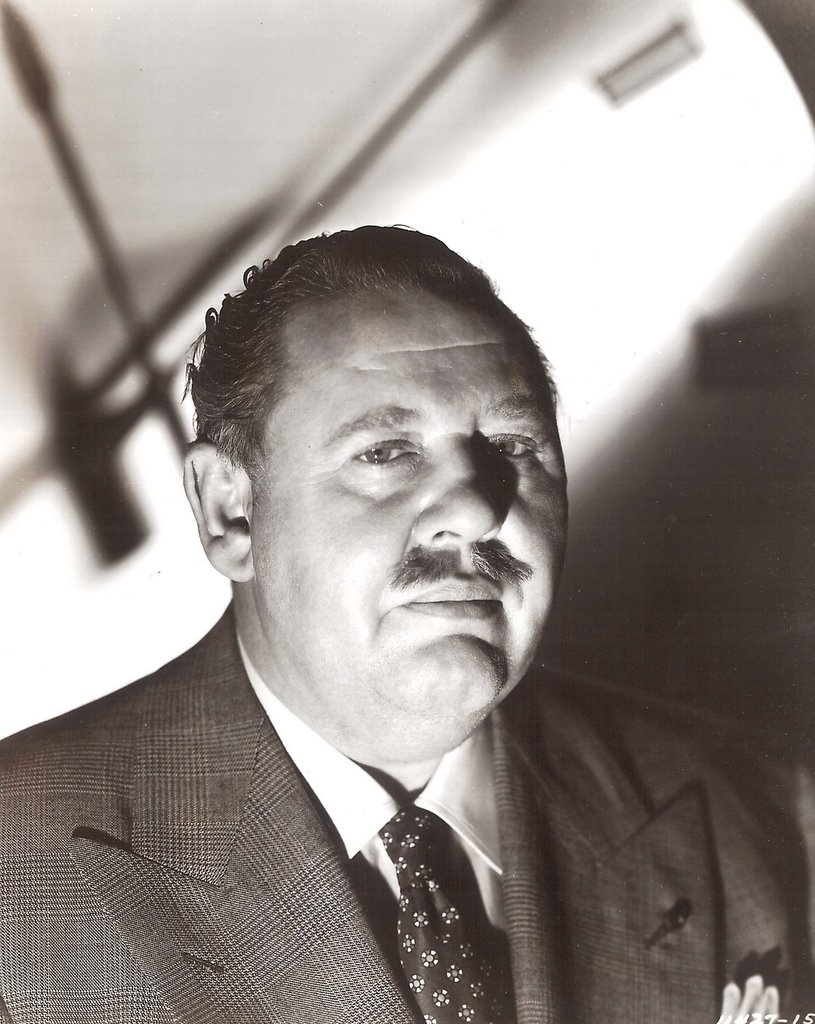
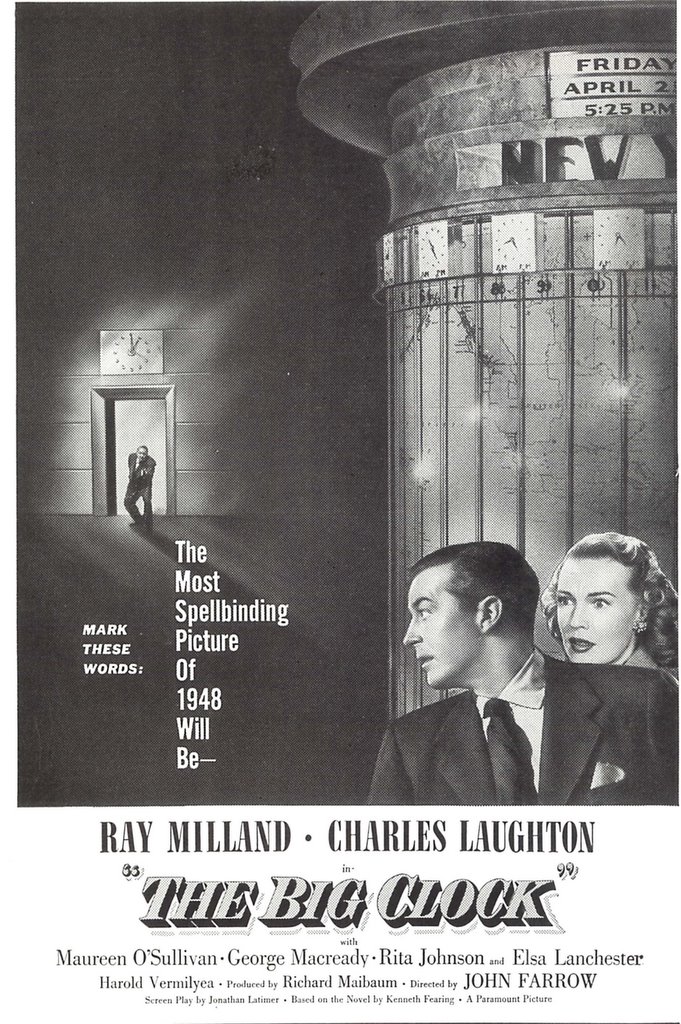
If there’s one movie I adore, it’s The Big Clock. Unlike so many latter-day film theorists, I think noir can provide a lot of laughs, if taken in the right spirit, and for my money, Charles Laughton gives one of the wittiest performances of his career in this one. Was there ever a more delightful corporate tyrant than Earl Janoth? I first saw The Big Clock at the age of thirteen, and he became one of my boyhood heroes from that moment. That lethal argument he has with Rita Johnson is just priceless, and the way he clutches that sundial, with those cocked eyebrows and curled lips twitching, not to mention that stunning fatal blow ... It’s one of the great moments in noir.

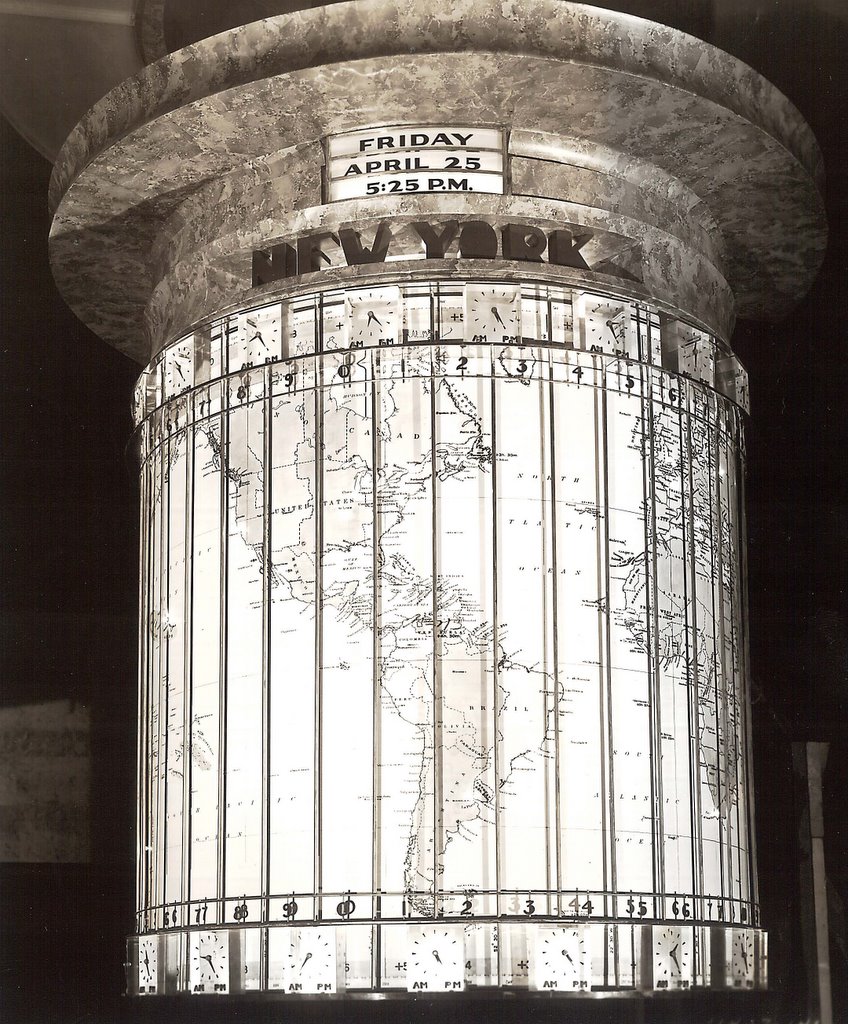
How about this clock? Both inside and out, it’s just a fantastic creation. All those eerie controls, and that neat sound it makes when Ray’s hiding behind the face. Then sinister Harry Morgan enters and Ray clonks him. Terrific stuff. Harry’s performance as Janoth’s majordomo and deadly errand boy is aces all around. That great rubdown sequence where he applies the alcohol to Charlie’s corpulent torso is just too creepy and unwholesome for puny words to describe. Further bonuses include director John Farrow’s wife Maureen O’ Sullivan in a rare post-Jane part, and Chuck’s better half, Elsa Lanchester, in another of her patented eccentric roles. Once again, I couldn’t resist some of those nutty pressbook suggestions put forth by the Paramount sales boys. Oh, to have worked in that department back then! Could we have been so brilliantly imaginative as these crack showmen?


A couple of personal reminiscences here. The first involves Noel Neill. She’s actually in The Big Clock, playing an elevator girl during the first reel. The whole scene’s done in a single take (from inside the elevator looking out!) as she chatters along from one floor to the next (we see each floor). People are getting in and out of the enclosed space, some carrying rather unwieldy props, and each with their own bit of business and/or dialogue. It’s a very complex sequence, and Noel’s really good in it. About fifteen or so years ago, I sat in on one of those Q&A sessions with her at a collector convention, and listened patiently (as did she) to the usual line of inquiry that has surely dogged this woman over decades of personal appearances. "Who killed George Reeves?" "Was John Hamilton really just an old drunk?" "Why do you and Phyliss Coates hate each other?" Well, I didn’t want to go that route, so I decided to ask about The Big Clock, and guess what? She remembered it, and remembered it well. It was a one-day job, she said, and indeed, they got it all in the first take.


My other Big Clock encounter was with famed designer Edith Head, and I probably made an ass of myself with that one. A bunch of us in the 1975 USC Summer Cinema Studies Program (I think that's what it was called) were meeting in a little conference room at Universal, and our guest instructor was Miss Head. She’d brought along some of her Oscar-winning costume drawings, and gave a nice presentation. Since we only had about twenty-five in the class, there was plenty of opportunity for individual questions. Now here was the woman who’d dressed Carole Lombard, Audrey Hepburn, Marlene Dietrich … who knows how many others, and I’m the student who just has to ask about The Big Clock. Well, she politely muttered, I don’t remember a lot about that one. I then compounded my folly by recalling a favorite scene in the picture…. Charles Laughton falling down the elevator shaft. That seemed as good a moment as any for the celebrated design genius to make her graceful exit, much as she might have done after an encounter with one of those obnoxious Art Linkletter kids on the old House Party shows where she was a frequent guest. I, of course, remained oblivious to my error, and have only recently come to appreciate the full dimensions of my gaucherie on that memorable day.


Tuesday, January 24, 2006


It's A Wonderful World In Color

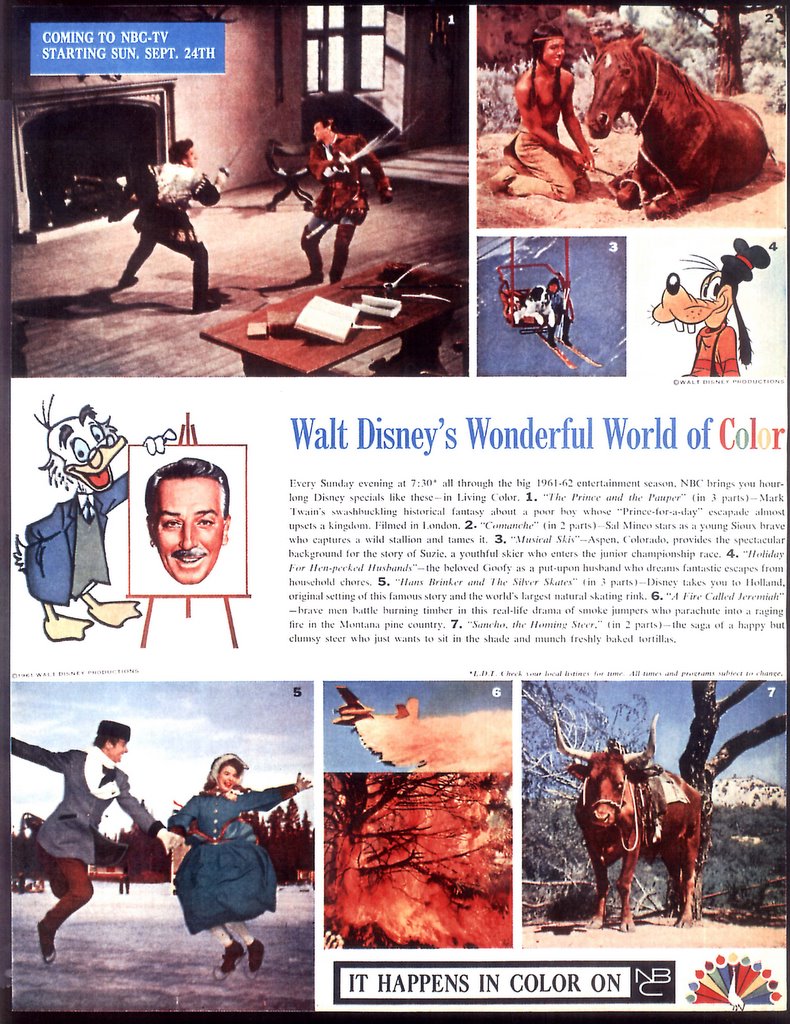
These ads will be a curiosity for the younger readers, and perhaps a happy journey back for many of the rest. Certainly for those of us who came of age in the sixties, the memory of Walt Disney’s Sunday night program is indelible. Color television was something beyond a miracle for me in 1961. We wouldn’t have a color set until 1966, but an uncle down the street was a great proponent of the various media breakthroughs of that era, and couldn’t wait to install his first color set. At that time, there was so little multihued programming available that the expense seemed hardly worthwhile, but the rainbow visible on NBC Sunday evenings compensated for many a monochromatic night otherwise, and the Disney show, with its dynamic, paint-splashed opening, was an essential rite of passage into the exotic realm of color TV . The sheer novelty of the program overcame some pretty dreary content that first season. For every good episode (usually built around cartoons), there would be a "funny" animal show, or an earnest animal on some endless, and seemingly futile, trek through the wilderness show. Those were hard to get through, even in color. Sometimes they’d use an obscure Disney live-action feature as a two (or three) parter. Some of these, like The Horsemasters (Annette!), or The Prince and The Pauper, were released theatrically in Europe, and first-run on television stateside. As you can see from these elaborate magazine ads, the campaign for September’s premiere that year was all-out. The idea was to use the series to sell RCA color sets, and the company sponsored Disney’s show in a determined effort to do just that.


Edgar's Nasty Little Dummy


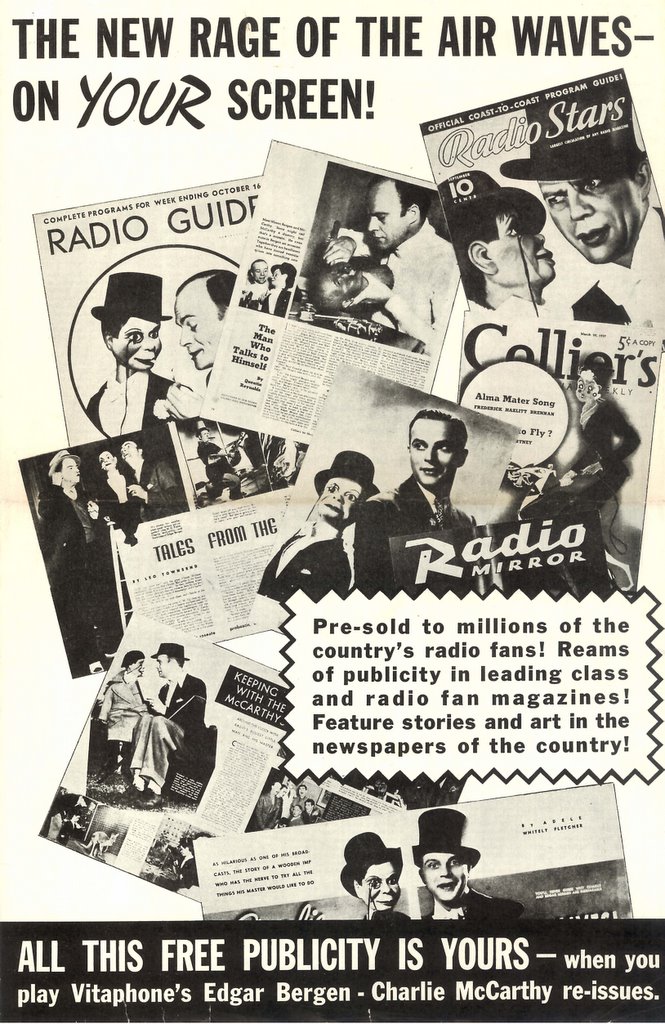
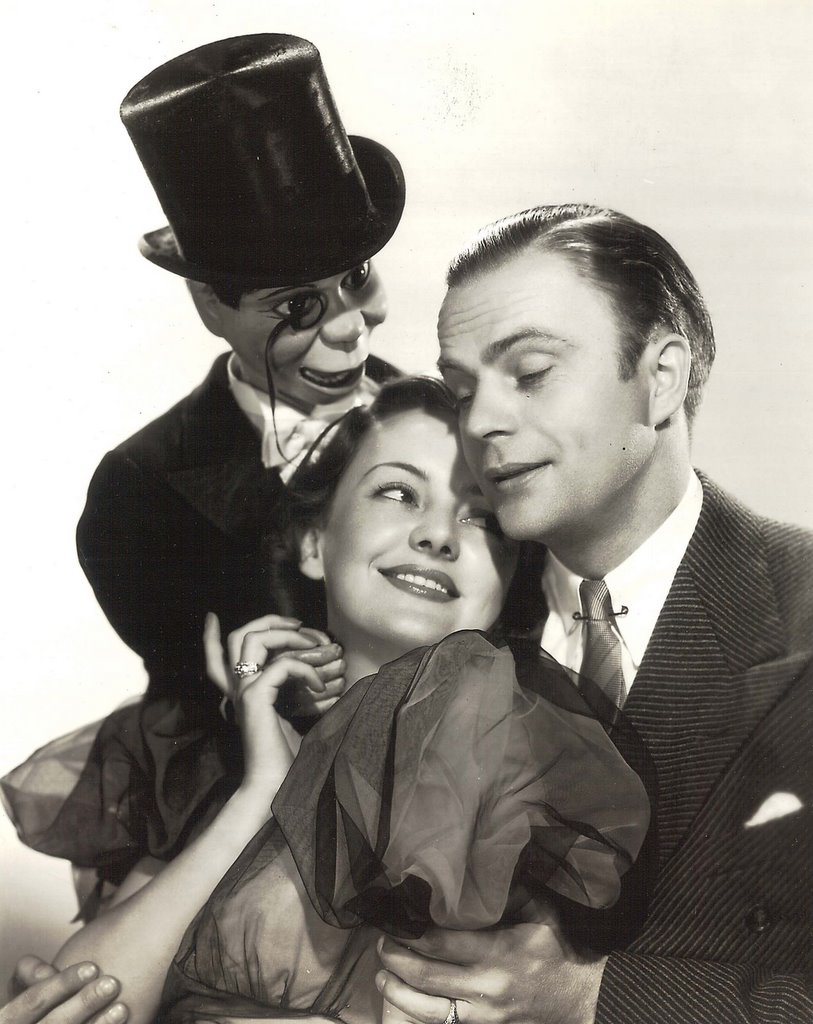
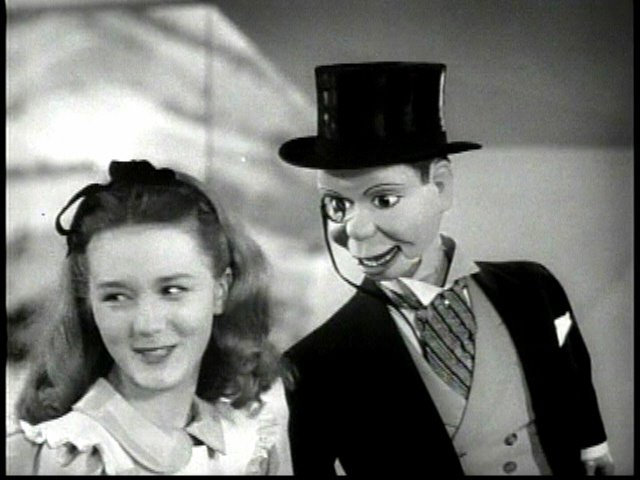
There’s an unwholesome quality about Charlie McCarthy that we at the Greenbriar have always admired. He was a frankly lecherous dummy who spoke for several generations of dissolute men and boys, sort of a Dean Martin in knotty pine. An ongoing affront to any and all polite exchange between the sexes, he burrowed into the hypocrisies of social intercourse in all its manifestations. Yes, we like Charlie a lot, ever since our first exposure to he and Edgar (and Mortimer) in the W.C. Fields classic, You Can’t Cheat An Honest Man. It’s great seeing their Vitaphone shorts featured as extras on Warner DVD's as well. The happiest surprise, however, came with Disney's recent release of Alice In Wonderland. Among the extras on Disc 2, there was a Christmas TV special from 1950, in which Bergen and the dummies are attending a party on the Disney lot, hosted by Walt himself, and featuring appearances by child star Bobby Driscoll and the English kid who served as a live-action model for Alice In Wonderland. In fact, the special itself (Walt’s first for television) was a promotion for the upcoming release of Alice In Wonderland, and twelve-year old Kathryn Beaumont is outfitted in full Alice regalia, even though the feature itself was animated, and she never appeared on screen. This is where Charlie swings into action, and I’m frankly amazed that ABC, let alone Disney, allowed their ribald exchange to get past the editor’s table. Walt makes the introduction, Kathryn is ultra-polite in that manner we expect from all British youth of the time, and then Charlie zeroes in, undeterred by the fact that he is dealing with a twelve-year old girl, as opposed to Mae West, Paulette Goddard, or some other saucy vixen on one of his radio programs. Charlie, this is the voice of Alice, says Walt, to which Charlie leeringly replies, Well… what goes with the voice isn’t so bad either! I’m ever so glad to meet you, Charlie, says Kathryn, at which point he leans in and delivers the proposition, Look sis, why don’t we slip away from this fish-fry and go somewhere. I happen to know of an intimate little soda fountain… She then interrupts with, I cahn’t, Charlie… and introduces the unenthusiastic dummy to Bobby Driscoll. Now, this sort of dialogue would no doubt wow ‘em at a camp show, or a guest spot with Hope, but how did Bergen end up with material like this for a comic exchange between his alter-ego and an underage girl? We figure it must have been some sort of snafu during the writing session, or maybe some gesture of insurrection on the part of a disaffected scribe. Anyway, it was as close as Charlie would get to the commission of a statutory offense, and it happened on Uncle Walt’s show!

Our love for Charlie is boundless, so we're providing several glimpses of our favorite little wooden man. That's Charlie and "Alice" Kathryn Beaumont on the left --- then he's intruding on Edgar's romantic moment in The Goldwyn Follies. That's the boys doing a swami act with a leggy chorine in Stage Door Canteen, and finally, a page from Warner's pressbook celebrating the return of their Vitaphone short subjects, and suggesting some of the tie-ins available.


Monday, January 23, 2006


Some Interesting People Born On This Date


Raymond Griffith (born 1895) was one of those "Silk Hat" comedians during the silent era, sort of a William Powell of his day (in fact, he and Powell worked together at Paramount). The fact that Griffith is utterly forgotten now is due largely to the fact that most of his starring vehicles are lost. There’s a reviewer on imdb who claims to have seen some of these features, but his reviews look a little fishy to me. Maybe there’s more Griffith stuff out there than I thought. Anyway, I saw him in a 1924 pic called Changing Husbands at one of those long-ago Cinecon gatherings, and believe me, this guy raised the roof. You know how sometimes people will laugh at a silent comedy because they come expecting nothing, and it turns out to be a little better than they figured? Well, this thing simply laid them in the aisles. Griffith’s pantomime was an absolute revelation. He made Chaplin look he was playing Ibsen. I wish I could have another experience like that with a silent feature. In fact, I wish I could see Changing Husbands again, maybe on DVD. Raymond Griffith never had a chance in talkies, because he’d lost his voice to childhood diphtheria (there’s also some screwy business about an on-stage trauma he suffered in a kid role, but I don’t buy it any more than those suspect imdb film reviews). One talker he did make was something called The Sleeping Porch, which I saw in an unannounced Syracuse Cinefest screening. It was a 1929 short, and they explained Griffith’s largely mute performance by establishing him as a man rendered speechless with a bad cold! Needless to say, this was not productive of laffs. Fortunately for Griffith, his producing acumen led to a longtime association with 20th Fox, where he’s credited with, among other things, The Mark Of Zorro (Bless you for that, Ray!). The real Raymond Griffith shocker is how the man died. Choked to death at his table during dinner at the Masquer’s Club in 1957! Dead at 62 of asphyxia. Ate something bad, they said. Great comedian, though. Check him out in another good one, Hands Up!, if you can find it.


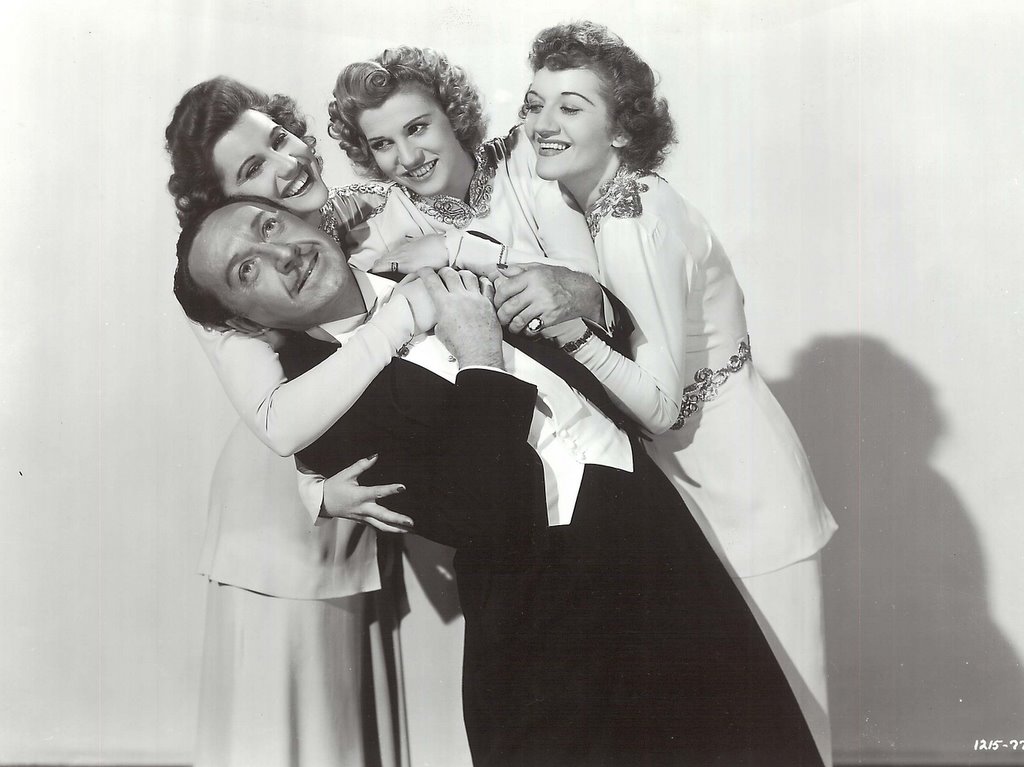
Franklin Pangborn (born 1888) was always a "nance" character --- more specifically a sissy, a fussbudget, a harassed clerk, or functionary. He worked behind a desk so often in his movies, I began to wonder if he even had a lower torso. Anytime Pangborn showed up in a feature, you knew the whole enterprise would be better off for it. Everybody had a good time watching Frank. He was always great. Bill Fields liked to use him, as did Preston Sturges. This is Frank with the Andrews Sisters in a little 1942 Universal musical called What’s Cookin’, and I guess there’s about as much a chance of the studio releasing this as there is of flying pigs colonizing Saturn. There is a new DVD of Paramount comedy shorts coming from Kino in February, however, and Glenn Erickson’s excellent
REVIEW says Frank’s in one of them. Reason enough to buy, I’d say.


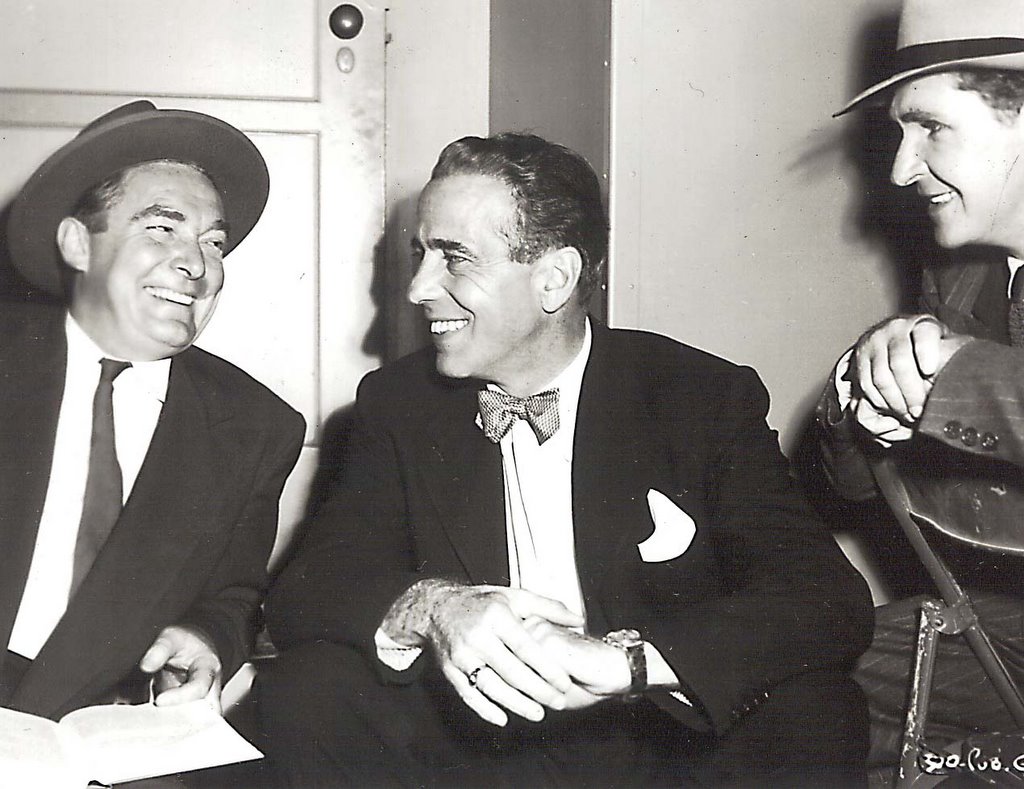
Bob Steele (born 1907) was a little whirlwind of a "B" western star who made his horse look like Winged Pegasus, but he could also be the nastiest "A" picture villain in the business, as witness his frightful nastiness in pics like Of Mice And Men (pictured here with Lon Chaney, Jr.), City For Conquest, and The Big Sleep (where he makes a sniveling Elisha Cook drink poison). Bogart really liked Steele, and made a point of using him in 1951's The Enforcer --- here they are hanging out on the set with that other very bad man, Roy Roberts. By the way, does anybody remember that time Bob did a 1970 Family Affair episode where irritating little Jody idolizes old-time cowboy star Bob, only to be disillusioned when Uncle Bill introduces him to the now aged and decrepit Steele? It was a nice vignette, and very nearly Bob’s last stand before a camera before emphysema laid him low. I recall some western fans telling me about a mid-eighties visit they’d made to the old timer where he could barely make the trip up the hallway to greet them. But he came, and they were thrilled. By all accounts, he was a good guy, and what a stunning go at fisticuffs he could stage!


Today's Glamour Starter --- Fay Wray


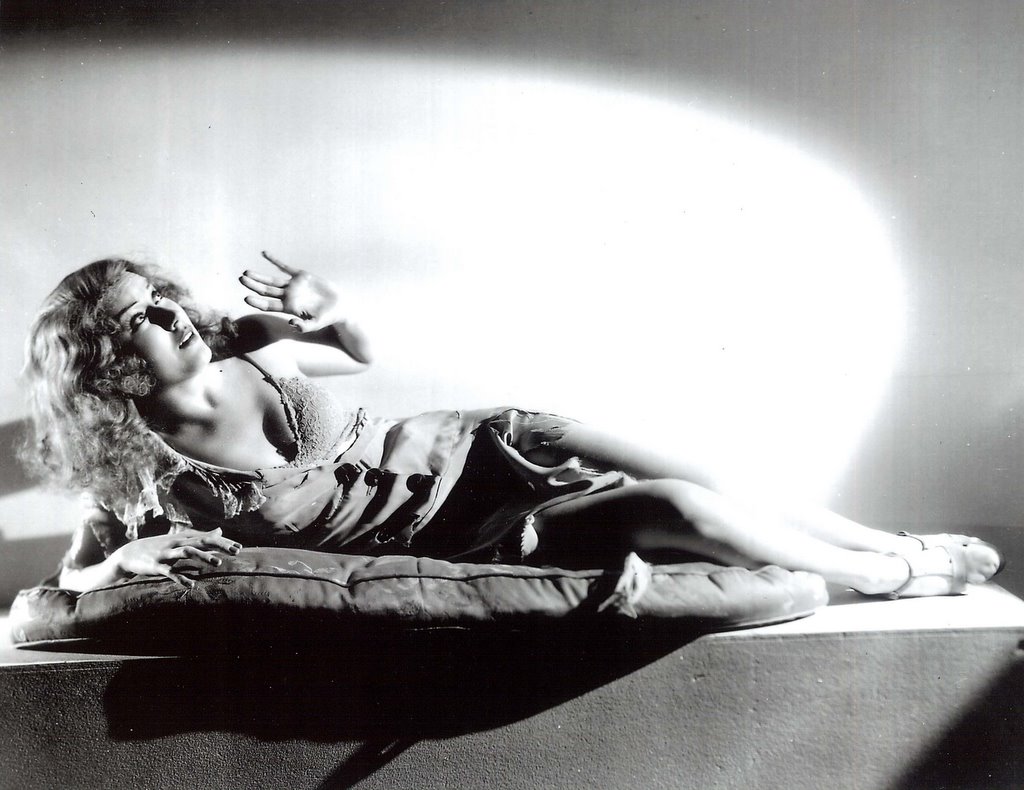
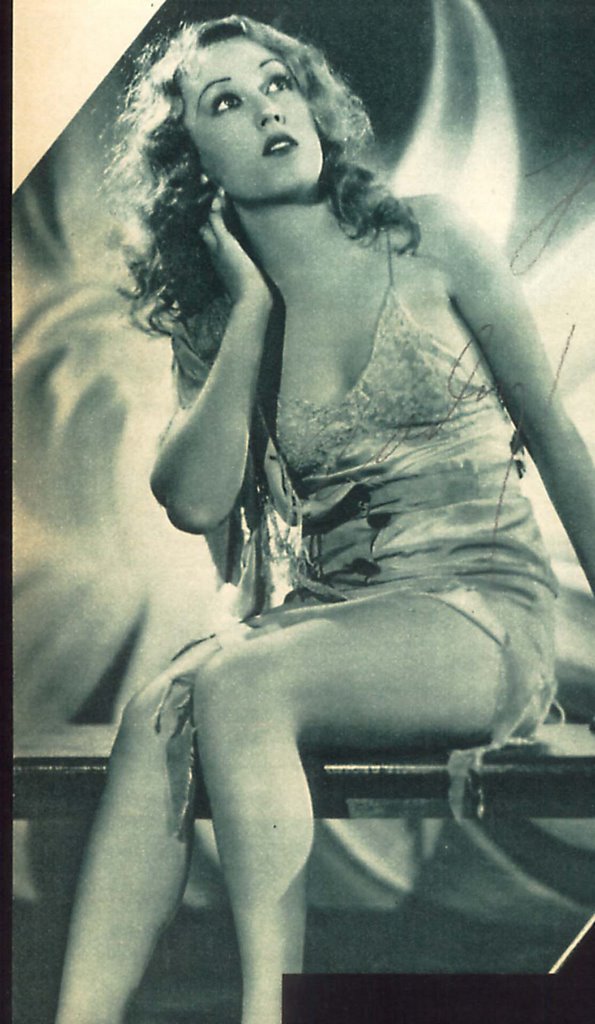
I'd resolved to stay off the King Kong bandwagon, at least until all this excitement over the remake died down, but hanged if these dynamite art stills of Fay Wray didn't come along, and… well … here they are. Just to avoid treading on too-familiar ground, I did a quick Google image search, and found surprisingly few underclad poses of our girl. Actually, this is only a few of them, as I don’t want to bore you readers, but if there’s sufficient interest, a stimulating Part 2 may well arrive at a later date!


Long before there was a King Kong DVD, there was the King Kong Treasure. Or should we call it the King Kong Falcon? Whatever term best describes the unattainable among collectors in those heady days when owning 16mm prints of favorite films was truly a mark of distinction. I’d been bitten by the collecting bug (no, let’s call it a scorpion) way back in 1964, the year I first saw King Kong on Channel 3’s Picture For A Sunday Afternoon. I’d just combined my meager purse with two other boys in the neighborhood so that our eleven dollars might obtain a pair of 8mm "home movies" from the back pages of Famous Monsters (folks, there are entire discussion groups on line devoted to this magazine alone!). Castle Film’s eight minute version of Dracula (or more if you were willing to run your projector real slow) was plenty okay with us, and all that great dinosaur footage in Official Film’s condensation of the 1925 Lost World would be seared into our memories for life. King Kong, however, was not even available in 8mm, not no way, not no how. If you wanted to see that, you’d have to wait for it on television, and by the mid- sixties, with color TV gaining its foothold, those old B/W movies were suddenly becoming passe; even the really great ones like King Kong were being pushed aside in favor of things like Taza, Son Of Cochise, and Ten Thousand Bedrooms. Our search for Kong became as frustrating as Jack Driscoll’s. The first breakthrough came surprisingly in a theatrical revival, just after I’d turned sixteen in 1970. Janus Films of New York, they of the foreign imports and art-house successes, picked up "The Mighty Monarch Of Melodramas" and added a little spice to the program that would rock Kong fandom to its very foundations. Rediscovered footage, long buried in a collector’s attic (why is it always the attic?), promised long suppressed, graphic footage that would make the old mealy-mouthed King Kong look like one of the Marquis chimps. Imagine my anticipation when I literally ran out of the school building, drove ninety MPH through a rainstorm (the Lord really does protect fools and children) in order to catch the 4:00 show at the Carolina Theatre in Winston-Salem, NC (it was an hour from home). I watched the thing three times that weekend, and yes, I know I should have been slapped into military school instead and taught real discipline, or at the very least, compelled to play junior varsity football, but thank heaven my parents weren’t like that, and besides, when a child has reached this level of disorder, what can one do? At least I’d seen King Kong again, and within two years, when I began collecting 16mm film, I knew I had to own King Kong as well.


Now, if you wanted to possess King Kong during those peak days of film collecting (that is, before DVD essentially wiped it all out), you had several ways to go. First was the "dupe" route. That’s just a print off a print … a muddy, bootlegged, unworthy thing. And you’d be clipped by $160 even for that. Alright, fair enough, but does it have the outtakes? After the Janus re-issue, no one wanted to see Kong again without the outtakes. Try explaining an incomplete print to a surly audience in your parent’s basement! They want to see Kong using natives for toothpicks, and dropping
Gary Cooper’s
future wife from that apartment building! What makes your film collection so special if you can’t give them that? The answer, of course, was to get a Janus print, or at least a dupe off a Janus print. Those tended toward $175+, assuming you could find one. But wait! How about that "monkey" print (so called because of the cryptic title etched on to the leader negative), so recently discovered in England, and spirited out aboard a clipper ship bound for the Americas? Could one of those be had? Well, yes, if you knew a collector who knew the collector who’d made that dangerous voyage. The monkey prints were supposed to be the best. Their only superior would be an original Janus print, and you’d have to commit a felony to get one of those (that’s okay, just tell us when and where!). A monkey print would even trump an original C&C (a note here for the uninitiated … C&C prints were those generated for TV distribution after RKO sold its library in 1955). I can’t recall the number of King Kong prints we used to "check out" at collector conventions over the years. I do have a vague memory of the night I ran my (first) print of Kong in the smoke-filled den of a crowded fraternity house back around 1974. We’d mixed a lethal potion called PJ, a fruity, alcohol-laced concoction that put everyone in a proper festive mood for the big ape thriller, and believe me, after working your way to the bottom of one of those PJ barrels, reel changes do not come easy, especially when your fingers feel thick as bananas, and they're asking you to repeat the picture over and over again!


Well, all of that’s smoked meat now. The day King Kong was released on DVD, I dropped by the Wal-Mart right after Frugal Breakfast, and paid $20 plus change for the absolute best presentation of that movie I’d seen in all my years of Kong pursuit. Rest assured that irony wasn’t lost on me. Decades of travel, expense, and heartache in search of the perfect print of King Kong … and it all ends at a Wal-Mart store not half-a-mile from my front door. I guess that’s real progress.


Sunday, January 22, 2006


Born This Day In 1875 --- D.W. Griffith


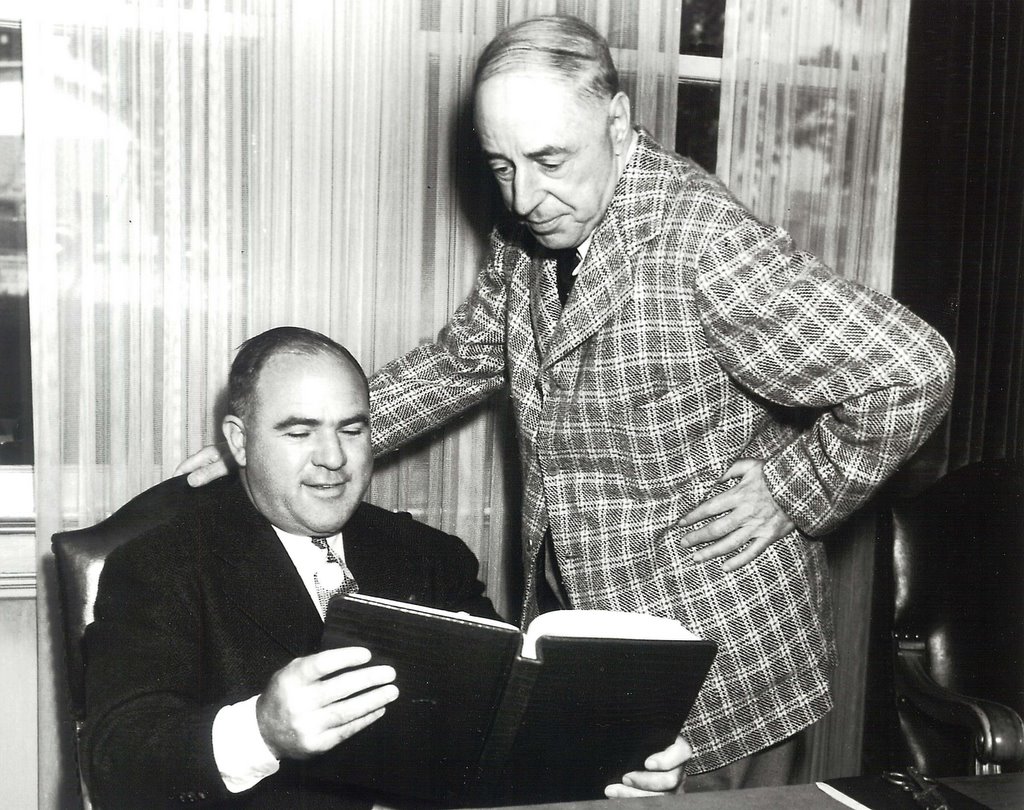
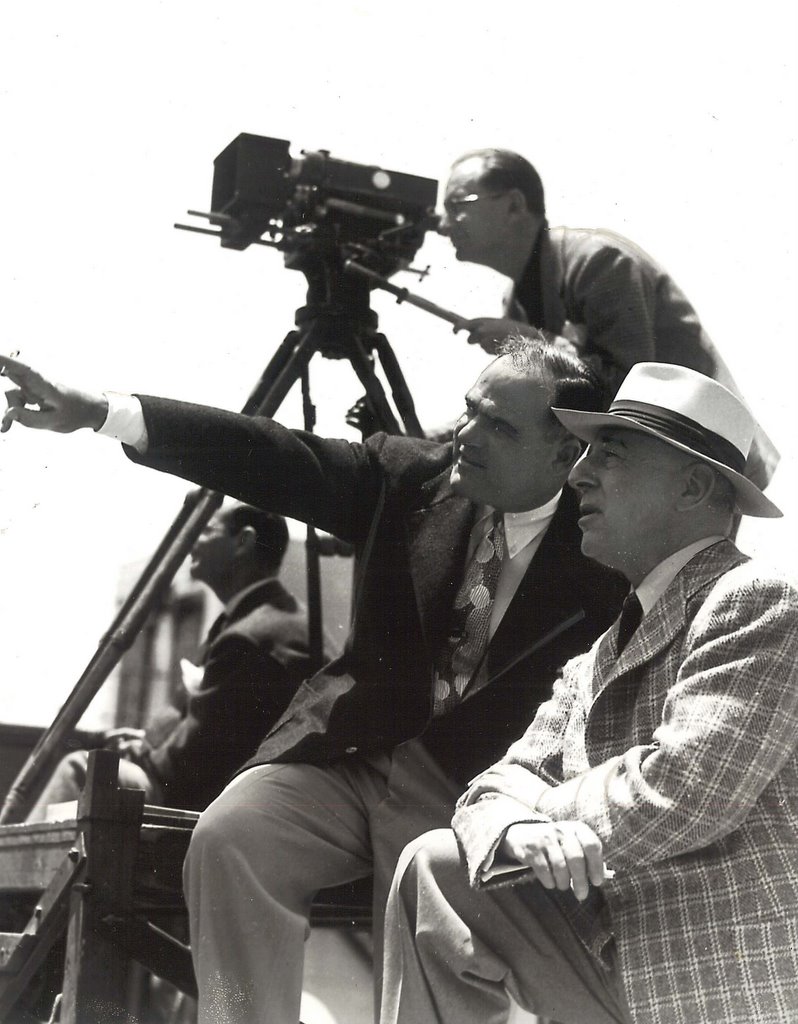
D.W. Griffith occupied a strange and unique position in the Hollywood community of the thirties and forties. No one was respected more, nor wanted less. The spectre of Griffith parked outside a studio gate aroused such feelings of pity, guilt, and general discomfort among all those on the inside that no door could be closed against him. Most of the power-players had learned their business from Griffith. The creative giant and father figure to an entire generation of producers and directors could no longer find a place in the industry he’d helped create. Nevertheless, work would always stop when Mr. Griffith arrived on a set. Just a visit and friendly reunion with an old associate who’d made it big, now shooting the important pictures Griffith used to direct. For men like C.B. DeMille and W.S. Van Dyke, those drop-ins had to be excruciating. They knew the sad old veteran wanted back in to resume his own career, but knew it was utterly impossible. Norma Desmond’s visit to DeMille’s Samson and Delilah set in Sunset Boulevard came closest to capturing the reality of those encounters. When someone once asked Irving Thalberg about giving Griffith a job at MGM, he merely shook his head, and said, "Impossible." Hollywood was anxious to give D.W. Griffith the grandest funeral tribute its money and shared guilt could buy, but even at that, they failed him. When the day finally came, on July 21, 1948, eulogist Donald Crisp delivered a stinging address before a half-filled chapel (fans were let in to swell attendance) in which he denounced an ungrateful industry for its shabby treatment of the great pioneer. Of course, they’d heard all that before, and now wanted only to get back to work and forget the whole thing.


These images do not represent D.W. Griffith at his peak. They show a man struggling to hang on in an industry that preferred he be confined to places like The Museum Of Modern Art, where they liked to keep relics. Griffith looks natty here with Cecil B. DeMille in a late twenties set pose. The man dressed sharp in those days. Good taste in hats, too. Griffith still had Abraham Lincoln and The Struggle ahead of him when this pic was made, so we shouldn’t count him out just yet. This next still, in which he appears to be directing a scene from San Francisco, was taken on the Metro lot in March 1936, and that’s D.W.’s old clapper boy W.S. Van Dyke standing behind the Master with his foot on the ladder. Van Dyke was another director who could never say no to Griffith, and by all accounts, the two were pals till the end (and Van Dyke’s would come sooner when he died young in 1943). I’d really like to know if Griffith actually called action on any of what made the final cut in San Francisco. This still is the only reference I've seen to his presence on the set, and the idea he might have directed a shot or two is a tantilizing one. Anyone got any dope on this? These last two are of Griffith in obvious decline. Note the tatty sport jacket he's chosen for a One Million B.C. publicity foray with producer Hal Roach. It's not a good fit, and that plaid is all wrong for him (still like the hat, though). I'm also a little miffed with Hal for using this great oracle of the silent cinema to shill for a dumb caveman movie with iguanas and other real-life critters standing in for prehistoric beasts (and for being so promiscuous in selling stock footage of self-same critters for every threadbare sci-fi pic to come along for the next twenty years!). At least Hal was offering D.W. some sort of a real job, as the original studio caption suggests ---

"Absent from films for eight years, David Wark Griffith, pioneer motion picture director and producer, arrived in Hollywood today. Griffith stopped in at the Hal Roach Studios in Culver City to pay a personal visit to his friend Hal Roach, a friend of a quarter century’s standing. Before the visit was over, Griffith was prevailed upon to return to picture making as an associate in the Roach organization, his only contract a firm hand clasp."

According to our information, the deal never came to much, but Griffith did hang around the lot for a month or so, offering some casting suggestions (was Carole Landis the Great Man's last discovery?). This shot of Hal pointing something or other out to D.W. reflects pleasure in having Griffith on the lot, but also determination in letting the old-timer know who’s in charge there.


Saturday, January 21, 2006


Star Scrapbooks --- Clara Bow


I was going through some old scrapbooks last night from a collector who'd acquired them years before in an estate sale. If we searched the provenance for all these clippings, they might well go back to the siege of Troy, but the thing that impressed me about this collection was how lovingly that nameless collector had gathered together and maintained it all. Among the artifacts of this long-ago devotee of Clara Bow, I found a neatly inscribed folder, brim-full of individual trims about the actress. Countless Clara images had been carefully removed from what must have been hundreds of magazines and newspapers over the years. The way he’d cut each one out, sometimes with intricate patterns, to avoid overlap with a neighboring article, was quite a monument to one man's patience and resourcefulness. I have no idea where these photos originally appeared, but a lot of them are both unfamiliar and well worth sharing with Greenbriar readers (and ask your kind indulgence, as I did opt for the sauciest poses!). Some individual cutouts were an odd size, so the collage effect on Photoshop seemed the best way to go. Just a small tribute to a Clara Bow fan of yore, artfully applying the scissors to his fan magazines, so that we might enjoy the fruits of his effort some seventy-five years later.


The full-color display above appeared in a Paramount exhibitors annual for the 1930-31 season. As you can see, great things were promised for Clara, but her career was headed for the barn by this time, and within less than two years, she’s be out of movies altogether. The Clara Bow Paramount talkies are among the rarest of her entire output, and we’d be thrilled to see Universal (they own the pre-48 Paramounts) release a box set of these, as they've recently done with the Dietrich, Lombard, and Mae West groups. If you want to read a fabulous biography of Clara Bow, look no further than
HERE.


Cartoons, Theatres, and TV --- Part 3


With so many cartoons choking the airwaves during the 1957-58 season, it’s no wonder exhibitors saw red. As far as they were concerned, theatres had been betrayed by the very industry they’d supported for over half a century. Saturday business was virtually a write-off as far as once loyal kid audiences were concerned. TV westerns and sci-fi programs had obliterated the "B" westerns and serials, once a mainstay for weekend showmen, and comedy shorts were essentially gone. Only Columbia bothered with these, as The Three Stooges limped along toward the end of their twenty-five year run for the company. They say television didn’t really penetrate every part of the country until 1956. Sounds right enough, for 1956 was sure a year for transition. First you had the massive studio dump of theatrical features and cartoons to TV; then the serials ended with Columbia’s Blazing The Overland Trail. Universal had just let go Abbott and Costello, and wrapped up the Francis and Ma and Pa Kettles. Series features were by now too much like television shows, and TV was free besides. Here in the south, we tended to run about ten years behind the rest of the country anyway, so much of the old product hung on a lot longer for us. Greenbriar has been astonished by what occasional searches of old newspaper ads reveal about the longevity of older product in southern houses. First off, we had serials running full-tilt right through to the mid-sixties; long after the rest of the country had abandoned them. I remember seeing Panther Girl Of The Kongo at our Liberty Theatre in 1967, having already caught a few chapters of the same serial on television several years before. The "Circle K" was a kid’s service organization during the sixties (may still be), and their Greensboro, NC chapter ran The Purple Monster Strikes for meetings at the Carolina Theatre in the summer of 1966. While the rest of the country was "discovering" the old serials and celebrating their "camp" and retro-ironies, we were still using them as standard exhibition policy, and without a trace of irony!


The only immediate casualty of the television/theatre wars, for us anyway, were the cartoons. They just seemed to vanish from the program. Companies continued to make them, and re-issued the old ones as well, but I’m hanged if I can recall ever seeing more than a handful in our local theatre, let alone any good ones. A look at the ads shown here will reveal what three of the major studios were peddling for the 1957-58 season. It’s pretty depressing. Paramount’s still got Popeye, but those things were real agony to get through by that time, and Casper --- yechh! I got so sick of him on those Matty’s Funday Funnies shows (or Sunday Funnies, depending on the day). He (or perhaps she, as gender was always in doubt) always played so sweet and nice, never assertive or aggressive no matter what the provocation. A mother’s idea, perhaps, of what her children should be watching in cartoons. I never experienced Casper in the theater. Had I done so, I may well have demanded the refund of my dime (yes, we got in for 10 cents until 1961). Herman and Katnip were an ersatz Tom and Jerry, their catch-penny antics making even the diminished efforts of MGM’s cat-and-mouse team look positively lavish by comparison. And look at these Columbia things! Ham and Hattie? Who in the hell are they? I never heard of them until I ran across this trade ad. Would Jerry Beck or someone please enlighten me? (oh, and by the way, thanks for the boost on your fantastic
CARTOON BREW website, Jerry). Then there’s Mr. Magoo --- boy, if you’ve seen one of these, you’ve seen them all. As a kid, I had but to see him starting across town in that jalopy yelling Roadhog!, and it was Greetings, Gate! as Jerry Colonna used to say. Warners was at least still trying to make decent cartoons. Records show they released twenty new ones in the 57-58 group, the average expense being $25,942. On one end, you had Woe Be Gone costing $20,905, and on the high side there’s Knighty Knight Bugs at $29,740. I always wanted to see WB cartoons theatrically, but our beloved Liberty just would not play them, despite my entreaties. Did they cost too much? I wouldn’t think so, as I know MGM was getting an average of just $4.60 per booking around that time for new cartoons, and only $3.13 each for the re-issues. All we got for cartoons in the theatre, at least by the sixties when I was going strong, was The Pink Panther and those gag-inducing Woodpecker things from Universal. Was there anything so odious as a latter-day Woodpecker? I’m glad Walter Lantz lived long enough to be the elder statesman of cartoons, but we think he achieved the status less for merit, than for the fact that he just kept hanging on, waiting for all of the really great animators to die! That’s okay Walter, we liked your avuncular and reassuring presence on the Woody TV show, even though you were kinda boring there too. The Panthers always seemed like cartoons for sophisticates, the sort Bosley Crowther might tolerate while he’s waiting for The Lion In Winter to start. Down here, waiting for something like The Reluctant Astronaut to start, we found the Panthers l-o-n-g and, what’s the word, minimalist? Anyway, that term animators use when there’s absolutely nothing to look at on the screen other than that damned Panther and a lot of empty space. That’s probably what Crowther liked about them.


Friday, January 20, 2006


Ingrid Bergman --- Retouched and Untouched


My favorite story about Ingrid Bergman is the time Hedda Hopper wrote a column excoriating the actress for her adulterous affair with Italian director Roberto Rossellini and their resulting born-out–of-wedlock child. Hedda waxed eloquently about the corrupting influence Ingrid had lately exerted upon American youth, emphasizing the scandalous pregnancy that had been the capper of Ingrid’s public perfidy. The Hollywood scribe then delivered a final bon mot when she cried, "Oh Ingrid, Ingrid, Whatever has gotten into you?" Show biz wags howled. They got the joke, only Hedda didn’t. She couldn’t appreciate the fact that she’d inadvertently delivered a verbal haymaker worthy of Oscar Wilde. When a friend enlightened her, Hedda was horrified. She’d never knowingly go in for a "blue" gag like that, but the damage was done, and her enemies (their numbers being legion) laughed about it for weeks.


Here at the Greenbriar, we like Ingrid fine, having first seen her many years ago in Intermezzo, where she got her start canoodling with married men. In this case it was Leslie Howard, who got to produce this picture as reward for agreeing to play Ashley Wilkes, a role he despised. Both characters were punished in truest Code fashion when Les’s kid gets run over by a car, all because Daddy has run off to live in sin with concert pianist Ingrid. It’s interesting to see Leslie Howard paying so dearly for his moral trespasses on screen, when we know he was one of Hollywood’s (no, the world’s) epic seducers off-screen. Industry lore has it that Les’s wife popped into his dressing room during the Scarlet Pimpernel shoot to find hubby vigorously engaged on the couch with co-star Merle Oberon (lucky pup!). When ball-and-chain voiced understandable objections, Howard merely glanced up momentarily and barked We’re rehearsing! before resuming his exertions. But I do digress, and this post is about Ingrid, so let’s check these two portraits and compare ---


This first one is a typical studio retouch job. It was done as publicity for the 1941 Dr. Jekyll and Mr. Hyde (the one where Spencer Tracy played both roles, and people used to make Spence mad by asking him which was which). The lab guys figured they’d make Ingrid’s pretty face even prettier with a little airbrush magic (nowadays such "improvements" are made in cosmetic surgery charnel houses, but we won’t go into that). Problem is, her features lost a little character along the way, but that’s the unfortunate nature of old-style glamour photography. Nowhere is it better emphasized than in this startling
unretouched portrait of Ingrid, taken November 19, 1943, no doubt for Gaslight (wish I could like that movie more). Note the "flaws" --- some blemish, a kind of ruddy, robust complexion, and eyes that bespeak the possibility of a big night previous. Now this is an Ingrid we can warm up to --- one of those rare glimpses of a great star as she really was. No wonder old Coop fell hard for her.


Buster Keaton In Transition --- Part 3


Buster Keaton appeared in his final foreign language versions of an American feature with 1931’s Parlor, Bedroom, and Bath, which was, incidentally, the most successful of his Metro releases up to that time. On this occasion, there would be no Spanish version, as there had been with Free and Easy and Doughboys, but there were both German and French editions. Being a more dialogue driven story, Buster would shoot much of it three separate times. The English language version of Parlor, Bedroom, and Bath was in production for fourteen days, from November 26 to December 12, 1930, plus six days for retakes. It was directed by Edward Sedgwick, and co-starred popular comedienne Charlotte Greenwood. The picture was released on February 28, 1931. Negative cost was $186,367, with domestic rentals of $476,000. Foreign was strong with $509,000, and the worldwide total was $985,000. The profit based on these figures alone was $306,632.


The German version of Parlor, Bedroom, and Bath was entitled Casanova Wider, and the negative cost was $47,079. Actor Edward Brophy, who also doubled as a unit production manager at MGM, directed both the German and French editions. The German was shot in twelve days, during April of 1931, and was shipped May 8, 1931. Since both foreign versions were filmed several months after completion of the English Parlor, Bedroom, and Bath, we can assume that most of the sets had to rebuilt for these (the French version, Buster Se Marie, was shot in eleven days during March of 1931, with a negative cost of $60,246, and was shipped April 22,1931). With the expense of the two foreign versions taken into account, the final profit for all versions of Parlor, Bedroom, and Bath would adjust down to $199,307.


The stills shown here represent all three languages. As before, note the negative numbers in the lower right corners. You’ll see the "Fr" for French, and the "Gr" for German. The English version is not designated as such, having only the production/negative number of 539, which is shared by all three. The other two displays show a typically attractive original ad designed by artists of the Fox Theatre chain, and the elaborate marquee display is that of the Carolina Theatre, in Greensboro, NC, which is still in successful operation to this day.


Thursday, January 19, 2006


Born This Day In 1931 --- "Tippi" Hedren


During frugal breakfast this morning, I tried to recall what other movies Tippi Hedren appeared in besides, you know, those two. The only thing that came to mind was A Countess From Hong Kong, so I checked imdb, and sure enough, she’s done lots of other shows, still working to this day. I’d read Spoto's story of how Hitchcock placed Tippi in coventry, thereafter consigning her to shabby television serials Universal was beginning to market. Having grown up on shabby Universal television serials, I launched an enthusiastic search for some of those credits. Did Tippi get to work with some of the really big names --- Doug McClure, Tony Franciosa, Leslie Neilson? Would there be a goldmine of exciting guest appearances on The Bold Ones, Name Of The Game … maybe even The Virginian? Well, the search left me somewhat wanting, as Tippi only did a Run For Your Life, one Kraft Suspense Theater (both Universal, so no doubt shabby), and a couple of Bob Hope gigs prior to 1970. I’d hoped for more, but what are the chances of seeing any of these programs again anyway? Think TV Land’s going to ditch The Andy Griffith Show for Kraft Suspense Theater? Me neither. Anyway, Tippi’s at least got The Birds and Marnie. Other than those two, I tend to think of her running around wildlife compounds, usually with tigers I wouldn’t care to occupy a state with. Maybe that's a relaxation after what she put up with on the Hitchcock pictures. Having read Spoto’s book, and much as I love the Master Of Suspense, I’m inclined to think it’s all true. Poor girl. Stardom couldn’t have been worth that --- and she didn’t even get to be a real star. The big push was over as quickly as it began. At least she got to do the Chaplin picture. It’s not much good, but I assume he at least left her alone (especially with Oona there knitting on the set every day). Those two Hitchcock pics look better every time I watch them, and it’s not just the gorgeous DVD’s (thanks, Universal!). I know there’s a lot of cheap mattes in Marnie, and that horseback stuff looks mighty phony, but so what? Hitch was heading into 65 when he made it. Why go out and catch pneumonia when you can fake it on a soundstage? I understand, Hitch (but you still should have made Cary Grant really eat that chicken leg in To Catch A Thief). The Marnie ending doesn’t inspire much confidance in Mark Rutland’s conjugal prospects either. You think she’s going to go straight back home with the guy and give him some right then? After all that bloody flashback revelation with Bruce Dern in his sailor suit? Nope. I’d say there’s years of therapy before she even lets Mark pet Fiorio, let alone her.


Here are some typically screwy Universal ideas to help exhibitors sell Marnie. Would a safe manufacturer cooperate with a window tie-in? Now, I assume this involves hauling your inventory into some hapless merchant’s store and putting it in his show window. Does that seem altogether practical? I mean, aren’t those things heavy? They seem so whenever one falls on Spike in a Droopy cartoon. A judicious showman in 1964 would most likely have passed on the safe bally.


How about that "prettiest secretary"angle? All right --- fine --- and who’s the sponsor going to be? The ACLU? National Organization of Women? Sounds like trouble to me. Better leave that one alone. The "Early Breakfast Showing For Secretaries" seems fair enough, but just how early are we talking about? This is a 129-minute picture! If you want to get those secretaries into work on time, you’ll have to open the curtain before cock-crow, and how many people are up for turgid sex thrillers at 6:30 in the A.M.?


These two behind-the-scenes shots show the Master at work, presumably before the big blow-up with Tippi (after which he wouldn’t speak to Hedren directly and referred to her obliquely as "that girl"). Wonder what was going through his mind when Hitchcock guided this business with Tippi’s bare and fetching legs? Well, the guy’s only human. No wonder he went a little daffy. If Tippi
looked at Vertigo, she probably saw some of this stuff coming!


Cartoons On TV --- Part 2


The sale of the Warner Bros. pre-49 library to Associated Artists included 850 features, plus 1,500 shorts and cartoons, and the price was $21 million. That may have seemed like a lot in those days, and God knows they needed the money, but in hindsight, this was an act of pure lunacy on Warner’s part. The cartoons alone were worth many times the total price, as it turned out. We're too young to recall the initial launch of these packages, but by the late fifties, the Greenbriar was on board for Popeye’s every sailing, and those WB cartoons, with their distinctive AAP openings (where you’d get to hear the opening fanfare twice), were ubiquitous on every channel hauled in on our "tenna roter". We particularly recall a daily ritual out of WLOS in Asheville, NC, which began at 7:00 AM, and continued with two solid hours of non-stop WB’s and Popeyes, interrupted only by the weather reports. It didn’t take long to become cartoon literate, as we learned to recognize the pedigree of each short by their opening titles. The good Popeyes were the ones with the ship’s doors, opening and closing to reveal the credits (we always liked that sound they made … still do). The Warner groups were less predictable, as there were certain rogue distributors out there (at least they seemed roguish then) who would remove the studio openings altogether and replace them with ugly cards crediting "Sunset", or "Guild" Films. We’d never heard of those guys, and we could tell they’d not really made these cartoons. Those drawings of Porky holding a rifle, that peculiar dog, and a weirdly distorted Daffy Duck were a stench in the nostrils of many young viewers, including myself, but the cartoons were good, as they were actually the B/W Warner titles not included in the AAP group. It seemed every station had a Popeye show. That sailor man was an absolute sensation when he first hit the airwaves. We had kid shows down here that would sandwich him in between the live studio spots with a kid host and his studio full of moppets (invariably Cub Scout or Brownie troops --- I was briefly a Cub myself, but was drummed out for cowardice). Those Popeyes, even the Fleischers, could get a little tedious when you were seeing six or seven in a row, eventually reaching a point where you’d look at a minute or so, then yell, "Just eat the damn spinach and get on with it!" At some point during every broadcast, those kids in the studio would get their treat bags, then you’d sit for an interminable recitation of every merchant’s name who’d "donated" the useless, and/or tooth-rotting, bric-a-brac within those sacks. One thing about these pages from AAP’s campaign manual --- the emphasis on color cartoons. How many households even had color sets then? I know my family didn’t, and wouldn’t, until 1966. In the meantime, I wonder how many stations broadcast these cartoons in color. It was cheaper for the locals to use B/W prints, and I’d guess that’s what most of them did. Of course, the station managers eventually went looking for "fresh" cartoons, and that’s when we got those dreadful Dick Tracy and made-for-TV Mr. Magoos. They were five minutes long (to the second!) and really sucked, if you’ll excuse the vulgarism. They were an insult to every thinking child in the audience. The offense inflicted by their presence on the airwaves could only be surpassed by the arrival of Astro Boy around 1964. One station manager even acknowledged the unworthiness of that character in a reply to one of my indignant letters sent back in the late sixties (my first letter, at the age of six, included detailed suggestions for a revamping of the Saturday morning schedule, and I’m still waiting for a reply to that one). All this action on TV screens made theatrical cartoons seem superfluous, of course, and that's where the theatre exhibitors got up in arms. In tomorrow’s entry, they fight back!


One housekeeping note. A Greenbriar correspondent has advised us that we need to change our settings, as the "comments" option presently requires some sort of draconian registration process before anyone can actually leave a comment! We've resolved that (hopefully), and invite readers to leave feedback on any posting.


Wednesday, January 18, 2006


Born This Day In 1892 --- Oliver Hardy


Words fail me when I try to describe my affection for this great comic actor and the partner with whom he made so many wonderful shorts and features, both silent and talking. The happy news that more of their comedies are forthcoming from Warner and Fox is tempered only by the fact that Hallmark Cards, owners of all the best Laurel and Hardy material, continues to ignore fan requests for a proper DVD release, and indeed, their piddling efforts so far have been sorely lacking in quality. But that is a story better left to more capable DVD reviewers than myself, for we’re here today to recognize Mr. Hardy’s 114th birthday (it seems only yesterday we celebrated the 100th!). We know that Stan Laurel was the more accessible of the two, as it was he who maintained the closer ties with fans of the team over the years. Hardy was more reticent, seeking his privacy off the set, and not given to the sort of detailed interviews Stan was always happy to accommodate. As I get older, I respect Hardy more for having guarded that privacy. He was rarely himself on camera. More often than not, he would retreat into the "Ollie" character whenever he sensed the photographer's presence. This is apparent in newsreel footage, even home movies and candid stuff. The only glimpses of the real Oliver Hardy I recall are the Ship’s Reporter TV interview from the early fifties, wherein he talks briefly of his early career, and the infamous This Is Your Life episode from 1954, in which a distinctly uncomfortable Laurel and Hardy are caught from ambush by a doggedly persistent Ralph Edwards during what they thought was an ordinary business meeting with their lawyer. This is one of the most amazing half-hours in television. Laurel is clearly annoyed; Hardy more resigned, and far too polite to reveal his mortification over the whole thing. I love his courtly greeting for those childhood friends flown in for the event. There’s every reason to believe he doesn’t recall a one of them, but he’s so gracious and charming with each --- here’s where we really get the essence of the Oliver Hardy I’d like to have known. In the wake of that coast-to-coast disaster, TV Guide interviewed the boys, and Laurel spoke freely of his disgust over the whole thing, while Hardy related a rather moving incident he’d experienced at the local market. Prior to the resurgence of Laurel and Hardy, he spoke of how shoppers would sometimes brush by him rudely, "Out of the way, fat!" they’d say. Now, with their comedies revived and revered on television, those same strangers were more likely to stop and greet him, "You’re Oliver Hardy, aren’t you?" It’s nice to think that he was accorded that kind of respect as the team gave their final performance, which indeed this turned out to be. A proposed TV series to be filmed in the wake of This Is Your Life was scuttled when Stan, then Oliver, fell ill. Oliver Hardy did not live to share in the triumph of Robert Youngson’s compilation, The Golden Age Of Comedy, for it was released only months after he died in 1957. Stan Laurel lived to enjoy the next Laurel and Hardy renaissance, however, and it lasted well beyond his own death in 1965. Those of us who mowed lawns for money to buy 8mm Laurel and Hardy shorts from Blackhawk Films will always have a certain sentimental attachment for this greatest of all comedy teams, and though we hopefully won’t have to cut grass to buy those DVD’s in the Spring, I’ve no doubt we’ll all be lined up for them just the same.


Born This Day In 1904 --- Cary Grant


Cary Grant was born 102 years ago today, and that's a hard thing for us to imagine, since his appeal is so modern, and yes, timeless. Was he wise to retire in 1966, and avoid the biz from then on? Yes, we think so. Maybe Cary anticipated the final breakdown of the Production Code, and the beginnings of a rating system pushing his kind of comedy into an "R" rated realm that would have proven an embarrassment for him, and his fans. It’s always nice to see an artist go out on top, and Grant was most assuredly in that position, right up to the moment of stepping down. His presence in virtually every sixties exhibitor poll is a refreshing reminder that here was a career of astounding longevity. We all know Grant was something of a paradox in his private life. The on-screen character was pure invention on his part, but what an invention! He often said he’d give anything to be Cary Grant, and that quote speaks volumes about the man. I never believed for a moment that rubbish about he and Randy Scott (watch the new DVD of Seven Men From Now and you’ll say NO WAY!). Roommate bachelors were a commonplace in thirties Hollywood, and besides, that whole flap originated with one fan magazine lay-out, which was admittedly a little dicey, but the poses in question were surely the inspiration of over-zealous photographers and publicists, not our boys. We like Cary best in comedies of course, and the one featured here is an under-rated gem we caught recently on TCM. Dream Wife is routinely dismissed in the review books, so we weren’t expecting much, but imagine our surprise when it turned out to be a pretty good little farce, and one of our favorite Grant comedy performances. It’s the little things he does, especially at the beginning when all his old-world courtesies are being rebuffed by the high-falootin’ career women he’s surrounded by (check out his attempt at providing a light for co-star Deborah Kerr). There’s also the delightful bonus of seeing old favorites Bruce Bennett, Les Tremayne, and Dick Anderson as a sort of hen-pecked Greek chorus for Cary to play off of (and it's great seeing Bruce so relaxed in a big "A" comedy for MGM). Nobody did gorgeous stills like Metro either. These shots from Dream Wife are typical of the studio’s first-rate publicity unit. We especially like the group portrait that so neatly captures the comedic conflict on view in the feature, and the spirit of this behind-the-scenes candid is nicely encapsulated in the studio’s original back caption ---


"THREE’S NO CROWD…. Cary Grant, Deborah Kerr, and Betta St. John, the three stars of MGM’s "Dream Wife", take time out for some off-screen dialogue. They’re a compatible trio and find plenty to laugh about between scenes of the romantic comedy. Sidney Sheldon directs, Dore Schary produces.


Cartoon Campaigns For Theatres and TV


1957-58 was a watershed season for theatrical cartoons. They were still out there, and did remain popular, but now kids at home were seeing the really good ones on television, and they were free. Instead of fossilized Van Buren and Farmer Alfalfa on the home screen, we had Popeye and Bugs Bunny, thanks to the massive sale of theatrical cartoons to Associated Artists Productions in 1956. That seismic event would change the Saturday morning viewing habits for kids nationwide. Whereas theatres had once enjoyed the undivided loyalty of their juve audience, they were now engaged in a grim, ongoing competition with the box at home. Local houses often programmed hour long cartoon shows as companions for features, and used them as well for Saturday morning kiddie fodder where a dime could get you in from 9:00 to 10:00, before the westerns and serial got underway. It was great while it lasted, and it did last right through the fifties in many situations, before TV finally brought the theatrical cartoon to its knees. Note this ad from the Allen Theatre in April 1953. The Bugs Bunny Revue is part of a "double feature" and a distinct attraction in its own right. Warners supplied the "paintbrush" ad with Bugs in a special umbrella pressbook that covered most of their cartoon programs during that period. Since these were an ongoing staple in many theatres, it was deemed necessary for management to emphasize that each show would be a different one, with fresh cartoons in every serving. MGM was packaging their cartoons in much the same way with the Tom and Jerry Festival Of Fun, which was generally ten or so shorts combining the cat and mouse team with such other Metro character favorites as Droopy and Barney Bear. By 1953, MGM was spending an average of $28,728 to produce their cartoons, while a more frugal Warner Bros. held the line at $22,972. The average rental that Metro could generate for a cartoon during the 1953-54 season was $3.43, not a lot on its face, but the combined average rental on an individual MGM cartoon by this time was $78,379, so there were a lot of bookings, and a lot of profits being made, on these shorts.


Associated Artists really went out with the big guns to publicize their acquisition of the fabled Warner and Popeye cartoons for TV, but honestly, these things sold themselves. Local stations were starved for product, and these packages (337 WB and 234 Popeyes) were an immediate sensation in every viewing market they played. Check out these colorful pages from the AAP sales manual, and you’ll appreciate why theatre exhibitors went to war with the TV-enabling studios during the fifties.


More on this subject tomorrow. We just keep running into these neat trade ads, and can’t resist scanning them! There’ll be lots of color from the AAP television campaign, so keep watching.


Tuesday, January 17, 2006


Flappers and Jazz Babies

We've gotten some nice reaction to the John Wayne posting of this morning, less from fans of Wayne than from admirers of all things jazz age, especially college-based comedies and musicals. Too many of these admittedly obscure features (and shorts!) are completely out of circulation today, so we've dug into the files to unearth some nifty trade ads for movies we'd really like to see, but probably never will.


Buster Keaton In Transition --- Part 2


Buster Keaton’s next feature for MGM, and his second talkie, was Doughboys. There was also an appearance in the German version of The March Of Time, an aborted follow-up to The Hollywood Review Of 1929. A number of musical segments were filmed for this partly two-color extravaganza, with the result being a $692,000 write-off. An attempt to utilize some of the footage in another musical, Broadway To Hollywood, could not recoup the loss, as this film failed to produce sufficient revenue to show a profit. Proposed French and Spanish versions of The March Of Time were also abandoned, but there was a German edition that was actually completed, and this is the film in which Keaton appeared. Ramon Novarro, Adolphe Menjou, and John Gilbert were also in the cast, and the negative cost for the German March Of Time was $83,000. The nature and content of Keaton's appearance is unknown, as there is no evidence of this film having survived.


The English language version of Doughboys was filmed from May 3 to June 9, 1930 in 24-days, and was released on August 10, 1930. Negative cost was $275,948, and domestic rentals were $428,000, with foreign bringing an additional $386,000. Worldwide rentals were $814,000. As with Free and Easy, there was a Spanish version (De Frente Marchen), and the negative cost of that was $72,867. Again, costs were lowered for this version by virtue of the fact that not all of the feature had to be reshot, and this edition was released on October 22, 1930. The MGM profit and loss statement, taking into account the English language version only, showed a profit of $160,051 for Doughboys, but with the expense of De Frente Marchen figured in, the actual overall profit for all versions was less at $89,184. This was still a significant improvement over the loss experienced with Free and Easy.


Buster’s leading lady in Doughboys was Sally Eilers. Her Spanish counterpart was Conchita Montenegro, who would later have a co-starring role with Leslie Howard in Metro’s Never The Twain Shall Meet (1932). Buster is pictured here in uniform with Sally, and in top hat and tails with Conchita. Also, by way of comparison, we have a board meeting sequence from both the English and Spanish versions. Note the "Sp" that precedes the negative number in the lower right corner to denote scenes from De Frente Marchen. Supporting players Cliff Edwards and Edward Brophy are identifiable in the scene from Doughboys, although Spanish-speaking players in the still from De Frente Marchen replace them. In the next, concluding post, we’ll cover the English, German and French versions of Parlor, Bedroom, and Bath, the last Buster Keaton feature for which foreign language versions were filmed.


Just Another Madcap John Wayne Kollege Komedy


Did anyone have a tougher climb to stardom than John Wayne? After several years of crew and extra work, he’s "discovered" by director Raoul Walsh, and cast in Fox’s The Big Trail, but that one’s a disaster with a million dollar loss, and part of the blame is laid at the fledgling actor’s doorstep. We remember an interesting Wayne interview where he talked about having to go on publicity tour for The Big Trail, and how they made him dress out in his buckskin costume for the press gatherings. He never forgot everyone making fun of him, and how it felt to walk through a hotel lobby in such a rig. As it turned out, his humiliation was just beginning, since the failure of The Big Trail would leave him rudderless at Fox, like spoiled meat left too long on the butcher’s counter. His next one was a "hey-hey" college romance called Girls Demand Excitement, which we at the Greenbriar would dearly love to see, but does it even exist? We’ve not heard of any screenings, but hope springs eternal, and in the meantime, we did run across these neat stills and ads to whet our appetites over the prospect of John Wayne as "a Master of Arts in osculation". Exhibitors of the day were encouraged to construct a cardboard devise which would "measure the fervor of a kiss". Patrons were discouraged, however, from demonstrating its effectiveness in the lobby. As to "the four-letter word that makes the world go 'round" as referenced in this vintage ad, there might well be a lively modern debate as to what that word might be! Wayne’s co-star was Virginia Cherrill, and her forthcoming appearance with Charlie Chaplin in City Lights was a big part of the publicity build-up for her debut effort here. She would be wed to Cary Grant around this time. Marguerite Churchill was another refugee from The Big Trail --- she’d co-starred with Wayne in that. For the rest of his life, Wayne would cite Girls Demand Excitement as perhaps the worst film of his entire career, but without having seen this "breezy and frothy comedy", we can't help but wonder ... can it be any worse than The Barbarian and The Geisha? No, we won’t pass such harsh sentence until we’ve looked at the evidence, so the ball’s in your court, Fox! Start digging in those vaults, and let us have a peek at John Wayne as a "frivolous, frolicking, freshman fraternity boy".


Monday, January 16, 2006


Born This Day In 1898 --- Director Irving Rapper


When you think about those poor directors Bette Davis used to kick around during her Warner Bros. reign, Irving Rapper’s name may spring to mind. He didn’t make a lot of great pictures, but for a while during the forties, did get important assignments on the Warner lot (Adventures Of Mark Twain, Rhapsody In Blue, One Foot In Heaven). Davis ended up trusting Rapper enough to bring him along for an independently produced 50's meller, Another Man's Poison. The remarkable thing about Irving Rapper is how long he lived --- 101 years!! We recall a wire story seven or eight years ago which presupposed he was dead, only to announce days later the triumphant discovery that Rapper was alive and well somewhere in England. It was as if they’d found a pterodactyl. We think Irving’s birthday deserves a mention just because he directed that all-time great Bette Davis vehicle, Now, Voyager, which showcases not only the First Lady Of WB, but also that Greatest Of All Thespic Gods, Claude Rains. The first time we saw Now, Voyager was actually in another movie, Summer Of ’42 (where they used clips during a theatre-going sequence), and I well remember sitting there in 1972 and thinking, why can’t we just watch this neat-looking Bette Davis picture instead of some lame, cold-crème-on-the-lens, phony-baloney, would-be nostalgia indulgence? You remember how Bette shaved her hairline for Queen Elizabeth in 1939? Well here, she really let them flog her with an ugly stick as the pre-transformation Charlotte Vale, and if you’ve seen the movie, you’ll remember that great scene where she hides her cigarettes before giving Claude Rains a reluctant tour of her sanctum sanctorum. The DVD of Now, Voyager is a marvel. It’s just about the most stunning B/W thing Warners Video has produced to date.


As always, we’ve tried to provide some images that haven’t been published or posted to death elsewhere. First off, that’s birthday boy Irving Rapper (our excuse for talking about this movie!) "directing" Bette on Now, Voyager (as if anyone could). She looks obedient and cooperative, but she knows that still man’s on the stage, and soon as he’s gone, she’ll take the blue pencil to that script again, and show Irving who’s boss! This other shot illustrates a sequence that was cut in its entirety. All the details of Charlotte’s transformation from ugly duckling to still-tormented swan were excised by producer Hal Wallis (if only we had him, and his scissors, around today to put the finishing touch on contemporary films!).


The pressbook stuff includes typical ad art for the 1942 release, and the tie-in page once again shows us the multiple means by which a major feature could be delivered to the attention of the widest possible audience. It paid off, too, for Now, Voyager, with its negative cost of $877,000, took a wow $2.1 million in domestic rentals, another $2.0 foreign, for a worldwide total of $4.1. The final profit of $2.1 million was the biggest pay-off of all the Davis/Warner pics.


Monday's Glamour Starter --- Janet Leigh


How many actresses today can boast of having made as many good pictures as Janet Leigh? And we mean really good pictures, like Psycho, Touch Of Evil, Scaramouche, The Manchurian Candidate, The Naked Spur --- those are just the acknowledged classics --- but we’ve always been partial to Act Of Violence, Holiday Affair (love that Bob!), Prince Valiant, Rogue Cop (Bad Bob!), The Vikings. Heck, she’s even in one of those fake U.N.C.L.E. features, The Spy In The Green Hat! Tell you what, Universal, if you’ll release The Perfect Furlough on DVD, we’ll buy it. Promise! Janet was by all accounts a nice person. I wrote her a fan letter once, telling her how much I enjoyed Holiday Affair, and got a nice autographed still in return. That’s pretty generous for a star in this day and age when they all want you to S.A.S.E., or better yet, lay $25.00 give or take on them for a signature. Thing is, I didn’t even ask Janet for hers. She just sent it. Good for you, Janet. We also loved that tribute to Norma Shearer she did for TCM. Anyone who pays tribute to Norma is aces in our book. Besides, Norma discovered Janet, out on a ski slope, I think. The portrait pose is from Janet’s very first movie, The Romance Of Rosy Ridge. She was nineteen when she made it. We suspect Janet knew a lot more inside dope on Vegas and Rat Pack hijinx than she ever revealed. After all, she and Tony hung out lots with that mob, and she worked with Frank and Dean several times. There's a lot of scoop and mysteries we still wonder about. Tony wrote a fine autobio, but we think he’s still holding back. C’mon Tony, tell us all before it’s too late!


Check out the dashing "Pancho" with Janet in the fetching backstage-at-Metro pose. That’s the amazing Gilbert Roland, and he’s taking the sun here during a break from The Bad and The Beautiful in 1952. Gil was truly the man. His career went back to the silents, and for a while, he was Clara Bow’s off-screen paramour, that is, when he wasn’t making time with Norma Talmadge. Married to Constance Bennett during the forties, Roland was an ageless wonder. To our everlasting awe, he was still doing action parts and bedding Italian starlets onscreen in a brace of spaghetti westerns in the late sixties! Gil had a long life, too. Made it to 88. Bravo, Gil. We wish we had half your stamina.


The Beatles Come To Town!


Ran into my old boyhood chum Mike Ferree last week after a customarily frugal oatmeal breakfast, and remembered the day he and I went to the Liberty Theater to see A Hard Day’s Night way back in August of 1964. I can’t honestly say it was a seminal event for me, although I enjoyed the Beatles a lot, and like every kid in town, was anxious to see their first feature-length movie. My only complaint lay in the fact that our beloved Liberty elected to hold it over that week, thus bumping Evil of Frankenstein to an undetermined "later date". My apprehension over the possibility of missing the Hammer thriller (forever!) clouded somewhat my pleasure at seeing those irrepressible Liverpool mop-tops. Unlike the incidents reported in these trade magazine accounts, we did not encounter a hysterical teenage femme audience when we went to see A Hard Day's Night. The Liberty’s stern and watchful management would not permit it. Decorum would be maintained even in the face of a Beatles invasion. Perhaps the local girls recalled, as I did, the infamous day when a number of boys (I was fortunately not among them) were ejected from the Liberty after an overly enthusiastic response to the almost unbearable on-screen excitement of King Kong vs. Godzilla.


We love the way this marquee shot perfectly captures the spirit of that summer phenomenon. There’s such openness in their smiling faces as these girls pose excitedly for the camera. We’re not sure if an accommodating exhibitor furnished those neat little placards two of them are holding up, but so what if he did? This may have been the last Summer that teen-agers would dress so neatly to attend the movies, and not to worry, they’ll all enjoy the show in comfort as they’re "cooled by refrigeration" within. Air-conditioning is so taken for granted now that we sometimes forget what a novelty it once was, even as late as 1964, when most homes did not have it (mine certainly didn’t). That marquee reveals another transition not so apparent at the time --- the beginning of Elvis Presley’s displacement by the cheeky British foursome. Fun In Acapulco is the co-feature, but we all know what these girls have come to see. It’s worth noting here that A Hard Day’s Night did a socko 5.7 million in domestic rentals, while Fun In Acapulco got by on 2.5, a figure that was a little below average for a Paramount Elvis at the time, and nowhere near what could be realized in the stunning profits from the very modestly budgeted Beatles show.


Audience turnover was a real concern as these trade articles and ads demonstrate. A lot of these kids were happy to remain in the auditorium all day, especially with that nice air-conditioning, but there was no profit in that, so harried exhibitors had to go in and flush them out of the darkness after each show. The severity of the problem is indicated by the "intermissions" notice on the theatre ad shown here, where kids are warned in advance that the house will be cleared between shows. The idea of a uniformed guard to protect the display is a clever bally, and I don’t doubt the necessity of it, since those 8X10 glossies do make an attractive target for poachers, especially since they don’t appear to be behind glass, and thus readily accessible. I had a friend in school who’d once made a clean snatch of several Dr. No lobbies from his local theatre, with no one ever the wiser.


Sunday, January 15, 2006


Born This Day In 1879 --- Ernest Thesiger


I knew a 16mm collector once that actually met Ernest Thesiger. It was during a trip to England, sometime in 1960, and a friend took this guy to Thesiger’s house! Now it’s one thing to have met Vincent Price, or Christopher Lee, or even Boris Karloff, if you were one of those kids lucky enough to visit that soundstage where they made those Mexican horror films he did --- but Ernest Thesiger? That’s like having a one-on-one encounter with Tod Browning, or James Whale --- these are people we’ve read so much about, but there’s just no personal anecdotes to be had on them. The collector told me that Ernest was "a strange sort". Well, yeah! Wouldn’t it have been a little disappointing if he’d been normal? To say the least, I was impressed by his account. And who could fail to be impressed with the work of this most individual of actors? He turns up in a lot of things (The Robe, Adventures Of Quentin Durward, etc.), but James Whale (pictured here with Thesiger) knew best how to harness that incredible talent. We don’t know how familiar these stills might be to you seen-it-all horror fans, but they’re pretty fresh to us (and who can fault us for posting an image of Thesiger with Dwight Frye), so we’re providing them here. Happy 127th, Ernest Thesiger!


These Shorts Are Real Dogs!


I can’t watch a Dogville comedy. They aren’t funny, and the animals do not look comfortable. Each of these interminable shorts is an alleged spoof of a big Metro feature, like The Broadway Melody or The Big House. The way they make the dog’s mouths move is creepy --- I know my own dog hates it when somebody makes him walk on his hind legs, and he certainly does not enjoy wearing clothes. The idea of MGM making comedies like this is very strange. Some renegade, States-Rights, Poverty Row outfit like Victory or Chesterfield, should have produced them. If I’d been Norma Shearer, I would not have wanted one of my features playing on a bill with a Dogville Comedy. I would have cut Irving off until he agreed never to do that.


Peckinpah Peculiarities


With so many Sam Peckinpah experts out there (I just had to double-check my spelling of his name!), we are naturally a little reluctant to approach the lectern on that subject, but a few minor oddities might be worth mentioning. The recent DVD release of Major Dundee, and the spectacular appearance of his westerns in Warner’s new box set has, in any case, inspired us to dip our toe into Peckinpah water. No, this won’t be yet another review of the DVD box (for the best one of those, you should go HERE). We thought these few images from the file cabinet might be a little less familiar to the director’s fans ---


Here’s something I’ve not encountered elsewhere, a newspaper ad for Dundee’s Fightin’ Rebels (!?!!), which played the Center Theatre in Greensboro, North Carolina on May 21, 1965. Somebody surely revised Columbia’s campaign here, but who? Was it the Center chain's home office, the regional Columbia exchange, or did the studio panic and change its nationwide marketing in a last ditch effort to save a faltering release? The records reveal that Major Dundee earned 1.8 million in domestic rentals, 3.1 foreign, and final worldwide rentals of 4.9 million, which was pretty disappointing (especially when you compare it with the company’s own Cat Ballou, a spoof western that did a whopping 10.2). We’re guessing that Dundee’s Fightin’ Rebels was a purely regional phenomenon, as I don’t think that title would play in San Francisco, or the Manhattan art houses, but, to paraphrase Major Reisman, "us Southern boys" really dig them pitchurs 'bout Rebels. I’d love to know if the main title was modified for these bookings. Are there prints out there of Dundee’s Fightin’ Rebels? What about the pressbook, or at least an ad slick, for this campaign? Do they exist? We’ll leave these questions to the Peckinpah scholars in the hope that they can enlighten us.


Now this is a family webpage, but we couldn’t resist this naughty little snap of Ben Johnson and Warren Oates cavorting among the wine barrels with "Mexican feature players" (as they’re described in the caption). But wait a minute, shouldn’t this be one of those clandestine shots concealed in the coat pocket of some crew member departing for the night? To our surprise --- no --- it’s a duly authorized Warner publicity still for the initial release of The Wild Bunch, and for the sake of the record, we include the original back caption here ---


EARTHY REALISM ACCENTED IN SUPER FILM – Film director Sam Peckinpah, exponent of all out action pictures, has just completed for Warner Bros.-Seven Arts "The Wild Bunch", starring William Holden, Robert Ryan, Ernest Borginine, Edmond O’ Brien, Jaime Sanches, Warren Oates, Emilio Fernandez, etc. Important ingredients of the movie are some exciting servings of sex. Pictured here are Warren Oates and Ben Johnson frolicking with Mexican feature players amongst and in, the huge wine vats.


Now this still was presumably issued sometime in mid-1969. Could this have been one of the first, if not the first, instance of a major Hollywood studio using nudity in a publicity photo? I can’t imagine this in a mainstream publication of the time, but I do remember, as an adolescent, reading profiles of The Wild Bunch in various men’s magazines, and their imagery tended to be a little rawer than what we saw in Life or Newsweek. Chances are, Warners had a separate presskit to accommodate the editorial requirements of Adam, Nugget, and other such publications, whose readership would have certainly found The Wild Bunch alluring. Again, we call upon the experts to enlighten us here.


This last little item is the original – original, mind you -- local newspaper review that your humble correspondent wrote back in 1969 when he was the insufferably obnoxious, know-it-all fifteen year-old film critic for The Wilkes News (now in its thirty-sixth year of defunctitude). I was paid $1.60 for each review, 60 cents to get in the show, and one dollar for the column itself. Believe me, folks, 1968-69 was a bitter season for movies --- The Green Slime, Hellfighters (‘The hottest picture I ever made", said Duke in the TV spots), Lady In Cement, Skidoo, Charro, Angel In My Pocket --- it’s a wonder I didn’t give up on our great industry and start collecting airplane models. There were a few good ones though --- Bullitt, The Devil’s Bride, one or two others --- but none as good as The Wild Bunch. We called it a "masterpiece" then, and still stand by that review today!


Saturday, January 14, 2006


Buster Keaton In Transition --- Part 1


The Buster Keaton MGM features are a despised lot. With the exception of The Cameraman, and to a lesser degree, Spite Marriage, they are disregarded by fans as wholly unworthy of Buster, an unforgivable instance of big studio avarice brought to bear upon a maligned and misunderstood genius. While we certainly regret the loss of Buster’s creative independence, we also recognize that he was never wholly independent to begin with. Producer Joseph Schenck was the ultimate authority on the Keaton series, and though he was indulgent of Buster’s creative impulses, he was also, first and foremost, responsive to the will of the public and exhibitors. Keaton often spoke of how he made Seven Chances against his own better judgment, that it was a project "they" forced upon him. "They" also assigned a production supervisor on his last United Artists feature, Steamboat Bill Jr., which, contrary to previously published Keaton scholarship, did show a profit, according to the producer’s settlement statement. With a negative cost of $386,000, Steamboat realized domestic rentals of $375,000, with additional foreign revenue of $347,000. Worldwide total was $722,000 (only slightly less than the $749,000 taken by the previous Battling Butler, a picture Buster cited later as one of the most financially successful of his career). The final tally for Steamboat showed a profit of $67,555. It’s true Buster would never strike lightning the way Chaplin or Lloyd could, but there’s every reason to believe that all three of his UA releases --- The General, College, and Steamboat Bill Jr. --- made money, and it’s unfortunate they’ve been branded as failures as the result of careless research. Also regrettable was the fact that Joe Schenck chose this time (1928) to unload Buster’s contract. There’s no question Schenck was overextended, what with wife Norma Talmadge’s vehicles and his Art Cinema ventures. The producer had managed to link himself with a number of high profile independent productions, and the profit potential in disposing of Keaton’s services was no doubt irresistible to him. In hindsight, Schenck’s Metro deal for Keaton was clearly a mistake, but that’s because we know and understand Buster so well. Back then, no one had a handle on what made Buster tick. Not even Buster. Chances are he saw this Metro deal as a good thing. How could he know what they’d end up doing to him? Chaplin advised against it, but Buster knew all too well he’d have to go to work for somebody, unlike Charlie, who answered only to himself. The money was a powerful inducement --- $3000 a week. Bear in mind, this is a man with a luxurious Spanish Villa to keep up, along with a free-spending wife on the verge of throwing him out. How do you turn down $3000 a week when you’ve got two young children, plus your own parents and siblings hanging around your neck? It would have been great if Buster could have gotten another independent producer to put together a comfortable, and autonomous, working arrangement for him, but we know Buster wasn’t good at that sort of deal-making, and besides, MGM was promising essentially the same thing under their stewardship. They certainly didn’t plan on sabotaging his career. It was just one of those things that … happened. Relations seemed to get off to a good start, anyway. The Cameraman was at least an artistic triumph. You can see the dreaded "Elmer" peeking in, but there’s still enough Buster, stalwart and resourceful, to remind us of the glory days. Problems arose when receipts were tallied. The Cameraman, with it’s $362,000 negative cost, brought back only $362,000 domestic, and though foreign was excellent ($435,000), the worldwide at $797,000 (with eventual profit of $67,000) suggested that Keaton might need closer handling. Spite Marriage, which came next, saw an alarmingly increased Elmer presence ("Elmer" was the ever more bungling character Buster would be obliged to play in all his Metro features), and it was clear the old Keaton was slipping away. This feature was cheaper than The Cameraman at $282,000, but domestic rentals for Spite Marriage stopped at $345,000. These North American numbers fell below the United Artists features, and it took considerable foreign revenue ($556,000) to bail out Spite Marriage, with a final profit of $197,000. This might have been considered an acceptable return, until you consider the kind of profits Metro was getting with the Chaneys, Garbos, Gilberts, Novarros … even a new star like Joan Crawford was pulling much more than Buster. Most sobering is the fact that in the area of comedy, MGM’s second tier series of Karl Dane/George K. Arthur laughers were actually more reliable, and profitable, than the Keatons.


Buster’s first talkie, Free and Easy, picked up $438,000 domestic, but lost ground in foreign with $437,000 (there was a silent version issued, but the fact that this was sold as a talker may have cut into overseas receipts). The much increased negative cost represented a hazard, and a final worldwide total could only yield a stated $32,000 in profits. No wonder Buster was being pulled in so many creative directions! The success of his pictures in overseas markets suggested the possibility of foreign language versions. This meant he got to make the same movie at least twice, and in the case of Free and Easy, he was obliged to speak Spanish phonetically, since, as far as we know, Buster was not fluent in the language. The English version of Free and Easy was shot from November 21 to December 26, 1929, a 31-day schedule with one day of retakes, and released March 22, 1930. Estrellados (the Spanish version) was released some months later on July 22, 1930, at a negative cost of $99,764, less because it was not necessary to reshoot every scene in Spanish. It is obvious that the original MGM profit and loss sheets do not contain the foreign language negative cost figures. If we incorporate the negative cost of Estrellados into our profit and loss calculation, we will ultimately show a loss for Free and Easy of $67,557. The only foreign language version of Free and Easy was the Spanish edition. Variety reviewed Free and Easy with French sound on January 28, 1931, but this was a dubbed print, as no actual French language version was filmed. The stills we have here are of both the English and Spanish Free and Easy. We see Buster with Anita Page in a scene from the English version, and in the same scene repeated months later with Raquel Torres, his Spanish leading lady. There is also Buster in a group with Spanish speaking cast members, filling in for American players Robert Montgomery (his role is played by Don Alvarado, who later appeared in La Cucaracha) and Fred Niblo. Note the "f" preceding the still number in the lower right hand corner of the still. That’s the identifier for the foreign version of Free and Easy. Finally, we have one of those nice and friendly cast-holding-the-slate poses that were so familiar in those days. That’s Bob Montgomery and Anita Page with Buster. There would be two more Keaton Metro features with foreign versions, Doughboys and Parlor, Bedroom, and Bath. Check in over the next few days for the coverage on them.


Please note that the foregoing account of Buster Keaton’s late silent and early talkie career would not have been possible without the very knowledgeable input, advise, and corrections of Dr. Karl Thiede, a Keaton scholar who has spent the last thirty-five years gathering information on the great comedian, and has very generously shared it with us for this project.


Peeling Aside The Veils Of Ignorance


How many theatres today include a noted hygiene commentator among the bill of fare? This Evansville, Indiana drive-in showman did, for a typical 50’s exploitation program that no doubt had them lined up four miles down the rural paved road leading to his ozoner entrance. Be sure to use click and enlarge here, because these ads are baited with all sorts of indecent and titillating allure. So as not to overlook any part of that week’s newspaper ad campaign, we’ve employed the miracle of Photoshop to combine the differing styles that made each morning edition a visual treat for sleaze mavens. Notice how the exhibitor has designed each ad for maximum effect, using alternate styles from the pressbook. The added proviso forbidding the admission of anyone under high school age "unless accompanied by parents" would seem a little pointless, since this is a drive-in, and little kids presumably couldn’t arrive behind the wheel of a Buick, though we will concede the possibility that these same moppets might follow the lead of corrupting teenage Pied Pipers, who would drive them into this fetid swamp of adult entertainment. So it would seem the civic-minded showman was merely trying to protect his youthful patrons after all. Always remember --- rules at the drive-in are for your own protection!


Born This Day --- Hal Roach and Mary Ann Jackson


Here’s an interesting shared birthday between employer and employee --- Hal Roach and Our Gang favorite Mary Ann Jackson. He, of course, was the producer of that venerable series of "Famous Kid Comedies" and she was one of its shining stars during the late twenties.


A lot of us grew up on the
Our Gangs, or as they’re better known, The Little Rascals. I hesitate to use the term "better known", owing to the sad fact that these short comedies have pretty much disappeared from the cultural landscape over the past thirty years. Those of us who still remember the Gang often betray our age in any conversation with young people where this series comes up. Kids just don’t know the Rascals any more. Nobody shows them on TV, and DVD availability is limited to spotty and indifferent efforts on the part of their current owner, Hallmark Cards. For most of us, Our Gang really was an essential part of growing up in the sixties. They’d been popular in the theatres when they were new, of course, but with television, one could enjoy the entire oeuvre again and again into a kind of viewing infinity, where songs, catch-phrases, and even physical gestures, could be borrowed from the series and incorporated into schoolyard habits and rituals. Where I lived, we had a Rascals show that was emceed by a region-based singing cowboy named Fred Kirby. Fred was a benign, genial host each Saturday and Sunday, when he would call the televised meeting of The Little Rascals Club on WBTV in Charlotte. If you wrote in to Fred, chances are your name would be mentioned on the air. One Saturday morning, he read my name, and pronounced it right in the bargain! Bless his heart. Fred kept a busy schedule too. He held theatre parties, where he’d perform on stage, then introduce Rascal comedies to the live audience. That must have been great. He came to my town in 1960, but I missed him. Still regret that. Fred used to visit children in the hospital as well --- he did that a lot --- and nobody paid him for it. Has that sort of kindness gone out of fashion? A major gig for him was summers at a place called Tweetsie Railroad, located in the Blue Ridge vicinity of North Carolina. As that old train huffed and puffed its way around the mountain, Fred would be on hand to quell occasional indian attacks, blazing six-shooters at the ready. Otherwise, he'd be available in the park area to sign autographs and pose for pictures with kids. You may rest assured there are, at present, tens of thousands among us Tweetsie veterans still clinging to treasured Brownie snapshot of ourselves with Fred. After a phenomenal TV run in excess of thirty years, Kirby retired from the station, then died in 1996 at the age of 86. My one encounter with him came late in that fabulous career, but it was memorable. This was 1984, and I happened to be at Tweetsie when up came a rainstorm, one so powerful that even Fred was obliged to seek refuge under the platform shed. Seeing him sitting there alone, waiting out the downpour, I seized opportunity and approached him. What I experienced was about as enjoyable a twenty minute conversation as one could hope for. He answered every question (and some of them had to have been annoyingly specific), while sitting patiently in his drenched cowboy suit waiting for the rain to subside. A wonderful man.

Well, back to Mary Ann Jackson. She’s one Rascal who did not have a tragic aftermath (surprise!), having moved on to a reasonably conventional real-life after graduating from the series. Little Wheezer, who’s shown in the picture with her, was not so fortunate. We understand he was blown up in a grenade accident at a training camp during WW2. Mary Ann was one of the more reticent Rascals, less inclined to bask in the reflected glories of her movie past. A few selected appearances, autographs here and there, but not the type to hang around the dealer’s room at a show for twelve hours at a stretch (Bless you for that, Dorothy De Borba). Mary Ann had a distinctive Gang personality, having come into the series a seasoned vet of a popular Mack Sennett group she’d done for several seasons previous. Mary Ann died in 2003 at the age of 80.


About Hal Roach. Did anybody live as long as this man? Charles Lane surpassed him for longevity, I know, but for years, before his death at 100, Roach was the living and walking embodiment of the eternal Hollywood pioneer. I remember seeing one of those Entertainment Tonight segments where they were celebrating Hal's 100th at the Hollywood Roosevelt, and Jay Leno was waxing effusive about how it was one thing to meet someone who had worked with
Laurel and Hardy
, but to meet the guy who created Laurel and Hardy! Even hardened, seen-it-all showbizzer Jay was in awe. Here is Hal with his immortal comedy team at a dinner celebration of Roach’s twentieth year in pictures. Nice to see the boys in formal attire.


Friday, January 13, 2006


Back Home With Olivia --- Part 4


We don’t know if it was intentional, but there’s a sense of isolation in these final images of Olivia DeHavilland as she returns home after what must have been a very long day at Warner Bros. Let’s hear what the caption boys applied to this shot at the mailbox ---

"At 7:15, Olivia DeHavilland’s very full day at the studio is over and by 7:30 she is dressed and on her way home. At 7:45, she enters her home, tired from working The Adventures Of Robin Hood at Warner Bros. The first thing she does is look in the mail box for her personal mail. Her fan mail is received at the studio."

First off, we wonder how many fans had Olivia’s home address, and how much fan mail may have ended up there. Were these just bills and maybe letters from friends who knew her when? There had to be a few confidantes she would have trusted with her home address. Otherwise, what do you suppose she did with the stealth fan messages --- junk them there at the house, or take them in to work and let the secretaries handle them? Wonder how much Olivia remembers about this period in her life. These pics might jog her memory if she saw them. I’m sure she’d have some interesting stories to tell (well, duh).

"At 8:00, Olivia De Havilland has her dinner. Her family has already eaten – hours ago, and Olivia serves herself with food kept warm in the oven. At this meal she finds time to read her mail. She doesn’t even bother to change into other clothing, but eats in the pajamas she wore to the studio. She has worked all day in The Adventures Of Robin Hood, the Technicolor production produced by Warner Bros."

Her family? Who are they? Where are they? Gone to bed? At 8:00? Why can’t they wait dinner till Olivia gets home? After all, she’s almost certainly paying for all the groceries. And no maid, no cook, no staff? What’s the use of working your ass off at WB if you can’t get a little domestic assist at home? We know the pay was lousy over there, but warming up soup and eating it by yourself? That’s a bit much. Errol would have been happy to take her out for a burger. Basil would have been thrilled to see to her nourishment. Eugene Pallette would have happily shared the bounty of his table....

Sorry, but somebody tore the caption off the back of this last still, no telling how many years ago. Speaks for itself, though. There’s a glare on the face of the clock, but it looks to say about 8:45, so at least this time they had the presence of mind to set it properly. Olivia has that slightly anguished look of someone who is serious about her work. This is surely the most actressy pose in the bunch. We don’t believe it for a moment, but this girl’s so adorable, we will let it pass. Thanks Olivia, for letting us spend the day with you, and we’re very happy you’re still with us 68 years (!!!) after these pictures were taken (yes, Olivia will turn 90 on July 1).


Today's 1943 Show Schedule


Boy, to have lived back then! Seeing shows like these, at a time when people really got excited about going to the movies. Some of us were just born too late, I guess. The flyer shown here is actually on cardboard stock, with movie info on both sides. It’s a co-op ad among the three local theatres in "Mattoon" (where is that?), and was distributed gratis to patrons and townsfolk. Friends who grew up in that era tell us that these things were mailed out as well. Must have been fun checking the mailbox for such treats. Note the sidebar about Alan Ladd going into the Army right after finishing China, and imagine getting into the show for a dime! And seeing pictures like Across The Pacific and Yankee Doodle Dandy for eleven cents!! Now they want seven or eight dollars to see Rumor Has It. And it is on that happy note that we adjourn for breakfast.


Bela Lugosi At Home --- Part 2


This man fairly reeks with style, doesn’t he? Lugosi's pipe rack is so utterly cool, it makes you want to take up the habit just so you can erect such a display. And that fireplace! They may all talk about a roaring fireplace, but this one really roars! I wouldn’t stand too close, Bela, especially in that devastating lounging robe you may well have borrowed from Karloff’s wardrobe designer for The Black Cat. Those are admittedly the kind of shoes that would have gotten a teenage boy beaten up at school, but Bela wears them with such panache, don't you think? Love that vase too. Could Colin Clive’s ashes be in there? Did Bela claim them? By the way, it was noted historian Greg Mank who uncovered that hitherto unknown fact about Clive that we mentioned the other day. He researched it for his outstanding book, Hollywood’s Maddest Doctors, and we got a very nice e-mail yesterday in which he informs us that he’s revising it for a forthcoming edition. Keep us posted, Greg. We’ll want that book! Meanwhile, check out Bela sitting on that massive trunk. Maybe he doesn’t want the photographer looking in there. Did they ever find Judge Crater, by the way? These two shots side by side give us a nice look at that section of the room. Wouldn’t it have been great to visit Bela in such cool digs? Boris Karloff was great to his fans, but they say Bela was downright effusive. He’d get paid for White Zombie, or some such thing, then blow the whole check on a slap-down meal for all his pals. None of that British reserve like you know who, Bela would fire up a stogie in one of those little Hungarian joints he loved, and have the whole place spellbound with stories of a hardscrabble life in the Old Country. Even when he went on the skids in the fifties (and boy, did this poor guy have a rough time then), he was, well, indomitable. Despite being mired in monstrosities like Bela Lugosi Meets A Brooklyn Gorilla and Bride Of The Monster, this man lit up the room. There were a group of teenage boys in Bela’s neighborhood, all devoted fans, that used to drive him to the grocery store, help out around his (by then modest) apartment, that sort of thing. According to their memories, he was great company. Still the consummate host and great reconteur. One night he took the boys on a tour of all his old Hollywood domiciles, striding up to the door of each and announcing his presence. All the current residents were thrilled to invite him in. Now this was just before Lugosi had himself voluntarily committed to the State Hospital for drug rehab. He’d gotten hooked on pain meds years before after some injury or another, and now he was making a valiant effort to get the monkey off his back. Have you ever seen that priceless L.A. news footage of Bela exiting the facility after his treatment period? The nursing staff is all lined up outside the door to say goodbye. You can tell they absolutely love this guy. He’s shaking hands with each one, time-honored cigar in hand, making the occasional theatrical gesture for effect, leaning in close to each well-wisher to express his appreciation. Honestly, you could cry watching this. He’s cheerful and optimistic, but here’s this damned reporter with rude questions right off the bat about Lugosi’s marital separation. The first cold splash of a cruel world just as he’s preparing to re-enter it. If Bela were leaving that hospital today, I wonder how many fans would be waiting that grew up with him and revere the man still. Thousands, I’d say. No vintage star has a more devoted following than Bela Lugosi. No one deserves it more.


More Good Food Gone Wasted!


This may be the time to get out that DVD of To Catch A Thief that you haven’t watched yet, because there is an instance of profound thespic dishonesty that needs to be exposed and brought to the harsh light of day. It involves the devilishly handsome cinematic sacred cow Cary Grant, who we all know can do no wrong on the screen, but friends, this man is no more eating chicken during that roadside picnic scene than I’ve flown to Venus on a pig’s back. You know the sequence I’m talking about --- he and Grace Kelly are rooting through a basket of goodies whilst engaged in sparkling double-entendre dialogue. Now you watch closely how Cary fakes it with that chicken leg. First she asks him if he wants a leg or a breast. Alright, let’s not go through that again. Just write John Michael Hayes and tell him how scintillating his dialogue is, and let it go with that. Don’t distract us with it. We are here to talk about the chicken leg. So Cary takes it, right? And he puts in his mouth, way into his mouth, like he’s Joe E. Brown! But then after what appears to be a robust bite, he takes it out of his mouth, and guess what? It’s pretty much all there. The man isn’t really eating it at all! Instead, he’s being debonair, and she’s being seductive, and I’m waiting for him to make one honest gesture with that bird. But he never does. Instead, Cary takes a few more phony nibbles, then sprinkles salt on it! Now honesty, does anyone put salt on fried chicken? Maybe they do, and I’ve spent my whole life doing it wrong, but I’ll tell you this, the next time I have fried chicken, I’m still not going to put salt on it. I gag upon the notion of such a thing. What I will do, however, is skin a KFC bird leg in about four seconds flat if you give me one, then ask for more, and I wouldn’t care if Grace Kelly were in the car with me. A person’s got to eat.


Thursday, January 12, 2006


A Day On The Set With Olivia --- Part 3


Olivia’s doing publicity today, an aspect of the job that we sometimes overlook, but which required much of the actor’s time (as much if not more than the performance itself!). In those days, there were hundreds of scene stills and exploitation shots taken on a major release (we knew a Gone With The Wind collector who tried to gather in all the stills taken on that production --- there were over a thousand!). It’s no telling how many photos are out there on Adventures Of Robin Hood. In addition to scenes, there were scores of set stills, location candids, behind the scenes, product tie-ins. A person could spend a lifetime collecting on this one movie, and never have it all. The accessories on Robin Hood would fill a warehouse --- poster kits for schools and libraries, study guides, "Sherwood Forest" fashions, archery sets --- it would take a stalwart collector to gather these artifacts, even if he were able to locate them. The few examples shown here are but a drop in the ocean, but Olivia looks great, doesn’t she? We once saw some of Basil Rathbone’s home movies taken on the location, and there’s shots of the two of them together. You can tell he had a major crush on her. All the men must have. I bet even Eugene Pallette had a crush on Olivia. Speaking of rare images, here’s one of William Keighley directing Errol Flynn and Alan Hale while they were shooting the Sherwood Forest scenes in Chico, California. Note the reflectors, and that big, monstrous Technicolor camera. Will that rickety platform stand so much weight? Keighley got the ax soon after this. Seems his action stuff wasn't actionful enough. Mike Curtiz took over, and that no doubt made everybody happy (hey Mike, did they ever find those extras you misplaced during the flood scene in Noah’s Ark?). No doubt a long day for Olivia. Check in tomorrow as she arrives back home, looking really tired (but still awfully cute!).


Pre-Code Fave Kay Francis


Kay Francis has a birthday tomorrow (born 1899), and TCM is running a number of her pictures, including some of the best. We particularly like Jewel Robbery (with the great Bill Powell), Man Wanted (David Manners!), and Doctor Monica (the incomparable Warren William). These are some great pre-code titles, and we suspect a lot of Tivos will be burning rubber from 6 AM on. Even the lesser ones are worth seeing. Transgression finds Kay cheating on Paul Cavanagh with rotter Ricardo Cortez. One Way Passage has a reputation, though we find it a bummer with that sad finish, but Jewel Robbery is a real treasure, and deserves to be better-known than it is. There’s a nice new bio of Kay that’s just been published by the way (and we’re told another one is due out in a couple of months!). It’s called I Can’t Wait To Be Forgotten, and it looks mighty definitive to us. Author Scott O’ Brien consulted Kay’s personal diaries for inside info, and hoo boy, there’s some sizzlers in here! Hard to put down. We’ve been gone on Kay for years anyway. She’s great in all those pre-codes. What a shame it had to end with the beginning of strict PCA enforcement, and what a raw deal she got from Warners when they set out to wreck her career in the late thirties. That’s quite a drama in itself, and O’Brien tells all about it. Check out the book at this LINK.


Bela Lugosi At Home --- Part 1


Bela Lugosi in his prime knew something about gracious living. These photos, most likely done for a fan magazine feature, offer a pretty fair depiction of the off-screen persona Lugosi wanted to project during the thirties. He was, in fact, an avid reader, as the view in his corner library shows, and judging by the untidy appearance of his bookshelves (note the periodicals crammed in there), Bela wasn’t faking the image as lots of pseudo-literary movie star types were wont to do. Those are gorgeous hurricane lamps, by the way, and further evidence that he appreciated accessories of timeless quality. That photo of Lugosi at the table was, we think, taken on the opposite side of the same room, as the table is the same one he’s sitting on in the library shot (note the lamp). We like the little corner bureau, and that unusual wall rack above. Wonder if that door leads to the outside? Guess so, since there’s curtains, and apparently a window, behind Lugosi. The portrait above reflects Bela’s immense (and well-justified) satisfaction in being Bela, and we’d sure like to have that massive thing hanging in our living room. Anybody know where it is now? Did I hear about it selling at auction a few years back? And doesn’t his furniture look solid? Like it would have taken a team of movers with really strong backs to get all that stuff in there. The shot of pajama-clad Bela affords us a nice glimpse of a Clara Bow nude portrait Bela supposedly commissioned in the wake of his torrid assignation with the "It" Girl back in the late twenties. Seems Clara saw him on stage in Dracula and rushed backstage to meet the vampire king in person. Things got pretty hot from there. Bela would show her claw marks on his back to any friends who might be interested. Bad as things might have gotten later on in the Ed Wood/State Rehab days, he at least had sweet memories of that. We like the well-used leather upholstery in Bela’s chairs too, and I believe there's a framed portrait of Lugosi as Christ above his head and to the right (click and enlarge here). We’ve seen stills of him in that role, and this sure looks like some of them. Stay tuned. More photos from this group tomorrow.


Wednesday, January 11, 2006


We Watched The Ghost Breakers


The Ghost Breakers gives us Bob Hope before his screen character was firmly established. Skittishness is not yet outright cowardice. Romantic pursuit has not become undisguised lechery. The vanity and conceit that would define the forties Bob is not yet in place. It’s refreshing, and at the same time, regrettable, to realize that this Bob Hope is but a temporary pleasure, and that he’ll soon be defined by the conventions of high-pressure radio and wartime comedy. He’s much more the leading man here, not the brash go-getter he’d become. The possibility of legitimate romance with Paulette Goddard does not require the suspension of disbelief, as it later would in his screen partnerships with Dorothy Lamour , Madeliene Carroll, and others. Bob actually gets the girl here, and we accept it, not just because he’s the star, and therefore must prevail, but because it’s plausible, and we believe in Bob as a romantic lead. This may have been the last time he pulled that one off, and it’s only one of the reasons that The Ghost Breakers is such a good movie. Notice we don’t refer to it as a "comedy", because it’s actually got a lot more going for it than merely that. To start with, it’s got bigger and better horror elements than any half-dozen by-definition thrillers, with photography, special-effects, and set design putting over the spook stuff with a conviction quite unseen in movies up to that time. Paramount wasn’t Universal. They had the money and didn't mind spending it. The Ghost Breakers would not be confined to the ghetto marketplace of straight horror chillers, and everything about it bespeaks class and high production gloss. In that sense, it’s very much like RKO’s You’ll Find Out of the same year. Thrills plus comedy broadened the market considerably, and both these pictures found a much larger audience than any Universal monster show could hope to draw. The scary stuff in The Ghost Breakers must have really been scary at the time, with only the leavening presence of Bob Hope to relieve the audience. Noble Johnson’s zombie is a frightful thing, and the (real) ghost that appears quite casually during the castle sequence is a beautifully realized, and totally convincing, spectre. The castle itself is a lulu --- huge, spacious, imposing. Everything taking place in there is a joy to watch. The Ghost Breakers is a movie we like to revisit, always good for a fun screening every few years. The DVD looks fine. Certainly this show never looked better. We recommend it highly!


The 1940 pressbook promised it would be "Scarier and Merrier" than the previous year’s The Cat and The Canary. Every tie-in imaginable was put into play. Fashion lay-outs for Paulette Goddard (one of them shown here) were designed with Edith Head’s assist. Bob Hope conducted an ongoing radio bally that reached 61 affiliates on the NBC Red Network. The ad campaign was stellar --- check out the example here.


We're Spending The Day With Olivia! --- Part 2


Here’s the original studio caption for the second in our continuing let’s-go-to-work-with-Olivia series ---


It is twenty minutes after six (no it isn’t, guys – we saw the clock!) and Olivia DeHavilland has been on the run since she awakened at six, because she must be on time for her latest Warner Bros. Production, The Adventures Of Robin Hood in Technicolor. A scarf over her head not only is used because it looks cute (oh yeah, she looks cute) but because it covers her hair which hasn’t been combed any too well (really, was that comment necessary?).


What a neat little safari outfit! Do women wear those any more? They should. A friend of the Greenbriar tipped us off to a few more issues arising from that so-called "breakfast" shot of yesterday (you see, the passage of a day has made us cynical). Our friend raised two questions --- 1. How does Olivia propose to eat her cereal without a spoon? 2. Is that an overcoat she’s wearing in bed, or just a heavy robe? Is it possible Carl Denham was there last night and left his overcoat? Maybe Olivia plans to stop off at the Venture docks and return it before C.D. sails for Skull Island. Anyway, she’s on her way to the studio, and here’s the caption that accompanied the next image ---


The camera begins to roll and a test chart is placed before Olivia DeHavilland’s face so that the cutter may be able to identify the scene from The Adventures Of Robin Hood at Warner Bros. Since the film is in Technicolor, the test chart is composed of all the colors of the spectrum. And because it is in Technicolor (yeah, guys, you mentioned that), twice as many lights as usual are used, making it more difficult on the eyes of the actors and actresses.


One seldom accuses the studios of understatement, but boy, that last sentence is a whopper. It’s a wonder those actors/actresses didn’t go altogether blind, considering what they had to put up with in those early three-strip Technicolor days. Talk about scorching light! And the heat! And those heavy costumes! They say it got up to 120 degrees sometimes on those sound stages. What about air conditioning, you’d say? What about the noise, they’d respond. Olivia really looks like she’s wilting in this shot. In fact, as I look at it, I’m expecting her to pitch forward and faint any second. She’ll survive, though, to pose for some lovely Robin Hood portraits we’ll be posting tomorrow. Stay tuned.


Everybody Loves George Reeves!


Is there an actor more beloved than George Reeves? The internet’s full of tribute sites, and his legacy thrives thanks to the release of the Adventures Of Superman series on DVD. TV co-stars Jack Larson and Noel Neill are in constant demand for fan gatherings, though that fraternity is aging fast. I remember in the late 70’s when the Warner Bros. Film Gallery salesman, representing the company’s non-theatrical 16mm arm, came to my college to pitch the new year’s rental package. Part of the proposed deal for the 1975-76 term was a live appearance by Noel Neill, accompanied by a grouping of three Superman episodes. We passed on the booking, but a lot of schools went for it, and no doubt did well, since the student bodies of that period would have all grown up during the peak of Superman’s syndication heyday. Though we’d missed the first-run of these shows, we were now able to see them each weekday afternoon, and the only thing that has ever tempered our pleasure (at least mine) was the knowledge that Superman himself had committed suicide back in 1959. Suicide? That might have been where I was first made to understand the meaning of that dreadful word, and it seemed so unthinkable that such a confidant, likeable, dependable --- well, we could go on. Suffice it to say that Reeve’s death was a reality few of his admirers were willing to accept. As we ventured into adulthood, the spectre of George’s death hung like a baleful shadow over so many of our optimistic assumptions about life and people. This was a dreadful, aberrant thing that upset an otherwise well-ordered equation. Could the acquired wisdom of our middle-age ever really explain George’s passing? The answer finally was to question it. Dig deep into the record and find out what really happened, just like Helen Bessalo when she launched her own investigation of the incident right after it all happened. Mrs. Bessalo got nowhere, but we would! Our army of boomer sleuths was determined to uncover and reveal the truth, and that truth would exonerate George. Finally, the emotional burden we’d carried from childhood would be lifted, with the essential fact at last revealed --- George Reeves did not commit suicide at all. At the very least, it was an accident. In fact, there’s a very good chance it was murder. After all, just look at that bungled investigation, and why did George’s fiancee, Lenore Lemmon, leave town that very morning, never to return? And what about those people downstairs when the shot rang out? What did they really hear? It was over an hour before anyone called the cops. What was that all about? Anyway, you get the picture. There were enough shifty maneuvers and sudden disappearances (of property as well as people) to call the whole thing into question. We’ll never know the truth of what happened, of course. Everybody in the house that night is either dead or untraceable. For pity’s sake, it was over 45 years ago! Might just as well get along with our lives and do the best we can with whatever assumptions we choose for our own peace of mind.

These stills remind us that George once had a promising career in features. A lot of small parts, even bits, but by the early forties, George looked like he was going places. He was Hoppy’s sidekick in a brace of westerns, and had leads in some other B’s. Calling All Husbands was a nice part in a Warners programmer, and George sure looks like star material. A really big break was So Proudly We Hail, as shown here with Claudette Colbert. That was a major hit, and director Mark Sandrich promised he’d give George a larger push right after the war. Well, Mark died, and by the time George got back from his own service hitch, the momentum was lost. From there, it was a quick slide. More bits, serials, and finally Superman. We could talk forever about George. What a fascinating life, and what a wonderful actor! There’s a new book just out on George’s movie career, by the way. We just heard about it this morning while reading the new issue of Cult Movies magazine at breakfast. Here’s the Amazon
LINK.


Tuesday, January 10, 2006


Picture People Born On This Day --- Vilma Banky


It’s 108 years ago today that Hungarian silent star Vilma Banky was born. She bowed out after a few talkies --- seems she had a pretty thick accent, and besides, fashions change, and her sort of vehicles was on their way out as well. She made some interesting silents with Ronald Colman, but little of that survives, thanks to Sam Goldwyn’s ex-wife having junked the prints and negatives many years ago (she ended up with these assets after the divorce). Vilma did two good ones with Rudolph Valentino (The Eagle and Son Of The Sheik) and they’re both still around. She married actor Rod LaRoque in one of those legendarily extravagant Hollywood "event" weddings. LaRoque said years later that a lot of the food was fake, right out of the studio prop department. They stayed married for the rest of his life, over 40 years. I read an interview with him once, done in the 60’s. He sounded like a well-grounded guy (Rod LaRoque was his real name), and did a nice job of revealing the utter stupidity of the biz in those way-gone days. Both he and Vilma had gotten out before the end of the thirties, so they had a lot of good years together living in the real world (Rod spent those selling real estate). I always thought that was kind of neat. After he died, Vilma appears to have gone it alone from then on, consistently refusing to attend revivals of her films, or to talk about the picture days. Too bad. They would have treated her like an oracle at those screenings and conventions (now that I think of it, maybe she didn’t such a bad idea after all). V.B. made it to "about" 90 (she might have been 100 for all anybody knew), and died in a nursing home in 1991. There had been encounters over the years with Banky adorers (one even carried her groceries), but she rebuffed them all. Apparently, no one ever found out what it was like kissing Rudy, at least not from Vilma.


Robert Taylor and His Two Favorite Things


Here at the Greenbriar, we count Bob Taylor among our major actor faves. Yeah, we know all that stuff about how he was too pretty, too stolid, too Hollywood leading-man ordinary. Well, we think that’s the bunk! As far as we’re concerned, Bob had three careers. The first one, before the war, was Steadfast Bob, and yes, he did exemplify all the superficial vapidity we associate with cardboard leading men from that era (in fact, he even did a movie called Her Cardboard Lover). He was foursquare, decent, and properly servile (but ardent!) toward his leading ladies, but it wasn’t long before people started noticing something, well, sinister about Bob. Could it have been his widow’s peak? Or that dark pool that would open up in his eyes when tempers flared? Fans caught it first in Johnny Eager, shortly before Bob decamped for Naval service in WW2. MGM gambled with his image and let him be crooked for once, and that’s where Bob found himself. By the time he returned from his distinquished wartime hitch, Bob had, like so many other stars who’d served, become a different man. Gone was the "male beauty in distress" (as Waldo Lyedecker would put it). Now the darkness settled over Bob and he became the Great Mildly Dissipated Leading Man Of The Disillusioned Post-War Hollywood Malaise. In short, he was Bad Bob. God knows, MGM didn’t intend it that way. They’d have been happy to let him resume his pre-war role as affable prop for Greta Garbo and Norma Shearer, but for the fact that those increasingly wizened actresses were no longer on the lot, and neither was their kind of movie. Instead, Bob’s return to civilian life was celebrated with Undercurrent, a remarkable instance of perverse casting wherein he played a dashing millionaire industrialist who’s actually a deeply disturbed, murdering psychotic. That was 1946, and it’s from this point that Bob begins his scale toward Olympus. He’s a neurotic war vet in The High Wall (great scene in that where Herb Marshall pushes an old man down an elevator shaft), a compromised federal agent in The Bribe (what an atmospheric noir that is), a communist spy trying to do away with teenage wife Liz Taylor in Conspirator, and a bitter (we mean really bitter) Indian civil war vet coming back to an utterly corrupted reservation in Tony Mann’s great western noir, Devil’s Doorway. People must have figured Bob for having sold his soul to the devil after this group, and chances are, Metro noticed it too, cause all of a sudden, they started dressing him out in tunic and breastplate for a whole series of costume spectaculars. From 1951, we had Quo Vadis, Ivanhoe, Knights Of The Round Table, and The Adventures Of Quentin Durward, all in fairly rapid succession, and each a major B.O. hit, except for Quentin. Now that Bob was the Boy’s-Own Hero of a thousand adolescent admirers, would he finally abandon those dark alleys of near, if not outright, screen villainy? Thankfully, no, for he’s Bad Bob again in Rogue Cop (a kind of Metro answer to The Big Heat), never more scurrilously evil than in 1956’s The Last Hunt (his finish in that one must be seen to be believed), then knee-deep in jazz-age gangsterism in Nicholas Ray’s cultish Party Girl. If you ever watch these shows, and Bob’s terrific in all of them, be sure to catch that little snorting, dismissive half-laugh of his. It’s a nice touch, and I like the way it neatly conveys Bad Bob’s cynical worldview, as well as disposing of the need for several paragraphs of dialogue. "I’m not really laughing, you know. That’s just my way of letting you know I find this whole situation faintly amusing in a disgusting sort of way". Valiant Bob of sword and sash may have been born, but Bad Bob never died.


Today we’re visiting Valiant Bob on location in Merry Old England, where 1954’s Knights Of The Round Table is making Cinemascopic history as Metro-Goldwyn-Mayer’s first feature in that exciting new process. Bob’s celebrating with a hot cup of coffee and a nice refreshing smoke. You see, this is how Bob celebrated everything, including getting up in the morning, showing up for work, and going to sleep at night. The guy was a total caffeine and nicotine fanatic. His Knights co-star, Ava Gardner, pictured with him here, said in her autobio that Bob put away anywhere from 50 to 70 cigarettes a day, "before the cocktail hour", as Ava put it. She also talked about that thermos you see in the pic. Bob lived with that thermos. It always rode in the car with him. Guy had to have his coffee close. Willing enough to share with Ava, as he does here, but there’s no doubt he’d quickly revert to Bad Bob if anyone tried to take that thermos away. Incidentally, Ava shared with Bob too, as they had themselves quite the fling that began back in ’48 when they co-starred in The Bribe. The actress with Bob in the other shot is British thesp Maureen Swanson. Judging from the photo, we might assume that Maureen is not a coffee-drinker, but undaunted Bob’s nursing what must have been his twentieth cup of the day. Here’s hoping his U.K. hosts provided a handy loo closeby.


We're Spending The Day With Olivia! --- Part 1


You’ll need to get an early start if you want to keep up with Olivia DeHavilland! Our roving Greenbriar camera has gone all the way back to April, 1938 (the back caption on most of these stills) to follow our busy Warners contract player as she makes her way through a typical day on The Adventures Of Robin Hood. We’re staying with Olivia through the whole process, so check back throughout the week, as we chart her progress from an early wake-up call to lights out.


A glass of cold orange juice is on Olivia DeHavilland’s breakfast menu every morning, and she usually studies her lines for the day while drinking it. She is appearing in Warner Bros. Technicolor production of THE ADVENTURES OF ROBIN HOOD.


That was the original studio caption that would have accompanied this image in most publications. Our first concern is the time indicated on the alarm clock beside the bed. Either it stopped sometime the night before or Olivia and her employers are practicing a little deception on the fans. In any case, that clock reads 12:09 (or very close to it). We don’t want to appear cynical though, so we’ll let it pass. We are curious about that buzzer on the wall above Olivia’s bed, however. Does she use it to summon her butler … or maid …or her mother? Later captions in the series indicate that Olivia lives with her family, so the question arises --- If Olivia had a butler, or maid, would he or she serve other members of the family as well? Did he or she bring them breakfast in bed? And what about this "breakfast"? It’s indicated she’s drinking orange juice, but what’s in that other glass that looks an awful lot like orange juice? Did the Warners photographer (he’s in the room too, you know) score a glass of that cool fresh beverage from Olivia’s butler and/or maid? Maybe that juice was supposed to be for Joan Fontaine, and she’s going to catch the lensman chugging it down. Could that be where all the trouble started between those feuding sisters? And what’s the paper doing on the bedspread? Looks like they just unwrapped that sandwich, or sweet roll, or apple pie, or whatever it is , and just tossed it on the tray. This whole breakfast thing is starting to look mighty fishy, and by the way, is it necessary to have a thermos of coffee if you’re having breakfast in bed? Maybe she’s getting it ready to take with her to WB. From what we hear, Jack L. was so cheap, he probably didn’t even comp the stars on their morning java fix.


Monday, January 09, 2006


Lewis vs. Paramount --- Was Jerry Right?


It’s never a surprise to hear about Jerry Lewis popping off , losing his temper, storming away from the dais. All of that is what makes him Jerry, and even if you can’t stand him, or don’t even remember the last time you sat through one of his movies, there’s something about the man that reminds us of hidden potential we all share to make an absolute, cringing, horrific fool of ourselves in public. It’s happened lots to Jerry over the years. You’d think age would soften him, but no. He’s as combative today as ever. Only a few weeks ago, a couple of wags in the audience pushed him over the edge at a promotional event for the new Dean and Jerry bio he’s written, and the guy turned into a live-action Donald Duck right there on stage. He never lets us down. We can always walk away from a Jerry moment secure in the knowledge that, no matter how moody, impolite, or impatient we may be at times, we can never be as bad as Jerry. But what about those isolated moments in time, few in number it’s true, when Jerry is right? Those occasions when someone else really was at fault, leaving an entirely innocent Jerry to bear the weight of an injustice not of his own making. Well, we’ve found just such an occasion, and even though it took place nearly forty years ago, we feel it should be brought to light for the sake of Jerry’s reputation, and for society’s greater peace of mind.


The article attached is dated May 16, 1966, a date from which we can chart the rapid decline of Jerry Lewis as a major boxoffice attraction. Others might trace the slippage further back. You could say it started when Jerry’s extravagance first manifested itself on Cinderfella and The Ladies Man. Or maybe he went on the skids that day he was horsing around in the commissary and launched a
football that almost knocked Paramount founder Adolph Zukor’s head off. For the sake of hypothesis, however, we will maintain it started here, with the filing of Jerry Lewis vs. Paramount. What was it all about? Well, check out the double-feature ad, and you’ll get the idea. Seems Jerry had been making comedies for Paramount, at a rate of two or so a year, since 1949. They were almost all hits too. In fact, they were bigger than almost anything else the company had. Surely tears were copious (among Paramount bookkeepers) the day he and Dean split, but Jerry showed them all when his solo pics kept batting them right out of the park (check out the still above of Dean and Jer signing a contract with producer Hal Wallis). The trouble started innocently enough with a 1958 re-issue combo of Scared Stiff and Jumping Jacks, M&L oldies that did $477,000 and $489,000 respectively in domestic rentals. Those are stout reissue figures, especially when you compare them with what other Paramount revivals were getting --- $261,000 for The Country Girl, $257,000 for The Naked Jungle, etc. The problem was that Jerry was beginning to compete with himself, and it would get worse. His new comedies were maintaining a domestic rentals average of around 2.7 million. A few of the early ones spiked --- The Sad Sack took a resounding 3.2 --- Don’t Give Up The Ship brought back 3.1 --- generally speaking, the Jerrys were a predictable, if profitable, franchise. There was Rock-A-Bye-Baby (2.6), The Geisha Boy (2.8), Visit To A Small Planet (2.6), and the biggest of them all, The Bellboy ( a whopping 3.4), fantastically profitable because it cost so little to make. It’s right after this that complications set in, because Cinderfella, a big-budget 1960 Christmas opener, was back down to 2.6, a figure that actually surpassed the norm for the remaining Paramount Lewises (there was only one more big hit with The Nutty Professor
at 3.3). Unfortunately for Jerry, it was around this period that the studio began it’s Lewis re-issue program in earnest. 1962 brought a combo of The Delicate Delinquent ($685,000) and The Sad Sack ($687,000), by far the biggest return for any of these packages. Drive-ins were playing the things by the pallet-load, and hardtops were saving film rental by using the oldies for kiddie shows they could book for as little as $20. So why go to the expense of paying percentage for a new Jerry Lewis when the audience was making little distinction between the old and the new? Rental numbers for the star reflected the glut of Lewis product. The Errand Boy and It’s Only Money fell to 2.3, while The Patsy took a further dip to 2.0. Meanwhile, costs were up, and Lewis was taking a bigger fee each time out. With so many of his pictures, old and new, floating around, even the re-issues now began to suffer --- Visit To A Small Planet ($179,000) and The Bellboy ($186,00), a 1966 pairing, put the writing on the wall, while a 1968 duo, The Nutty Professor ($174,000) and The Patsy ($136,000), finished off the reissue program for good. Jerry’s claim before the court was a valid one. Paramount had wrung him dry. To add insult to injury, they were beginning to dump his product onto network television, where the home audience far surpassed the numbers he’d seen lately in theatres. Could he continue making new comedies? Columbia thought so, but Three On A Couch was good for only 2.5, pretty much what the Paramounts were yielding, and they’d gotten fed up with numbers like that. A side trip to Fox produced a crushing flop, Way Way Out, with it’s reckless negative cost of 2.8 million, puny domestic rentals of 1.3 (foreign 1.0), and an overall loss of $855,000. It only took a few more like this to finish Jerry, with Warners supplying the final blow-off of Which Way To The Front (an appalling $729,000 in domestic rentals). Maybe Jerry was his own worst enemy in a lot of ways, but for a comedian who’d been a top-liner in movies for twenty years (who’s done it since?), Jerry got a pretty raw deal. It would be interesting to know how that claim against Paramount turned out. I hope Jerry won.


An Errol Flynn Mystery Photo


This is a very early Warner Bros. Publicity still featuring Errol Flynn. That much we know. We’d like to think it’s one of the first things he was assigned to after getting off the boat and reporting to work at the Burbank studios. One possibility is that Errol’s pitching in to stir up a little interest in Gold Diggers of 1935, a picture likely getting ready to go about the time he reached our shores. But what’s with the hats? They seem to be the focal point of the exercise, so maybe it’s a product tie-in. If anyone has the lowdown on this obscure shot, please let us know, as we freely confess to total bafflement! It does, at least, help to whet our appetite for the upcoming Flynn biography by Lincoln Hurst, which promises to be the definitive work on one of the Greenbriar’s favorite actors. You go, Errol!


A Monday Wake-Up Call


There’s no particular justification for including these Lillian Roth cheesecake photos other than the fact that we like them, and figured you might too. These were taken while Lillian was at Paramount during the early thirties, around the time she appeared in Ernst Lubitsch’s The Love Parade and played opposite The Marx Brothers in Animal Crackers. She was later the subject of a harrowing 50’s biopic called I’ll Cry Tomorrow, which I’ve never watched because it looks too depressing. We don’t want to depress anyone here at the Greenbriar, so we therefore submit Lillian as the first of our weekly Monday morning glamour starters.


Sunday, January 08, 2006


Tolerating Louella Parsons


It wasn’t easy being a movie star in those bygone days. You really had to play ball, and often with people you’d traverse continents to avoid otherwise. Such was the case with Hearst columnist Louella Parsons. Did anybody like this woman? Probably not, but she sure as hell got in all the best places, and that’s largely because she knew how to put the thumbscrews to just about everyone working (or seeking to work) in that frightened little community. Then as now, the place ran on an engine called fear. Why else would Clark Gable be putting up with her? Guy was the ultimate Big Cheese. If he had to roll over for Louella, was there any stopping her, short of coming after the woman (secretly, of course) with a deer rifle? Actually, I understand that’s kinda how she got her columnist job (and kept it) with the Hearst papers. Seems Louella had been on board William Randolph Hearst’s private yacht the night silent producer Thomas Ince (he was sure silent after this!) got shot in the back of the head by a jealous Hearst (he must have borrowed one of Von’s dueling pistols). To her everlasting joy and gratitude to God, Louella saw the whole thing. Question is, why didn’t old Willy just do her too? Guess he ran out of bullets. Anyway, lucky eyewitness Parsons gets a lifetime stipend with the Hearst publishing empire, then it’s off to Hollywood, where the grazing’s good, and everybody’s got something to hide.


Now these two photos are a sort of tutorial on how to, and how not to, handle Louella. If you’re Tyrone Power, you know how. It’s a snap for Ty. He’s young, a little boyish. Needs a mommy. Louella obviously finds him cuddlesome, like all the girls. In fact, by Jupiter, she’s just going to put her arm around that handsome boy , and she doesn’t care who knows it! That’s okay with Ty too, because he’s played this game before. He’ll play the rest of his life, all the way up till they carry him off that drafty Soloman and Sheba soundstage. Would guys have envied Tyrone Power if they’d known what he had to put up with? The haircut and the svelte form suggests this pose to have been taken shortly before Ty put on the Marine uniform. Our guess is he’s just finished Crash Dive, and now Louella’s dragged him onto yet another of her radio broadcasts. Did stars get paid to appear on radio with Ms. Parsons? Not on your life! In fact, I’m told that anyone turning down one of her invitations could soon find him (or her) self doing extra work in Hoppy westerns, if that!


And now Clark Gable. I love candid stills of this guy because, well, they’re often so nakedly candid. Especially when you catch him after the war, and he’s just clearly disgusted with the whole dirty game. Look at that face! Did someone leave the door open and let a polecat in? Looks like Clark smells something, and I think it’s Louella. He’s even drawing back a little, but to what? Fourth wife Lady Sylvia Hawkes Fairbanks Ashley Gable? She wasn’t much of a retreat for the tired old warrior. We think he’d be happier in a duck blind. Maybe he’s thinking about Carole right now, and how it used to be. Or maybe last night and how he really shouldn’t have finished that last bottle. And just what is this old cow talking about anyway? The new movie he’s doing? Well, here’s a tip, Louella. It ain’t Gone With The Wind. None of them after WW2 would score like that one. Aw, what the hell. It beats working in those oil fields, and Clark always said that’s where he’d be were it not for the luck of the movies.


Dramatic Photo Alert --- Colin Clive


You know something’s gone wrong with your life when you come to end of it, and no one shows up to claim your ashes. Such was apparently the case for poor Colin Clive, shown here in a shipboard pose I've not seen elsewhere. A closer look at that face tells the story. A faint smile, yes, but somewhat hollow --- that same vague expression of torment he had when the monster got loose and terrorized the village. Note, too --- he's leaning on the rail. Was the boat listing? Perhaps they’d gone beyond the ten-mile limit, and the shutterbug has just caught C.C. exiting the bar after one (or five) bracers. I like the mustache. A rakish touch. It goes well with the tilt of his hat. And does that look like Carl Denham’s overcoat Colin's wearing? Could he be standing aboard the Venture, gone there to return that lovely garment just before Carl sails off in search of Kong? I don’t necessarily think Colin’s been drinking here. If he were, he’d be grabbing the rail instead of just leaning on it. Ever notice how often he played cuckolded husbands? If this guy’s married in a picture, and Ronald Colman or Bill Powell pop into the room, you can pretty much figure poor Colin's going to start noticing things before long. At least he doesn’t go looking for the dueling pistols like our old friend Von, but he does get mighty twitchy, and that’s a Clive specialty in all his movies. And really, shouldn’t he be taking better, shall we say, care of his screen wives? The man’s barely wed in Bride Of Frankenstein before he rushes off with Ernest Thesiger to look at some silly bottled homoculi, leaving fresh-faced (and sweet 16 when she played the role!) Valerie Hobson all to herself in the castle --- and after she’d just thrown her nubile body across that bed in a bid for his conjugal attentions! What if the burgomeister stopped by after Colin left and saw opportunity? Maybe that’s one of those legendary cut scenes we’ve read about! Anyway, back to the ashes. It seems no one wanted them. They may still be sitting out there for all we know. Really sad. If only this man, looking back at us from that long forgotten voyage so many years ago, could have known how many admirers he would one day have. Great actor, Colin Clive. Any of us would have been proud to join him in Ship’s Bar for a nip.


Saturday, January 07, 2006


Selling Trader Horn Before and After The Code


Those spicy pre-code pictures we enjoy so much never existed in a vacuum. They were pushed out there with some of the raciest advertising this side of a burlesque house, as this original 1931 ad for Trader Horn will attest. The premiere at Graumann’s Chinese must been a stunner, with the outer lobby redressed as an African trading post, and Wallace Beery serving as master of ceremonies on opening night. The publicity said "Two Years in the Making", and the claim was nearly accurate, as location shooting on the dark continent had actually commenced in the Spring of 1929. Native chiefs who’d appeared in the feature were on hand to greet patrons, and the mob outside far exceeded the theatre’s capacity to seat them. Business was fantastic. Against a budget of 1.3 million (their biggest outlay since The Trail Of ’98), Metro brought back domestic rentals of 1.6 million, with 1.9 more from foreign markets, for a worldwide total of 3.5 million. Final profit for the initial release was a bullish $937,000. Re-issue proceeds were outstanding as well --- $188,000 more in the till for a 1937 encore. Even better was an aggressively sold 1953 campaign wherein Trader Horn roared back into theatres to grab another $350,000 domestic, $63,000 foreign, and an eventual $248,000 in profit (distribution fees, plus prints and advertising, had to be deducted from the worldwide $413,000). Very few pictures of this vintage could have played so successfully in 50’s theatres.

Note Edwina Booth’s nudity in the original ad (not that I need to point it out). This was prior to the enforcement of the Production Code, and though there were occasional complaints from editors over salacious movie advertising, most newspapers agreed with exhibitors that arresting images such as this were what brought folks up to the ticket window. By 1953, when Trader Horn was re-issued, things were very different. There was considerably more decorum in the presentation of Edwina Booth on the three-sheet shown here, and in fact, Metro had more or less replaced all of the original art.


Friday, January 06, 2006


How Did Lon Jr. Feel About Missing The Phantom Remake?


It always seemed to me that Lon Chaney Jr.’s story was a pretty sad one. A question persisted as to whether he even wanted to become an actor, as opposed to just submitting to his place in the thespic family business at a time when any kind of work was at a premium. Apparently, there was friction between father and son. Lon Sr. had his own issues, and couldn’t have been easy to get along with. The younger Chaney didn’t exactly burst upon the scene amidst garlands of praise either. His timing was not great, as Senior had just died and thus not around to help out when Lon Jr. was starting out. The parts were mostly bits. When they were bigger, it was things like RKO’s one-serial-ever, The Last Frontier, to which no adult viewer or critic was likely to pay attention. After that, it was cheapies and occasional glimpses in "A’s", primarily, it seems, at 20th Fox. The serious praise, make that raves, came with Of Mice and Men for Hal Roach, but that one ended up doing more harm than good when Chaney found himself typed in dumb brute roles for much of his remaining career. Efforts to duplicate his father’s success with self-applied make-up were frustrated by the lately empowered trade unions that put the nix on Chaney’s would-be (and frankly grotesque) face job for Roach’s One Million B.C. in 1940. The inevitable came within the year when he was the object of Universal’s "B" level star-making treatment in a slick horror, Man-Made Monster, the first in a well-orchestrated series designed to elevate Chaney the younger to his father’s stellar heights. By 1943, he was being shuttled back and forth between budget thrillers and program fillers. Serials were not considered beneath him, as he was merely a utility player in a company not normally associated with important "A" properties. One big exception was Universal’s technicolor remake of Phantom Of The Opera. The added value of color told the story. This was a big picture, and no expense (within reason) would be spared. Chaney had to want that title role. It was one of his dad’s biggest. He’d been subject to comparisons with his father since walking through the gate. There was a tribute ceremony a couple years before wherein Chaney was asked to dedicate a plaque which was placed at the entrance to the old Phantom stage (I remember seeing that in one of Dick Bojarski’s career articles in Castle Of Frankenstein magazine). The trick shot shown here obliged Chaney to appear in his Ghost Of Frankenstein make-up for a ghostly reunion with his father on the familiar location. Since Universal did not permit photos of Chaney Sr. in the Phantom make-up to be published at the time of the silent film’s initial release (1925), and assuming that policy remained in force for the 1930 "sound" re-issue, I'm actually wondering if this might have been the first time the horrific face was shown in a still image (the shot here was made in 1942). There were certainly plenty of stills issued the following year of the unmasked Chaney in connection with publicity for the new version, but I'm still curious --- could this have been the public’s initial still glimpse? The other shot, as you can see, is Lon visiting the remake set for a cordial pose with eighteen-year-old leading lady Susanna Foster. I showed this one to Susanna when we met seven or eight years ago and asked if Lon seemed okay with Claude Rains having been chosen for the title role over him. She said he was fine with it. Well, that’s what I would have expected her to say. After all, she probably didn’t spend ten minutes with the guy. Big Lon could be a boisterous sort at times (he and fellow bruiser Brod Crawford would occasionally beat hell out of each other just for fun), but this is one disappointment I suspect he kept pretty much to himself. Truth is, the role was probably beyond him anyway. Lon Jr. had yet to develop his father’s delicate touch in 1943. The really fine performances lay ahead in High Noon, The Defiant Ones, and others wherein Chaney reached full maturity as a seasoned character player. I remember being startled by his unexpected appearance on an episode of The Monkees TV series around 1966, and wondering if any of those boys were old fans of his. You’d like to think that someone on that set would have gone up to Lon and told him how great he was. If I’d been a Monkee, I sure would have.


Being that the Phantom stage is the oldest one still in active use today, it seemed appropriate to pay tribute with this elevated view from Universal’s 1960 meller, Midnight Lace (pretty good show, too). That’s Doris Day, Myrna Loy, and Herbert Marshall in the opera box.


Sneaky Hollywood Monkeyshines Revealed!


Ever get tired of reading those spurious cinema histories that credit any number of films and/or personalities with saving their studios from bankruptcy? Lately, it’s been King Kong (no, not the recent remake!) that supposedly pulled RKO’s fat out of the fire (it did fine, but Rio Rita and Little Women did better, then Top Hat surpassed them all). We’ve also heard about Mae West, Deanna Durbin, Abbott and Costello, and the Frankenstein monster (poor Universal always seemed in need of fiscal rescue). Sometimes the real saviors go unheralded, never to claim the credit they so richly deserve. Such is the case with Bob Vaughn and Dave McCallum. Now, some of us know Bob from the Ray Courts autograph collector shows, and who’ll ever forget McCallum as dreamboat secret agent Illya Kuryakin (with that lilting accent!). Actually, I think both these guys are tremendous actors (seriously), and it’s great to see them still working, but I must confess to having made a faux-pas with Bob the time I met him at a Courts show. Instead of seeking an autograph and telling him how much I appreciated all his work (and I do, Bob), this writer made the unpardonable error of asking about what it was like working with Boris Karloff in The Venetian Affair --- and nothing else. No questions about the Oscar Bob nearly won for The Young Philadelphians, his powerful titular role in Teenage Caveman (saw it recently --- not bad!), and the grueling Towering Inferno shoot (wish he’d told Bill Holden to lose those ugly horn-rimmed glasses he sported all through the pic). I just got the dope on Karloff and walked away. They should have flayed me and driven me out of the Beverly Garland Holiday Inn in disgrace. Consider this my mea culpa, Bob, and apologies to you, profuse ones.


Now about that salvation from bankruptcy. The studio in question was MGM. It was the latter half of the sixties. The mighty Leo’s mane had become tattered and mangy. The list of casualties in the field was appalling. Seven Women, Made In Paris, The Singing Nun, Hold On!, Lady L (three million lost on that one), Mister Buddwing, Hotel Paradiso, Penelope. We could go on --- and on. Even the Elvis
shows lost money. Remember Spinout, Double Trouble, and Speedway? All of them came a cropper at the B.O. Hard to imagine how the place stayed open. But then wait --- someone had an idea --- an inspired idea. What if we pasted together some two-part episodes of Man From U.N.C.L.E and called it a theatrical feature? Sure it’s a cheater, but the chumps won't know until they’ve settled in with their Pom-Poms and Cherry Cokes. By then, we’ve got their sucker money. It’s better’n a carnival scam, and with all those two-part U.N.C.L.E episodes piling up from TV, this thing can go on forever! Funny thing is, it very nearly did, cause believe it or not, there were eight of these pics. Three released worldwide, and five distributed in foreign territories only. And dig some of those crazy foreign titles --- How To Steal The World, The Spy With The Green Hat, The Helicopter Spies, among others. But here’s the kicker. All but two made a profit (there is such a thing as going to the well too often, even with an U.N.C.L.E paste-up). A friend of mine caught The Spy With My Face in a grindhouse around 1966. He and his buddy entered the theater in good faith. After about ten minutes, my friend’s companion tumbled on to the deception. Son of a b---h! I saw this a month ago on television! Well, you should have examined the one-sheet more closely, said their friendly exhibitor. Sure enough, there it was. The disclaimer. Two Feature Length Hits From The TV Show. Case closed, and after all, these boys were only sixteen. They knew from nothing about semantics, but you don’t have to be an adult to know a skunk after he’s sprayed you. Yes, the incident was filed away, but never forgotten, nor forgiven. My friend carries the scars to this day. MGM made a bushel of profit on these rip-offs. In legal circles, they call that unjust enrichment. A whole lot of kids got duped. I know I did when I went to see One Spy Too Many (which, incidentally, brought in three quarters of a million dollars in profit). The only saving grace was that I had missed the TV episode from which it was "adapted", so the whole thing was new to me. I guess in a way you can’t blame Metro too much. Desperation makes scoundrels of us all, and the U.N.C.L.E’s really were the only sure thing they had for a while.


Let’s imagine for a moment that we're hapless exhibitors trying to make heads or tails of this "promotion aid" you’re looking at. By all means, click and enlarge. Only then does the full weight of it’s absurdity settle upon you. First note the attache case bally. That’s where your usherette gets to "slink" around town, "slipping" U.N.C.L.E identification cards to passerbys. Wouldn’t be long before you’d have police involvement if they tried that one today. How about the man "going around in a trenchcoat with a tamed bird on his shoulder." That would be good for a thirty-day psychiatric commitment. As far as that sign he’s carrying, HELP! I’m being held captive by a THRUSH agent, please send word to the Man From U.N.C.L.E. at the State Theatre. Well, we’ve got a thing called the Patriot Act to address that kind of tomfoolery. Oh well, as old Pete says in Nightmare Alley, it’s all smoked meat now. No more stunts like this today, and more’s the pity. I do wish I had one of those U.N.C.L.E. membership cards, though.


Thursday, January 05, 2006


How To Lose Your Job As A Motion-Picture Exhibitor


You think you’ve seen everything in our crazy, wonderful business, and then something like this comes along. Now, mind you, they used to give depression-era exhibitors awards for this sort of stunt, but today? Forget it, he’d be hitting the bricks. They wouldn’t even bother with sensitivity training for a guy so dumb, but back in those whimsical days of 1931, life was just a Ton ‘o Fun, as these Big Mamas found out when clever-as-a-fox (Fox Theaters, that is) Jim Clemmer got together with his "publicity director"(all the big houses had them in those days) Vic Gauntlett (as in running the….) to stage what the trades generically referred to as the old fat woman’s gag. I know this appears made up, but we are on the level here. Seattle, Washington still bears the shame of it. Anyway, the pitch was that every femme who could tip the scales at 180+ got free admission to see Reducing, starring those two immortal "blues-chasers", Marie Dressler and Polly Moran. Ready for the clincher? The scales were located at the front door of the theater, and the contestants had to walk through the boxoffice throngs to get to them! Most women today won’t even submit to that in a doctor’s office! I guess folks looked at it differently in those days, or maybe it was ol’ man Depression, because Jim and Vic handed out over 1,000 free ducats. Quite evidently, fat people are not adverse to enjoying a little fun as the number of free admissions indicate, sniffed the Seattle Post-Intelligencer. The hell! I bet if any of them were alive today, they’d still be in therapy over a blurb like that. Clemmer and Gauntlett more than proved that a good ballyhoo will create interest any time. Granted the free admission cost them quite a bit, but the publicity attained was worth it. Hey, this might be an idea for the DVD launch!


Trouble's Brewing On The Sabrina Set!


Tensions on the set of Sabrina have been well documented. Between the bios of Humphrey Bogart, Audrey Hepburn, William Holden, and Billy Wilder, you get a pretty fair impression that this was anything but a tranquil place. Bogart was surly, Hepburn was skittish, Holden was combative, and Wilder was just too cruel and sarcastic to live with. I started reading this stuff at a tender age after watching Sabrina’s network bow on NBC around 1965. There were a couple of Bogart books shortly after that, just paperbacks, mind you, and both were written by veteran newshounds (Joe Hyams and Richard Gehman) who’d followed Bogie around in the old days and always found him good copy. It seemed he was always ready to shoot off his mouth and insult people in print, and the press, then as now, loved this kind of thing. So did I when I was thirteen. It was really neat to watch Sabrina on TV, then read about how Bogart really felt toward sweet Audrey Hepburn, or the time Bill Holden got so mad that he lunged at Bogie on the set and had to be physically restrained. How about when Bogart called Director Billy Wilder a Nazi? Whoops! Might just as well pitch a cherry bomb onto the sound stage. I remember something about studio brass complaints concerning Bogart riding a bicycle around the lot, "dead drunk and wearing filthy pajamas". Okay, I’ve got my doubts about the veracity of that one. First off, I’m not sure that even Johnny Weissmuller, right after the olympics, could navigate a bike while "dead drunk", assuming I understand the meaning of the term. Plus the fact that Bogart was fifty-four years old at the time, and to say this man had a close and ongoing relationship with alcohol and tobacco would be a monumental understatement. I’m talking years of ingesting the stuff, and now he’s within months of its catching up with him. And the pajamas. Did he drive to work in them? I doubt if Bogart would have cared if a speed cop had stopped him on the way in from Holmby Hills and found him wearing P.J’s ("That’s O.K., Mr. Bogart. By the way, loved you in Battle Circus"). Otherwise, I’ll have to assume he was wearing them for the picture, but there’s no such scene in Sabrina. BUT AH, we DO have the bicycle, and there’s a dapper, sans pajamas, Bogart checking out the hand-brake (could he be disabling it so Audrey will crash?). Note the toupee, readers. Hair thick like Tony Curtis, that touch of gray for authenticity’s sake. Go ahead and finish that cigarette, Bogie, it’s too late already (what a pity he didn’t quit that years before, so we could have enjoyed this great actor a little longer). Was this Bogie’s personal Schwinn used for drunken joyriding occasions? Is this the bike he drove while impaired? Careening about the Paramount lot and nearly running over Bing Crosby, Chuck Heston, Dean and Jerry? Doubtful. I think the whole story’s apocryphal. That two-wheeler looks more like a commercial tie-in, but if that’s the case, why wouldn’t the Schwinn people have at least cleaned the tires? I did pull the pressbook to see if there was indeed a publicity link with the bicycle company for Sabrina, but there’s no mention of it. The mystery deepens.
Now this other picture, the one where they’re sitting in the lawn chairs, was taken while on location on one of those ritzy Long Island estates where much of the movie takes place. In fact, I’m told it was shot in and around the home of Paramount topper Barney Balaban (guess it’s still there, though I wouldn’t advise crashing the place to get snapshots). Now be sure to highlight and enlarge this one, and look at Audrey’s legs. Yes, they are nice, but look at all those goosebumps. Poor little waifish thing was cold! And not eating enough either, I’ll wager. And having to sit there with this surly old man, and him telling the press that she’s O.K., if you don’t mind a hundred takes (he did say that, the cad). And wouldn’t it help if he’d smile once in a while? Were she sitting closer, you know he’d blow smoke in her face. Such a mean expression. Just like the one he gave Mary Astor and Lizabeth Scott right after they double-crossed him in those other movies. At least he let her use his coat (presumably). Those shoes Bogie’s wearing look to be about ready for the Goodwill, don’t you think? Audrey appears as though she’s about to shock everyone and say something like, "Mr. Bogart, you are not a very nice man!".

Check out this L.A. premiere photo. Wouldn’t it have been fantastic to be there? Those lucky people. Most of them probably took it all for granted. Ho hum, just another opening. Not as good as that one last week for A Star Is Born. Saw Judy there. Oh well, at least we 21st Century dwellers have our Sabrina DVD.


Wednesday, January 04, 2006


We Just Watched Nightmare Alley!


Let us assure you from the outset that this will not be another of those fawning DVD reviews about the dark, shadowy world of film noir, and how they represented the malaise and disillusionment of postwar society. Besides, if we’re talking disillusionment, I’d say the bookkeepers at Fox could have told us plenty about that in 1947, when this picture came in for a final loss of $567,000. Ouch! That’s not blood on the street in all those noir pics --- it’s studio red ink! In fact, from what I gathered in Rudy Behlmer’s excellent collection of Darryl F. Zanuck memos, the studio chief eventually put the kibosh on what he called pictures of violence and films with underworld or "low" backgrounds. That was an order dated June 14, 1950, after the crash and burn of Cry Of The City, Thieves Highway, Night and The City, and Panic In The Streets. When I look at some of these figures, I start to wonder if audiences were really all that crazy about this kind of stuff. After all, a little of it does go a long way, and for a few years back then, theaters must have seemed swamped with such grim fare. Darryl was no fool, but he probably thought Ty Power was for wanting to make Nightmare Alley. We all know how Ty "fought" for the role. Well, if he did, and indeed Zanuck went against his better judgment in producing it, then I don’t wonder that Power’s career suffered afterward, because it seems to be right around this time that DFZ found a new boy in Gregory Peck. I mean, doesn’t it make sense that Tyrone Power would have wanted to star in Gentleman’s Agreeement, with all that prestige and a bushel of Oscars? My guess is, there was a little bit of punishment being meted out here, and besides, as someone said while watching the movie yesterday, Ty’s getting a little age on him. Oh, he’s still got the movie star looks, but it’s not like the old Zorro or Jesse James days. When you watch things like That Wonderful Urge or Luck Of The Irish (if you can bear it), there’s a pervasive sense of invisible skids being positioned under the guy, and all the good properties are being routed to Greg's’agent, or worse, Dick Widmark's’! The war had a lot to do with it, with all that lost momentum. Four years out of a man’s professional life, and in a business where you had to keep dancing for Mr. And Mrs. Moviegoer just to survive. Ask Ronald Reagan, or Gable, or Bob Taylor. Things just weren’t the same after the surrender. Power had distinguished himself with military service, but so had a lot of other guys, and now he’s back, electing to show up in a thing like Nightmare Alley, which was only his second post-war vehicle. You’ve got to admire his pluck, that boxoffice-be-damned-I’m-here-to-show-you-I-can-act bravado. So does he pull it off? Oh, yeah --- he does --- resoundingly so. The man was never better than here --- and that voice! Why can’t actors speak any more? Back then, the leading men made themselves heard and understood. That’s how they led. Boy, I wish we had actors like Power around today. He’s just a maestro in this picture with all that huckster business, and hanged if you don’t want him to get away with it! Oh, and that ending. Don’t let anyone tell you it’s a cop-out. Gracious, I’ve never seen a man look so rough as poor Ty at the finish of this thing, with those awful droopy eyes, and that shirt! That has got to be filthiest, grubbiest shirt I’ve ever seen on a human being, on or off the screen. I can't imagine how he put that thing on every day! Maybe it was actually clean and fluffy, and those are just special effects, but I don’t think so. Mister, I was made for it. Well, boy, he looks it! Leave it to nasty Roy Roberts to apply the finishing touch. That guy was always trouble, whether luring derelicts into geekdom, or burning down wax museums. Roy was plain trouble. About that ending again, I don’t think it’s hopeful at all. Poor Molly’s going to carry down-and-out Stan all the way to the finish, just like Zeena did with Pete. Great movie.

Aren’t these some neat production stills? If nothing else, they show what cramped, grueling work making movies really was. Does Ty look annoyed with Helen Walker in that one shot?. Maybe he’s just getting in character. Coleen Gray says he was great to her during the shoot. Director Edmund Goulding died not too many years after this. I read somewhere that when it came time to bury him, the pallbearers dropped his casket and it slid all the way to the bottom of an embankment. Sounds like a real madcap Hollywood funeral.


Vitaphone News Of The Day


As I sat down to frugal breakfast this morning, I was delighted to find among a lot of otherwise boring mail the new Vitaphone newsletter from that champion of early sound, Ron Hutchinson. This is really great stuff, all about ongoing efforts to locate and preserve vintage talking movies and sound discs that went with them. Hutchinson has a terrific website too, and he’ll guide you to venues where Vitaphone restorations are presented on the big screen. And by the way, here’s a colorful trade ad for an early casualty of the sound era, the great Harry Langdon. For one brief shining moment, he was First National’s top comedy man, having graduated with honors from a series of well-received Sennett shorts. Harry’s one of those tragic figures who achieved a certain grandeur for me at an early collecting age. He’d never get by in today’s hurried comedy market, and for that matter, sledding got tough for Harry even then. I read of his downfall in Kevin Brownlow’s immortal The Parade’s Gone By (if you don’t have this book, get it!). Harry was said to have let success go to his head, and made a dangerous enemy in future big-shot director Frank Capra, who still had the knife out for Langdon forty years later penning his autobiography, long after his nemesis had passed on. Frank even wrote nasty, and public, missives about his old employer after Langdon fired him from First-National. Harry was pilloried for taking over direction of his remaining features at F.N and quickly came a cropper. Audiences and exhibitors gave him the razz, and by mid-1928, he was washing out. These ads were posted in the trades for the 1929-30 season when Harry went back in shorts, and by most accounts, these were an indifferent lot. Hal Roach wasn’t particularly cordial either. He didn’t want Harry grabbing for the megaphone on his lot. Langdon's career would continue, but fitfully, until his death in 1944. I know of precious few screen personalities more fascinating than Harry Langdon. One day Greenbriar will revisit him at greater length.


Southern Sidekick Sensations


Very few movie stars ventured into the rugged and forbidding mountains of North Carolina for their personal appearances. It was not merely apprehension of the goat paths we called roads, or their impression of us as mutant, possibly cannibalistic hillbillies. No, I think it was realization that we just weren’t that interested in what they had to sell. Even if it had been possible for the Super Chief to roar into our backwoods terminal bearing George Arliss, Greer Garson, and Paul Muni, I don’t think there would have been much of a crowd to greet them. You see, our taste ran more toward cowboys, and perhaps even more so toward their sidekicks. The Gabbys, Fuzzies, and Taters were all part of that great institution, the Dagnabbit circuit, where they didn’t have to play in support of anybody. On our stage, they were the stars! Note if you will Gabby’s ad. Tickets were fifty and sixty cents for adults, depending on the time, and for kids, a quarter. Considering this is 1948, these are roadshow prices, especially since I was only paying twenty-five cents to get in the same theater almost two decades later. But Gabby was just that big. He was also a smart dresser offstage, very sophisticated. So was Fuzzy. Just a second, let’s keep these Fuzzies straight. There were two of them, you know, Al "Fuzzy" St. John, and Fuzzy Knight. Right now, we’re talking about Al St. John. Colonel Forehand’s daughter met Al Fuzzy when he hit town around 1954, and told me he was quite the polished gentleman. Now mind you, this is the same Al St. John who appeared in those really early silent comedies with Charlie Chaplin and Buster Keaton. He actually worked with Chaplin at Keystone. The guy was also Roscoe Arbuckle’s nephew. This is a man who carried the whole history of Hollywood in his hip flask, but judging from his grotesque, and frankly demented persona in those comedies, I don’t know how you could have ever made a polished gentleman out of him. In fact, he would seem more at home among our hillbilly cannibals. Maybe that’s why he liked it around these parts. They say Fuzz got in some trouble a few years after the Liberty gig when he and fellow imbiber Lash LaRue decided to sweeten their purse from an Arkansas county fair appearance by looting a few parked cars. I hope for Fuzzy Knight’s sake that his monicker didn’t confuse anxious peace officers on the lookout for Bad Fuzzy. Their gigs did tend to overlap one another from time to time, and a man can’t be too careful with his reputation. Fuzzy Knight, by the way, was one of the great eccentric vaudeville acts during the twenties. I watched him in a Vitaphone short not long ago, one of the funniest things I’ve ever seen. Sure wish I could have caught his act at the Liberty, but I wasn’t born yet, so I guess that’s a pretty good excuse. Even Bad Fuzz would have been great, especially if you could have sat him down for a long talk about the old days with Buster and Roscoe. You’d just need to make sure your car doors were locked.


Tuesday, January 03, 2006


Reason For Posting Self-Explanatory


Ray Harryhausen and his table-top monsters are all well and good, but we mustn’t ignore the human element in The Seventh Voyage Of Sinbad. The actress pictured is Kathryn Grant, soon-to-be-wife of Bing Crosby, and future roving hostess of a thousand golf tournaments. We did have the option of scanning an image of a very arresting cyclops, but we figure there are other websites to gratify such desires, and besides, it’s bedtime for a lot of us and there’s no need in promoting bad dreams.


Von Stroheim's Wearing That Suit Again!


My good friend Mark Vieira (author of some of the most gorgeous coffee table books of movie imagery ever produced) has alerted me to the fact that rascally old Von has been sighted once again in that infamous suit. Was Metro too cheap to dress our man properly, or were they still punishing him for Greed? Anyway, this one’s from As You Desire Me and the year is 1932, so the suit is still fresh enough, I suppose. That’s Greta Garbo with Erich, by the way, and guess what, he’s insanely jealous in this one too, and so quirky in his scenes with poor, stiff, conventional Melvyn Douglas that the latter ended up hating him (as in "The Man You Love To…"). There’s a real knockdown kissing scene where Von lays one on Greta that she couldn’t have seen coming. Boy, when she recoils from ‘ol Von after that smooch, she’s not acting. The scuttle is she fled from the set in utter revulsion! Well, they told him to kiss her, and man, you can almost feel that nasty tongue seventy years later. Just watch the movie when you get a chance, and see what I mean.


Great Big Cake On The Set That Nobody's Going To Eat Alert

There's an insidious sort of movieland hypocrisy at work here. It's the old oversized cake-wheeled-on-to-the-set ploy that seemed to bedevil the production of every studio movie that ever was. Why did they do it? We say it narrows down to two possible reasons. One is it's somebody's birthday, and the cast and crew wants to offer sincere tribute and recognition. Yes? Okay, me neither. So it's for publicity, right? Well, yeah, sure, that's it! Otherwise, we wouldn't have seen so many of these inane "spontaneous" moments captured by the still camera. The first one I ever encountered was in Famous Monsters magazine -- Boris Karloff cutting a cake for his natal day on the Son Of Frankenstein set. Cutting is the operative word here, cause nobody ever seems to be eating those great big monstrous things. The just stand and coo over them, sometimes they stick their fingers in the icing (where's the point of that?), or maybe they just grin and look at the camera as if to say, "We're getting ready to have cake and you can't have any!". So we are here today to unmask the lie, and pledge to maintain an ongoing vigilance where this sort of abuse is concerned. To wit, there will be more postings with cakes, and we will just as fearlessy expose their non-eaters.

But what of that other reason we mentioned? Well, it's illustrated here, on the set of Giant. Look closely at that Texas-size behemoth that Liz is holding off with her carving knife. It's a gift from Jack Webb. Yes, that Jack Webb. Dragnet, Adam-12, all that. But why did Jack do it? According to the back caption, it's supposed to be a good luck gesture to launch the production of Giant. But what does Jack care about Giant, or anyone's luck, other than his own? Well, that's where it all ties in, cause maybe Jack figured sending over that big, hulkin' thing might bring him a bit of luck one day. You see, Jack was working at Warner's too, making features. He'd just done a Dragnet for the big screen (a smash, by the way), and probably figured on settling in at the WB lot for a long time. What better way to consolidate your position than to send grotesquely oversized cakes to other soundstages? I won't say Jack was a bootlicker (and we love The D.I., by the way), but I'll bet he didn't send a cake over to the set of Them!. After all, Gordon Douglas was no George Stevens.

Speaking of Kingfish, there he is with the big wheels of his sprawling Texas train (Liz, you watch that knife!), and one of them, the guy with the cheerful expression that looks like a cross between Harry Cohn and Herbert J. Yates, is, I think, a man by the name of Henry Ginsberg. Now Henry (I doubt if anybody ever called him Hank), started out at Hal Roach Studios just like Kingfish, and he was known as a ruthless man with the budget. It's said that when he was at Roach, there were a lot of pink slips flying and corners being cut. In fact, you can thank Henry for that runaway car sequence in Laurel and Hardy's County Hospital looking so phoney. Henry wouldn't let Stan Laurel have the budget to do it right.

That other pose shows Liz serving Rock. Now the man's either going to cut his finger off, or get that gooey mess on a very expensive suit and thereby hold up production to replace it, or he'll stick his fingers in his mouth and lick it off. Kinda gross. Don't let the photographer catch you doing that, Rock. So what's the one thing Liz and Rock won't do. That's right --- eat the cake. I guess the crew might have some -- you know, those little people who are the heart and soul of our great industry. Or it will be fed to the starving multitudes outside the gates of the magic Warners kingdom, sorta like after a bullfight. If I had been there, I would have eaten about a fourth of that leviathan. Sugary white icing is so good -- and then I would have sneaked out that decorative oil derrick and kept it as a souvenir of my day on the set of Giant.


Best Performance By An Actress In A Wardrobe Test --- Part 2

Now we have Liz back on the job in May of 1955, and she's doing the biggest show of her career --- GIANT --- directed by George Stevens!! (well, Quo Vadis was maybe bigger, but she didn't have to carry so much of that one on her back). A quick aside here, for us to recognize that director George Stevens shared his name with another 20th Century folk hero, George "Kingfish" Stevens of Amos 'n Andy fame. I wonder if Gosden and Correll might have chosen that name for their immortal character as a tribute to the obscure young cameraman then grinding out Hal Roach comedies, knowing someday he'd rise to the very heights of the Hollywood firmament? Or maybe it's just coincidence, you think? Anyway, we think "Kingfish" is a good monicker for both these guys, and so henceforth we'll be referring to director George as "Kingfish", being he was a king among the Hollywoodites, or a bigger fish than all the other big fish in the pond, or however you want to think of him.

Back to Liz. Isn't she sweet in that night dress, even without her shoes dyed (note the instruction on the board)? She's smiling too, as if somehow knowing that this wardrobe still would one day be pilfered out of its filing cabinet at Warner Bros. and sold to one of those "No Questions Asked" memorabilia shops that used to line Hollywood Boulevard, ultimately to end up right here on Greenbriar Picture Shows.

Now, check out the other one. She's darker, a little moodier, but not sullen. Sad, perhaps. You see, they're getting ready to bury Sal Mineo and she wants to be in character for the scene. Liz really needs to do this right, because even on his best days, Kingfish shoots about fifteen miles of film every time he turns on the camera. Whew. Looks like a hard day. Maybe it's okay for me to lean on this standee board. Boy, this sure is gonna be a long picture.


Best Performance By An Actress In A Wardrobe Test --- Part 1

The screen actor's supreme test of dedication may well be the wardrobe still. They're taken purely for in-house use. They are not intended for the public. Stars learn this early on. Some of them may pose and smile for a costume test early on, but as the years, and the hundreds of such sessions wear you down, the need to wear a sweet expression for the folks in wardrobe becomes less urgent. After you've been in the business a while, you learn to embrace these sittings (or standings) as an opportunity to work through that hangover, or subtly convey your contempt for the studio establishment, or just express boredom and indifference for the whole dreary process of making movies.

Now there are exceptions to every rule, and by way of example, we have Elizabeth Taylor --- here young and fresh-faced and still under the childish impression that one must always smile for the nice cameraman, just like in school pictures. For the sake of the historical record, these lovely shots were made at MGM on October 1 and November 8. The year is 1943, and the movie is National Velvet. Lest you think for a moment that Liz eventually became cynical and gave up her demure countenance before the test lens, we invite you to regard Part Two's assurance that even (over) ten years later, she still had a sweet smile for all those invisible, beleaguered little people bent over their sewing machines in some remote warehouse there on the lot.


Monday, January 02, 2006


A Little Caesar Art Montage

The Fox Theatre chain did a lot more than show Fox movies. They handled and developed their own campaigns for every other major studio release as well. Their art department routinely turned out beautiful work. These pen-and-ink renditions of scenes from Little Caesar were surely a lure for patrons during that 1930-31 season. As to whether "fans fought New York Police to see it", I'll leave that to the viewer's own judgment.


Gratuitous Mummy Posting

I include this for no reason other than the fact that it's a beautiful montage, with very sharp images, and it's a movie that I've loved since I was ten years old. Hope you enjoy looking at it as much as I do.


Peter Lorre and Smiley Burnette --- A Natural Combination

Several questions arise as I stare dumbfounded at this Columbus, Ohio booking from 1944 ---

1. Did Pete's agent happen to mention Smiley's presence on the bill when
he told his client about this particular gig?
2. Were there any discourteous rubes in the audience that yelled "Hey ---
Where's Frog?", while Pete was essaying his "dramatic skit"?
3. Was Smiley tempted, if not encouraged, by patrons to do his beloved
"frog" shtick immediately offstage while Pete was trying to perform in "The
Man With A Glass Head"?
4. Did Pete exit from the theater hastily lest he be asked to use his influence
to get Frog's autograph?

These are legitimate inquiries that might well have arisen in 1944. They are still vital questions today! But alas, I suppose the answers to some mysteries must be forever locked in the past.


"If We Could But Journey Back ..."

That opening line from Bing Crosby's narration for Ichabod and Mr. Toad seems entirely appropriate for this glimpse of what must have been a happy day for an anxious throng of patrons attending RKO's stellar tandem bill of Mighty Joe Young and Isle Of The Dead. It's 1953, and re-issues were filling the product gap in theaters nationwide. RKO may have leaned harder on the oldies than anyone. They seem to have squeezed every dime out of these pics before finally dumping them on television in 1956. It's worth noting that RKO did a brand-new campaign for both features, as well as ten different TV spots for Mighty Joe Young (the spot promotion had been a big success for the 1952 encore of King Kong). The pair was probably sold to exhibitors at a flat rental.Depending on the territory, these could have been had for as little as $20 each. Judging by the crowd above, there must have been some nice profits in the venerable old shows.


The Daily Publicity Grind Of A Soon-To Be-Dismissed Almost Star

Studios back in the day were always sending their players out on screwy promotional chores. This time Dorothy Sebastian's been obliged to pick up the latest edition of Screen Mirror from the local "News-O-Mat", located at a then-nearby service station. Now this is something none of us are ever likely to do. For one thing, there are no more service stations. There are, however, plenty of self-service stations, where customers are privileged to splatter overpriced gasoline all over themselves whilst trying to fill their tanks. Notice too that Dorothy can choose Liberty and/or Collier's among her News-O-Mat purchases. Those were, like, news magazines. I read the other day that only old people read news magazines now. And I didn't read that in a news magazine, or a newspaper. It was right here where we are --- online. Sad to say, we'll never share Dorothy's adventure in news gathering. This News-O-Mat no doubt closed within minutes after the pic was taken on February 7, 1931. I'd venture to say, in fact, that this was the only News-O-Mat in existence, brought in and carried off by MGM and the Screen Mirror folks within an hour of Dorothy's posing. The still was probably used as a fashion tie-in as well. I'll bet it was 75 degrees the day they shot this ... and she's wearing that smart coat and matching cap. I wonder if people like Dorothy Sebastian had any understanding of the complex studio machinery that engulfed stars in those days. Guess not. She likely just showed up, stood where they told her to stand, and collected the pay packet. Dorothy had to question the whole thing eventually, because it was around this time that MGM let her go. Why did they do it? She headlined with Joan Crawford and Anita Page in that Daughters/Maidens/Brides trilogy, and she's Buster Keaton's leading lady in Spite Marriage (... and was awfully mean to him in that, though much more accommodating off-screen, they say). He called her "Slam-Bam" Sebastian, or maybe it was "Slam-Bang". Either way, the monicker evokes all sorts of vivid imagery. Her voice for the talkies was not well liked. Too low, and too southern (she hailed from Alabama). I think she looked too much like Joan Crawford. In fact, I once mistakenly bought some stills of Sebastian in one of those Tim McCoy Metro "historical" westerns in the belief that it was Crawford. Anyway, Dorothy moved on to Columbia for a few jobs, then it was poverty row independents. She was even back with Buster in one of his better Educational subjects, Allez Oop. That was 1934, and, not to be unkind, but Dorothy had kinda let herself go. She was married to good 'ol soon-to-be-Hoppy Bill Boyd at the time, but by 1936, it was splitsville for them. Now here's some irony --- in 1939, she's back at Metro in The Women, playing a bit part as a shopgirl, and the big star is Dorothy's old co-star, Joan Crawford. I wonder if Joan took Dorothy to lunch. Maybe talked over times when the fates were kinder to Dorothy. Did Metro generate condescending publicity about loyal old friend Joan giving a washed-up colleague some charity? Studios used to put out that sort of thing a lot. We take care of our own. Pretty cruel. Must have been rough on Dorothy. She really wanted that career back, but she never got it. DeMille used her as an extra in Reap The Wild Wind; he was a good guy about things like that, and the togas on his pics were often filled with needy silent vets. Dorothy died awfully young in 1957 (born 1903). I read that when Buster's wife told him about it, he couldn't even remember Dorothy. Maybe he just said that to avoid trouble with the missus over an old girlfriend. Pretty sad either way.


Sunday, January 01, 2006


Stroheim's Sartorial Splendor

I've always been fascinated with Erich Von Stroheim. There's a perversity about his acting (never mind his legendary excesses behind the camera) that's just a delight to behold. The way he'll gesture suddenly, interrupt other actors (thespic co-worker interviews have never been that complimentary of Von) , and if you ever give him a drink for a prop -- look out! -- because he'll take the glass, or goblet, flagon, whatever the hell it is, and just throw back that shaved head of his, and down the hatch. I always look forward to someone giving Stroheim a drink in a movie. It's the worst mistake an acting partner can make, because it's at this moment that you may consider the scene stolen. Notice how he was always a jealous husband in those early 30's roles? And not just jealous, but insanely so, and murderous besides. Someone once asked Von if he was as cruel to women in his private life as he was on the screen, to which he crisply replied, "much more so". I once read an old Films In Review report, from around 1953, about a South American film festival where Stroheim was invited to attend and introduce several of his silent classics. It souded like a swank event, lots of names like Errol Flynn, June Haver, etc. among the participants. So what does Von do when they bring him up to the dais after the well-applauded screening? He RIPS into the Hollywood philistines, names names, excoriates the hell out of our beloved industry. And this whole thing was supposed to be a good will tour --- hands across the border --- hello, neighbor. Poor old Von made self-destruction a lifestyle, he's almost contemporary in that respect. Except he had real talent. Today, they're just self-destructive.

NOW ABOUT THESE STILLS --- Notice anything anything, well, similar, about them? Check out the suit. It is a great suit. I've had a few just like it. If I'd had the monocle and bald pate to go with it, people might have mistaken me for Von. I just wonder if I wore mine as often as he did... and for as many years. I know some actors used personal wardrobe in their movies, and I certainly don't blame Stroheim for getting lots of wear out of such a devastatingly cool outfit. In fact, I'm impressed by his ability to have maintained the svelte waistline that made it possible for him to don such an arresting double-breasted creation for so long. The portrait with the cane (God, did this man know how to use props) was done at Fox Film Corporation in 1933 shortly before they snatched Walking Down Broadway from him, mutilated the film, and effectively finished his career as a director. Note the slave bracelet. I think Von was into ironies, because he was nobody's slave. He didn't mind making slaves of other people, though. The one with the guillotine is from The Mask Of Diijon. Folks, I really think that's the same suit, and this is 1946. I'm also thinking how Von and that severed head seem to go so nicely together. Now as for the last one, someone will have to help me, because although I know it's from one of Stroheim's French crime thrillers, I don't have any idea which one. You see, there were lots of them. In fact, I'm told that Von often completed an entire French crime thriller before his first drink in the morning (kidding). And again, look close. Same suit. I just know it is. That means it came over the Atlantic, possibly on the Leviathan. There may have been a valet on board whose sole function was to attend that suit. Any dereliction of duty might well have resulted in a beating with Von's riding crop, or that bamboo cane. I wonder if that suit still exists. I hope so. It should hang in a museum. It is a very cool suit.
grbrpix@aol.com
  • December 2005
  • January 2006
  • February 2006
  • March 2006
  • April 2006
  • May 2006
  • June 2006
  • July 2006
  • August 2006
  • September 2006
  • October 2006
  • November 2006
  • December 2006
  • January 2007
  • February 2007
  • March 2007
  • April 2007
  • May 2007
  • June 2007
  • July 2007
  • August 2007
  • September 2007
  • October 2007
  • November 2007
  • December 2007
  • January 2008
  • February 2008
  • March 2008
  • April 2008
  • May 2008
  • June 2008
  • July 2008
  • August 2008
  • September 2008
  • October 2008
  • November 2008
  • December 2008
  • January 2009
  • February 2009
  • March 2009
  • April 2009
  • May 2009
  • June 2009
  • July 2009
  • August 2009
  • September 2009
  • October 2009
  • November 2009