Classic movie site with rare images (no web grabs!), original ads, and behind-the-scenes photos, with informative and insightful commentary. We like to have fun with movies!
Archive and Links
grbrpix@aol.com
Search Index Here


Wednesday, March 29, 2006

Monday Glamour Starter --- Natalie Wood --- Part 2

I didn’t say much about Natalie Wood’s movies in Part 1, wanting to save that for today’s entry. I subscribe to the radical notion that Nat’s best work isn’t Splendor In The Grass, or West Side Story, or any of those other ponderous sixties things. I've always preferred her in Warner cheeseburgers like The Girl He Left Behind (a classic), Bombers B-52 (you shouldn’t have turned it down, Tab!), Marjorie Morningstar (her debut as a "serious" actress), and Cash McCall (it will live forever). These were the ones made to order for the Natalie clubs and their fifteen- year-old girl memberships who’d mimicked her gamine haircut and breathlessly awaited news of the next "romance" (would Tab be supplanted by Ray Burr?). Sitting through these pics today (if you can find them --- ain’t easy) is a time transport back to a day when fan culture and movie production still walked hand-in-hand. It wouldn’t last much longer…

Of course, Natalie was a seasoned vet when she made the big teen splash with Rebel Without A Cause. Her moppet resume seems to have jinxed her in the eyes of director Nick Ray, who wanted a fresh face for her role. Upstart cast members were suspicious of her "Old Hollywood" links (she’d worked with Bing Crosby after all), so she had to overcome a degree of prejudice there. This first grouping shows Nat with her cigarette poised over what appears to be a waste can full of discarded film strips (good thing they’d made the transition to safety film by this time!). Is that a reefer behind Jimmy Dean’s
ear? Kinda looks like one. He’s checking out today’s call sheet. Let’s see, are there any seasoned character actors who can prop me up and make my self-conscious performing look good, like Albert Dekker, Raymond Massey, and the others did in East Of Eden? Nick Adams is quietly speculating as to whether director Ray might let him wear that silly hat on screen --- Nick’ll do most anything for attention, you know.


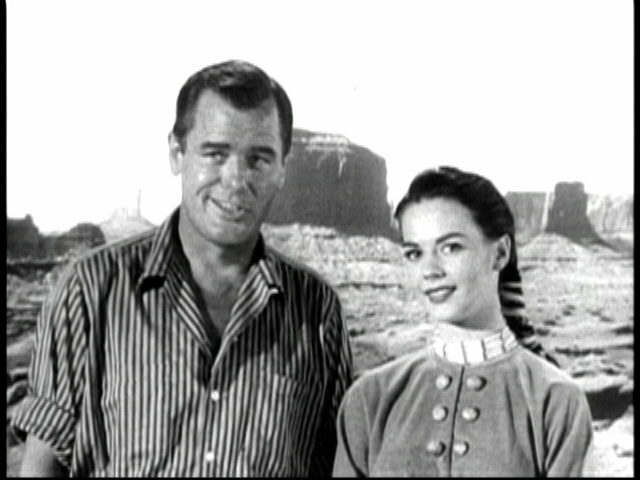
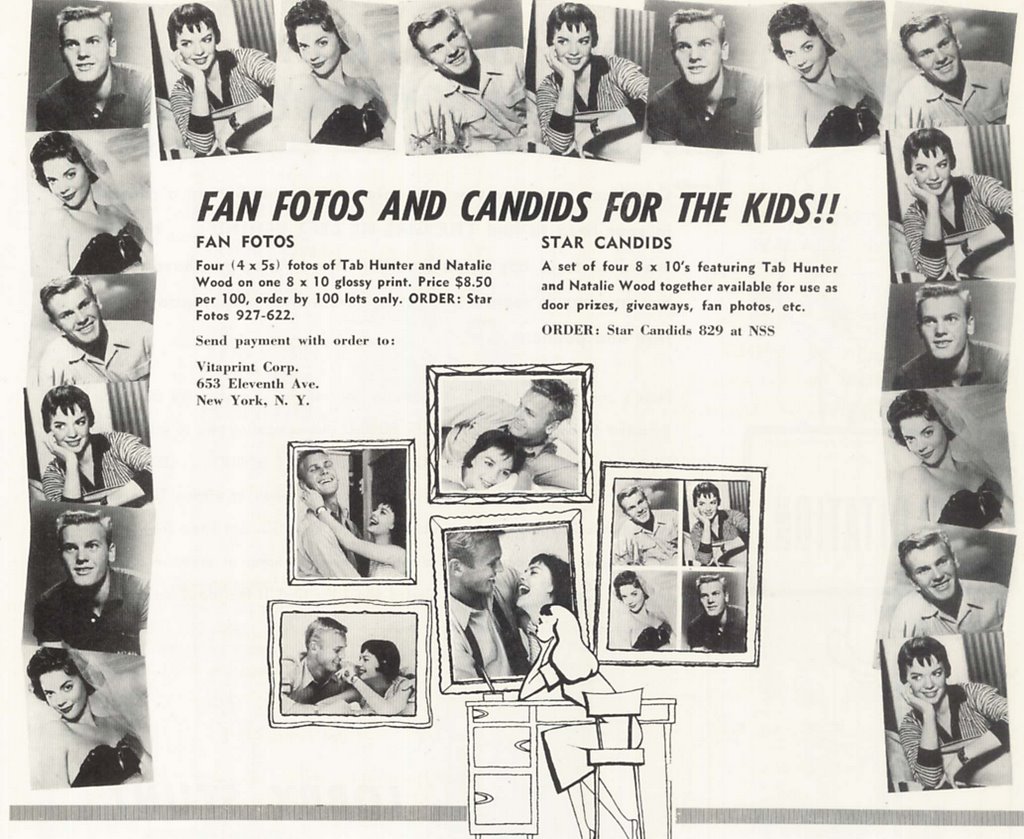
Natalie drops in on Warner Brothers Presents host Gig Young at the "location" for The Searchers as they pose before one of the most audacious process screens ever to stand in for an outdoor setting. Natalie speaks to the home viewers as though she were giving the valedictorian address at Hollywood High School. These "behind-the-scenes" moments were forced on ABC by Warners as part of the deal when that studio finally agreed to dip its corporate toes into video waters. The program collapsed in the first season. The photo offering we next see was part of the campaign for The Girl He Left Behind, a peacetime service romance in which Natalie and Tab Hunter were teamed for the first time. Selling fan photos in bulk meant exhibitors could hand them out to patrons coming in, or use them as giveaways with radio dee-jays, record stores, and the like. Director David Butler later confessed that he’d have preferred young supporting player James Garner for the lead instead of Hunter, but the big guns were behind Tab after Battle Cry, so Garner was vetoed by studio brass. Butler also recalled Natalie having to take breaks for school "lessons" and avoid exhaustion (still a minor, you see). Trouble is, as soon as work was finished, she’d be off for all-night partying, and come in the next day --- exhausted. Must have been an excess of ice-cream sodas, as we’re assured by the fan mags that Natalie was a model teen.


Impetuous Tab went on suspension to avoid Bombers B-52 and a new star was born, Efrem Zimbalist, Jr., who also got the TV part Hunter nixed --- Stu Bailey in 77 Sunset Strip (colossal boner there, Tab). The fact such pictures once got respect is borne out by this Christmas 1957 ad from our own Liberty Theatre, where Bombers B-52 was the brightest ornament on the holiday program. These Warner pics stayed within limited budgets --- The Girl He Left Behind had a negative cost of $967,000 --- Bombers B-52 cost $1.4 million. Domestic rentals were fairly predictable --- Girl took $1.3 million, and Bombers less at $1.1 (probably because Hunter didn’t do it). Bigger things were expected for Marjorie Morningstar, which they hoped would break beyond Natalie’s (age) limited fan base, but that expensive production ($2.8 million negative) took a loss of $190,000. Part of the problem may have been the eccentric romantic pairing of Natalie with Gene Kelly (playing a character 32 when he was 46). Her jump to major stardom came with loan-outs, but she'd had to compete with mainstream actresses more accomplished in the dramatic stuff she longed to do. By then, the Natalie Wood teenage fan phenomenon had run its course, and the bloom was off the rose. We’re sure there’s no urgency on Warner’s part to release Natalie’s early features on DVD, but we’d love to see them again all the same. Any votes out there for a box set?

Finally, we'd like to acknowledge (and enthusiastically recommend!) a fantastic Natalie Wood website, which you can find
HERE. It's filled with articles, photos, essays ... the ultimate go-to place for all things Natalie. So, go there and be dazzled!


They Act Their Age In Germany


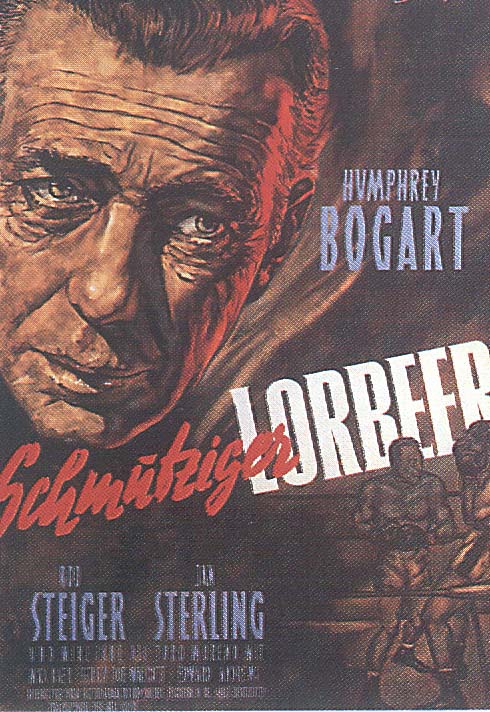
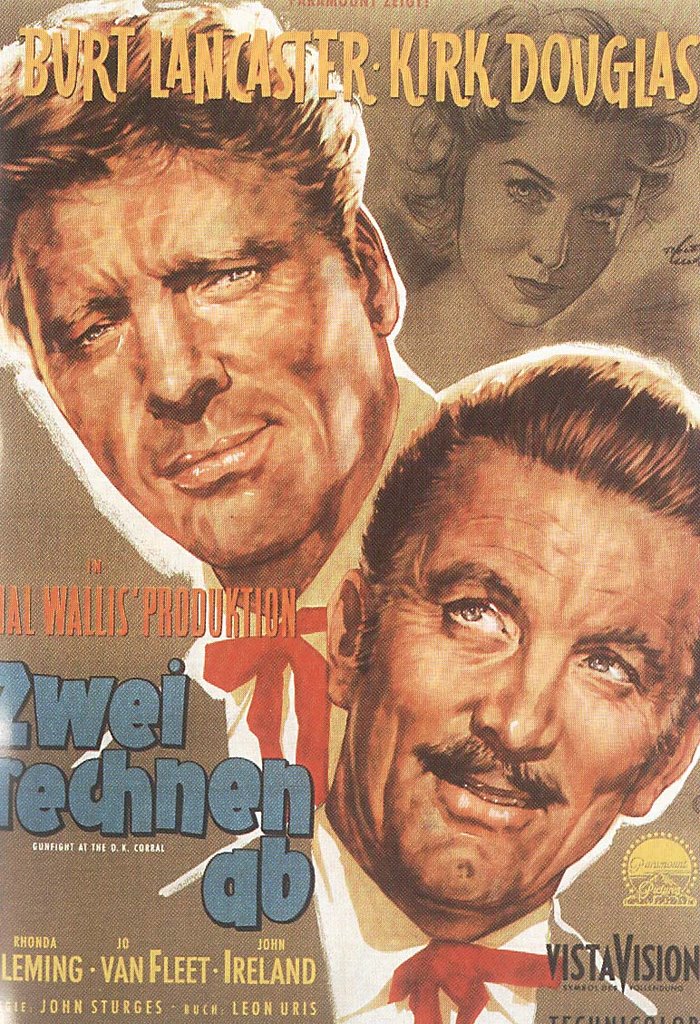
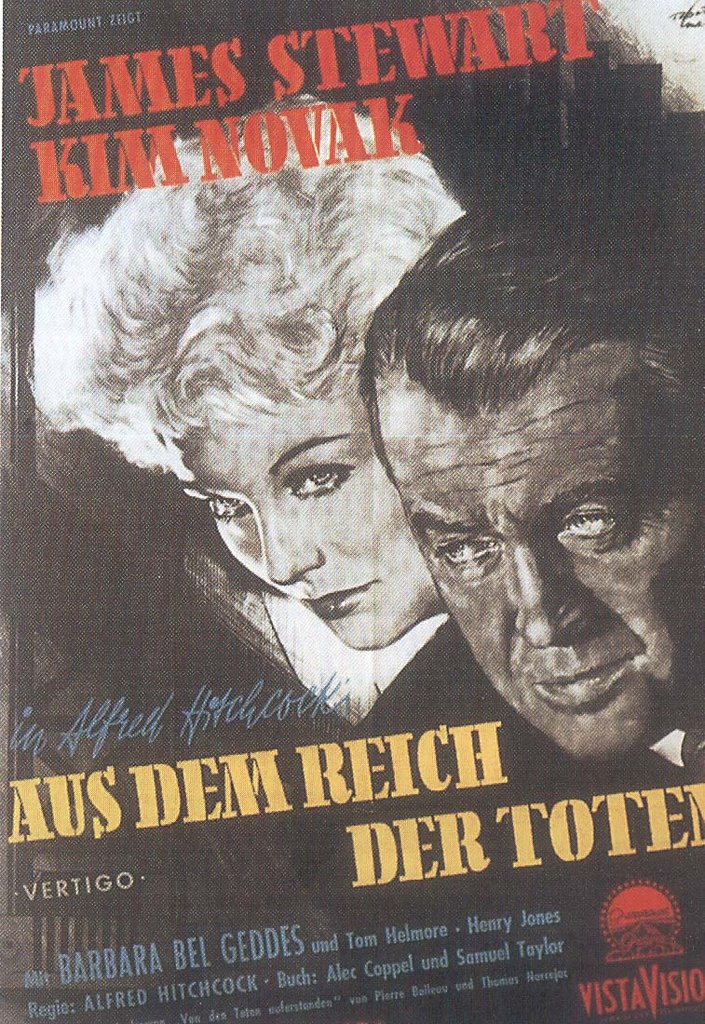
As this writer gets older, he appreciates more and more those who are willing to act their age. He appreciates even more those poster artists willing to depict actors as they really are, or in this case, were. These images aren’t designed to flatter their subjects. There’s an honesty about them that’s refreshing. We never had posters in the U.S. so revealing of their subjects as these. I think they’re great. You really get the character of these veterans as they headed into the twilight of their careers. Apparently, German audiences were better prepared to appreciate these actors in realistic terms, while the rest of us made do with heavily retouched, misleading portrayals. That’s a wonderful image of Spencer Tracy, for instance. It’s from The Mountain, and sure enough, that’s how Spence looked by 1956 --- like a monument. This artist salutes those long, hard years that brought Tracy here. To my mind, he never looked so majestic. Same for Bogart. The artist doesn’t shrink from the dissipation that shows in the man’s expression. In fact, he celebrates it. As far as I’m concerned, none of Bogart’s American posters convey his stature so effectively. Burt Lancaster and Kirk Douglas were not so old, of course, but already the artist explores the mature image that is making it’s presence felt in their screen images, and celebrates it. Cary Grant may not have appreciated the rather severe depiction we have here, but isn’t it refreshing to have a glimpse of the actor at a point when age was becoming a serious issue, and Grant was himself considering retirement at times because of it. There’s such drama in these German posters. They seem to have understood these icons far better than we ever did.


Tuesday, March 28, 2006


Reader Request --- June Lang


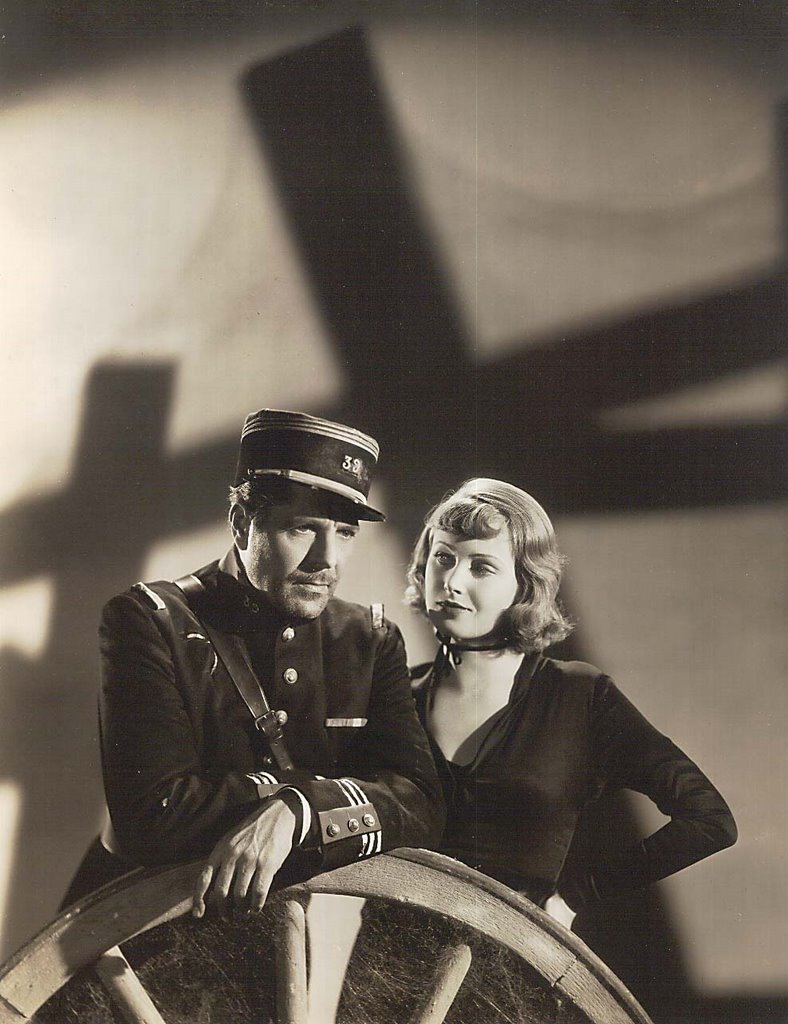
Occasionally we get requests, usually for more of a star we’ve just highlighted, but correspondent "Chris" e-mailed the other day with an interesting suggestion that sent us digging into the file cabinets --- he’d just seen The Road To Glory, a 1936 Fox war drama directed by Howard Hawks, and was mightily impressed by June Lang, an actress whose sexuality, he said, "dripped off the screen." Since we’d been at least ten years since seeing the movie, it seemed like a good time to take another look. Sure enough, there’s June Lang, and yes, you’ll need a grease pan, or a bucket, or whatever’s handy to mop up all that dripping sexuality. June’s all the more impressive for putting it over in a Code show, and she’s a big reason we’d recommend The Road To Glory (which has turned up from time-to-time on Fox Movie Channel). She was a busy actress in the thirties, and worked with Shirley Temple (Wee Willie Winkie), Laurel and Hardy (Bonnie Scotland), and other big names. Her career got sidetracked by an ill advised marriage to well-known mobster Johnny Roselli. She only died within the past year. Does anyone know if she was ever interviewed? Seems I heard somewhere that she was pretty inaccessible. Chris couldn’t locate much June Lang on a web image search, so he asked us to fill the breech. To quote Art Baker then, You Asked For It.


Imagining The Life Of Bill Wolfe

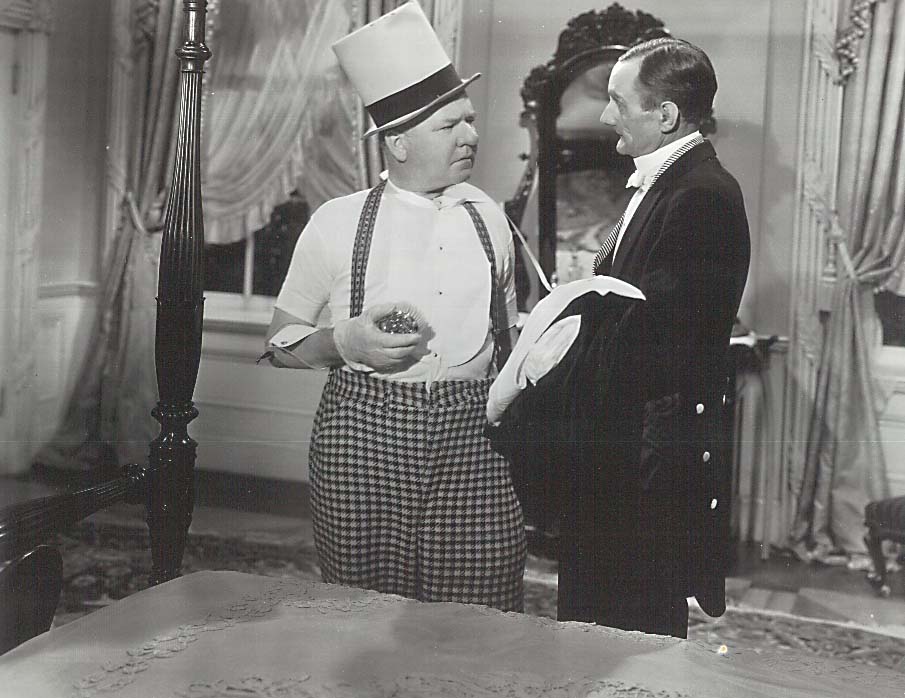
Ever been so frustrated by the lack of information on a favorite personality that you’d resort to inventing your own biography for him/her? Well, today’s little bit of April Foolery is our imagining of the life of Bill Wolfe, that stalwart stooge who enlivened a number of W.C.Fields comedies with his ultra-low-key, cadaverous presence. We’d like to think Bill enjoyed an exciting and romantic life off-screen --- why should his admittedly skeletal, undernourished appearance deprive him of Hollywood’s high life? Whatever wrongs were done to Bill by way of neglect or indifference (try finding any info on this poor guy!), we are here to right them in the Greenbriar Theatre Of The Imagination --- so here goes with some memorable moments from the life Bill Wolfe should have had ---
Bill agrees to fill in for pal Jack Barrymore when the "Hamlet" star twists an ankle backstage. It’s just one performance, but the audience was still talking about it months later when harried producers made a bid to replace Barrymore with Wolfe. "Can’t do that to a friend", says Bill, but still-in-a-pique Barrymore refuses to speak to him for the next ten years.

Despite Mayor Jimmy Walker’s recent Prohibition crackdown, Bill throws an "invitation only" champagne breakfast (trouble is, he sent out 400 invitations!) that keeps the lights burning at Texas Guinan’s nightclub for three days. Bill later confesses that, "…maybe it got a little out of hand".

Teenage Follies showgirl Louise Brooks embarrasses Bill when she refuses to vacate his digs at the St. Regis after a night of intense lovemaking. Decades later, her explicit recollections of the event are judiciously edited from an otherwise revealing PBS documentary.

Bill graciously volunteers to take over crowd control at the Valentino funeral in 1926. After all, he’d once rescued Rudy from a gigolo’s fate by getting him some extra work on Long Island. Trouble is, once Bill gets out among the mob in front of Campbell’s Mortuary, frenzied femmes get one look at him and forget all about Rudy! Pulled down from his mount, Good Samaritan Bill has to be rescued by cops.

Arriving in Hollywood, Bill begs old friend Joe Schenck not to sell Buster Keaton’s contract to Metro. Then he implores Buster not to go along, but the advice goes unheeded. Years later, Joe admits he was wrong when loyal Bill accompanies him to the train headed for federal prison. Seems poor Joe had also ignored Bill’s recommendation that he pay those income taxes!

When Doug Fairbanks chickens out on a hazardous Iron Mask stunt, Bill pinch hits for him and leaves premiere audiences aghast. "Let’s not say anymore about it" is modest Bill’s only statement for a curious fan mag columnist.

Some busy body at the Coconut Grove tells Bill that cowboy star Ken Maynard’s being cruel to his horse, Tarzan, over at Universal. In a rare show of temper, Bill strides over to Ken’s table and gives him a good pasting right then and there. Next day, it’s all handshakes and forgiveness. "Guy’s got a right hook like a jackhammer!" admits Ken, as he gives Tarzan some extra sugar cubes under Bill’s watchful eye.

Bill takes up for one-time boyhood chum John Gilbert when he rebuffs Irving Thalberg’s plea that he replace Jack in the Red Dust lead. Seems Irving thought Bill would be perfect to star opposite up and coming bombshell Jean Harlow. Discussion of the matter doesn’t go beyond Thalberg’s office. "After all", says Bill, "hasn’t Jack had enough disappointment?" Several years later, eventual Red Dust star Clark Gable sees Bill at the Troc. "Thanks for the break", he murmurs, as they pass each other at the bar. "Don’t know what you’re talking about, Clark", replies a subdued Bill.

Feisty Bette Davis gives producer Hal Wallis ulcers when she demands that Jezebel director William Wyler be replaced with "the absolute love of my life" Bill Wolfe. Much-amused Wolfe turns down the offer. "Grow up!" says he to besotted B.D. Off the record, he later confides, "… one night and they think they own you!" to sympathetic columnist Jimmy Fidler.

Seeking to assist family friend and former Broadway juve Humphrey Bogart (Bill had once co-authored a medical journal piece with Bogie’s physician dad), Wolfe advises thuggish dumbbell actor George Raft not to accept the leads in High Sierra and The Maltese Falcon. When he’s reminded of it years later, Bill gets a belated attack of guilt and arranges for buddy Frank Sinatra to throw down-and-out George a couple days work on Ocean’s 11.

Irrepressible bad-boy Errol Flynn’s
carrying teenage nymphet cargo on his yacht again, and right after he’s been acquitted before an L.A. jury on statutory charges! Bill spies the contraband through his binoculars and lends a much-needed hand. "Chiggers, Errol! It’s the harbor police!" yells Bill as he comes up alongside on his own launch. "Thanks, pal. You must have eyes in the back of your head!" laughs Flynn as he and the girls beat a hasty nautical retreat.

Patriotic Bill is forfeiting a night at the clubs to put in a volunteer stint dishwashing at the Hollywood Canteen when he hears a ruckus in the parking lot. Seems a bunch of Marines are getting fresh with starlet-hostess Yvonne De Carlo, so good-guy Bill lends a hand by taking on the whole battalion! Within minutes, the ground’s fairly littered with chastened leathernecks. "Let’s remember we’re gentlemen, boys", he tells the penitent warriors, "… besides, we’d all rather see you whip Hitler than an old duffer like me". Reporters were amused when they noticed Yvonne’s enthusiastic attentions toward her shining knight. "I’m stuck to Bill like glue!" said she as a scarlet-faced Wolfe rushed back to his dishes!

Bill’s own induction was delayed by what he referred to as a "military snafu", but insiders knew that the old rascal had lied about his age. Long-time padre (and navy Admiral) "Bull" Halsey finally gave Wolfe his own vessel, but how could he have anticipated that Bill would sail the thing right into Tokyo Bay --- and in the week before the surrender!

Delores catches Bob
dead-to-rights in Marilyn Maxwell’s apartment, and it’s the night before he’s supposed to host the 1951 Oscars! Soft-touch Bill agrees to step in, but Bob’s let out of the doghouse just before the curtain. The two old friends share a laugh about the whole thing at Musso and Frank’s the next day. Twenty years later, loyal Bill stakes Marilyn’s love-child to a Harvard education. "I don’t care if it’s Bob’s or mine. Every kid deserves a leg up!"


Monday, March 27, 2006


Fleischer Challenges Disney

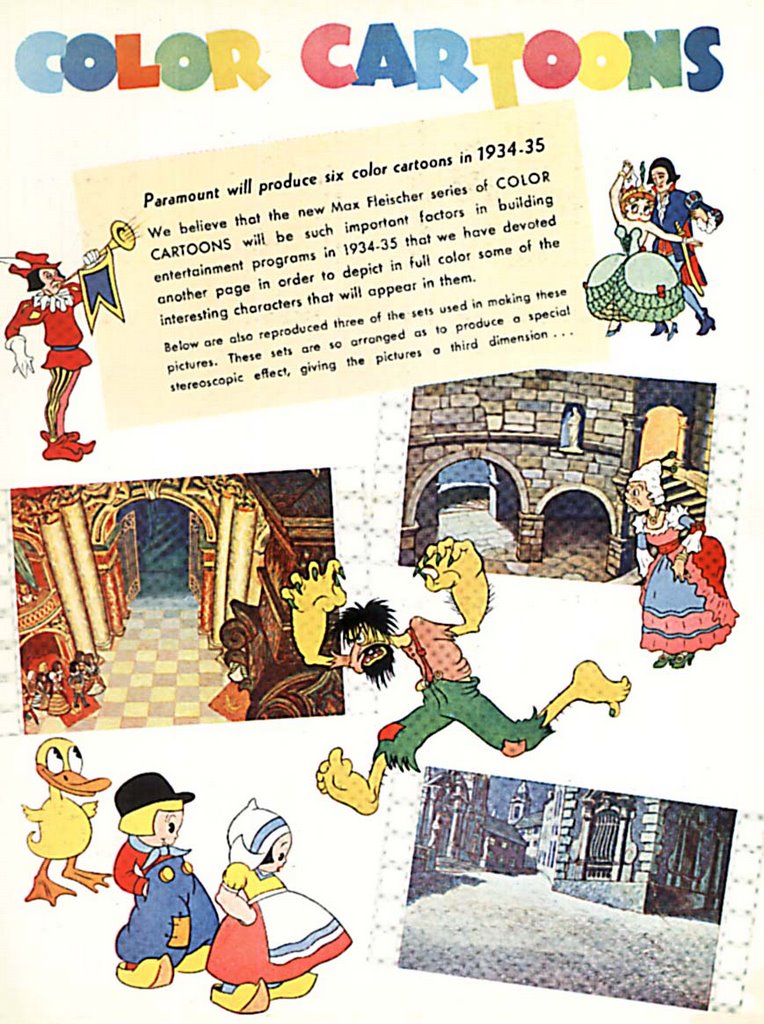
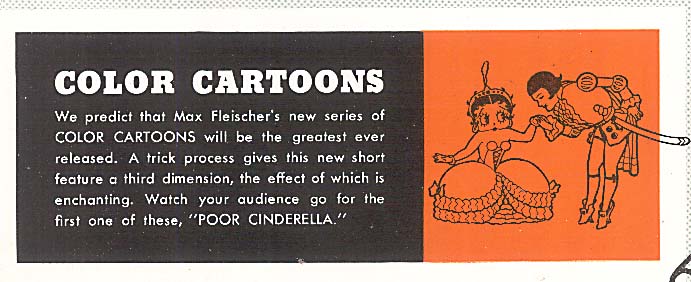
A lot of viewers regard Max Fleischer Color Classics as the poor man’s Silly Symphonies. Paramount tried to sell their cartoon man as a possible successor to Disney’s throne, but one look at a few of these shorts, and you knew it wasn’t gonna happen. Max was great with Popeye and Betty Boop, and I’d challenge Walt to have done them better, but these Color Classics are all too clearly poaching on Disney’s Technicolor-ed preserves, and they generally come up wanting. To start with, Paramount couldn’t even use the three-color process. Disney had that locked up with an exclusive pact he’d made with the Technicolor people in 1932 when he launched his first color Symphony, Flowers and Trees. The deal was, nobody gets to make full-blooded Technicolor cartoons except Disney, and because of that edict, Fleischer had to go begging with whatever ragtag processes he could harness --- first Cinecolor (red and green only --- try topping Disney with that) and later Technicolor’s own, and very limited, two-color process, which by its very name implied a limited palette. All this might not be so bad today if we could at least have the original elements at hand for DVD restorations. As it is, virtually all the Color Classics long ago fell into the Public Domain, and now it's catch-and-catch-can for anyone wanting to gather them up for a re-viewing. As it happens, a team of dedicated animation archeologists, led by eminent cartoon historian Jerry Beck, have done just that --- unearthing the best available elements on these shorts and releasing them in a two-pack DVD that finally allows us to screen these rarities end to end. Having stumbled upon these Paramount exhibitor manual ads this weekend for a visual aid, I decided to give the cartoons a look.


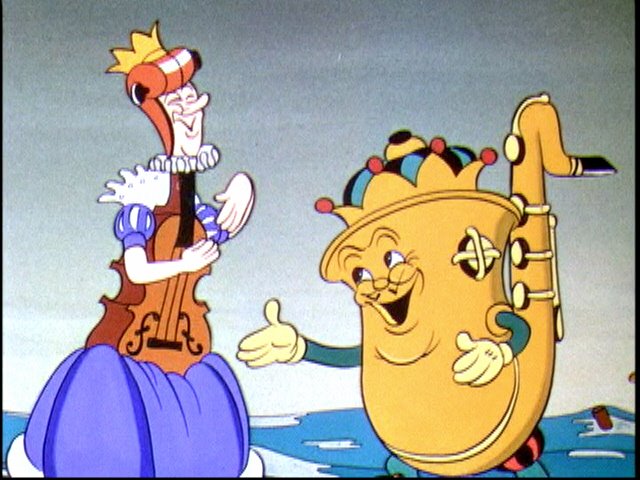
First of all, does anyone remember seeing these on TV back in syndication days? I really do not. None of them crossed my path until I started collecting 16mm, and then were often as not black and white prints of indifferent quality and condition. I know N.T.A. (National Telefilm Association) distributed these for television, but none of our stations ever got them, and if they had, I dare say we'd have seen B/W prints (all our syndicated WB cartoons were that way until the late 60’s). When I finally scored a color Fleischer around 1980 (Christmas Comes But Once A Year), I thought it was interesting, but a little long, and not a patch on what Disney was doing around the same time (mid-thirties). All the Color Classics tend to run long, and in direct comparison with Silly Symphonies (I went back-and-forth between them a few times), they don’t really stand a chance. To be fair, we have to consider the prints used for both (check out the DVD frames shown here --- one from Fleischer’s Somewhere In Dreamland, the other from Disney’s Music Land). Disney has original elements, and their presentation is impeccable. VCI (the Color Classic distributor) had, for the most part, 16mm prints gathered up among collectors, rental houses, and archives around the world, a salvage operation necessitated by the fact that the cartoon’s present owners are unwilling to restore and release their property. VCI has done a remarkable job all the same, and I definitely recommend their set. Unless I’m badly mistaken, these Color Classics have recently come back into the possession of Paramount after some fifty years of "wandering between the winds", as Ethan Edwards might say. That’s good and bad, of course. Good because it’s nice having them back on the home lot. Bad because Paramount has so far shown no interest in cartoons on DVD (has anyone other than Warners?). Speaking of DVD cartoon collections, I’d like to cast a strong "yes" ballot for more of those audio commentaries like the ones on the Color Classics set. Having listened to these, as well as the ones on the Looney Tune groups, I’m struck by the joyful and unabashed enthusiasm these experts bring to their narrations. These guys love cartoons, and their flights of rapture over Daffy, Porky, and the rest have done much to enhance my enjoyment of these shorts. It goes without saying I’m overwhelmed by the depths of their knowledge in that field, but best of all is the fact they have such fun with cartoons, and it’s infectious.


These colorful ads for the Fleischer group were included in some of those lavish Paramount sales manuals designed to induce exhibitors to sign on with the studio’s season package. Much was at stake here, as individual contracts meant a showman’s commitment to run most of the studio’s output over the course of that year, so Paramount always put its best foot forward in these promotionals. I was lucky enough to come into possession of several account books which once belonged to a Paramount customer back in 1937-38. This was a rural North Carolina exhibitor with a small house and no doubt smaller audiences, but he booked heavily with that company, as well as United Artists and RKO. These last two handled Disney product, and in fact, Walt’s transition from UA to RKO for distribution of his cartoons took place around this time. These ledgers are a treasure trove for me, as they show just how much this exhibitor spent in rentals at that time, as well as offering a comparison between cartoon prices for Paramount and Disney. For instance, a Silly Symphony through UA, Woodland Café, was $5.00 flat, while a later Donald Duck (Self-Control) through RKO got $5.25. Paramount took only $2.00 for a December 1937 booking of Christmas Comes But Once A Year, but that Fleischer Color Classic was by then an oldie, having come out the previous December, so terms were a little more favorable for this run. Otherwise, this theatre doesn't appear to have used the Color Classics, although they did book heavily on the Popeyes (I Like Babies and Infinks cost $4.86). The best money for cartoons from this venue seems to have been collected by MGM, whose Bosko and The Pirates got $6.65, while Bosko’s subsequent encounter with the Cannibals netted $6.95 for the Metro exchange. Just a lot of numbers for long-ago, and long forgotten, bookings --- but they give us some insight into the selling end of the cartoon business
, at a time when such nickels-and-dimes as these kept small showmen, and big studios, afloat.


Sunday, March 26, 2006


Shadow Of A Doubt Oddities

Who says the world is a foul sty? Uncle Charlie’s been ripping the fronts off houses, and what did he find? Not swine, but a refreshing Pepsi Cola, which he shares here with an admiring Young Charlie. Since they’re mirror images anyway, and share all the guilt over those Merry Widow murders (not forgetting that unspoken, beneath-the-surface incestuous attraction the Hitchcock books talk about), it’s a cinch they’d both have a taste for that bracing cola flavor, particularly after an exhausting day pushing each other around a mock-up train and falling into process screens. What’s a serial killer to do when he can’t charm his niece with rings taken off the corpses of his latest victims? He just says Pepsi, Please! and all’s forgiven.

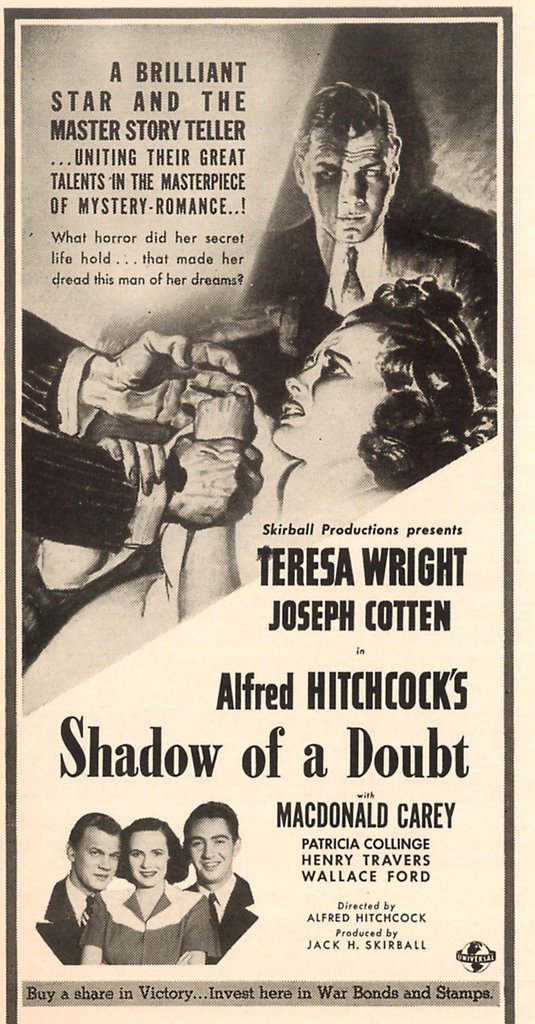
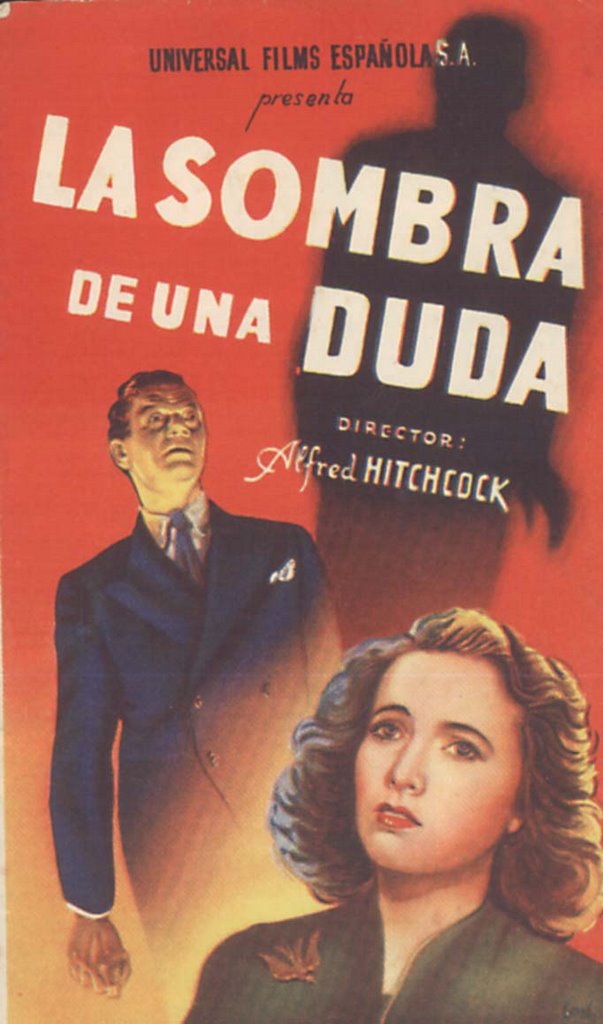
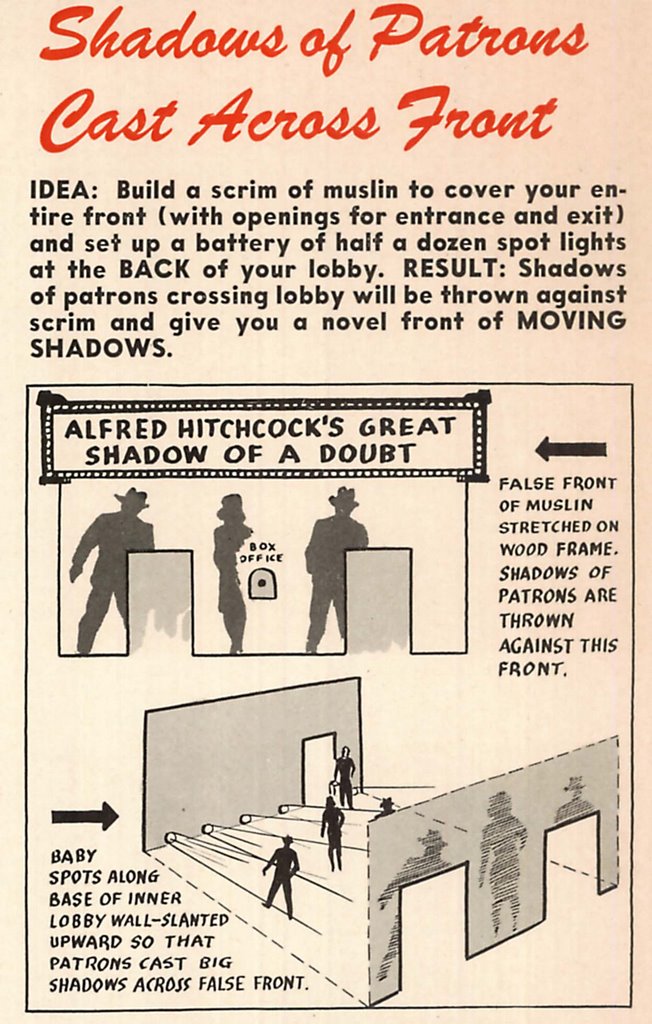
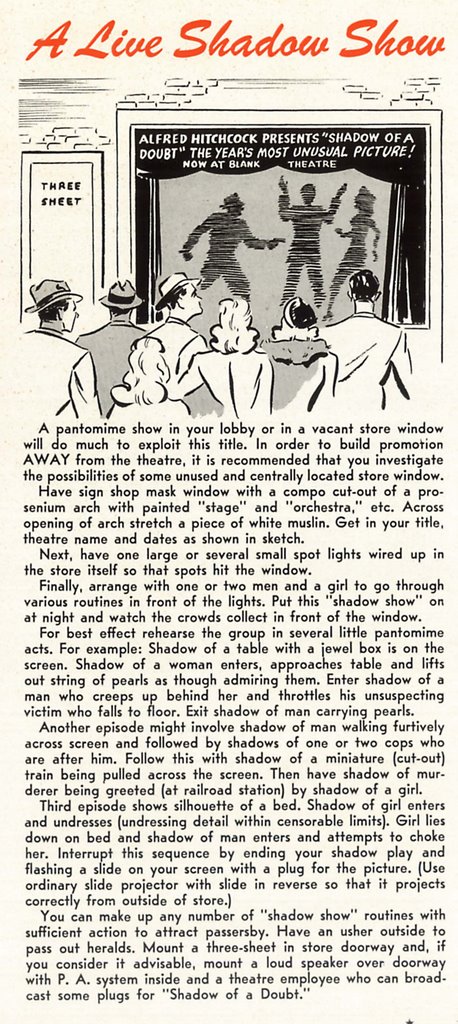
Honestly, you have to feel a little sorry for the publicity department at Universal this time. Just how do we sell this Shadow Of A Doubt anyway? I know --- shadows! We’ll put em’ everywhere! So what if people become disoriented in a theatre lobby tricked out with floor level lighting and patron’s shadows projected twenty feet high on the opposite wall. No less problematic was the idea of putting actors in store windows and having them stage various acts of mayhem for passerbys. Would the performers be obliged to repeat the same gag ad nauseum throughout the evening and into the night? Do bear in mind that all this took place
years before Hitchcock
took an active role in the selling of his movies. He’d have never permitted stunts as lame as these. By the 1950’s, he’d apply the same creativity with publicity campaigns that he brought to bear on the films themselves. Ever see the Psycho trailer? Hitchcock personally supervised the roll-out for everything with his name on it. He could have retired from directing at any time and successfully taken over the publicity department of any studio in town, and probably done a better job than any one hundred flacks in residence there. Fortunately for Universal, the innate qualities of Shadow Of A Doubt allowed it to succeed despite the efforts of their sales division.


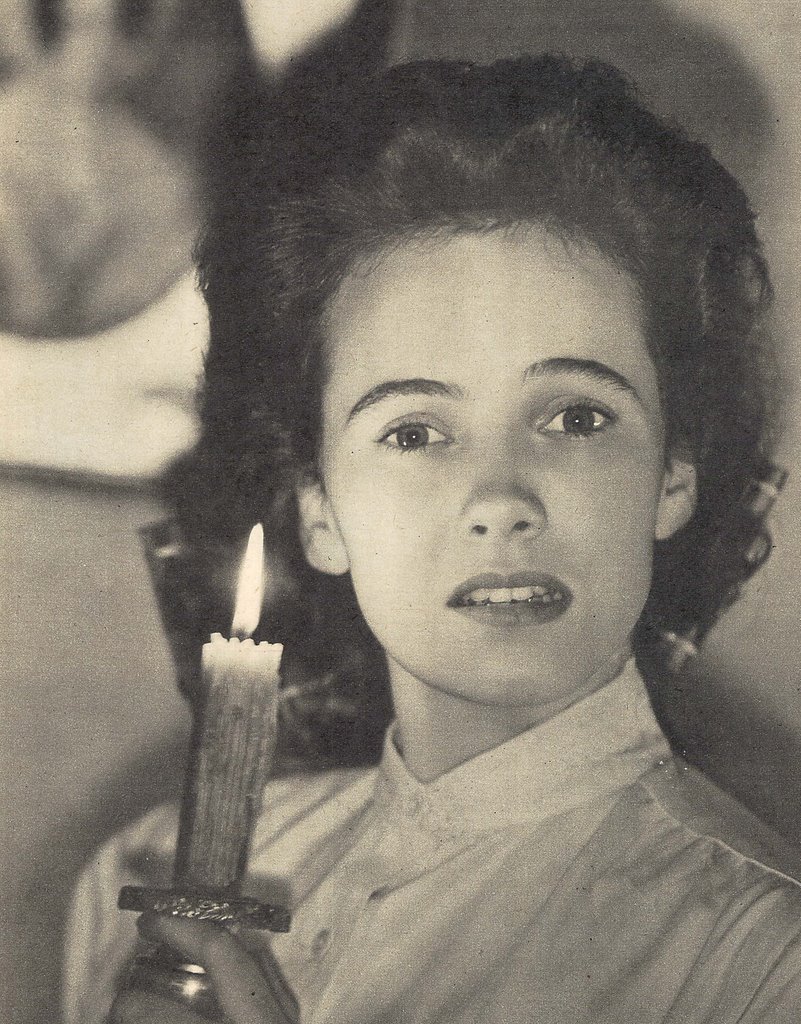
My good friend Lou Sabini met Teresa Wright quite by chance one day about four years ago. He’d been teaching a film class in Stamford, Connecticut when one of his students mentioned that she was next-door neighbors with Teresa. The lady told Lou that Miss Wright (then in her eighties) favored a bright blue baseball cap, which she always wore when she went out. He made a mental note of that and went on with the class, which coincidentally, included a showing of Shadow Of A Doubt. A few months later, Lou was at his job with Sleep, Etc., a furniture store in Norwalk, CT., when an elderly woman entered the store to look at some beds. When he approached her to lend an assist, Lou recognized Teresa Wright immediately. Sure enough, she was wearing the baseball cap, but she also had that crooked eyebrow he remembered from all her movies. This was the real tip-off (see the photo of Teresa with the candle… and the eyebrow). After a moment or two of conversation, she introduced herself as "Teresa", and Lou responded with "Yes, I know, Teresa Wright." According to him, she was taken aback, but pleased to learn he was a film collector and teacher. They ended up talking awhile, and Lou says she was great. Just think, one minute you’re selling furniture on a slow day, and the next you’re hanging out with one of your all-time favorite actresses --- the star of The Best Years Of Our Lives, Pursued, The Little Foxes, Shadow Of A Doubt … well, that’s some kinda thrill, we think. Thanks Lou, for a great memory!


Saturday, March 25, 2006


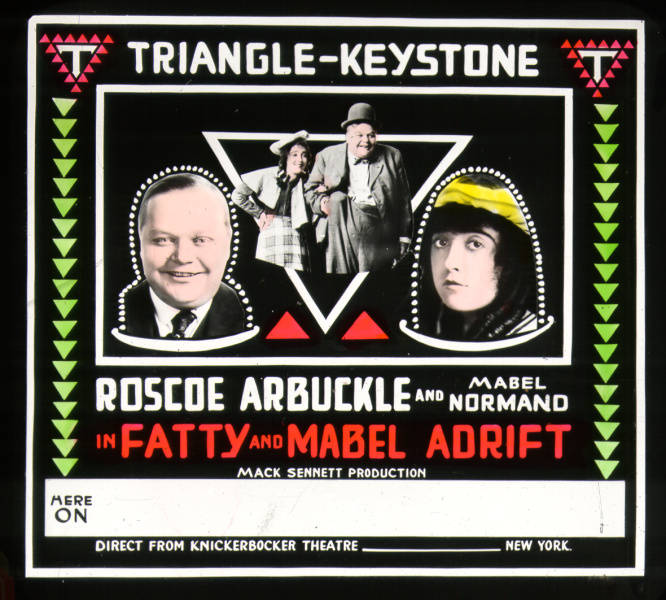
Roscoe Arbuckle's Birthday

Nobody got a rawer deal than Roscoe Arbuckle (3/24), but that’s not news. He’s one silent star you can mention among civilians (you know, those non-film fanatics we have to share the planet with), and a surprising number of them know all about him. Or they think they do. Usually, you get Oh yeah, he killed the girl during that orgy, or an indelicate reference to Coke bottles. Well, we know better. So did that third jury when they came out and said the State Of California owed Roscoe a very big apology. Well, how do you give a man his life back after dragging him through a mess like this? They started out accusing him of capital murder, for Cripe’s sake! Some say Arbuckle’s films were allowed to deteriorate over the years because nobody wanted to be reminded of him. They pretty nearly accomplished that, because a lot of them are gone now. Roscoe himself had a vault hidden somewhere, but nobody’s been able to locate it. I wish they could. His reputation could still use some major rehab. As a comedian he’s not up there with Chaplin or Keaton, but maybe we’d all appreciate him a little more if the prints looked better. Whenever I read about that fateful Labor Day weekend in 1921, I think about how close Roscoe came to staying home, then I think if only he had, and all that other stuff we can’t do anything about now. His accusers were a scruffy lot. Blackmailers, abortionist doctors, crooked prosecutors, you name it. Poor Roscoe (notice I don’t call him Fatty --- he never liked that) dropped $700,000 in legal fees (this is 1921 money!) and still got banished from the screen despite his courtroom vindication. The dead woman, Virginia Rappe, was said to have had five abortions by the time she was sixteen, and an out-of-wedlock child when she was seventeen. Wacky Mack Sennett had her tossed off the Keystone lot for spreading venereal disease, though it was later revealed she had lice! Boy, the stuff that went on in those tumultuous teens --- lice --- ugh. So you can see what Roscoe was up against. It’s nice to know he had a comeback of sorts just before the end. Warner Bros. hired him for a series of Vitaphone shorts in 1932. He did six. I’ve seen most of them, and they’re good. A couple of them, Hey, Pop! and Buzzin’ Around, are really good. This was the best exposure Roscoe had since the trial. Warners was talking up more for him, maybe even features. All that collapsed when he died unexpectedly of a heart attack in his hotel room in 1933. He was only forty-six. Good friend Buster Keaton said he died of a broken heart. I don’t know as I agree, although the damage had been done and it was devastating. Still, things were looking up for Roscoe. On that final evening out, he and his wife had dinner with Ed Sullivan, of all people. Is it any wonder Ed was so blasé about The Beatles thirty years later? After all, he’d once dined with the Arbuckles!


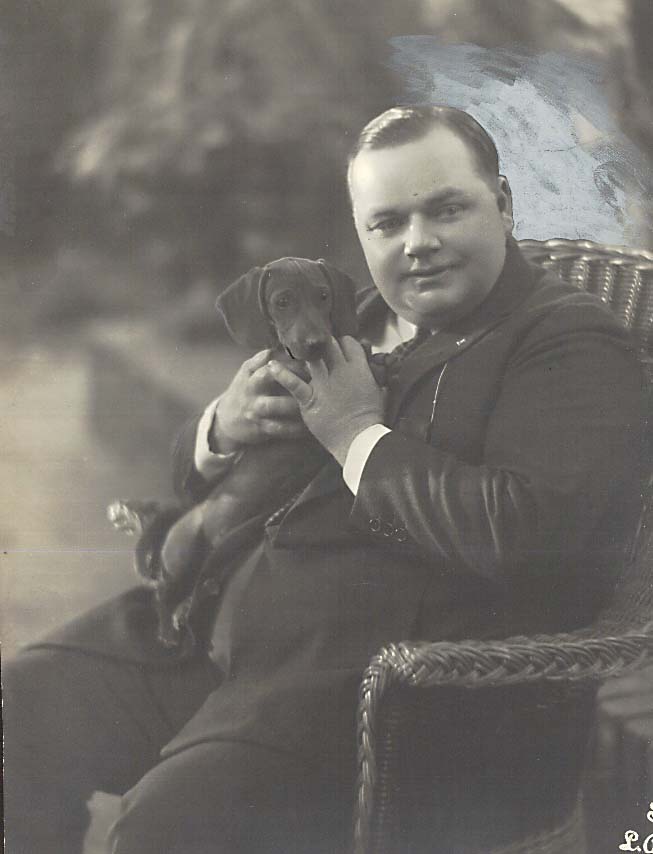
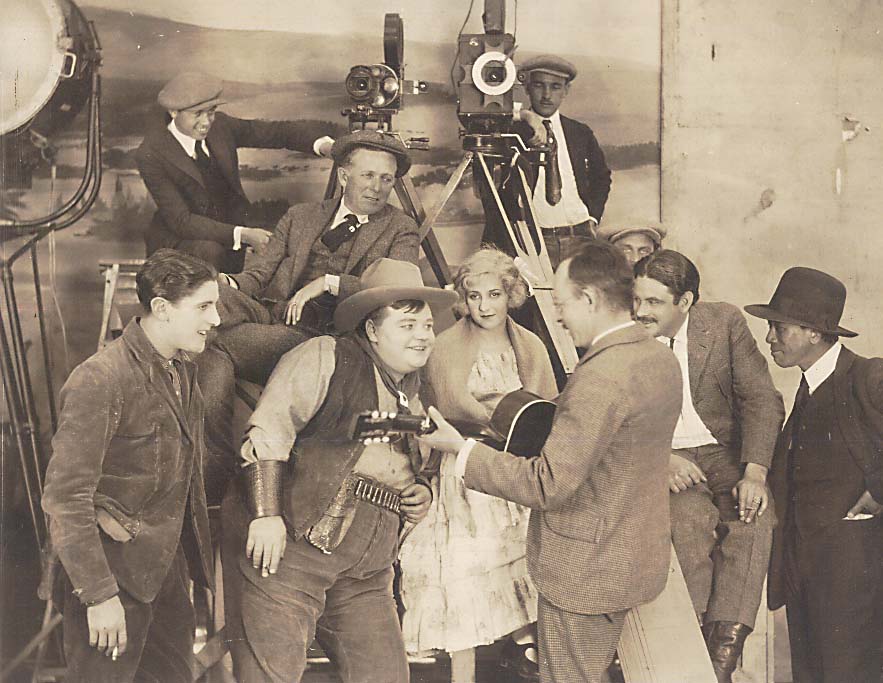
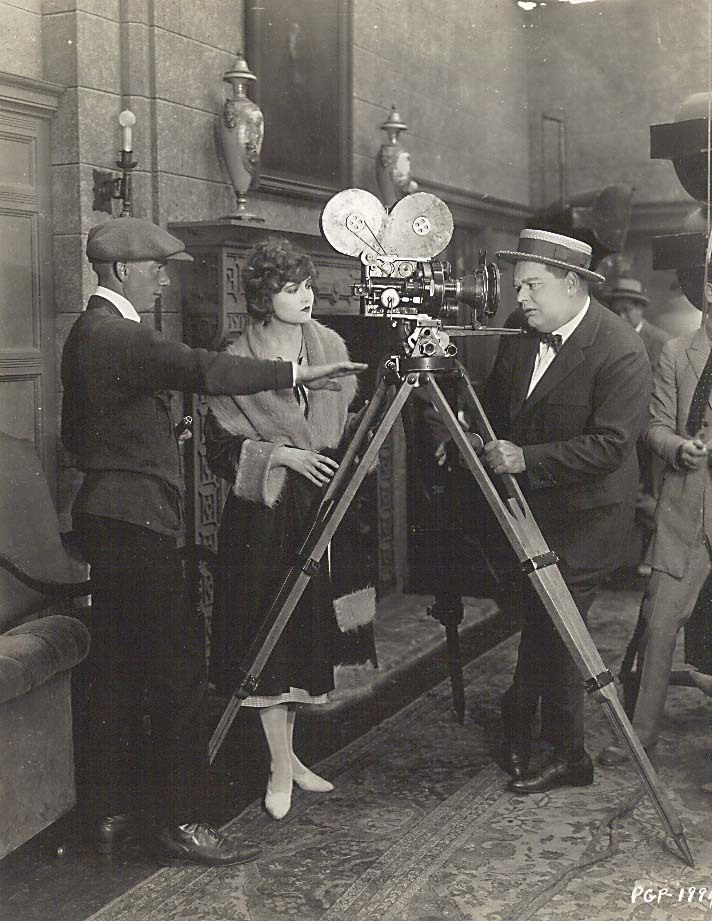
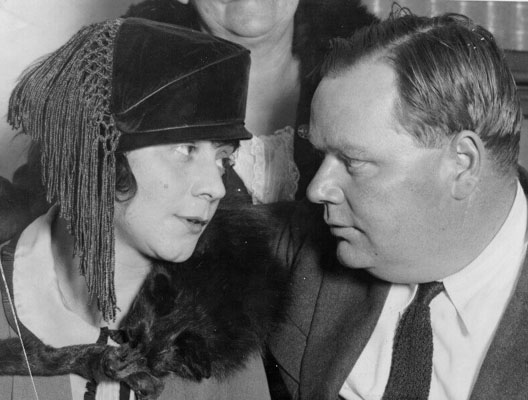
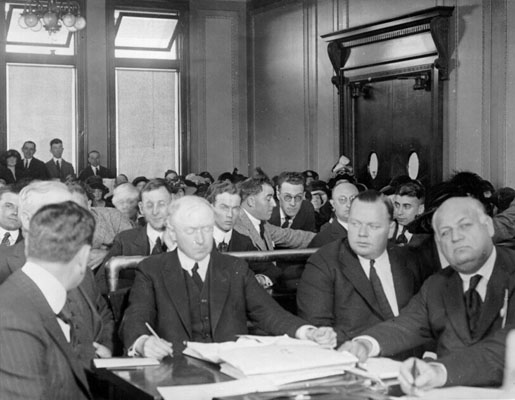
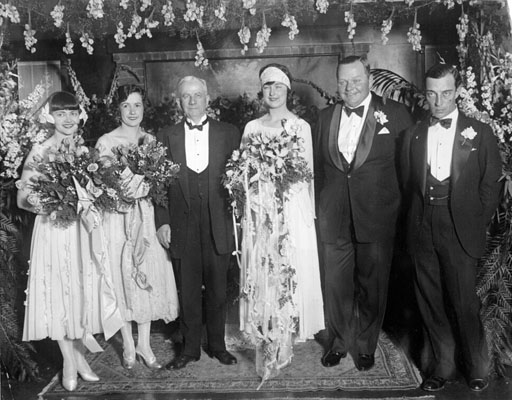
Stars who are good to their doggies always rate special mention at the Greenbriar, as I'm devoted to my pooch as well (even if he was sprayed by a skunk last night). This portrait is actually dated 1924, well after Roscoe’s retreat behind the cameras. He might have been seeking a director spot around this time, or perhaps a return to the stage. In any case, that sobered expression reveals a changed man. From happier days, here is Roscoe at Paramount doing close inspection on the camera lens for This Is So Sudden, a title which must have been changed (or the picture abandoned?). We do know his Paramount features were shelved and/or withdrawn after the trial. I assume that’s director George Melford serenading Roscoe and crew during The Round-Up in 1920, but by all means, correct me if I'm wrong. From the trial --- two dramatic shots. Roscoe in the courtroom --- and his stunned, disbelieving countenance tells the whole story, as if the horror of this ordeal were still not fully absorbed. Former wife Minta Durfee provides a courtroom lifeline in a revealing close look at the two --- she was there throughout to provide moral support. Roscoe seems to be regarding the last friend he has left in the world. Maybe he was. Finally, his wedding three years later to Doris Deane on May 17, 1925. The best man is stalwart pal Buster Keaton
, and that’s Natalie second from the left. Buster kept a framed portrait of Roscoe on his wall till the day he died.


Monday Glamour Starter --- Natalie Wood --- Part 1

Some of us neighborhood boys were gathered in a tree house around 1963 when one of our number began to brag about having seen Gypsy the previous day. Yeah, man, it’s about this stripper, and Natalie Wood is totally naked through the whole thing! Now that was a pretty incendiary claim for anyone to have tossed about in that year, and we were more a bit skeptical. Now wait a minute, did you say totally naked? Like she showed everything? Absolutely, he swore. Well, I wasn’t buying that tall-tale any more than the one I’d heard from a kid at school describing a scene in Black Zoo where it showed a lion biting a man’s head off. But we’re here to talk about Natalie Wood, not Michael Gough. For a lot of people, Natalie Wood as an actress made Crawford look like Sarah Bernhardt, but whether or not Natalie could act was never the point. She was a product --- the movieland equivalent of those exciting new frozen TV dinners being offered for the first time in the mid-fifties. She was the glorious last stand for that dying era when the studios could make the public believe anything. From the beginning, they knew it was just the kids who’d buy her. This was the Confidential era. Stars were being outed on any number of accounts --- be it past criminal records (Rory Calhoun), alleged promiscuity (Maureen O’Hara – she sued), or that favored stand-by, the closeted homosexual. This last one was the net that closed around several of Nat’s co-stars and "boyfriends", and it was considered the most damning. Teenagers didn’t generally read the peek-a-boo rags, though. They were more Dad’s speed, something to go with cocktails and ribald conversation during Happy Hour. Besides, Natalie had real integrity. She was a teen just like them, save for the Thunderbird, the pool, and the ermine jacket (even fan mags liked to have a little fun with their readers). As for her own reading, Nat was said to favor Dostoevski and Nietzsche. She and Nick Adams used to read Thomas Wolfe together. Is it any wonder they came terribly close to getting married? Her soulful side was duly celebrated in the fan press, though sometimes they went far afield, as in Nat’s confession that she carried a snapshot of James Dean’s headstone in her wallet. That one had to give parents the willies, but the Dean death cult was a popular avalanche that simply could not be banked, and all the young stars enjoyed mild flirtations with it, particularly those ambitious young players trying to get ahead at Warner Bros. Some of them went to extremes --- Nick Adams, Dennis Hopper, etc. For all I know, Hopper’s still trying to channel Jimmy’s spirit, for all the Dean-prattling he still makes with during interviews (could this be why he’s so credible in all those latter-day psychotic villain parts?). There’s nothing quite so gooey and ghoulish as Natalie and others grave-worshipping Dean in all those post-9-30-55 fan profiles. All of her dates for a while were would-be Dean reincarnations, from swarthy thrift-shop "rebel" Scott Marlowe (he of several AIP J.D. cheapies) to poor lifelong star sycophant Nick Adams with his customized hot rod patterned after Jim’s wheels. For herself, Natalie didn’t want to be tarred with a "rebel" brush. Indeed, she was an apostle of clean living --- Why drink? If I drink, I’m bound to feel bad, and I won’t be able to work the next day. If I don’t work, I’ll be unhappy --- and look at the money I’ll lose for the studio, not to say myself. Indeed, Natalie preferred sodas. So did the parents of her young readers. The same parents who gave their children an allowance to buy movie magazines and go see Natalie Wood pics. Everybody understood the rules, you see, and abided by them. It’s true they wouldn’t much longer, but Natalie was there and at the top while they still did --- riding the last glorious wave of a culture that would soon disappear. I wonder if she realized it?

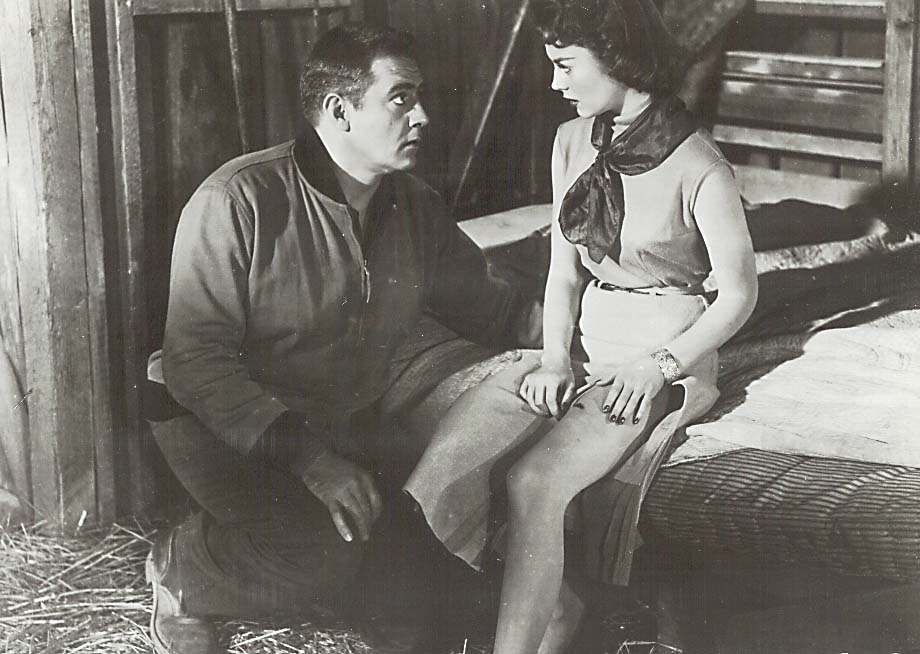
Based on what we know now, Natalie’s "romances" take on an almost surrealistic quality. Check out her dance card for 1956-57 --- Tab Hunter, Sal Mineo, Raymond Burr (gulp!) --- the list goes on. Safe dates all, and after a traumatic sexual assault that was alleged to have taken place when Natalie was just fifteen, you can understand her reasoning. Tab’s excellent new autobio goes into their on and off-screen partnership. While he and Nat were photographed endlessly on studio manufactured "dates", Tab says he was shacked up with Tony Perkins, something Natalie presumably knew all about. Well, she and Tab were both Warner contractees, and useful to each other, as well as to the studio, so it was a comfortable arrangement, as long as fans bought the lie (which they did, in droves). Tab went on to say that he and Scott Marlowe were an item before Marlowe took up with Natalie in an affair that she seems to have taken somewhat seriously. Well, who says Brokeback Mountain’s a new idea? The notion of pairing Nat with Sal Mineo was downright cracked, however. Even the dumbest kid in the auditorium had to be hep to Sal, but again, he was caught up in the same studio net as she, and each was comforted by the other’s skill at playing the game. For me, Raymond Burr’s the joker in the deck. Now where’d he come from? Well, as it turns out, they’d done a little picture together called A Cry In The Night, where Ray was convincing, as always (what a great actor!), in the part of a psycho Mamma’s Boy who kidnaps Natalie (this was before WB knew best how to exploit her). She and Ray hit it off, or so it was alleged by the breathless fan corps --- "he opened up new worlds of culture to her" (what, that again?). We were assured that nothing serious would happen with Tab (I’ll say it wouldn’t) because "her real heart is Raymond Burr" (you’ll have to forgive some of that prose, folks, cause it ain’t like these mags had Thomas Wolfe on their editorial staffs). Ray, or his publicists, had already dreamed up a cockamamie story involving at least three previous marriages (one of the wives supposedly went down in Leslie Howard’s doomed plane!) and even a son that no one had actually seen, so Ray was no stranger to showbiz subterfuge. "Once there was an understanding for the future with Raymond Burr", they all gushed, but one can only hope that Natalie never bought into that. As for these fan magazines, I can’t really recommend them to modern readers. Having just examined a brace of them, my brain feels like a bowl of oatmeal that’s been left on the breakfast table too long.


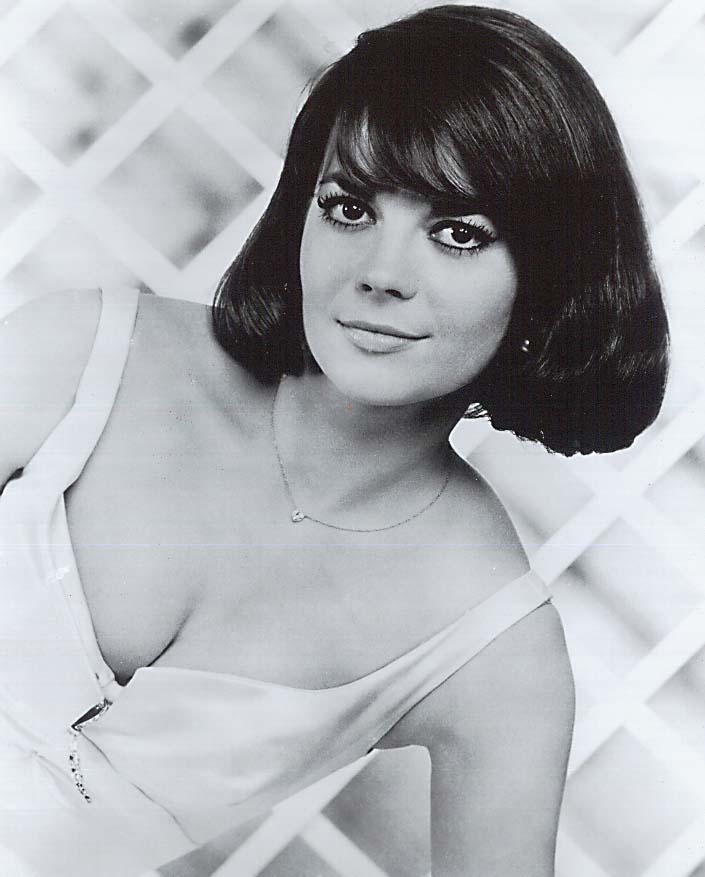
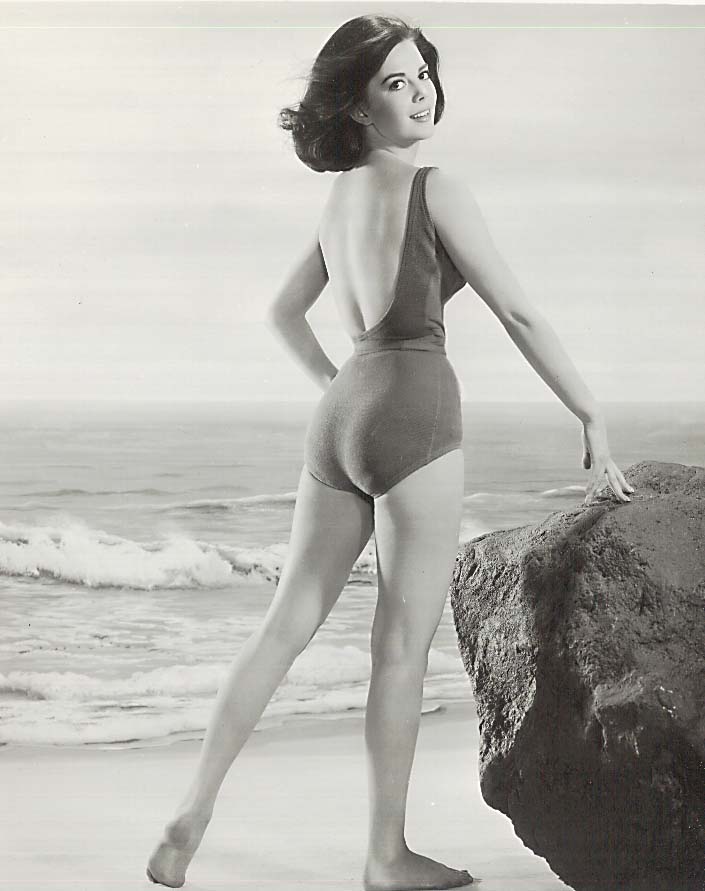
These Warner publicity stills require little explanation, other than to point out the script in Natalie’s lap (it’s resting on that rather alarming leopard skin she appears to be wearing). Close examination reveals that it’s for The Searchers. Wonder if Natalie made any margin notes? Perhaps a few suggestions for Mr.Ford as to how he might improve his movie…. You’ll note too that Natalie’s a little fickle about her dogs. Were they both hers, or was one discarded in favor of the other? "From Betty Higgins’ shop in the swank Royal Hawaiian Hotel came this exotic cocktail gown of a rare silk and gold metallic material imported from India." That’s the caption for this fashion tie-in on The Girl He Left Behind (1956), which goes on to say, "Natalie’s off-screen wardrobe roused the envy and admiration of her co-workers in her current Warner Bros. production."


Hoppy and The Blue Birds


One of these days, I’m going to post one of these old stills, and someone’s going to comment or e-mail with "That’s me!" or maybe, "That’s MOM!" I wish it could happen today, for here is Hoppy with two sets of Blue Birds, representing candy mint drives for 1950 and 1951. The goal was to "extend the Camp Fire Girls program to more girls in the Los Angeles area". The red, white, and navy blue uniforms signified the junior organization of Campfire Girls, known as Blue Birds. So there, now you know. All that’s left to do now is find these girls! The ones at the radio station are identified as, left to right, Martha Warn, Joan Stabler, and Patricia Van Hartesfeldt --- according to the caption, they "wanted Hoppy to have the first sample". Folks, I don’t care what’s gone on in these girl's lives since 1951 --- they’ve got to remember this day. The other photo, with Hoppy in costume, finds him with twin sisters Johanna and Karen Lindquist. Wonder if any of them have copies of these stills. Are the Campfire Girls still a going concern? Do they still sell candy mints? One of you out in L.A. should know. Check it out, or better yet, find those girls!


Friday, March 24, 2006

The Choice Of Wake Forest Collegiates?


G.F. Ann has a brother who went to Wake Forest University (then College) during the mid-sixties. A few weeks ago, she borrowed one of his old yearbooks for some reason, and I was flipping through it when I saw this. Now, under ordinary circumstances, I wouldn’t share what most would consider a commonplace relic of long-past schooldaze, but, well --- just look at that 40X60 poster behind those two students. Dr.Goldfoot and The Bikini Machine! Our best and brightest going to see an American-International picture!! Couldn’t they have located a display that might better reflect their academic status and discriminating tastes? A Man For All Seasons must have been playing somewhere. Better to stand in the rain beneath a drive-in marquee featuring Blow-Up and Who's Afraid Of Virginia Woolf? than submit to such indignity as this. You’d think these kids would have considered their futures. What if the selection committee at that medical school got a squint at such a compromising pose? It was OK for an eleven-year old like me to go see Dr.Goldfoot (and I did, too!), but I never dreamed a near grown-up would sit for dross of that sort. But who am I to talk, as I just watched it again a few months ago, and good news, folks, it still holds up! Maybe these two weren’t so misguided after all.


Thursday, March 23, 2006


Joan Crawford's Birthday


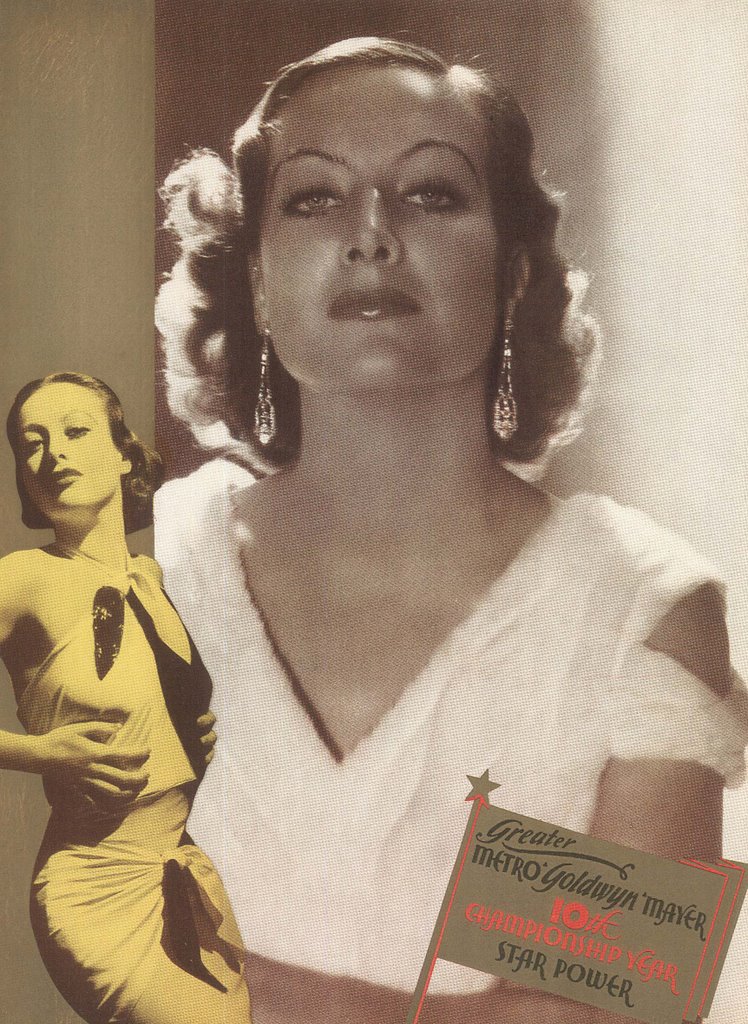
Joan Crawford (3/23) may not be anyone’s idea of a great actress, but she could sure do melodrama, a thing people stood hip-deep in line for back in her day. Nobody slapped or got slapped as much as she did. Poor David Brian walked around for weeks with Joan’s handprint on his cheek (and from what we hear, her clawmarks on his back), while Ann Blyth gave her a whopping that almost flipped Joan over the stair bannister in Mildred Pierce. Second-string slapees included John Garfield, Steve Cochran, Van Heflin … even portly Sydney Greenstreet got ambushed in his rocking chair during a fierce exchange in Flamingo Road. Confrontations were Joan’s bag. She liked them on the set, and at home as well. Second husband Franchot Tone got into the act when he gave her a pasting over some disagreement, which was a switch from milder-mannered Doug Fairbanks Jr., who was said to have demurred whenever Joan tied on the gloves. Is it any wonder this woman lost all contact with reality? The story goes that she blew her entire fee from one of those TV show appearances in the late sixties by treating the crew to a full-tilt Crawford entrance on Day One of shooting --- cheuffered limousine, baskets of food and drink for everybody --- the works. She might as well have been paying Universal for the job. By close of that first day, she knew every man on the crew --- and his wife, and kids, and whatever else it took to get ingraitiated and thereby insure their protection in the event she needed it. A kind of genius, that’s what she was. If current actresses had half her survival skills, maybe they’d last beyond those three or four years which seem to about be the run of the play for distaff players among us nowadays. Joan was no spoiled child of privilege. They had her cleaning toilets in those Dickensian orphanages from early girlhood, and damned if she didn’t carry the habit right into the star days, obsessively cleaning toilets in every Beverly Hills mansion she visited before she’d sit on them. Yipes! Well, they say you never get over those childhood traumas, and Joan evidently needed steamer trunks to tote hers around. Pity she couldn’t enjoy the stardom more, because she had it longer than just about any femme name I can think of. Billing above the title from the twenties into the seventies --- amazing. At least three or four separate re-inventions --- flapper, shopgirl, fashion plate, post-war noir leads, horror hag ---hey, that’s five! Have I missed some? And all that stuff about the daughter --- I mean, who cares now? It’s not like they’re ever going to release her in a DVD box set, and how many more years is she going to whine anyway? Have she and the Bette Davis daughter ever taken their show on the road together? That might be good showmanship at least, though it’s been decades since their books, and I guess there’s only so much water in a well. I read that Crawford spent her last days in seclusion, with only a devoted fan to wait upon her. He/She (which?) slept on the floor at the foot of Joan’s bed --- just like a faithful dog. Really gothic, methinks, though I wish Joan could have lived longer to enjoy the attentions of serious film historians and interviewers. On those occasions when she did sit for career reflections, Crawford was very lucid and informative. Too bad she didn’t leave more of those insights behind.


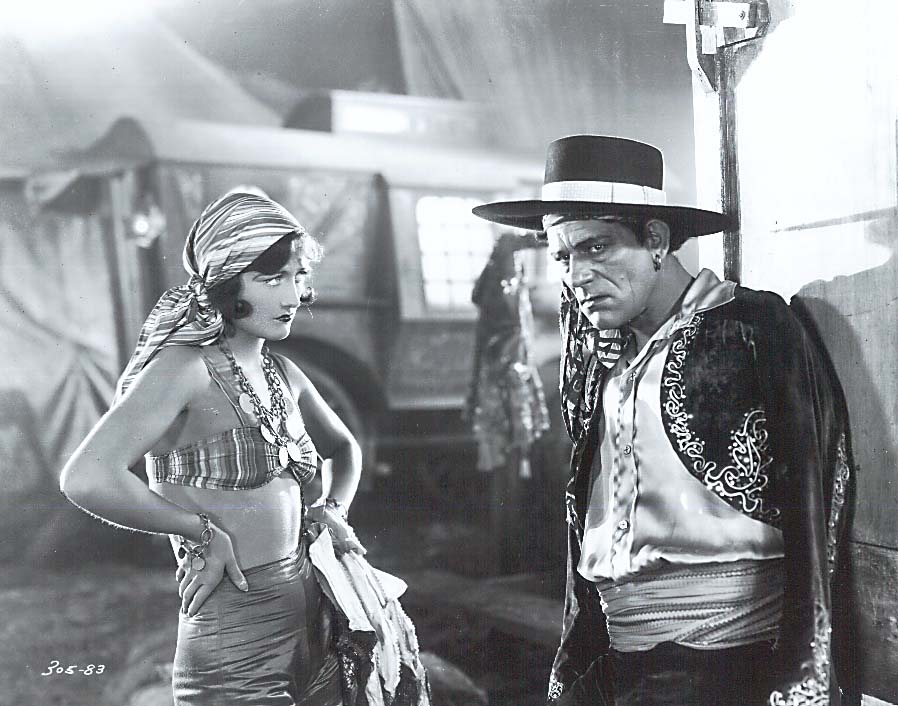
Above: Indefatigable working actress Joan sits for make-up on her breakthrough pic, Our Dancing Daughters. Exhibitors did back-flips for this one as their houses brimmed over with jazz-mad teens and would-be flappers. Joan’s ambition ran at fever pitch. She even wanted to cut short her honeymoon with Doug Jr. so she could return home to the lot. Corporate employers would love her today. Maybe it was the siren call of all that fan mail that lured her back, and folks, she personally answered every single letter on the back of that truck! Joan tried to rise above humble beginnings by slavishly observing every social nicety. She’d send a gift, the recipient would reply with a thank-you note, then Joan would respond with a thank-you note for the thank-you note! For all we know, she was still thanking for thanking for thanking in 1977 for gifts she’d sent out in 1927. Death may well have been her only release from that bondage. It’s doubtful that crusty old Lon Sr. (what am I saying? He was only in his mid- forties when he made The Unknown!) would have been that impressed with Joan’s etiquette, but according to her, he was some kind of great acting teacher. Many years after this shot was taken in 1927, when Joan was pulling time at Universal doing a Virginian episode, she was approached by a knowing crew member and fan who asked her what it was like to work with Lon. To the fan’s delight, she was most complimentary of Chaney, and happy to reminisce. If they'd only filmed those casual on-set conversations instead of yet another dreary installment of that bloated hoss-opry.


Here’s Joan and Constance Bennett at one of those vaguely unsettling Hollywood parties where everyone dressed up like little kids. Charlie Chaplin no doubt knocked off early on City Lights so he could be there. By the looks of Joan and Connie, this would seem to be his kind of bash, but did anyone really need to be confronted with Irving Thalberg in a sailor suit with a whistle in his mouth? (yes, there's a still of that from the same party, but I'm holding it for another day). Speaking of kids, check out the caption on this next one --- "JOAN CRAWFORD ADDS HER NAME TO THE AUTOGRAPH BOOKS OF OUR GANG YOUNGSTERS … Darla and Alfalfa, appearing in their first feature-length production, "The Ice Follies Of 1939", in which Miss Crawford is starred." First off, I think this is totally bogus. Alfalfa probably wanted Crawford’s autograph about like he wanted castor oil, and where are any Our Gangers
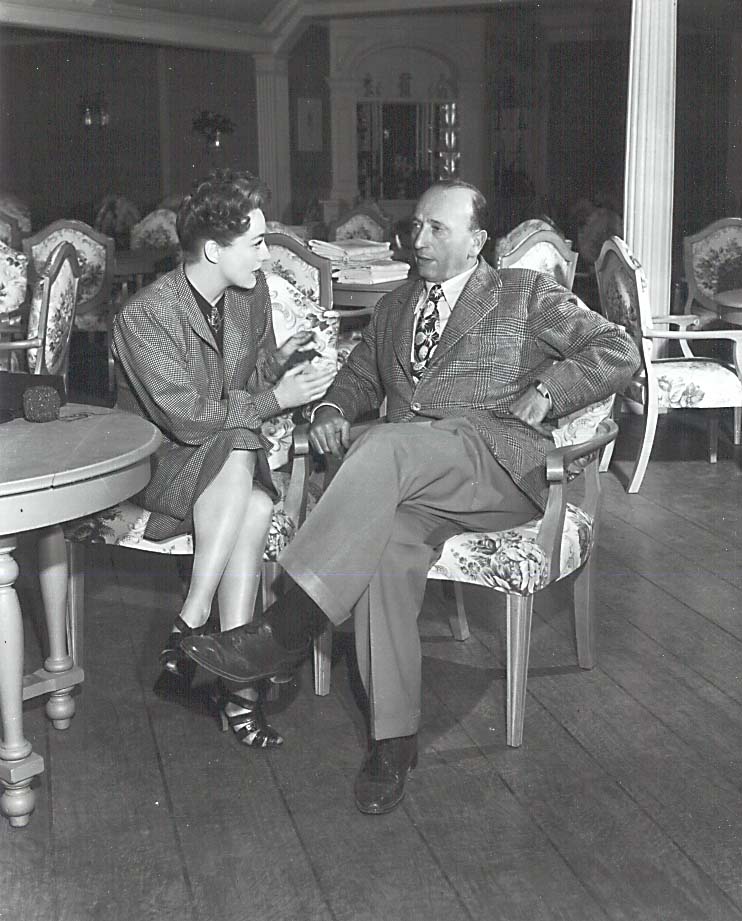
in Ice Follies Of 1939? I’ve never sat through this feature, and had no idea Darla and Alfalfa were among the cast. Otherwise, I might have tuned in (I assume their footage was excised prior to release). Anybody know the story on this? Finally, an on-set "huddle" (that’s what the caption said) between Joan and martinet director Mike Curtiz during Mildred Pierce. Did he really rip off her trademark shoulder pads and berate her in front of the crew on the first day of shooting? Well, it was worth it if he did, cause this picture revived an all but dormant career, and gave Crawford another decade’s momentum before the next lull.


Wednesday, March 22, 2006


Lita --- You Fascinate Us
One of the hottest Hollywood memoirs of the sixties was Lita Grey’s My Life With Chaplin, a near-porn account of a fifteen year old girl’s seduction by, and forced marriage to, the famed comedian whose own autobio had been published less than two years before. Lita disowned her book later on --- said the ghostwriter had monkeyed with her manuscript --- but there’s no doubt she had a long-standing score to settle with Chuck, for she felt he’d given her short shrift in his book (Lita and their marriage was barely mentioned therein), and besides, she was tired of "half the world" thinking she was a gold-digging whore. By 1966, Lita may have been under a misapprehension in imagining that the world, even half of it, was thinking about her at all, for it had been forty years since le affaire Chaplin had rocked the tabs. It’s true that C.C.’s own book had reawakened interest in him, as I recall seeing a paperback publication of he and Lita's original divorce complaint and answer around 1965 in a drug store (it must have been a very tawdry drug store to let ten year olds loiter about and read such things). When I finally came across Lita’s own book, I was captivated by her graphic re-telling of she and Charlie’s numerous couplings --- the first time in a steamroom so thick with fog they couldn’t even see each other? --- gotta hand it to him for sheer stamina in performing amidst heat like that! Well, it’s just one more reason to revere the guy --- but wait a minute, the girl was just fifteen (heck, she might have been younger than that!). Was he nuts or what? Apparently so when it came to nymphets like Lita, and boy, did she and Mother make Charlie pay! In the end, he ponied up 650 G’s to get out of the mess, and for me, this is where Lita’s life really gets interesting ---


She ran through that cash faster than Seabiscuit, and it wasn’t long before (dire) circumstance forced her to hit the road with the Orpheum circuit in a high-toned vaude revue highlighting (1) the notoriety of her name, and (2) her somewhat lackluster way with song and patter. Now, here’s good news for those millions of us who’ve had to rely upon our imaginations as to the musical and thespic talents of Lita Grey Chaplin --- she’s now available on DVD! Buried amongst numerous shorts and cartoons within the Busby Berkeley extras menu, Lita’s there in a 1933 Vitaphone two-reeler called Seasoned Greetings, part of The Golddiggers Of 1933 DVD. Believe me, Lita fans, this little musicale is worth the price of the disc. She’s unforgettable in it. I even watched it twice --- utterly entranced much as Charlie undoubtedly was. There’s a certain endearing quality about Lita --- a kind of glum, let’s get-it-done resignation that sets her apart from the typical eager-beaver Vitaphone performers. Although she performs at least four numbers, there’s little effort on her part to "sell" the songs, and her tentative line readings actually have a kind of unintended naturalness that I liked a lot. Considering the fact she was only twenty-five when this short was made, Lita displays a world-weary, seen-it-all quality that lends a real-life dramatic punch to otherwise pedestrian material. Smiling is a real effort for this woman. Knowing her circumstances at the time makes that easier to understand, for Lita was headed for the shoals in a hurry --- alcohol abuse and several nervous breakdowns would eventually land her in a series of asylums (at least one prescribed electro-shock treatments). Her eventual port-of-call would be Robinson’s Department Store in Beverly Hills, where she was employed as a sales clerk for some fifteen years. I remember reading about that in one of the Richard Lamparski books. It really freaked me out to think that I could have
walked into a store in B.H. and found Charlie Chaplin’s second wife manning the ribbon counter. I wonder how many customers recognized her during those years. Would they ask questions about those weeks on The Gold Rush between
dress purchases? I would have. Hell, I might have tried on a dress just to get some face time with Lita. As it is, we never met, even though she did several Cinecon appearances before her death in 1995. I’m told she was quite accessible toward the end. They even interviewed her at Filmfax. Nice when veterans get the attention they deserve, and Lita was nothing if not a survivor. It’s worth noting that she outlived all of Charlie’s other wives. He’d told her once during the forties that she and Oona were the only ones he ever really loved. To the end of her life, Lita would time and again quote that conversation.


Something New Has Been Added


Since December 29, 2005, we’ve posted 129 stories here at Greenbriar Picture Shows. Today is number 130. Until now, we’ve had no links, no search engines, no index, but as of last night, all that has changed, and we are today introducing Old Movie Exhibition, our brand new website for looking up past articles on favorite stars and titles. Everyone’s there --- from Bud Abbott to Daryl F.Zanuck --- there’s even an entry under Snerd, Mortimer. All the names and titles are listed on a drop-down menu, and the search will give you the postings in which they’ve appeared, with a link to take you there. Each new posting will be added to the index as we go along. The links will also be updated from time to time, as we run into interesting new sites every day, it seems. At the top of this page, you’ll note the new Archives and Links and Search Index Here options. Click on either and you’ll be taken to Old Movie Exhibition. While you’re there, you may want to bookmark the address, just in case we have another episode with the Blogger service like this past weekend, when we went dark for several days because of a server snafu. That could happen again, of course, but it won’t affect Old Movie Exhibition, as that is an altogether separate website. By all means, let us know what you think of our new feature.


We ran across some fantastic tinted Hollywood portraits last week, and naturally wondered whose guiding hand was behind such inspired work. The search led us to a certain Tom Maroudas of Melbourne Australia, whose ebay listings have lately featured forty of these lovely color creations. We asked Tom’s permission to publish some of his work here, and he graciously consented. The Clara Bow still was "colorized" by Mr. Maroudas himself, and our hats are off to his superb efforts. We’ll be using more of his images in future Glamour Starter postings (by the way, our new search service under genres has an option for Glamour Starters where you can pull up all of our past Glamour pieces) --- and
HERE is the link to Tom Maroudas’ e-mail address, and HERE is his ebay listings address.


Tuesday, March 21, 2006


A Barrymore/Welles Feud?


What could have been more degrading for the great John Barrymore than to be a stooge for fading crooner Rudy Vallee on his early forties radio program? That was the burning question among critics and columnists when The Great Profile submitted to the weekly airwave ritual of public humiliation as dispensed by Vallee and his writers, wherein Barrymore’s name and whatever was left of his reputation provided a handy punchline for every lame joke and situation. So just why did he do it? Well, according to Barrymore himself, it was the oldest reason in the world --- money. He described himself as a "whore" to brother Lionel, who would often pinch-hit for Jack on the Vallee show when sickness, or a hangover, made it impossible for him to go on. When he did, however, the Profile-lees of Profile-lees (as he’s described in the WB cartoon, Coo-CooNut Grove) went through an exhausting retinue of snorts, bellows, and guffaws as he traded quips with Vallee and various guests. The gags, of course, were generally at Barrymore’s expense. Sometimes they’d give him a brief spot for a little Shakespearean recitation, played more or less straight, though Jack was long past the point of doing that material justice. On one occasion, December 19, 1940 to be precise, guest Orson Welles engaged in a kind of dueling rendition of Julius Caesar with his old acting idol (he’d gone to see Barrymore on stage in My Dear Children dozens of times), and the two played a five or so minute excerpt with real gusto. Even unctuous Rudy was "thrilled" at its conclusion.


This being the end of 1940, Orson gets an on-air plug for the still-in-production Citizen Kane, and though he’s obliged to stage a "fued" with Barrymore for an extended comedy sketch, you can tell his heart’s not really in it. The debate seems to turn on the question of which man is the greater Shakespearean actor. No doubt the off-air Welles gladly ceded the honor to Barrymore, but for purposes of the easy laugh, he’s forced to swap put-downs with the older man here. That must have been tough on Orson, who despite a considerable ego of his own, did maintain respect for his elders, if not his betters. Of course, Barrymore was no stranger to insults in other media, as witness this ad for Playmates, in which "that son-of-a-gun of the Royal Family" has a go at Shakespeare with corn-pone bandleader Kay Kyser. That was 1942, the year Barrymore collapsed under the weight of it all --- sinking into Vallee’s arms during a rehearsal and rushed to the hospital where the final curtain awaited him. As for Orson Welles, how could he imagine that night in December 1940 that his own life story would have distinctly Barrymoresque parallels --- with a third act spent largely in tawdry films and television, with ad agency hucksters vying to trade on his good name. Knowing that history makes this particular Vallee show a fascinating listen --- a real lost-and-found moment in show-biz history.


Sunday, March 19, 2006


Monday Glamour Starter --- Linda Darnell
Linda Darnell walked on to the 20th Century Fox lot at the age of fifteen with her crazy mother and a live rooster in 1939. They’d come from Texas, and Linda was about to be groomed for stardom in much the same way as her screen counterpart in the following year’s Stardust, a Cinderella story designed to showcase the new teenage attraction. The rooster was a pet from home (they just couldn’t bear to leave it there), and the mother was sufficiently obnoxious to get herself permanently banned from the lot. Linda’s rise --- no, make that catapult --- to the top rungs of stardom was very much the stuff of girlish fantasies across the land, and if it could happen to Linda, maybe it could happen to them. Of course, if they’d known what eventually did happen to her, they might well have directed their dreams elsewhere, for this would be a Hollywood story with a sad end, and not a lot of good times in the interim. Her looks were the only thing that equipped Linda Darnell to enter the movie business. Her father was with the post office in Dallas, so at least the depression hadn’t starved them out by the time precocious Linda started bringing home the loving cups from various local beauty contests. This real-life Esther Blodgett was really named Monetta, but the siblings called her Tweedles, and this family’s idea of a night out was to drive down for a close-up view of the bullet-riddled bodies of Bonnie Parker and Clyde Barrow after those two desperados were taken in a nearby ambush. Linda never forgot the sight of that to-be-glamorized-in-the-sixties couple as they lay on the lawman’s butcher board. Who knows, it might have prepared her better for the ambush that awaited her in Golly-wood. Her innocent beauty made ingenue-dom a foregone conclusion, and she languished in these parts for five or so years until it looked as though they’d wrung her dry. A sultry image change forestalled the inevitable, and she rode that spike for another six or so years before the decline of the studio system and a post-war public’s indifference finally sent her packing. Three marriages and countless dinner theatres later, she was making her last stand in one of those ten-day (if that) A.C.Lyles westerns for Paramount, Black Spurs. Alcohol had made its inroads by then, and the career was pretty much a bust-out. Whatever was left of her public was startled to hear of Linda’s death in a Chicago house fire when she was only forty-one. For all the hardship she’d had, it was a surprise to learn she’d died so young.


You might notice from these pics that Linda went right off the launching pad into adult roles. Fox didn’t need another Shirley (they were ready by now to get rid of the one they had), and so it was co-starring parts with heartthrob Ty Power right from the get-go. Here they are as a married couple in 1939’s Day-Time Wife, and get this, Linda was fifteen when they started shooting the thing! The movie isn’t much. Like so many others from that period, it’s hobbled by the Code, but was the Breen Office aware that this kid was playing at four-way marital hijinks with Tyrone Power and roguish Warren William? It’s a cinch they’d not get by with such casting today. The only time Linda was cast age-appropriate in these early ventures would be Star Dust, and that charming Hollywood story (which turns up occasionally on Fox Movie Channel) was released in 1940. Here she is, age sixteen, sitting behind the slate marked January of that year.

One of the first 16mm features I ever owned was a dupe of The Mark Of Zorro. During college years, I used to crawl through half-open windows at night and watch it on classroom projectors, hoping the custodians wouldn't detect my presence even though I liked playing that Alfred Newman score at a booming volume. Well, it’s not as though you could get the DVD for five dollars at Wal-Mart in those days. Anyway, this shot of Linda with Tyrone Power came from a "killed" negative, meaning Fox elected not to use it for publicity. How it came into the possession of my source would make an interesting story, I’m sure, as this negative should have been destroyed over sixty-five years ago. The color image shows a maturing Linda headed for the siren phase of her career, via things like Summer Storm, Hangover Square, and Fallen Angel (just out on DVD). Among the really good ones Linda did (and there were lots) was John Ford’s My Darling Clementine, and here she is with Vic Mature in that one. I remember seeing a TV interview ten or so years where Burt Reynolds was talking with Carol Burnett. She was describing the thrill of meeting Linda Darnell once when she was a teenager at a premiere. Burt listened politely, then casually mentioned the fact that he had worked with Linda on the stage back when he was starting out in the fifties --- "I did Tea and Sympathy with her once …" Just as Carol reacted to that, a commercial interrupted them both, and we never heard the story. If ever I meet Burt Reynolds, this will be the first question he gets from me.


Thursday, March 16, 2006


Ad Slick Rarities --- Laura


Ad slicks are single sheets, usually about nine by twelve inches, which are made up of various sized ads for newspapers, heralds, flyers --- any publication where promotion for an individual movie is needed. Having conferred with good friend and noted expert Dr.Karl Thiede (he’s worked in this field for over forty years), I learned that the slicks generally preceded the standard pressbook which was issued for features (and many short subjects as well). They were an alternative advertising resource for theatres, sometimes used when the pressbook was not yet available, and in many cases, the ad art used for the slicks would be completely different from the campaign reflected by the pressbook. These ads for Laura are by way of example. If you’ve seen ads and posters for that feature, chances are they weren’t anything like these, and that’s what I like about slicks. They’re always unpredictable. Sometimes they surpass the pressbook ads. In any case, they offer an interesting spin on the familiar art and graphics we continue to see for various classic titles. From time to time, we hope to present more of these. One interesting irony we’ll note for the record, and that’s the fact that ad slicks have now taken the place of pressbooks. Contemporary exhibitors need nothing beyond a choice of small newspaper ads to sell their product locally. Grassroots showmanship is long gone. All that remains is that single sheet to promote the arrival of a new movie. A comparison, for instance, between the 1933 King Kong pressbook and the puny scraps furnished to exhibitors for the recent remake would be a thing too depressing to contemplate.


Our Search For The Rogue Song Goes On


Along with London After Midnight, The Divine Woman, and a complete Magnificent Ambersons, The Rogue Song ranks as perhaps the most sought after of all lost films. There have been discoveries over the years, frustrating ones in a way, because they only offer a glimpse of what this all-talking, two-color Technicolor feature might have been like for audiences in 1930. There were rumors as well. A print in the Soviet Union --- shown to military troops there as late as the 1960’s! And how about that listing in some of the early TV syndication source books? Could there have been one print made before it was withdrawn from the package? Most likely not. The fire that claimed MGM’s negative materials happened decades ago. If a complete Rogue Song surfaces, it will most likely be some renegade European print. In the meantime, there have been fragments --- jumbled pieces of a 103-minute jigsaw to tantalize us. First, a random sequence. Some dialogue with Lawrence Tibbett, followed by a truncated Laurel and Hardy routine involving a bear --- and wouldn’t you know it? Stan and Oliver run into a dark cave and we can’t even see them! There’s only the briefest glimpse of the two within this three or so minute clip, which was itself discovered by a New Hampshire collector in a used book store back in the eighties. Since then, another segment has turned up --- this one a ballet about ten minutes long --- and damn it all, Laurel and Hardy aren't in it. There’s also a trailer, and hopefully it’ll be on the L&H DVD that Warner plans to release soon. Original sound discs of the complete feature are also said to have survived. Does anyone know of anything else?


Everyone assumes that The Rogue Song was, as one modern day critic put it, a real stinkeroo --- but these trade reviews and columns would appear to tell a different story. Now I realize certain publications were compromised by their mutual back-scratching relationships with the studios, but these raves go way beyond the customary boot-licking policies maintained by the trades. You’ll note that MGM has laid out some very attractive color ads for the film, none of which emphasize Laurel and Hardy. Chances are they wanted to sell baritone Lawrence Tibbett to the highbrows for these flagship openings, and leave the push on the boys for the sticks. Interesting that even deluxe Broadway houses had sound problems during those first awkward talkie years, as you’ll see from the complaint about excessive volume during the Astor Theatre engagement. Otherwise, The Rogue Song seems to have wowed ‘em. But then again, maybe not. Like all the majors, MGM knew how to cook the books on new releases, using misleading figures and bought reviews to make all of them look like solid Broadway hits. That may well have been the case here, as The Rogue Song did ultimately lose money (note the figures). So where does the truth lie? Did people like this show? After seventy-six years, it’s unlikely we’ll ever know, and under the present circumstances, equally unlikely that we’ll ever get to see The Rogue Song for ourselves.


Tuesday, March 14, 2006


Creature Concerns


Despite being genitalia challenged, the Creature may well be the most visually arresting monster in Universal’s distinguished gallery. Certain gender issues remain cloudy, however. Naïve fifties assumptions that he(?) was male are put to rout by the fact we have no concrete evidence to that effect. Like some accursed precursor to the "Ken" doll, he/she is forever consigned to an Amazonian Twilight Zone, where his/her sexual identity must be forever in doubt. The male impulse would seem to manifest itself by way of the Creature’s expressed interest in Julia Adams, Lori Nelson, and Leigh Snowden, but in our own age of enlightenment, couldn’t there be, shall we say, another explanation for that? It would, after all, be no more alarming to find the Creature in ongoing romantic pursuit of Mssrs. Richard Denning, John Agar, and Rex Reason, and after all, who are we to judge? Surely director Jack Arnold addressed these gender ambiguities with cast and crew --- wonder what those guys inside the suit had to say about it. And by the way, just who did wear that Creature outfit? I’ve read it was Ricou Browning in the water, Ben Chapman on land, and Don Megowan for pensive and longing expressions directed toward the ocean --- but something tells me there were more of those Creature enactors. In fact, I’ll bet you could sit in a pancake house out in North Hollywood today, and it wouldn’t be ten minutes before you’d encounter some robust septuagenarian who’d once played the Gill Man.


I’ve recently re-watched the Creature trilogy, not having seen the last two since the sixties, and before you say Get A Life, let me assure you there are points of interest in all three. You must first, however, accustom yourself to the nerve-wracking repetition of that principal theme --- a kind of bombastic musical stinger that accompanies every shot of the titular character. Once you’re beyond that, and the yards of exposition that precedes the Creature’s initial appearance in each film, you’re okay. Be forewarned that a rigid formula applies here --- first they talk about him, then they catch him, then he escapes (usually with the girl), and finally they "kill" him. Well, they don’t really kill him, since he's reliably back for sequels, but I always wondered why they couldn’t just let him stay dead and allow an offspring or perhaps a sibling to pinch-hit. Oh, and before anyone corrects me, I do know they never actually capture the Creature in the first pic, but they do force him into a number of ignominious retreats, thus complying with sci-fi
narrative rules.

Remember Clint Eastwood’s rib-tickling screen launch as a lab technician in Revenge Of The Creature? That was 1955, and eager neophyte Clint wrings every comedic possibility out of that one scene he shares with star John Agar, but I couldn’t help wondering as I watched, what was he really thinking? Was this eager, hungry Universal-International contract player secretly coveting John Agar’s higher profile? Was Clint privately dreaming of the day when he might play the lead in a Creature sequel? Just food for thought. If one of you out there knows Clint, ask next time you run into him. He’s a square guy, and get back to us, okay? Another thing about Revenge Of The Creature is that Marineland location stuff, where the Creature gets loose and all that… well, doesn’t it look just like the Universal tour down there? --- even if it was shot in Florida? That’s sure what the entrance area reminded me of, and while we’re on the subject of Revenge Of The Creature, do you suppose Shirley Temple ever watched one of John Agar’s sci-fi movies? He made all of them after they divorced, although that whole thing was so bitter I understand he never even got to see his daughter with Shirley, even when she was married years later. So, my question is, has Shirley checked out Tarantula? --- or Zontar, Thing From Venus? Was John ever reunited with his daughter? I’d like to think so, because he was a good actor, and by all accounts, a nice guy.

The Creature Walks Among Us was the last one. I’d heard rumors of a fourth that was supposedly bandied about Universal boardrooms around 1964, but nothing came of it. A shame too, because the idea had possibilities. C.W.A.U. was the one where they took out his gills, or fitted him with lungs, or exchanged his gills for lungs, or some such thing. All I know is, they kept talking about corpuscles. I haven’t heard so many references to corpuscles since eighth grade science, and those aren’t memories I particularly cherish. Also, they put clothes on the Creature. Not very stylish clothes, but functional. Problem is the Creature doesn’t look as good wearing clothes. We prefer him near naked if possible. He’s like Joan Blondell
in that respect. The movie itself is all balled up with romantic triangles as well. I think they must have been watching Written On The Wind before they wrote this, as much of it seems a homage to Ross Hunter and Doug Sirk. Since the Code wouldn’t allow murderers to go unpunished, the Creature had to "die" at the end of all three movies. The last one’s at least a little ambiguous on that score. The Creature walks toward the ocean, but doesn’t actually submerge (you see, with his/her new lungs, he/she would drown). Anyway, that’s how they could have had their sequel. Instead of being a chump and drowning, the Creature could have come back in 1964 (or even today!), having found a place in civilized society and perhaps raise a family, thereby inspiring any number of rollicking domestic comedies where he/she could be played by Tim Allen, Jennifer Anniston, or any number of our glittering present-day luminaries. Imagine the possibilities!


It's Everybody's War
War really was hell for a lot of the stars, both in and out of uniform. Men were expected to suit up and join the fight. Women were obliged to entertain the G.I’s, either by way of camp shows, or at the Hollywood Canteen . Some of the guys had it particularly rough. Tony Martin got in hot water over a training camp mix-up that gave off the pungent odor of a movie-star fix for privileges denied others. He remained a pariah for years afterward. The press was merciless with perceived slackers. Their respective studios kept getting deferments for Alan Ladd and Mickey Rooney. After finally getting into uniform, Laddie fell sick and had to be mustered out, while Mickey was late enough getting in the game to miss the action (but he sure dazzled interviewers with some whoppers decades later --- you’d have thought the Mick took Iwo single-handed!). Jackie Cooper had a go at fisticuffs with any number of drunken sergeants who reminded him of his Skippy days. Needless to say, he pulled some hours in the brig. Ronald Reagan lost the momentum of what might have been a major star career when he was assigned to Hal Roach’s now commandeered studio to make training films. Some of these have turned up on TCM, and they’re pretty good. The younger fellows that came into the studios to fill the breach may have seemed unlikely star material (think Van Johnson), but with all the big guns now manning big guns (think Gable, Power, Taylor), these boys had to do in a pinch.

There was plenty of glamour and glory to go around for the leading men who played their cards right. James Stewart joined early as a pilot, and flew some dicey missions over
Germany. So did Clark Gable, who assumed so much risk as to alarm superior officers. Henry Fonda went Navy, and had a distinguished record there, as did Robert Montgomery, whose smooth way with the brass got him stationed briefly in the White House (here he is night-clubbing it on leave with Tallulah Bankhead). Even old timers got in on the action. The California Evacuation Corps was set up to provide emergency services in the event of a Japanese invasion on the west coast. Station wagons were standard equipment. If you had one of those, you were in. They drilled two nights a week at Warner Bros., and the ranks included Rudy Vallee, Cesar Romero, Buster Keaton
, and Lewis Stone. Here’s Judge Hardy with Captain Donald Crisp and Lieut. Rudy Vallee as they conduct close inspection of a 16mm projector. Stone had been a veteran of both WW1 and the Spanish-American War. I’m betting he rode with Stonewall Jackson as well, if appearance is any indication.


There were some guys who couldn’t get in. John Garfield had a heart condition and it was serious --- his attack on the set of Hollywood Canteen wasn’t publicized, but enlistment was out of the question. Despite all this, Garfield’s service with the Canteen and other areas of morale boosting was stellar. Eddie Robinson was too old, so he took his Little Caesar act on the USO circuit. Eddie hated doing the gangster bit, but that was his image, and he was stuck with it. So was Humphrey Bogart
, whose own tommy-gun routine was comparatively staid beside the donnybrooks he and firebrand wife Mayo Methot staged in various European hotels during their tour, including an incident in which Bogart told a senior officer to piss off.


The roughest duty of the war may well have been reserved for Lew Ayres. He declared himself a conscientious objector, and was pilloried for it. The studios distanced themselves, and even other stars attacked him in the press. Ayres wound up in the medical corps and did great, according to commanding officers, eventually picking up the pieces of a tattered career upon discharge. This September 1942 profile represents the tentative, though generally favorable shift in public opinion after Lew got into the Army’s medical unit.


Monday, March 13, 2006


The Shaggy Dog


Audiences used to laugh at The Shaggy Dog. In fact, they’d roar --- guffaw --- shake the roof with glee. When I saw it in April 1959 (my first theatrical movie ever), those squealing teens and kids shook the house. Again in 1967, when The Shaggy Dog was re-issued with The Absent-Minded Professor, the crowd went nuts. All they had to do was cut to those two comic policemen, and everybody’d bust a gut. Those guys didn’t even have to do anything. Just the sight of them was enough to alert the audience that big laffs were coming. So how does this comedy riot play today? Well, we just looked at it again. Not with an audience, mind, so we can’t speak to how it might come off in that situation, but we can report that the roof is secure. No guffaws on my part, but I never expected that. After all, it’s forty-seven years later (I’ll not weary you by going on as to my incredulity over that). Like so many childhood memories, it’s faded with the passage of time. You Had To Be There is an expression we often hear, and never was it more truly applied than to The Shaggy Dog. I don’t think kids today would give it ten minutes. Maybe I’m wrong though. Roberta Shore said something on the DVD extras about showing it to her grandkids, and how they loved it (she also referred to it as a classic in the same league as Casablanca, but we’ll not get into that). Bless your heart, Roberta, but I suspect their attention was mostly stimulated by the fact that it was Grandma up there on the screen, not the movie itself. Tommy Kirk went her one better by claiming that The Shaggy Dog was the biggest grosser of 1959, surpassing even Ben-Hur at the wickets! But why nit-pick? We go to these interviews for nostalgic reminiscence, not accurate history. It’s enough just to see how these people look and sound today.


Maybe I didn’t laugh at The Shaggy Dog, but boy, was I fascinated by it. Being Disney’s first comedy, it sure changed the direction of studio operations. Old Walt must have gone through five packs of Pell-Mells trying to figure how a low-budget black-and-white like this could have out-profited a behemoth like Sleeping Beauty, which was out the same year and cost a blue fortune to produce. The dog movie had been proposed to ABC for a possible series, but the lunkheads over there gave Walt the breeze, and in a fit of pique, he decided to do it as a quickie feature. Star Fred MacMurray got down off his horse (he’d been mired in westerns for a while), and rode a career rocket out of this one that got him six more Disney assignments and a TV series we thought would never end (My Three Sons). Walt rented the Universal back-lot for exteriors (did I see the Munster house in the background?), so the physical trappings fit neatly into what is often, and derisively, referred to as a "typical" fifties suburban family setting. Tommy Kirk’s character (Wilby) mentions a paper route he once had, and dad Fred is an alleged postman, though never seen on duty. That opening scene irritated me because Fred was clearly drinking out of an empty coffee cup. Who do these actors think they’re fooling? Tim Considine is a wise-ass neighbor kid clearly patterned after Eddie Haskell (director Charles Barton had previously helmed a number of Leave It To Beavers), and when Wilby ventures into an apparent House Of Horrors exhibit in the local museum (wish my town could have boasted a museum House Of Horrors --- we didn’t even have a museum), the whole thing becomes a direct lift from House Of Wax, even the "depth" effects so strikingly photographed in 3-D for the
earlier pic.


This color ad is actually the cover of the original pressbook. Disney really had an inspired campaign for this show. "A New Kind Of Horror Movie" was a lure for all those kids who’d gorged themselves on the American-International cheapies --- there’s even a specific reference to AIP’s teenage Frankenstein and Werewolf pics in the dog’s balloon caption. Black-and-white wouldn’t have been a problem, because The Shaggy Dog’s audience was well accustomed to it, not only in the theatres, but at home on TV as well (although Disney would go largely with color after this, the Flubber pics notwithstanding). The usual nutty tie-ins are here. "The First and Only Album Ever Recorded By A Dog" is almost certainly a collector’s item among Disney completists, but one can only imagine the hell attendant upon listening to it. Wonder if Roberta Shore’s ever scored a copy of it for the grandkids? That may have been pushing family loyalty too far. The "Shaggy Dog Mask" might well have provided a short cut to an after school beating, if it were not first confiscated by teacher, and the idea of wearing a dog tag emblazoned with Tommy Kirk’s image would appear to be a singularly pointless enterprise, even if you were a fan of Tom’s thesping. Wish I had that Sunday Comic Series so I could reproduce it here in vivid color, but this B/W sample will have to do. Just fill in the later entries with your imaginations.


You wouldn’t know it until the final third, but The Shaggy Dog also has a sub-plot about Communist spies. Attentive viewers will have their radar up near the beginning, however, when the as-yet-unmasked miscreant is revealed to be an intellectual and an art collector --- sure tip-offs that he’s also a Red! Seems the spies (including a boyish Strother Martin) are after "the complete mechanism of the undersea hydrogen missile." Well, surely Walt had one left over from 20,000 Leagues Under The Sea. Anyway, Roberta Shore’s hitherto benign father all of a sudden turns nasty and brutal, manhandling even her in the one genuinely disturbing scene in the film. They really stacked the deck against the Russkies in those days! In fact, there’s a number of alarming aspects about this movie. At one point, Fred chases the titular character out of his house with a shotgun, firing both barrels in what has been clearly established as a populated neighborhood. Any number of Universal sitcom characters could well have been killed! Charles Barton does show remarkable restraint in the Country Club party scene (in which parent, teen, and even little kid couples dance merrily together to a striped-suit combo --- it’s wonderful). When Wilby/Shaggy gets loose, he leads the customary manic chase through the crowd, bypassing a very Parent Trappish punch bowl that looks ripe for the tipping --- but it remains intact. Barton no doubt regarded that punch bowl prior to shooting and asked himself, "What would Lubitsch have done?" To Charlie’s everlasting credit, he doesn’t go for the easy laugh. Guess it was just that well-known Barton Touch at work again. Finally, and this is an element of the story that no doubt caused a lifetime of sleepless nights for astute viewers --- Wilby isn’t cured at the end. There is every reason to believe that his transformations will continue. Unlike Larry Talbot at the end of House Of Dracula, there is no joyous release from the curse of lycanthropy. Logic would dictate that, at the very least, the dog would have to be euthenized in order for Wilby to find peace, but of course, we can’t have that. To this day then, we must assume that Wilby, now into his sixties, remains beset with this dreadful malady. I wonder if Walt got letters addressing the issue in 1959? If so, he no doubt pushed them aside on his desk to make room for the money he was counting (we’re told it was upwards of eight million).


Sunday, March 12, 2006


Monday's Glamour Starter --- Joan Blondell


If King Kong’s Ann Darrow had been a real person, she might have been Joan Blondell. To read Joan’s recollections of a hardscrabble life in vaudeville, and the frequent days and nights of starvation attendant upon that, is to evoke an image of hungry A.D. creeping up to the fruit-stand. Performers often went without food --- sometimes for days. Lucille Ball would order hot water at a diner, then pour in tomato ketchup so she could have soup. No wonder these people were so frugal in later life. They never forgot the struggle. Jack Benny’s stingy persona was more likely a role model for them, rather than a joke. Like so many others in the life, Joan Blondell never spent more than a week in public school. She attended that hard knocks place we keep reading about in star bios. Seems most crawled out on stage for debut performances, what with whole families in the biz, kids being just one more useful prop for their act. Blondell could do anything in the way of performing before she was five. Is it any wonder she’s so good on the screen? Discovered while still in her teens by none other than Al Jolson, she and stage co-star James Cagney got the big break when Al bought their play and insisted Warners use them for the movie version. The two youngsters worked together lots, though Jim freqently rebelled against studio dictates --- fighting control like the very devil, and inasmuch as it was possible in such feudal days, bringing them to their knees. Joan, on the other hands, was compliant --- grateful just to have the work. Perhaps that specter of ketchup soup loomed over her. Anyway, she never regretted a live-and-let-live philosophy. Working eighteen hour, six-day-a-week jobs doesn’t allow a lot of time for introspection. There was one occasion, however, when Blondell became so exhausted from overwork that her eyes twitched, she couldn’t focus steadily, and even developed a stutter. Without telling anyone, the beleaguered star drove up California's coast, checked into a quiet inn, and slept four days. Reporting back for work, Jack Warner docked her pay, possibly on the theory that horses out at Santa Anita need care and delicate handling, but the same philosophy need not apply to actors.


Well, I guess it’s hard to escape the fact that Joan Blondell looks her very best sans clothes, and in those happy, free-wheeling pre-code days, that’s usually how they got her. You'd have to assume no one complained, because this woman did more cheesecake (and some of this goes beyond cheesecake) than any major actress I can think of. This very early one with an awe-inspiring deco lamp (where, oh where, is that beautiful thing today?) was dated February 1930, and the photographer was Warner maestro of the lens, Bert Longworth. Joan looks cheerful. Maybe they let her off after just sixteen hours that day.


I’d like to think the obliging leopard who loaned Blondell a portion of his coat went on to a full and happy life, as she used such a small portion of the natural raiment. Would PETA object to such minimal borrowing? Hopefully not, as it looks so becoming on her. Joan seems at home in funky costumes. How many pin-ups successfully combined torrid leg art with clown costumes? The caption reads "Quite a lovely panel for your room or office" (the photog was Elmer Fryer). Nuff said!


A whip-wielding Joan reads the riot act to co-stars Ruby Keeler and future real-life husband Dick Powell
in a publicity shot from Dames (too bad the post-code movie wasn’t friskier). Joan recalled the public outrage that ensued when she and Dick got married. Seems the fans thought she was stealing him away from on-screen heartthrob Ruby Keeler. They didn’t mind so much when Ruby married Al Jolson around the same time (that was Ruby’s problem --- and how!). Blondell never took time to watch her rushes nor the finished movies. She was too anxious to get home and perform domestic chores (no kidding!). Finally getting around to some of them late in life, she couldn’t remember any of the stories. All those sausages off the Warners assembly line were just a blur to her.


It’s always a good thing when Bill Powell gets into the act, here at dapper summit on the set of Lawyer Man with Joan. Bill’s got that notorious cigar that he uses to such good effect in a particularly raunchy pre-code moment during the film. Another Elmer Fryer shot of our star on the telephone carries this caption --- "Joan Blondell’s anonymous friend on the other end of the wire doesn’t know what he is missing by not talking to the blonde Warner Bros. player face to face." But does the anonymous friend know how heavily they’ve had to airbrush Joan’s cleavage here? Imagine what this would have looked like before the retouching! The next shot was something we picked up from a French dealer at a show (appropriate, n’est-ce pais?). Try to focus on that super-duper art deco chair, if only for a moment. Did fan mags actually print this shot? It really does look like something off a French postcard. Maybe that explains how my vendor wound up with it. Finally, the gal in the abbreviated pirate costume is not Joan Blondell. It’s her sister Gloria, whose own Warners career was a brief one. She does play Errol Flynn’s
secretary in Four’s A Crowd (1938), and when she comes into the room, you’d swear it was Joan. That could be why she never hit it big.


Saturday, March 11, 2006


A Rathbone Mystery Worthy Of Sherlock Holmes


Can anyone help us out with these? They’re almost certainly from a television program … but what? … and when? Rathbone did a lot of TV --- from the late forties, all the way to the end. But wait --- what if we’re talking about a play? Basil’s obviously in some sort of dual role (Holmes and Watson?), so how could he pull off the scenes depicted here in a stage production? For that matter, how would they have put both Rathbones in the same scene on an early fifties TV broadcast? This thing gets more perplexing the more I think about it. The other Basil is more likely playing a butler, if these stills can be trusted --- notice how he’s adjusting the flowers in that one shot --- and Basil seated on the couch doesn’t look very Holmesian --- note the modern dress. That would seem to clash with the traditional deerstalker outfit he’s wearing in the other stills. I did check out Marcia Jessen’s incredible Basil Rathbone fan site (go HERE), and didn’t find any hints, although her coverage is so extensive, I may well have overlooked it (if you love Basil, and don’t we all, you must go there). We invite comments, speculation, wild guesses --- anything. For all I know, one of our informed readers will know exactly what it’s all about, and thereby clear up a mystery that’s been weighing heavily upon me for the fifteen or so years that I’ve had these baffling images.

Oh, and just a little something extra, included merely because it’s just impossible to pass up a thing so cool as this --- Basil shilling for Chesterfield in 1946. Note the reference to his final Holmes outing, Dressed To Kill. I’m told that Universal wanted to take a flyer on another year with the series, but Rathbone, feeling the stranglehold of typecasting, nixed the deal. Word is that pal Nigel Bruce was most annoyed. Hollywood gigs were hard to come by after that. Wonder if Universal execs got the word out that Basil wasn’t a team player? Pat O’Brien and Loretta Young both said they got the ice around town after they chose not to re-sign with their home lots (WB and Fox, respectively). Those moguls could damage a lot of careers as they sat together around their card tables at night.


Friday, March 10, 2006


An Awful Ending To The Awful Truth


Finally got around to checking some of these Cary Grant features in the new Sony DVD box, and the first one I watched was The Awful Truth. If you like screwball comedies, this is as good as any of them. Some people don’t like screwball comedies, however. They get on some people’s nerves. They used to get on mine too, but somehow I’ve grown to like them better as I approach my dotage. But it’s true they can be awfully frantic. Characters run around and shout a lot in them. I’ve sat with audiences during these things when I can feel the movie starting to wear on them. The problem with most screwballs is that they go on too long. It suits me best when they’re on and off in less than ninety minutes. The Awful Truth is right at ninety minutes, and that’s good, because five more and I would have feeling around in the dark for that remote. Now admittedly, I’m no scholar of these pics, but just what is that ending about? I mean the stuff with the clock and the door swinging open and all that…. okay, after Cary Grant jams the chair under the doorknob, aren’t we to assume that he’s going to sleep with Irene Dunne? Not that I’d be in any hurry to do that after the way Irene’s been treating him (and that's even more of an issue for me in My Favorite Wife), but since she’s letting him prop the chair on her side of the door, common sense would dictate the woman’s ready to yield, right? Then why in hell does she laughingly say "Goodnight" to him just as he’s getting ready to approach the bed? It really killed the moment for me. Despite the cutaway to the figures retreating into the clock together, I smelled a Code intervention here. It’s like they were trying to hint at a consummation on the one hand, while providing reassurance that nothing’s actually going to happen on the other. What a cheat! I don’t blame the movie. I blame the Code. Leo McCarey and those actors must have hated having to shoot that. Still a good picture though, and maybe your read on that ending will be different from mine.


Thursday, March 09, 2006


Some Delightful Foreign Affairs


I used to think American movie posters were the cat's meow until I started encountering examples of what our international friends were doing to sell Yank products in their markets. These far-flung cradles of civilization had a way with design, don't you think? Some of their ideas would have been considered too radical for our shores back then, but they have a startling effect today, and even ones from the thirties seem quite modern to these tired old eyes. I'd check for this stuff at collector's shows, and believe me, you had to look, because foreign promotional material comes in every conceivable size and shape. The samples we have are tiny heralds, which were given away to patrons by way of cooperative merchants, and/or newspapers. We had heralds too, but they weren't generally three and a half by five inches in size! These diminutive keepsakes are fragile as porcelain, and I think, every bit as pleasurable to look at. How any of them survived the passage of so many years is a miracle in itself. Bear in mind that some of these movies were slow getting release dates in their host countries, due to war, quotas, blockades, pirate raids, you name it --- so we can't fix a definite date as to when these little jewels were mined. Suffice to say, there are plenty more if readers would like to see an encore in the future.

Talk about capturing the spirit of noir! If this little cameo for Out Of The Past were any blacker, I'd have ink stains all over my hands. A handy magnifying glass just revealed all those swirling colors in Bob's
trenchcoat. Can't wait to see how this looks when it's gone up on line.

What great art of Bill Powell and Myrna Loy --- and look at that all that color detail in Bill's tie! Somebody'll have to help me out with these languages, but it's obvious enough, judging by Powell's femme disguise, that this is Love Crazy. That's the one g.f. Ann likes a lot --- especially the part where Bill gets his head caught in the elevator door. They excerpted that in MGM's Big Parade Of Comedy, Robert Youngson's 1964 compilation. I saw that on a triple bill with Tarantula and The Hustler. Sorry, I digressed.


Wonder if Bette Davis ever got to see this stark portrait for her 1942 pic, In This Our Life. There's always been this legend that the cast of The Maltese Falcon appeared briefly as extras in this movie as a good-luck gesture for director John Huston. I've never seen them, though. Was it even shot? --- or maybe shot, then deleted? Could be the whole thing's just fiction.

Forthcoming glamour starter Linda Darnell has always been a Greenbriar favorite, and we particularly dig this image of her from Forever Amber, a picture she dismissively referred to as "Forever Under". Even if it had nothing but that fantastic David Raksin score, it would be enshrined among the immortals as far as we're concerned. It's frighteningly ironic to note that Linda nearly burned up in a fire scene gone wrong (Otto scorned the use of a double for her), and indeed her character would perish in flames on two other occasions in movies (Hangover Square and Anna and The King Of Siam) --- making her real-life finish all the more chilling (for the best account of that tragedy, go HERE).

Never have I seen this pose of Cary Grant and Priscilla Lane from Arsenic and Old Lace, but I think it represents the movie as well as any I have seen. Anyway, it's lots better than the kinda drab one-sheet they used in the U.S. Wouldn't it have been great if Boris Karloff could somehow have played Jonathan Brewster? What a bummer, but somebody had to stay out on the road with the still-popular play and give it hinterland star appeal, so Boris laid down the sacrifice. Just one more reason to love the guy.


Finally, here's Doris Day in her debut feature, Romance On The High Seas. Great movie, but Jack Carson seems an unlikely romantic partner for Doris --- yet there they are in a clinch for the fadeout, and she says in her autobio they had a thing offscreen as well. Seems Jack was a pretty morose type when the bright lights were down. Used to sit around home and drink by himself. Great actor, we think, or did we say that before? And how about that Don DeFore? How did he miss the brass ring? Hal Wallis thought enough of him to extend a personal contract. Too bad the big screen wasn't more hospitable to Don. He was always a likeable presence.


Wednesday, March 08, 2006


Your 1941 MGM Roadmap

There’s something about that Metro product from the early forties that just exudes confidence. Almost everything they did was a hit. Some of the pictures may not seem so hot today, but they sure delivered the bacon then. This jokey studio map was published in February 1941. That was also the year MGM initiated The Lion’s Roar, a designed-for-exhibitors quarterly reminiscent of the lavish Fortune magazine, with it’s one dollar cover price. The studio even did a separate periodical for its short subjects, as you’ll see in this still of Robert Benchley perusing one of them. Lion’s Roar turned up in more than a few public libraries and doctor’s offices, as in-the-know movie followers quickly recognized it as the daddy of all fan magazines. The studio at Culver City is depicted here as a whimsical fairyland. Mickey Rooney’s still around to assure us that indeed it was. There was no happier place in the world when you were riding high. So who among these stars had reason to be happy, and which ones were headed for the rocks?


From the top, we have "Wally" Beery. People couldn’t stand working with him, but his stuff brought in the coin. Watching a lot of it today can be pretty rugged, especially the ones during the forties, when the Beery formula was so calcified that the stories almost wrote themselves. That big lovable oaf slobbered over every kid player that ever passed through the lot (not off-screen, heaven forbid), and those "romantic" pairings with one-note battle-ax Marjorie Main became increasingly cringe-worthy as the decade wore on. Lew Ayre’s black eye wasn’t intended to be prophetic, but that’s sure how things turned out when the war started less than a year later and Lew declared himself a conscientious objector. Metro certainly wouldn’t be "Calling Dr. Kildare" after that. We’ll have more on this fascinating topic next week, by the way, so check back. Norma Shearer’s telling the studio guard that she "practically own(s) the place", but that wasn’t much help when her last two for them (We Were Dancing and Her Cardboard Lover) took a nosedive into a pool of red ink. Same was true for the Marx Brothers, whose track record at MGM included three that lost money (A Day At The Races, At The Circus, and Go West). And would Mickey Rooney have been as cooperative if he’d known that he was far and away the most dependable profit-getter of the whole bunch? In fact, Mick was the only sure thing on the lot. Every Metro picture he did up until Summer Holiday (1948) was a hit. If this map had been drawn a few months later, I suspect Greta Garbo would have been omitted, as her bags were nearly packed by this time.


Depending upon your viewpoint, Lana Turner is either dining with Satan Incarnate or the Sweetest Daddy Figure a girl ever had (and we’re not referring to Tony Martin). No story involving MGM would be complete without at least a glimpse of the head man, so here’s Louis B. Mayer night-clubbing with grateful wage slaves Lana and Tony. Wonder if he picked up the check? This happy group exiting the Thalberg building needs no introduction, but by this time, Shirley Temple had to know she’d made a bad mistake signing with Metro. Her brief tenure there would yield only one starring vehicle, Kathleen, before she’d move to Selznick and better roles. If you’d told Gable that day he’d be enlisting in the Army within the year, he’d have no doubt said you were crazy, but that’s how things turned out, and the fresh-faced, almost boyish, smile he displays here would be a thing seldom seen around the MGM lot after the war ended.


Tuesday, March 07, 2006


Keaton Columbia Comedies --- We Like 'Em!


Buster referred to these as "crummy two-reelers", but I was sure happy to see them coming in the door this week, as this was my first exposure to a Columbia Keaton comedy. How many of you remember seeing these on TV? I never did, and rest assured, my old sixties-era tenna roter took aim at four or five different viewing markets during childhood. None of those stations ever ran Columbia shorts other than The Three Stooges. As mentioned in a previous post, I never went for that team --- but maybe it wasn’t the boys that turned me off --- it was their studio. There’s just something grubby about a Columbia comedy. They always looked cheap to me, and those sound effects they used were so --- icky. All of that weighs heavily upon Buster’s group, but somehow, these ten shorts, representing his entire output for the studio, play a lot better than I ever imagined they would. They were always depicted as the bottom rung on Keaton’s career ladder --- and just how much did he get paid for doing them? The DVD documentary says $1000 (per film? --- per week?). Eleanor said $2500 per subject (he’d gotten $5000 per at Educational). I’m inclined to believe Eleanor. After all, she had to make grocery buys out of those checks, for all of Buster’s family, not to mention alimony and/or child support he must still have been paying Natalie. From what I hear, the two Keaton (now Talmadge) boys were driving over to see their father, now that the older one had his license. I assume that would have been around the time he was at Columbia. One source says these shorts were distributed "free of charge" to theatres playing Columbia features. Not true, of course. Pest From The West, the first series entry in 1939, brought back domestic rentals of $23,000, and subsequent ones tended to hover around that approximate figure (Nothing But Pleasure did $24,000 --- General Nuisance got $26,000). Columbia also realized profits from re-issues of the Keatons after the war. The Spook Speaks was back for the 1949-50 season, and picked up $24,200, this in addition to the $28,500 it had realized on its initial run. Worth noting here is the fact that every Columbia series ran a distant second to the Stooges, whose comedies averaged rentals of $30,000 plus during the period of Keaton’s employment there. The thing I really admire about Buster is the fact that he ultimately walked out on Columbia, even though they wanted to renew him for another year. Not many comedians would have left money on the table in those days, especially one who needed it as badly as Keaton undoubtedly did. His integrity just wouldn’t allow him to continue doing work he felt was beneath him. Laurel and Hardy would do the same at Fox a few years later. They could have had at least another season there, but pride made them walk. Stan
, like Buster, just couldn’t bear cheating the audience any further.


This shot with Keaton and the policemen carries an interesting back caption --- COMEDIAN TURNED DIRECTOR ... Joseph "Buster" Keaton, one of motion picture’s greatest comedians, has turned director, and his first assignment is a Metro-Goldwyn-Mayer short subject. Here he is amusing some of the cast between scenes. The short in question is more than likely Life In Sometown, USA, one of three single-reelers Keaton directed in 1938 for MGM. These were among bones occasionally tossed to Buster during post-stardom years he spent at the studio. Sometimes there were parts in features as well, though he didn’t always make it beyond the final cut. Old pal Louis Lewyn (he was married to The General’s leading lady Marion Mack) used Buster in some of those execrable Hollywood shorts he made for Metro release. Here’s a color shot from La Fiesta de la Santa Barbara. I hate to say it, but Buster looks pretty soused. Or maybe he was just disgusted at the idea of being mixed up in something so foolish as this (see for yourself --- its on DVD). Most of the time, Keaton sat in his office on the MGM lot and waited for the phone to ring from one of the sets. His legendary way with a sight gag pulled many a production chestnut out of the fire. I still don’t know what they actually paid Buster, but I’m sure it wasn’t enough. Some sources say as little as $150 per week, some go as high as $350. No doubt he made it to $350 over the considerable number of years he punched that MGM clock (does anyone know just when he left?). Lucille Ball remembered how Buster would while away the downtime building crazy devices in his little cubbyhole, until somebody would call from Red Skelton’s set to come down and fix a gag that wasn’t working. A friend of mine once asked Red about that, and got a very chilly response. Seems old Red wanted everybody to think he cooked up all those yoks himself. Of course, Buster never took the ego trip like Skelton. Everyone knew he was the best. Here’s the only still I’ve ever seen of Buster actually pulling gag consultant duty on a Metro soundstage. The negative says this was taken on November 20, 1946. The movie is Cynthia, and the director seated is Robert Z. Leonard. He and Buster are watching Scotty Beckett
dance. Note Buster’s glasses. Wonder when he started wearing them?


Don’t you love it when they refer to Buster as an "old-time dead-pan comedian"? It happened a lot after the career tanked, such as here at the "Old Time Swim Party For Stars", where Buster’s been pressed into service (again!) as an over-the-hill pie-thrower. This was May 1941, and the Keaton/pie link had become fairly well established thanks to his extended cameo in Fox’s Hollywood Cavalcade. Of course, Buster Keaton was no more a pie-throwing comedian than Noel Coward, but I guess it made a pretender like Milton Berle feel better about his own witless persona when he could use Buster as a glorified comic waiter at one of his parties. And just what was the point of this gathering? Probably none --- other than the fact that a lot of press would be there, and everyone could strike funny poses and land in the fan mags. This photo layout captures the essential phoniness of the whole "Hollywood Party" racket about as effectively as any. I’d love to ask the apparent only survivor, Jackie Cooper, if he remembers having a good time. At Milton Berle’s house. I’ll bet not. Certainly not if what I’ve read about Uncle Miltie is any indication. And what’s this about "guest-of-honor" Mack Sennett picking the 1941 Glamour Girls? Imagine how they all treated him. "Dear, dead days", indeed, although we would add the caveat that Mack’s work was nice if you could get it --- Carole Landis, Sheila Ryan, Linda Darnell
--- yowza!


The three tackiest stills are, you guessed it, Columbias. That close shot with Dorothy Appleby is from Nothing But Pleasure, a title which doesn’t altogether describe the short, but there are moments. The harsh direct sunlight doesn’t flatter Buster, but on a three-day shoot, who’s got time to bring in George Hurrell for stills? This next one shows our man playing horsey for a lesser talent --- the Columbias are chock full of those --- and all of them pretty much rode on Keaton’s back. It’s a tribute to Buster's democratic spirit that he never regarded his co-players so indifferently as we do (oops, sorry if there’s an Elsie Ames fan out there). Bill Fields
once regaled a female gathering with a priceless greeting --- “Ah, bevy of beauty!” --- but would Buster say the same in the face of this rather drab coterie of Columbia starlets? They look like they just came off the location of a Charlie Starrett western. Yessir, it was all klieg lights and glamour at Columbia. At least Buster had the good sense to get out after a few seasons, but what about the fate of these poor femmes?


Monday, March 06, 2006


Hollywood Canteen Fact and Fiction
Just got out the old laser disc of Hollywood Canteen and looked at it again. First of all, I found myself fast-forwarding through most of Dane Clark’s scenes. Is this dude obnoxious or what? Did servicemen from Brooklyn behave like this in wartime? Even Bill Bendix over at Paramount was less irritating than this guy, though George Tobias does run Dane a close second as a tiresome Brooklyn shtick character. Still, we love Hollywood Canteen. When it’s good, there’s nothing better. The air of total unreality is off to a good start when we open on the G.I.s catching a 35mm (!) screening of The Hard Way in a jungle clearing. The boys are quietly reverent when they see girl-next-door Joan Leslie (yes, her again) on the screen --- not like actual camp screenings where the soldiers were often as not hurling profanity-laced epithets toward the players and giving the horse-laugh to all the phony heroics being staged (at one such unspooling of So Proudly We Hail, Veronica Lake packs a grenade into her shirt and walks into a group of Japanese soldiers, blowing the whole crowd, including herself, to smithereens -- it was at this point that one wag in the audience yelled, “Hey! I know which part I want!”). Anyway, "Slim" (nicely played by comparative newcomer Robert Hutton) falls for Joan, and from there it’s off to Hollywood for Bob and drag-the-picture-down-like-an-anchor pal Clark, both of whom have received the kind of battle wounds that only involve a sling and/or a slight limp, but don’t really hurt or anything. Immediately upon arriving at the Canteen, Bob unburdens himself to that ultimate purveyor of show-biz brash, Jack Carson, confessing his love for Joan with a line that, if nothing else, reveals his appalling naivete. “I feel that she’s really just like the girls back home at heart”. Jack right away lets good pal Bette Davis in on the secret, and this is where one of the essential absurdities of Hollywood Canteen begins to reveal itself. First off, all the stars are presented as one big joshing fraternity, everyone on a first-name basis. Since they’re all Warner players conscripted to be in this movie, that may not be too much of an exaggeration, but it raised the question in my mind --- Just how well did movie stars of that day know each other? Obviously, a lot of them worked together, but what about the rest? I remember reading that when they told Clark Gable that his Soldier Of Fortune leading lady would be Susan Hayward, he’d never even heard of the woman, and this was 1955, years after she’d first made her splash. And speaking of Jack Carson, have you seen that kinescoped opening-night footage from the 1954 A Star Is Born premiere? It’s fantastic stuff, and there’s a moment when Donald Crisp is greeted by Master Of Ceremonies Jack with “Hiya, Donald, haven’t seen you since Bright Leaf!” It’s a great candid moment.

The story goes that Ann Sheridan was approached to play herself in Hollywood Canteen, that is to play what became the Joan Leslie part. Sheridan loudly declared that the whole idea of a movie star entering into a successful romantic relationship with a soldier was utter nonsense, and that she would never participate in such a lie. Now, if any of this is true, you’ve really got to hand it to Annie, because the love story presented here, between lonely soldier Robert Hutton and supposed real-life “Joan Leslie”, is so patently false, so utterly outlandish in every detail, that it’s no wonder audiences began to turn away from the movies not long after the war ended. To begin with, “Joan Leslie” (who was nineteen when this picture was made) is still living at home with her parents and a sister (played by Joan’s real-life sibling). The father is standard- issue patriarch Jonathan Hale, and it’s clearly indicated that he’s master of the house, even though we know it’s Joan who’s bringing in the major bucks (if anyone working at Warners could be said to have done that). There’s even a scene where mother and father go in to prepare the evening meal for guest Robert Hutton, saying that for this special occasion, “We’ll give Joan the night off”. Respect for elders is the order of the day, even when you’ve hit it big in movies. The dishonesty is further compounded when Joan hesitates to invite Bob in after she discovers her parents have gone to the movies. “I don’t think they’d like it very well if they came home and found just the two of us in the house”, she says. Talk about pandering to good old-fashioned Middle American family values! If Joan Leslie really lived like this during her years of stardom, I’ll eat my hat. The topper to all this absurdity is a train station farewell where Joan pledges that she’ll wait for Bob, just like Jennifer Jones promised her Bob in Since You Went Away. The whole ridiculous conceit might almost work if she were playing a fictional movie star, but this is Joan Leslie playing herself, and asking the audience to buy a finish like this is plain breathtaking in it’s audacity. That, of course, is only part of what makes this movie such a delight ---

The pressbook ad shown here will give you an idea of the cast --- those that got billing, that is. Others to be glimpsed include Diana Barrymore, Robert Shayne, Julie Bishop, John Dehner, Dick Erdman, James Flavin, Dorothy Malone, Mark Stevens, Ray Teal, and many more. The “Love Conquers All” feature is a misrepresentation of what actually happens in the movie, and you can’t help wondering how much false hope was raised among servicemen when they saw the “photographs which prove that even beautiful movie stars are not impervious to the American uniform”. We won’t comment on the “doughboy’s persistence” and “individualistic strategy” beyond speculating that all of this must have caused a good deal of hardship among actresses trying to get through their shifts at the real Hollywood Canteen. The mention of Bette Davis and her “toughest assignment” was actually on the level, as we understand B.D. found it near impossible to play herself on film. Maybe by 1944, she’d forgotten who the real Bette Davis even was. There's also a shot of forlorn Joan Crawford making the best of a bad situation as she waits for Mildred Pierce, and the resumption of her stardom, to roll around. She’s about the only big name in Hollywood Canteen who never interacts with other big names. This was her first appearance in a Warner Bros. picture. Of course, the whole story is built around the gimmick of Robert Hutton being the "millionth man" to walk through the doors of the Canteen. For the sake of accuracy, we've dug up the still at the top to show you the real millionth man, First Sgt. E.W.Bell of Rising Star, Texas, who just happened to have received a Purple Heart in the South Pacific (folks, just between us, I think this whole thing was rigged). His reception committee includes Lana Turner, Deanna Durbin, and Marlene Dietrich. I do wonder if this veteran might still be with us. Anybody know him?


Sunday, March 05, 2006


Monday's Glamour Starter --- Maureen O'Sullivan -- Part 2


Maureen said in an interview once that she was always doing a Tarzan picture while she was at Metro. The things were constantly in production, according to her. Well, that may be a little bit of an exaggeration, but we can surely appreciate the discomfort she must have experienced --- as valued correspondent Laughing Gravy pointed out in a comment to last week’s Maureen posting, it must have been pretty raw having to sit atop an elephant in that skimpy costume (speaking of elephants, that's Tarzan author Edgar Rice Burroughs standing in front of one with Maureen and Johnny). She used to regale Tom Snyder with horror stories about the chimps biting her as well. Whatever the money was, it probably wasn’t enough. Maybe that’s part of why she eventually quit (can anyone identify the MGM director in that on-the-set shot? We say it's Jack Conway, though we know a number of others assumed megging duties on this show as well). Tarzan pics were never the same without Maureen. Beauteous Frances Gifford was a welcome addition to Tarzan Triumphs, but hers wasn’t the Jane part, and eventual substitute Brenda Joyce was never really embraced by the fans. Ever notice how "Boy" started getting kinda beefy as the forties wore on? Well, so did Johnny, for that matter. As long as he stuck with the series, grosses were predictable as sunrise. Worldwide rentals for the RKO Weissmuller Tarzans stayed resolutely between $2.3 and $2.6 million (Tarzan and The Leopard Woman was the biggest earner of that group). There was a shocking drop down to $2.0 for Johnny’s last, Tarzan and The Mermaids. That may be part of what took him out of the loincloth, but successor Lex Barker never represented an improvement, money-wise. Tarzan’s Magic Fountain, his first, took a weak $1.8, though admittedly there was an industry-wide slump at the time (1949). Rentals slipped further with each new Barker release. We always liked Lex, but next-in-line Gordon Scott was better. In fact, he may have been the best Tarzan of them all. We consider Gordo's Tarzan’s Greatest Adventure to be an unsung classic. Not only is it a great Tarzan movie --- it’s just a great movie. We look to the day when it becomes available on DVD.
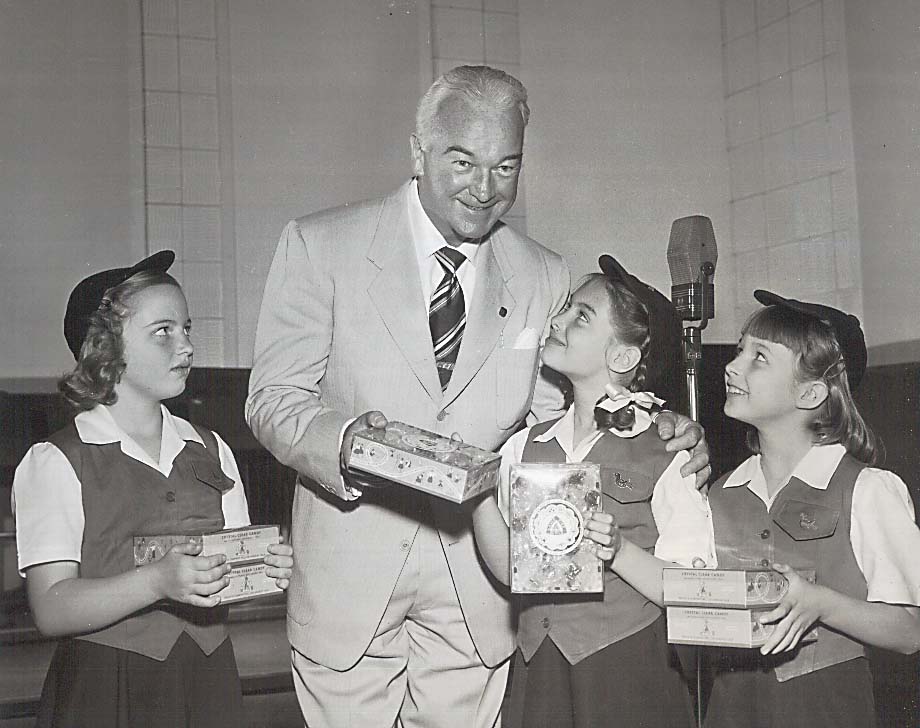


Stranger Than Fiction Showmanship


Anyone remember those "Bizarro" stories in the Superman comic books? They took place in a kind of parallel universe where unexplainable happenings were the norm and a weird sort of skewed reality prevailed. Now what if there were such places in our own experience? Certain remote corners of the exhibition stratosphere that somehow defied every rule of sanity and logic --- where showmen dreamed of the unimaginable and somehow made it happen? Well, I think they got a dose of it in April 1964 at Inglewood, California's Century Drive-In. The first Bizarro Cinerama Outdoor Screening. Just imagine yourself parked comfortably among 1,100 vehicles, quietly enjoying your first corn dog of the evening. First you hear rumblings of that enormous "mobile" projection system behind you (how would they have gotten such a monster parked?), and suddenly, there are three criss-crossing beams of light in would-be perfect synchronization (love to know if they were able to maintain that for even one show). You’re watching a picture that is 180 feet wide --- that’s going way beyond the scope of the windshield, let alone your peripheral vision --- and the thing’s 62 and a half feet high! Better just sit on the hood for this show --- or drive four miles or whatever back home and watch it from your front porch. I'd imagine passing truckers were alarmed. They must have felt like James Bond when Oddjob set up that big mirror in front of his speeding Aston-Martin. Wonder if drive-in Cinerama caused any pile-ups on the road? And what about five or so weeks from now when the fad’s over and they’re back showing Reptilicus, Hound Dog Man, and the like? Those are going to look mighty punk on that gigantic screen. I’ll bet that massive edifice was thoroughly stained with remnants of hurled popcorn, soda, and yes, corn dogs, by the time they finally gave up and took it down (assuming a stiff wind hadn’t already done the job for them). But what a crazy, magnificent spectacle in the annals of showmanship! It would be great to hear from someone who was actually there. Maybe they could tell us how long it lasted. Do you suppose there might still be structural remnants of that long-darkened screen still standing on some lonely, vacant spot out there in Inglewood, California? I’d like to think so. Just one little bizarro trace of a vanished moment we’d give anything to have experienced.


Saturday, March 04, 2006


Animated Prestige


They say that Jack Warner was one day conducting some lot visitors past the animation building. Someone asked Jack about it, whereupon he waved a dismissive hand and replied, Oh, that’s where we make all those Mickey Mouse cartoons. I can believe that story, for based on an ongoing perusal of old trade magazines, it never did seem as though Warners really noticed their cartoon department, certainly not to the extent other companies did --- as witness these attractive ads for the 1945-46 release season. It goes without saying that RKO was proud of their relationship with Walt Disney. Those family-friendly features and shorts were quite an inducement for exhibitors when an RKO season contract was laid before them, and the studio could prop up a lot of their own weak sisters with the promise of Disney subjects to sweeten the deal. Notice how they’re linking cartoon characters with that massive crowd outside Radio City Music Hall. Prestige bookings on Broadway sure helped when it came time to sell product to the hinterlands. RKO salesmen would no doubt be waving this trade ad in front of every small exhibitor in their territory.


Metro took a lot of pride in their shorts department, and nothing made them glow like Tom and Jerry, which was far and away the biggest success story of any cartoon series the company had. Here they are clubbing exhibitors with the Academy Award for Quiet, Please. That cartoon was like every other T&J --- cash cows for MGM. Ponder these figures --- Quiet, Please, a 1945 release, had a negative cost of $27,198. Domestic rentals for its first release totaled $77,520. Since cartoons were happily a timeless product, Metro was able to bring it back in 1953 for another haul --- this time rentals were $67,018. Yet another re-issue, this time in 1963, enriched the company to the tune of $35,404. Add to that the eventual TV sales, non-theatrical --- yak yak --- and those registers still sing with DVD sales for Quiet, Please as part of the Tom and Jerry Immortal Uncut (whoops --- some of them are!) Classics Collection, or whatever it’s called. That’s a lot of coin for a little seven-minute cartoon to be mining over sixty-plus years, and a real tribute to the longevity of golden age animation. Even Jack Warner might finally be impressed.


Friday, March 03, 2006


Pajama Party Scandal Of 1964


American-International was one company that clung to the old notions of showmanship long after the others had abandoned them, and that’s just one more reason we enjoy reading and writing about them. 1964 was a banner year for AIP, as they were knee-deep in a ten-year anniversary celebration, and once again touting their soon-to-be-major studio status. In the meantime, of course, they were still getting out their Poe series, along with the boffo Beach Party comedies, of which Pajama Party was a current release. Toward building those all-important bridges to exhibition, AIP toppers Jim Nicholson and Sam Arkoff attended all the important trade shows, and frequently brought along members of their talent roster for a little on-stage entertainment. Vincent Price was pressed into service as M.C. for many of these con-fabs, and beach faves Annette and Frankie were often obliged to give out with a tune from one of the pics. Out on the road, drive-in audiences were regaled with personal appearances by lesser AIP lights, including Jody McCrea, Candy Johnson, and others. Their comedy and musical interludes would generally be enjoyed from whatever stage area might be available in front of the screen. Often as not, however, the performers were relegated to the roof of the concession and/or projection building, where a spotlight might be provided from a parked vehicle. Many an AIP celebrity performed before the headlights of a pick-up truck. Still, the rubes were happy enough to have a little stardust sprinkled upon their benighted venues, as AIP was often willing to go into exhibition combat zones the majors had long since evacuated. Trouble was, those drive-in managers were notorious for skimming on percentages. Arkoff spends chapters in his outstanding memoir talking about how he chased those guys around for his share. One old-time vet told me that Sam himself would sometimes make a surprise drop-in at a rural ozoner, just to count the receipts. Old Sam put the checkmate on a lot of would-be help your-selvers this way. He and Jim were two guys that really worked hard for the money.


Sometimes AIP came a cropper with their daffy promo efforts, and Pajama Party provided nothing if not a stern lesson in decorum for the boys in publicity. The beach movies always promised more than they delivered. Kids were lured with posters and ads implying all sorts of bacchanalian frolics, near-nudity among beach bunnies being the least of these attractions. Parents were already on the prod. Girls just home from a drive-in encounter with the latest AIP product were ripe subjects for a pregnancy exam. Public opinion among moral watchdogs, especially in rural areas, was already at a slow boil when Pajama Party gave them just the ammunition they needed. As you’ll note from the Boxoffice headline, ministers in Gastonia, NC (hey, I saw MGM’s David Copperfield at a kiddie show there in 1969!) were "roused" by the pajama-clad flower of local youth, parading, nay flaunting, their nubile selves on a public street as they wantonly exchanged glimpses of their near-naked bodies for free ducats to the Center Theatre. Beleaguered exhibitor Henry Hughes must have wished he’d chosen a career with Winn-Dixie that week, for it looks as though all hell, if you’ll pardon the expression, had broke loose among the local clergy. This whole thing was a tempest in a teakettle however, since the errant youths did apparently wear street clothes under the pajamas, or sweaters and coats over them (must have been a bulky night at the movies). It was just the idea of such decadence that lit the fuse. Apparently, one minister went so far as to encourage parents not to let kids see the movie at all, perhaps on the theory that their entertainment dollar might be better invested in the forthcoming engagement of Masque Of The Red Death. Whatever.


Having recently watched Pajama Party, we found it harmless --- rather pleasant, in fact. Donna Loren’s kinda cute, and she performed some ingratiating toe-tappers. Buster’s there too, providing constructive outreach to Native Americans with his characterization of Chief Rotten Eagle. You can sample a few other AIP marketing strategies with these pressbook ideas, and while you’re about it, just imagine finding any 1964 exhibitor serving up a "country-style" buffet breakfast in his theater lobby --- free --- for Pajama Party patrons. You’d have had better success locating feathers on a frog. On the subject of money coming in, Pajama Party took a sharp turn south from the monster rentals garnered by the just previous Bikini Beach, which at $2.2 million domestic, was the biggest performer of the whole series. Being the
fourth in the group, Pajama Party brought back $1.5 in domestic rentals, heralding a downward trend that would continue with each new beach outing, until Ghost In The Invisible Bikini, with its paltry $745,000, ended the series once and for all.


A POSTSCRIPT: The ad for the Carolina Theatre on top is one I discovered in a Winston-Salem, NC newspaper dated March 19, 1966. Interesting that patrons were still being encouraged to attend in pajamas two years after initial release of the feature!


Thursday, March 02, 2006


A Few Birthdays


Very much a creature of the loud and brassy forties, Betty Hutton (2-26) is also a notable survivor of that era, and what a surprise Robert Osborne served up on TCM when he presented Betty, unseen for decades, as an interview subject on his Private Screenings series. When last we’d heard, she’d been on her knees scrubbing floors in a nunnery somewhere in New England, following a well-publicized crack-up, and forced retirement from the screen. Actually, she’d done a little television work here and there into the sixties (and even a Baretta in the seventies), but by and large, Betty Hutton had indeed become an enigma wrapped inside the cloistered confines of a protective convent, never to sing and dance at the top of her lungs again. This may have been the sort of escape Judy Garland needed, for Betty’s outlived Judy for over thirty-five years so far, and based on that interview, seems to be fit for a good many more. Her movie persona has admittedly not worn well. Hard-sell personalities of her type seldom do, and Betty is nothing if not "on" --- all the time --- non-stop --- which is part of the reason I’ve never been able to finish Miracle Of Morgan’s Creek, though her Annie Get Your Gun works OK if you’re of a charitable mindset. This subdued Betty portrait demonstrates that she could look very pretty when the occasion called for it.


There’s nothing quite like Jennifer Jones (3-2) in Duel In The Sun. I think she should have gotten the Academy Award just for that scene where she and the horse drank out of the mudhole together, but that’s just me, I guess. Anyway, the story goes that about eight or so years ago, some group was showing it in L.A., and Greg Peck begged her to show up for a live appearance. All day, he pleaded, and she refused, till at last he went over and picked her up in his car. Her hesitation was for the usual reason --- she wanted them to remember her "as she was". The story of Jen’s first break was interesting --- seems her dad, a high-powered Midwest exhibitor named Phil Isley, called in some favors with Herb Yates of Republic Pictures fame, and induced him to cast daughter Phyliss (as she was then known) in a few of his serials and "B" oaters. A few years later, after Selznick got the big campaign underway to "introduce" Jennifer Jones, she tearfully confessed her past as leading lady for Dick Tracy and The Three Mesquiteers. Dave saw red alright, but the thing was smoothed over quickly enough, much to the chagrin of soon-to-be-discarded first husband Robert Walker (Bruno!). We could say lots more about Jen, as she’s one of our very favorite femme stars. Suffice to say, she’ll be back in the near future as a Monday Glamour Starter.


Here’s the demure and lovely Mayo Methot (3-3) with husband Humphrey Bogart. He’s getting ready to enjoy a drink better suited to Glenn Langan in The Amazing Colossal Man. The whole set-up looks to be just this side of another of their legendary drunken brawls, the kind that on at least one occasion ended with a knife between Bogey’s shoulder blades, courtesy the wife. She’d been a modest hit in a few Broadway shows, done a few movies, but that success of his really got under Mayo’s skin and the violent fits of jealousy were no help either. Along came nineteen-year-old Betty Bacall in 1944, and it was Greetings Gate for Bogart. Poor Mayo descended into a black pit of alcohol abuse, and died there in 1951 at the age of 47. "Too bad", Bogart said, "such a waste". He always thought she had talent and threw it away. Now she’s a more or less comical footnote in the bios of her famous husband. "The Battling Bogarts", they always begin. You can see her in Counselor At Law, Case Of The Curious Bride, and Marked Woman, among others. She’s pretty good in a hard-bitten, down-and-out sort of way. Life had prepared her to be fairly convincing in such roles, I guess.


Wednesday, March 01, 2006


Feast and Famine For Bud and Lou


Suppose we begin by quoting some friends on the subject of Abbott and Costello --- "I used to watch them when I was a kid, and thought they were funny then …" --- "Do you really think they’re good?" --- or how about, "Those things don’t hold up for me anymore". Let me hasten to add that I don’t necessarily subscribe to any of these philosophies, though I would acknowledge some mixed emotions about A&C. First, one must weigh in the sentiment factor. I suspect most film fans of my generation share a degree of nostalgic warmth for these comedians --- be it their Universal features, or their fifties TV series (with it’s always at a crescendo of hysteria laugh track) --- as both were television staples at one time. For me, it was a handful of the features that did it. Were he alive today, my father might still recall his own alarmed reaction to my expressions of boyish mirth over the antics of Abbott and Costello when they met the Keystone Kops, and this sixties youngster always had his radar up when one of the Meet the Monsters pics showed up, as that generally promised the bonus lure of Karloff, Lugosi, and/or Chaney. I know boomer fans today who still regard Abbott and Costello Meet Frankenstein as a near-religious experience, although when I ran it recently for a 34 year-old nephew and his wife, it got nary a chuckle. Just kind of laid there. If we can no longer maintain, or even acknowledge, our one-time appreciation for Abbott and Costello, then what’s next? Will we someday renounce Chaplin … Keaton … Laurel and Hardy? Old age may indeed be a desolate place where nothing seems funny anymore. For the meantime however, I’m still willing to express a certain fondness for the boys, if for no reason other than the fact they're so fascinating as individuals.


Two nagging questions that have haunted me. (1) Did Bud really ask fans to send him fifty cents, or a dollar, or whatever, when he was down and out? (2) Was Lou really a tyrant and mean to Bud? Alright, first the begging story. I found an old interview on line, and it’s dated 1960, very soon after Lou died, and Bud’s flat on his uppers. Yeah, he admits he’s busted, thanks to a punitive IRS, but damnit, that reporter misquoted him when he said Bud wanted handouts from fans. Sure, things are bad, but he’d never sink to that --- and anyhow, the few hundred bucks the fans did send weren’t enough to make a week’s payment on that tax bill, but thanks anyway. The scribe portrays Bud as a bitter old man. Well, you’d be bitter too after spending much of the war criss-crossing the nation, at your own expense, to sell bonds and support Allied relief efforts. I thought Bud and Lou got a raw deal when I first read about that some forty years ago. If anything, I’m even more sympathetic today, having enjoyed taxpayer status myself for a number of decades. Poor Bud. There was never any doubt that he was a nice guy … but what about … Lou? If you read Bob Thomas, or see that incredibly lame TV movie with Harvey Korman and Buddy Hackett, then you know Lou was a monster, a lout, a sawed-off little bas --- well, let’s not belabor it. Daughter Chris Costello tells a different story, and yeah, she’s talking about Daddy, but I still tend to tip the scale a little in her direction. Maybe it was seeing Abbott and Costello on This Is Your Life that did it (available on DVD). That’s an incredibly moving and dramatic episode. The segment when Bud comes out, and this is shortly before the split, is just one of the most heart-rending moments on television. It’s like this hapless guy wants so desperately to get his old partner back, but you can tell it’s hopeless. Lou’s very subdued throughout. Maybe he was brusque around the set, but this is proof he was a devoted family man, and what he did for various charities is still pretty awesome. No, I don’t care what anybody says. Lou was alright. God knows the loss he suffered with his son and that swimming pool is enough to get him a pass from me, no matter what else he ever did. That, plus the fact that he’s a great talent, and I dare say if most of us had been around in 1941, we’d have no doubt called Buck Privates the freshest, funniest thing on the face of the earth.


Here are the boys doing what they really did best --- raising money for the war effort. And here they also are --- gambling at cards between takes (of Hit The Ice) in a game that might just as well have been called "Easy Come – Easy Go", as that’s how their respective fortunes went from the moment they hit the movie big-time. Was it boredom on the set that made them so reckless with money? Lou certainly looks bored here, doesn’t he? And they both seem pretty zoned out with Governor Whatzit of California as he drones on with a thank-you speech they must have heard at every whistle-stop throughout the war. We do like the little photo feature of Lou’s kitchen antics just before he and now pig-tailed peekaboo girl Veronica Lake do their butter and egg auction. Wonder if high bidder Mrs. Julia Green of New York could possibly be alive today? She must have had a neat story to tell her own boomer kids years later as they sat watching A&C on the telly. One can imagine the comedic donnybrook that ensued when the boys put their own wardrobe on the bidding block --- look at that gallery of screwballs on the dais --- Bert Wheeler, Lee Tracy (don’t let him on the balcony!), and genial big oaf "Slapsie" Maxie Rosenbloom. Between their war work and raising funds for the Lou Costello Jr. foundation, the two comedians no doubt assured their place in Heaven, and to think, much of this took place after Lou had been out a year, flat on his back with rheumatic fever! Great troupers in their glory days --- and both would finish in IRS imposed bankruptcy. But for all they’d done here, couldn’t the tax boys have gone a little easier?
grbrpix@aol.com
  • December 2005
  • January 2006
  • February 2006
  • March 2006
  • April 2006
  • May 2006
  • June 2006
  • July 2006
  • August 2006
  • September 2006
  • October 2006
  • November 2006
  • December 2006
  • January 2007
  • February 2007
  • March 2007
  • April 2007
  • May 2007
  • June 2007
  • July 2007
  • August 2007
  • September 2007
  • October 2007
  • November 2007
  • December 2007
  • January 2008
  • February 2008
  • March 2008
  • April 2008
  • May 2008
  • June 2008
  • July 2008
  • August 2008
  • September 2008
  • October 2008
  • November 2008
  • December 2008
  • January 2009
  • February 2009
  • March 2009
  • April 2009
  • May 2009
  • June 2009
  • July 2009
  • August 2009
  • September 2009
  • October 2009
  • November 2009