Classic movie site with rare images, original ads, and behind-the-scenes photos, with informative and insightful commentary. We like to have fun with movies!
Archive and Links
grbrpix@aol.com
Search Index Here


Monday, October 02, 2017

Generations Since We Had It Complete ...


The Sea Wolf (1941) Howls On Warner Blu-Ray


We're about to get dosed up with a more complete Sea Wolf than they've had since initial release of 1941. Warners delayed disc release for years in hopes a complete print might turn up. There was but one in 16mm for the meantime, that owned by actor John Garfield, and later property of his estate. This was shown on isolated occasion, but no way could Warners construct satisfactory whole by ying-yang from pristine, but cut, elements of their own with cloudy 16mm via the Garfield holding. Sounds much like old "uncut" prints of King Kong where inserted snips fell down a quality well each time one popped up. Jumps throughout The Sea Wolf would have been glaring, with complaints assured. The original negative did exist, on deposit at the Library Of Congress, but this was the cut version. Happy find that led to forthcoming Blu-Ray release was a nitrate fine grain at full-length. Now at long last we may sail again, October 10 the launch date. The Sea Wolf has made do with thirteen minutes shorn for seventy years, so Bravo to Warner Archive's righting that wrong.


1947 was chopping date, The Sea Wolf tail-end of a double bill reissue with The Sea Hawk. Both were shortened so theatres could freshen crowds every three and a half hours instead of hosting them for over four. Trims would add at least an extra show per day, and that spelled much paid admission. What did casual patronage care from incomplete versions? The Sea Wolf went from 100 minutes to 87, The Sea Hawk taking steeper drop to 109 minutes from 1940 run-time of 127. Warners tried the duo in test markets during early 1947 and saw two Albany houses equal their house record, a dazzling score for first-runs, let alone an oldie serve. Word of the gross brought 100 requests from outlying showmen, said WB to Variety (4-2-47), and April 26, 1947 was set for a national rollout.


"Unprecedented" day-and-date bookings, on first-run terms, were arranged for the pair, Chicago getting a "fabulous" $19K in a first week, but "falling apart" for a second (Variety) with a mere $8K. Warner's Strand on Broadway committed to two weeks, dropped its customary stage show, but admitted in hindsight (7-22) that Hawk/Wolf did "weak" business overall. There may have been overconfidence in keeping the pair past a single frame. 1947's public was bullish for some reissues, ice-cold on others, as 20th Fox found with "miserable flop" that was Alexander's Ragtime Band, which had lots of promotion money poured over it that would not be got back. As with so many shows, different territories told a different story. Three Warner theatres in the Los Angeles market racked up a "pleasing" $50K for the first Hawk/Wolf week, and nationwide tally had 150 first-run situations grabbing carrot that was The Sea Hawk/Wolf. Variety saw trend of oldies "going big out in the stix" (4-25-47), WB's combo liked by small towns. Bad fallout of the 1947 revive was Wolf negative cut for bunk-in with The Sea Hawk and left that way, all theatrical, and then TV prints from 1956 syndicated release onward bearing the scars. It's lucky, if not a miracle, that the nitrate showed up for Warners access. This then is a Blu-Ray I will be most eager to see.


Monday, September 30, 2013

Flynn As "The Robin Hood Of The Seas"


Favorites List --- The Sea Hawk

There's a provocative entry among Steven Scheur's Movies On TV entries that reads thus: Sea Hawk (1940) Try and stop your youngsters from watching this salty tale of a sea-going Robin Hood. Don't leave the set too fast yourself because you're liable to enjoy this lusty sea story. Scheur's capsule reviews used to appear in our Winston-Salem Journal with TV movie listings. He was the critic who infamously referred to Bride Of Frankenstein as "way above average for this kind of trash." Ten-year-old me wanted to box his ears. Such snobbery prevailed in the 60's and much of the 70's. Are we even now past it? There was a Hollywood and The Stars episode, done around 1963, wherein Joseph Cotten narrated an appreciation of swashbucklers and referred to The "magnificent" Sea Hawk. Now that was more like it. Trouble was low contrast prints sent by then owner United Artists to stations leasing The Sea Hawk and others of the pre-49 Warners package, 16mm washed in flat gray-tone to meet prevailing broadcast standard (it was felt that low contrast registered better on home receivers). Collectors had a fit finding a Sea Hawk worthy of rich B/W audiences in 1940 experienced.


There also was a wonderful soundtrack album issued in 1972 to renew interest in The Sea Hawk. Charles Gerhardt conducted selections from the sefaring epic and others of Erich Korngold composition in what RCA sold as first in a series of classic music revivals. Colleges could rent The Sea Hawk for $75, but prints from UA/16 were a same as television, to-wit gray as ghosts. A hazard too were cuts that had been made by WB for a 1947 reissue, these diminishing The Sea Hawk from 127 first-run minutes to 109 for a pairing with The Sea Wolf (also trimmed). The footage had been put back to most prints in later TV/rental circulation, but collectors still felt the bite of stragglers reduced down from Dominant Pictures' 35mm that serviced 1956 dates. Dominant was a late theatrical stop for The Sea Hawk before its surrender to television with other Warner oldies. You could recognize cut prints for Dominant's logo that appeared at the head of credits. For 16mm gatherers, this meant Buyer Beware.


Now all that is as much quicksilver, for The Sea Hawk flies upon High-Definition wings on streaming services and hopefully soon from Warner Blu-Ray. It is a show that benefits for sharpest delivery of black-and-white, being one of the most richly designed and photographed of Gold Agers shot monochrome, a word I almost hesitate to use considering that The Sea Hawk looks more vivid than many peers boasting Technicolor. It might have been done in the latter process but for stock footage from earlier Captain Blood and even 20's sword/sash stuff Warners intended to use, but barely did, as spending for The Sea Hawk rose to a near studio record of $1.701,211 (only The Adventures Of Robin Hood had cost more). Of pirate pics Errol Flynn top-lined, actually fewer than you'd think considering his iconic status as such, The Sea Hawk was a summit. It's among his best and now even better thanks to HD delivery.

A Concluding Scene for The Sea Hawk That UK Patrons Saw More Of.

What Warners has today is unique too as a definitive and for years unseen version of The Sea Hawk, being complete beyond even what American audiences saw in 1940. British prints featured an extended version of Flora Robson's Queen Elizabeth speech at The Sea Hawk's conclusion, it being a call to arms and plea for preparedness that would resonate with a UK public girding for their own war with Germany. The speech wasn't used for US prints, Flynn's character being knighted, and no more, for the pic's finish. Even notwithstanding the trim (and a sequence aboard ship between Flynn and Donald Crisp), The Sea Hawk was nakedly political, and one more reason voices rose in protest over Hollywood's support for Euro intervention. TV watching of years after WWII ignored or didn't notice parallels between Spain's King Philip, the Hitler counterpart, and Queen Elizabeth standing in for beleaguered England. Where was difference between plotted Spanish conquest and Germans laying in 1940 wait? The message couldn't have been clearer if contemporary-set.

A "Color-Glos" Still As Issued by Warners for The Sea Hawk in 1940

Something else I noticed this viewing was the violence. Was that basis for Steven Scheur's counsel for parents to  "stop your youngsters from watching"? Battling aboard ship is brutal, as are whips applied to captive backs below deck. The old Fairbanks model could distance itself from carnage through silence. The Sea Hawk used the clash of swords and an aggressive music score to update benign pageantry to a new level of costumed bloodletting. We notice it less today for endless imitating since, but imagine 1940 response to The Sea Hawk's fresh coat on swashbuckling. Captain Blood had been a start, but harked more to a ruffle sleeve past than to vigorous future The Sea Hawk would herald.


Flynn's performing too, had matured. I don't know of another 30's lead man whose acting progressed so rapidly (compare him in Captain Blood with immediate-after Charge Of The Light Brigade). Errol gets a little cute and ad-libby at times in The Sea Hawk, business with the monkey as example, but in moments where he exhibits leadership under stress, there's just no peer to Flynn. Watch next time business in the swamp where he notes desperate condition of his men, then draws himself up in knowledge they'll look his way for salvation. It's a great moment that wordless-conveys quality this star had that others wouldn't duplicate.

Luxury in Abundance at The Ambassador Theatre in St. Louis 

Here's an interesting engagement for The Sea Hawk that illustrates ongoing love-hate between exhibition and a by-1940 entrenched double-feature policy. The Ambassador in St. Louis was a deluxe house that seated 3,005, and was thought fully equal to any palace in the country. Their launch of The Sea Hawk in September 1940 would also inaugurate a Single-Feature strategy, featuring the "Finest Short Subjects Available" as opposed to the customary B feature in support. Reserved seats were available with prices advanced. RKO supplied the junior fare, a March Of Time about the Dutch East Indies, and Walt Disney's Technicolor cartoon The Bill Posters, with Donald Duck and Goofy. The entire program, with perhaps a newsreel, would have exceeded two and one half hours. The Sea Hawk teed off a testing period for the new policy as conducted by Ambassador owners, the Fanchon and Marco chain. Over five weeks following The Sea Hawk, these were tendered as singles: Brigham Young, The Howards Of Virginia, Spring Parade, No Time For Comedy, and Down Argentine Way. According to Variety report, the plan failed and double features were back by late October. Had two-for-one been implanted for keeps in the minds of moviegoers?


Monday, December 14, 2020

Do They Like You Best When You Play Yourself?

That's Hal Wallis Hovering Over Eddie and Paul

Personality The Cake, Versatility The Icing


Under head of disliking someone who has too much in common with you comes Edward G. Robinson and Paul Muni, two peas in a Warner pod who had strong personalities plus versatility, but could not abide one another, as stated flat in Robinson’s memoir, “I disliked Muni and Muni detested me.” Being “versatile” saw Robinson/Muni engage strikingly different parts, never so hemmed in as many of peers. Tough customers at a start, bound by that profile you’d think, but these two itched to go beyond brute man mode, Muni early declaring himself done with it, Robinson keeping avenue open should career flux oblige him to again snarl and wield a gat (it would, and often). Theirs in the day was adjudged to be “acting” in a sense of no role beyond either, exaggeration on its face that Robinson/Muni sensed better than critics draping them in laurel.

Joseph Jefferson as Rip Van Winkle

Maude Adams ... Writers Claim She Was Not a Beauty ... Sez Them!


Wrangle between performance bound by “personality,” as opposed to “can-do-anything,” (and should) fed debate and discussion among actors from a thesping start, consensus no nearer now than in the nineteenth century when braver voices (some prominent) lauded players who put aspects of themselves into whatever part they took, audiences not only appreciative, but insistent that they do so. A so-called “cult of personality” arrived with greater realism the stage would embrace, actors becoming more like us as individuals rather than representatives for the American spirit. Versatility could still be admired, but loyalty, in fact love, was a performer’s reward for choosing those parts that fit best. Joseph Jefferson could do, had done, a mosaic of roles over a long career, but it was as Rip Van Winkle that he would gain immortality. Maude Adams, basking in warmth her Peter Pan generated, knew too well, and from humbling experience, that Shakespeare was ice flow to be avoided, at least for her elfin type. The list went on: James O’Neill a nonpareil Count of Monte Carlo, even if trapped by the role, Edwin Booth a Hamlet or Richelieu for the ages (above right), but wise enough to duck Othello. People came less to see Hamlet than Booth as Hamlet, his singular impersonation their value for money. So never imagine the movies introduced a star system. It was well in place before first flickers lighted a screen.


William Gillette Shows Off The Personal Railroad At His Connecticut Estate


Most prosperous of artists knew their strength, and limits. Each acclaimed great, their public responded to favorites playing a character as much or more than the character being played, each role but variation on what the actor or actress had offered before. Critics said this was valuing outward appearance rather than proven acting skill. Aged in wood from birth in 1858, and a thousand parts played since, Otis Skinner spoke for an old guard raised on the road or in stock companies, “Acting has changed. Versatility, once the choicest possession of the player, is being bred out of the stock. Actors are no longer chosen for their ability to express every and any character, but for their physical and temperamental approximation to one particular character.” So how was this a bad thing, answered others, among them William Gillette, who wrote his own best vehicles, and was legendary as Sherlock Holmes. Gillette spoke to personality as any actor’s defining asset. Citing a “plain fact” to the New York Times, he claimed “personality as the most important thing in really great acting,” this a quote from 1914 as applied to stage artists, a star system in movies still emerging at the time. Gillette challenged a consensus. Stock companies throughout the country had after all prided themselves on membership that could do it all, and did. Veterans from “palmy days” longed for a lost era when to act was to act whatever needed acting. Was this not the truest measure of a professional’s skill? Gillette thought not, pointing out that times, and audience expectation, had changed. Realistic acting required a closer identity between part and player. “Personality is the most singularly important factor for infusing the Life-Illusion into modern stage creations that is known to man,” said Gillette. Actors “playing themselves” need not apologize for doing so.


Movies took this many steps further as stars created by screens made the audience-artist identification far more intense than anyone could have imagined. Old-timers saw this and were threatened by it. How could a comparative beginner who made a specialty for him/herself rise overnight to fame no stage artist dreamt of? Yet it happened, and repeatedly. Close-ups were a factor, in fact the determining one. Suddenly we were near enough to feel nuance and expression as our own, a level of intimacy not attainable no matter how close one sat to a stage. The meteoric rise of a Chaplin or Mary Pickford went beyond anyone’s experience, but if electric lights and motor cars were possible, then peace must be made with this, even as many a grey eminence resisted (see Tully Marshall kick traces in early 30’s interviewing). These of a passing generation kept faith that to act was to enact whatever was put before them. Maybe this would do for character and small parts, but stars weren’t born by such route, and most actors, after all, longed to be stars.


Edward G. Robinson and Paul Muni were character stars. Romantic leads sat uneasily with them, both the better for that, as options widened to include youth-to-elder sagas (Muni with The World Changes, Robinson and Silver Dollar), social-driven themes (much of Muni), and show-offness of dual roles to offer wide range for one ticket. Having shown capacity to startle, Robinson with Little Caesar, Muni with Scarface and Fugitive, both could show amplitude to a public safely aware of dynamism they had in reserve. Throughout years to follow, we sensed the killer instinct behind whiskers Robinson and Muni often wore. Our knowing they could return to basics made variances tolerable. Fun was when restraint was served in a same frame with hard cases we liked Robinson or Muni to play. Humble-in-extreme The Man With Two Faces (72 minutes) has Robinson being “himself” for a first half (an actor of forceful E.G. mien), then showing up bearded as a timid scholar (mere disguise… he’s committed murder and is hiding behind the muff). His next feature had Robinson, meek again as a bookkeeper and butt of office jokes, met by a snarling “Caesar” doppelganger (also Eddie) on the lam. This was The Whole Town’s Talking in 1935, which by then saw a whole town talking about Robinson as one who could do most, if not all, of what dramatists devised.


Paul Muni’s was a more distinct about-face, maybe too much considering legacy he left and how we remember him. No longer would Muni be an ordinary Joe at a reporter desk (Hi, Nellie!), a sort of part to invite comparison with livelier wires Cagney, Lee Tracy, others more at home in city rooms. The Story of Louis Pasteur was his own radical idea, at least going forward with it, a departure from what Muni played to then. Warners resisted, so far as the star flattered himself in recalling (practically “snuck” it past them, he said). Pasteur then was the plunge, his Academy statue the reward, “Mr. Muni” addressee for Warner memos composed from kneed position in deference to status now his. Rugged up to then in Bordertown and Black Fury, mitigated only to extent of ethnic tilt laced with accent, Muni’s unadorned face was still there to look at, till Pasteur and Zola belled the cat, heavy beard and bent posture under weight of an industry's esteem. Wallis saw threat of Muni forsaking “Paul Muni,” a charismatic brand with life left in it. Trouble was Muni wanting no part of things he had done before, thus firm and final no to High Sierra, being a gangster part, him foresworn not to be that again. The Sea Wolf was also offered, Muni in something akin to energy and aggression of old, but again he’d pass, Edward G. Robinson doing Wolf Larson and thriving (Wallis: “Muni … was extremely critical of the roles offered him, and turned down part after part”). Muni eventually left Warners by mutual consent after a last few for them went into red, the star blamed in part for overruns on Juarez. A vogue for historicals seemed over, and maybe Muni with them.


Robinson had gone a similar route and knew it, referring later to Muni as “my most potent competition. He played Pasteur and Zola; I could have. I played Ehrlich and Reuter; he could have. The Brothers Warner regarded us as two sides of a coin and did not hesitate to exploit the situation.” Robinson was flexible where Muni had not been, E.G. mixing character tries with what his mob expected from “Edward G. Robinson,” investing in safe stock to keep taut a lifeline (Ehrlich and Reuter both lost money). The 40’s saw Robinson broadening his brand further, triumphs in Double Indemnity (a support role, but the picture could not have done without him), Scarlet Street (a milquetoast, but murderous where pushed), ganging it up for laughs (Larceny, Inc.) or being hardest bark (Key Largo). HUAC weight and domestic collapse put Robinson in what he’d call “B’s,” but how he elevated them … Vice Squad, Black Tuesday, even a trifle like Big Leaguer. Paul Muni opted mostly for the stage, did a welcome reprise on gangsterism for half of dual role he had in Angel On My Shoulder, which in 1946 showed what might have been had Muni played ball with genre formula. Like virtually all of past/present Hollywood in the 50’s, Robinson and Muni guested (separately) on What’s My Line, Eddie brisk and chatty, Muni reserved and giving answers via awkward device of playing “Yes, We Have No Bananas” on a violin he brought, a gesture to counter those who claimed he had no sense of humor. There are books on Robinson, one by himself, and excellent. Michael Druxman wrote on the life and films of Muni, revised and reprinted by Bear Manor in 2016.


Monday, May 31, 2021

Gold Is Where Average Viewers Find It


Critics --- Get To Know Your Audience!


What more useless than critic reviews the product of screening rooms where company was other critics, films they saw not yet put before a retail public. These I skip in favor of notices the fruit of crowded view, where a Mordaunt Hall, Frank Nugent, or James Agee bore witness to crowds lit up by movies they were not paid to evaluate, but themselves paid to enjoy. Plain folk reactions often guided critics as to how they should react. How any film was received by its first-run audience was most valuable data any observer could record. Fans memorialized such events in scrapbooks, while pro scribes who were most perceptive incorporated live and spontaneous response into columns they wrote. Mordaunt Hall did so in 1925 when Valentino came to Broadway’s Mark-Strand with The Eagle, Hall’s reporting a clean break from herds reviewing the film but none of context surrounding it. Frank Nugent found himself hip-deep in hepsters on January 4, 1939 when he settled at the Paramount to ostensibly review Zaza, a Claudette Colbert drama-comedy few cared hoots about, for they were there to see Benny Goodman and his Boys play live on stage. Nugent gave up notion of critiquing Zaza to instead eulogize said hapless non-attraction “rude enough … to disturb the chatter, the hand-clapping, and the rhythmic foot-stamping of an audience that was impatient for Benny Goodman’s orchestra to take the Paramount’s stage again.” Sad was fate of any film backing white hot stage accompany, none so steamy as Goodman at ‘39 zenith of popularity.


Quote Nugent: “Key scenes (of Zaza) were greeted by chants of “We want Benny! We want Benny!” Colbert and company were “received coldly,” love scenes prompting “audience wits (who) took it upon themselves to shout advise, most of it unprintable,” result being “Mr.Goodman and his adolescent following had the Paramount all to themselves … Zaza and its would-be reviewers were simply interlopers.” Nugent was obviously a good sport, realizing as he should that the profile of any film is tied up in its reception by initial audiences. No movie played in a vacuum, even if current circumstance suggests they do, and will, what with streaming the increased way to go. Anyone thinking they know the Val Lewtons and Curse of the Cat People should read a remarkable notice James Agee turned in circa April 1, 1944, his having caught Curse (ideally) at Arthur Mayer’s legendary Rialto Theatre, all-night and day retreat for seekers after screen sensation, Agee there “by pure chance” on what he referred to as “a reviewer’s holiday.” Curse of the Cat People took he and patronage by surprise, for contrary to what the title suggested, this was low-key and sensitive exploration of a child’s dream world, a seeming last of choices the Rialto mob might make. They responded warmly, “showed it in their thorough applause,” said Agee, whose review became as much an appreciation of Rialto clientele as an endorsement for Curse of the Cat People, even to a point of citing the “West Times Square” viewership as a “finest movie audience in the country,” calling them “deeply experienced” where it came to rooting out worthwhile films.


Agee lauded “infinite superiority” of Rialto watchers over what he termed “art-theater devotees --- not to mention … the quality and conduct of Museum of Modern Art film audiences,” him fed up by self-conscious art/quality seekers. So long as there was patronage like the Rialto served, “no one in Hollywood has a right to use the stupidity of the public for an alibi,” Agee maintaining there was always a ready audience for “films as decent and human” as Curse of the Cat People. Among thinking critics then, it looked like a crusade on behalf of Val Lewton and work likely to be misunderstood due to RKO merchandising and theatres appealing to low denominators. Manny Farber boosted Curse to point of comparison with The Song of Bernadette, vision-seeing Jennifer Jones’ performance left wanting beside that of little Ann Carter, whose similar sightings were for Farber more effective and believable. Something about Lewton drew renegade reviewers. They saw how he upturned Hollywood formula from basement level at RKO, a model for those who thought for themselves in an industry largely forbidding step off a chalk line. To like Lewton was to be of his independent stripe. Being fashion choice for critics was no influence, however, upon trade appraisal concerned only by whether product pulled B.O. weight, Curse of the Cat People a distinct letdown by their reckoning.


Those on the inside knew getting customers on board with art mislabeled as horror was a higher hill than quick in-and-out theatres could climb. What two-day run built word-of-mouth even where latter was enthusiastic? Trades figured Curse of the Cat People too elegant for anyone’s good, let alone teens who were “practically the entire patronage” for chill bills where Curse typically placed, consensus opinion as expressed by Indianapolis manager of the Lyric Theatre, Frank Paul. Keep selling simple was not just a best, but an only way to go where hundreds of features passed through your doors per year. No time to cultivate even a most exquisite rose; let uptown critics pluck these at leisure and maybe send gem seekers your way. This was real world of management trying to mollify cat people fans asking why they didn’t get cat people in this movie. Based on such a title, who'd blame them? Trade reviews could be cruel, but they spoke to truth of marketing. “Mediocre” said The Motion Picture Herald and Harrison’s Reports, “unique horror of the original is not recaptured,” added the Herald, Harrison of the opinion Curse “fails to carry the punch” of previous Cat People. Motion Picture Daily warned against drawing parallels with the 1942 chiller, lest fans feel “defrauded,” Curse less a shocker than “a fanciful tale for children.” A real concern was exhibitor attempts to link Curse with Cat People, for that matter any horror, patrons most likely to be alienated once wise to what for them was a ruse. Merit of any film was secondary to its sales potential, trades there to pitch for … or warn against … all to arrive at market. Anything falsely advertised was better avoided. Why invite complaint with horror that was anything but horrific?


Curse of the Cat People
stood its Rialto ground for two weeks, where, like most of their attractions, it played as a single. Manager/owner Arthur Mayer (showman colleagues the Brandts had a 25% Rialto interest) kidded his status as “The Merchant of Menace,” fact being virtually all his attractions were NY first-runs, not of highest profile perhaps, but a banquet spread before passerbys lured by Rialto front promotion and wild stunts to sell action/thrill subjects Mayer cleaved to. Curse of the Cat People collected $12K a first week, and so held for a second, which took $8K. Previous tenant Calling Dr. Death, from Universal, merited a three-week stay, arriving just after Return of the Vampire, these typical of product the Rialto played. Mayer and ad-designer, entrance-decorator George Hoffman out-circussed the circus, except Rialto fairground stayed open all night, two entrances from the street plus access from a subway platform beneath the theatre. This was useful for school truants, errant husbands, or whoever was on the run from authority, downstairs a quick getaway to departing trains should anyone come through the front looking for you. Gunshots were commonplace amidst dark Rialto trappings. Mayer’s son acquired usher skills in part by advising amorous couples that they might enjoy greater privacy by retiring to coital confines of the Rialto’s less populace balcony, for which Dad gave him a raise for tact and ingenuity. This was before Mayer tore down the old Rialto, which had begun as Hammerstein’s Victoria, once home to the “Flying Appletons” of Portrait of Jennie fame. The space tumbled from 1,960 seats to 600, sans balcony, part of ultra-streamlining Mayer meant to apply now that ongoing Depression had Broadway by show throats.
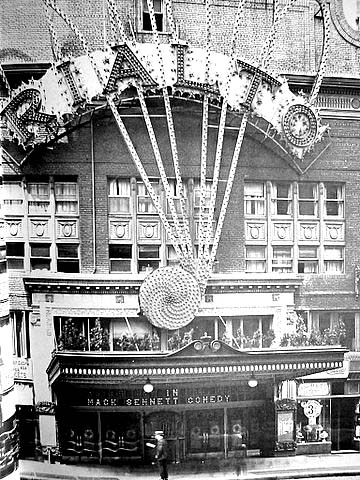

Above Two Images of the Rialto in Earlier Incarnations 


Mayer proved himself a scrapper from early on. He had leased the Rialto from Paramount after being in their employ for years, doing publicity, taking orders. Para brass thought the Rialto washed up, a teens-era barn seldom filled. Mayer began the comeback upon leased receipt and stripped overhead to bare bones, working a deal with distributors to play second-tier product, including Universal’s, the Rialto in receipt of U’s the Music Hall did not want. One of those was The Bride of Frankenstein, which Mayer thought ideal for his mob, but the Roxy wanted it also, and Universal in a venal moment let them book it, result an aggrieved Mayer filing suit to block the engagement. Courts got involved: he wanted an injunction against Bride unveiling on Roxy ground, negotiators from warring sides burning late-night oil toward peaceful resolve. Outcome was the Roxy taking Bride of Frankenstein, the Rialto getting Werewolf of London’s premiere as salve for its pain. Such was contest over goods with exploitation promise, Mayer knowing what sold best and ready to go to the mat for it. He talked about policy … wrote witty accounts for trade chums, Terry Ramsaye at the Herald of long-stand association. Mayer was educated (Harvard), knew culture, but chose to wear it lightly, kicking highbrow notion in the pants for preferred “murder, horror, mystery, and fighting.” He (and patrons) liked comedy too, lower-brow the better. Mayer arranged a mural for Rialto walls to celebrate his “steady and sturdy clientele, primarily male.” To that strategy he applied The Lost Patrol, which other Broadway houses “passed up because it had no women in the cast.” Patrol stayed at the Rialto three weeks to packed seating, a bold stroke against ingrained theory, and it worked. Mayer’s notion that one man’s theatre should reflect his own philosophy, and adhere to it, was a sound one.


The Rialto stuck with single features but loaded up on shorts that would excite male interest, newsreels plentiful, not ones fashion-oriented (unless it was swimsuits), sport reels a best where prizefighting was focus, cartoons always a hit, short comedies so long as they were impolite. News took a spike with fresh war in the 40’s, The Marines at Tarawa a rousing extra with Curse of the Cat People, as was The Hungry Goat, a Paramount Popeye, latter a favorite for the Rialto’s kind of audience. That wall mural featured him, plus the Three Stooges, Laurel and Hardy, along with poised daggers, mad science, vampires, a full course for Rialto diners. The theatre was first-run Gotham host to scare offerings from the mid-thirties through much of the forties. Mayer’s would also be launch pad for Laurel-Hardy feature output, the Rialto first to get Way Out West, Swiss Miss, The Flying Deuces, Air Raid Wardens, others. Super-A’s went elsewhere, for what use did Mayer have for a latest Greer Garson or Paul Muni? He chided the Music Hall for advertising “too dignified,” cursive scroll, white space, and what not. The Rialto took what was trade-known as “sluffs,” humble fare if not outright B’s the big studios generated but did not care to showcase at flagship housing. That’s how Mayer came by, and gave pride of Rialto place, to Arsene Lupin Returns, an MGM runt of 1938 litter that George Hoffman dressed up like a thrill-Vesuvius poised to erupt.


Arthur Mayer got joy from playing “bad” movies, but really, it was those bad movies he respected more than gilt-edge emptiness the lot of too many studio specials. If his offerings were so lousy, why were people so eager to come in and watch them? Mayer during 1941 singled out stuff critics did not like … The Shanghai Gesture, Hellzapoppin,’ Sundown, emphasizing how each were selling strong along Broadway. Further example from his own Rialto, The Wolf Man, spat upon by reviewers, “piled up the year’s outstanding gross” for Mayer, while celebrated Citizen Kane, down several blocks at the RKO Palace, “left most picture-goers either bored or puzzled or both.” New York critics “are too smart,” he said, Mayer summing up that “Movies are a mass art and must be judged by men and women whose pulses beat in rhythm with the heart of humanity.” So who did Mayer think he was? Just someone who had worked this business since the teens. “Most theatres have to sell 100 to 300 pictures annually. They cannot do this with under-emphasis or apology. The day that advertisers in this industry stop believing that every motion picture is the greatest of all forms of entertainment, that day we are all sunk. The day that every producer, whether he is making an A picture, a B picture, or an XYZ picture, regains that faith, that day our worst troubles are over.”


Unveiling the Rialto's Drawn-To-Ghastly-Measure Mural


Mayer thought Top Ten lists were largely for birds, lest it was ten most attended or popular among hoi-polloi he catered to. Being one who’d act on rebel impulse, and happy always to travesty taste-makers, he made annual gift of “Rialto Ten Worst,” a Yuletide thumb-to-nose for critics who took cinema too serious. Partying was fuel for Rialto staff, trades filled with recap of whatever Mayer lately celebrated. It could be the venue’s anniversary, a birthday (anybody’s), or just the help saluting their boss for being such a regular guy. Guests came from up-down Broadway-42nd, every hour Happy Hour at the Rialto, as the place never slept. Bookers, brother managers, studio folk in from the opposite coast, even stars who knew where fun was best had (Sir Cedric Hardwicke announcing “Worst” winners for 1939 at a Santa soiree). Rivals by day were common-cause revelers by night.  Wonder if critics like Agee or Farber attended a Rialto party … only if they could laugh at themselves, I suspect. Guests could get stewed and not worry about a drive home, hacks or subway mere steps or stagger away. The working show world was a closest of any fraternity because these people ate and slept their trade, yes, drank it too. Selling dreams round clocks was way of life that once engaged, never was parted from. Arthur Mayer stayed a biz course through exhibition, distribution (Euro imports), production (documentaries), consultation (remember his supervising Freud events in 1963?), a memoir (Merely Colossal), plus what was for many a first book on movies, called The Movies, co-written with Richard Griffith. The Rialto, sold by Mayer in 1948 to Brandt interests, demolished since, thrives among annals of splendid showmanship. Best ballyhoo a film could get was got just for opening there, truly a portal to then-viewing paradise. Mayer himself lived ninety-five years, till 1981.

Many Thanks to Lou Lumenick for supplying the Paramount Theatre's Zaza ad.


UPDATE: 5/31/2021 --- 11:10 am --- Ed Watz checks in with as-always fascinating info and some terrific ad images:

Hello John,

Hope this finds you well - we're doing good in our neck of the woods.  I just read your latest post on critics critiquing a movie amongst moviegoers - what can I say, it's excellent as always!  Your analysis of Arthur Mayer and the beloved Rialto's fare reminded me that my mom had saved some wartime issues of the NY Daily News that I enjoyed paging through as a kid.  I recalled that one paper in particular intrigued me -- inside was a 1945 ad for  Laurel & Hardy in THE MUSIC BOX.  Faulty memory told me this attraction played The Rialto - it didn't - it played The Laffmovie house - close enough proximity to The Rialto - but regardless, as a kid I was reassured that Bill Everson's (and others) claim that L&H were cast aside by '40's audiences in favor of modern comics like Abbott & Costello, Bob Hope, Danny Kaye or Red Skelton doesn't hold true.


Here's the ad, first by itself, then with the full page so you could see how prominently the 13-year-old, 28-minute MUSIC BOX was being promoted.  You can imagine how this floored me as an 8 or 9 year-old - for me, that yellowed and crumbling Daily News was like discovering the Dead Sea Scrolls!

In the Keaton talkie book (out soon, I hope) I've included a mid-forties ad for a current war film double-billed with Keaton's 1935 two-reeler TARS AND STRIPES.  Buster's short receives as much ad space as the new feature.  Who says the old-time comedians were forgotten - if the films were talkies, there was no problem finding an audience in the 1940s, in big cities or small towns.  And as you previously showed us, if the films featured Chaplin, they didn't even have to be talkies!

Thanks for always educating all of your friends & fans with the Best Blog ever!

All best wishes,

Ed
grbrpix@aol.com
  • December 2005
  • January 2006
  • February 2006
  • March 2006
  • April 2006
  • May 2006
  • June 2006
  • July 2006
  • August 2006
  • September 2006
  • October 2006
  • November 2006
  • December 2006
  • January 2007
  • February 2007
  • March 2007
  • April 2007
  • May 2007
  • June 2007
  • July 2007
  • August 2007
  • September 2007
  • October 2007
  • November 2007
  • December 2007
  • January 2008
  • February 2008
  • March 2008
  • April 2008
  • May 2008
  • June 2008
  • July 2008
  • August 2008
  • September 2008
  • October 2008
  • November 2008
  • December 2008
  • January 2009
  • February 2009
  • March 2009
  • April 2009
  • May 2009
  • June 2009
  • July 2009
  • August 2009
  • September 2009
  • October 2009
  • November 2009
  • December 2009
  • January 2010
  • February 2010
  • March 2010
  • April 2010
  • May 2010
  • June 2010
  • July 2010
  • August 2010
  • September 2010
  • October 2010
  • November 2010
  • December 2010
  • January 2011
  • February 2011
  • March 2011
  • April 2011
  • May 2011
  • June 2011
  • July 2011
  • August 2011
  • September 2011
  • October 2011
  • November 2011
  • December 2011
  • January 2012
  • February 2012
  • March 2012
  • April 2012
  • May 2012
  • June 2012
  • July 2012
  • August 2012
  • September 2012
  • October 2012
  • November 2012
  • December 2012
  • January 2013
  • February 2013
  • March 2013
  • April 2013
  • May 2013
  • June 2013
  • July 2013
  • August 2013
  • September 2013
  • October 2013
  • November 2013
  • December 2013
  • January 2014
  • February 2014
  • March 2014
  • April 2014
  • May 2014
  • June 2014
  • July 2014
  • August 2014
  • September 2014
  • October 2014
  • November 2014
  • December 2014
  • January 2015
  • February 2015
  • March 2015
  • April 2015
  • May 2015
  • June 2015
  • July 2015
  • August 2015
  • September 2015
  • October 2015
  • November 2015
  • December 2015
  • January 2016
  • February 2016
  • March 2016
  • April 2016
  • May 2016
  • June 2016
  • July 2016
  • August 2016
  • September 2016
  • October 2016
  • November 2016
  • December 2016
  • January 2017
  • February 2017
  • March 2017
  • April 2017
  • May 2017
  • June 2017
  • July 2017
  • August 2017
  • September 2017
  • October 2017
  • November 2017
  • December 2017
  • January 2018
  • February 2018
  • March 2018
  • April 2018
  • May 2018
  • June 2018
  • July 2018
  • August 2018
  • September 2018
  • October 2018
  • November 2018
  • December 2018
  • January 2019
  • February 2019
  • March 2019
  • April 2019
  • May 2019
  • June 2019
  • July 2019
  • August 2019
  • September 2019
  • October 2019
  • November 2019
  • December 2019
  • January 2020
  • February 2020
  • March 2020
  • April 2020
  • May 2020
  • June 2020
  • July 2020
  • August 2020
  • September 2020
  • October 2020
  • November 2020
  • December 2020
  • January 2021
  • February 2021
  • March 2021
  • April 2021
  • May 2021
  • June 2021
  • July 2021
  • August 2021
  • September 2021
  • October 2021
  • November 2021
  • December 2021
  • January 2022
  • February 2022
  • March 2022
  • April 2022
  • May 2022
  • June 2022
  • July 2022
  • August 2022
  • September 2022
  • October 2022
  • November 2022
  • December 2022
  • January 2023
  • February 2023
  • March 2023
  • April 2023
  • May 2023
  • June 2023
  • July 2023
  • August 2023
  • September 2023
  • October 2023
  • November 2023
  • December 2023
  • January 2024
  • February 2024
  • March 2024
  • April 2024
  • May 2024
  • June 2024
  • July 2024
  • August 2024
  • September 2024
  • October 2024
  • November 2024
  • December 2024
  • January 2025
  • February 2025
  • March 2025
  • April 2025
  • May 2025
  • June 2025
  • July 2025
  • August 2025
  • September 2025
  • October 2025
  • November 2025
  • December 2025
  • January 2026
  • February 2026
  • March 2026
  • April 2026
  • May 2026
  • June 2026