


Monday Glamour Starter --- Jennifer Jones --- Part One
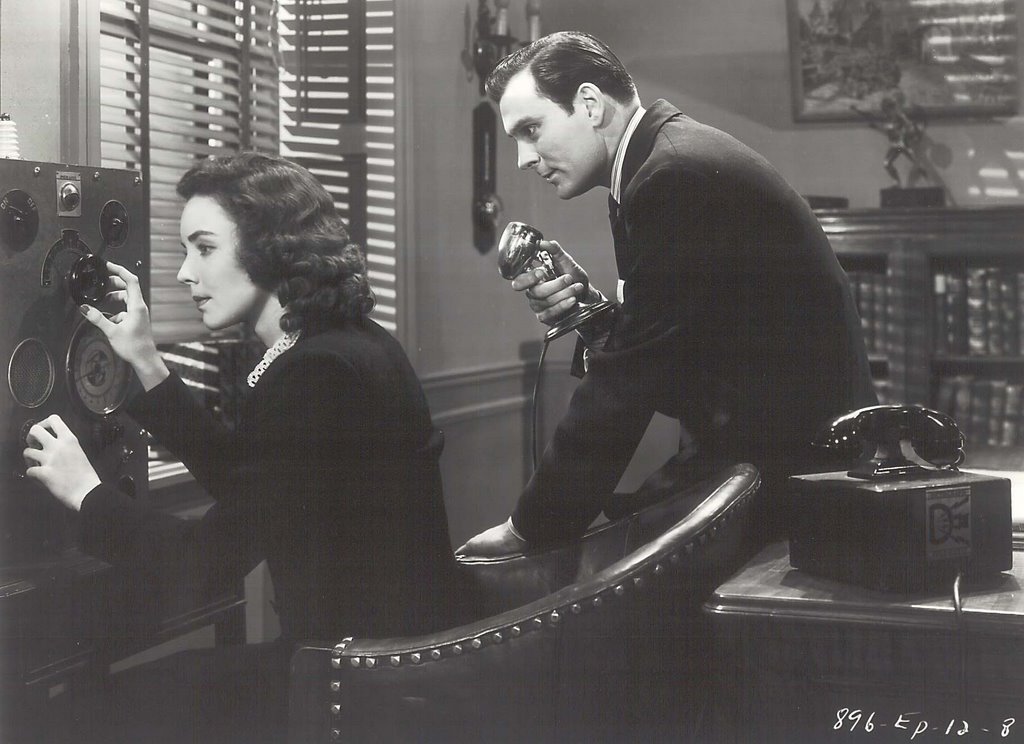 Permit me, if you will, to recast the story of The Devil and Daniel Webster with Phylis Isley, Robert Walker, and David O. Selznick. Phylis is the young actress burning with ambition to become a great star. So far, she’s managed some stage parts and a brief contract with Republic Pictures, but Phylis will not be satisfied playing support to Ralph Byrd in Dick Tracy’s G-Men, so her Tulsa exhibitor father uses his influence, and that of his theatre chain, in persuading Herb Yates to release her from "B" studio bondage. Robert Walker is the boyish thesp who met Phylis as both struggled in New York --- but wait, Phylis never had to struggle, at least not in the sense most actors do --- well-to-do parents bankroll performing ventures and set her up nicely in Gotham. Bob and Phylis (now married) eventually settle in Hollywood, but so far it’s Bob getting the plums, via $400 a week on radio. Enter the estimable Mr. Scratch --- in the person of David O. Selznick --- bearing contracts, fur jackets, and promises of glittering success for a newly christened Jennifer Jones. His Faustian bargain --- allow me to guide your destiny and I shall make of you the most cherished and sought-after name in motion pictures. And so Phylis submits herself to Selznick handling, and basks in a waiting public’s adulation. She has to sacrifice Robert Walker, but what is that against an Academy Award? Golden coin rains down upon her, but Mephistopheles Selznick exacts a price beyond even the forfeit of a husband. He will exert such obsessive control as to take away much of the joy her stardom might otherwise confer, and collaborations like Portrait Of Jennie, Terminal Station, and A Farewell To Arms add up to a price paid in damnation for the unholy compact these two have sealed.

As most will gather from that dose of overheated prose, my view of Jennifer Jones’ fame and fortune is more than tempered by apprehension as to how she came by it. Talent was never at issue. I consider her one of the best actresses of the era, even as it seemed she got no fun out of it. Interviews were ordeals, awards anathema. Candids reveal a glum resignation. Now I ask Greenbriar readers who have previously won Oscars (and don’t be modest, we know you’re out there) --- is stardom worth all this? Maybe in the short term, but Jennifer surely carried guilt over Robert Walker like Pilgrim’s Progress. Of course, every cloud has a silver lining. If Bob hadn’t suffered so in his private life, we’d not have his Bruno Anthony in Strangers On A Train. No account of Jennifer Jones is complete without a consideration of Bob. His was the great post-war epic of self-destruction and fall from grace. There were two sons, one of them a dead ringer for Dad. Writers approached Jennifer Jones about books they were writing. Would she co-operate? No dice. We’d see Jennifer mulling over the career with Robert Osborne on TCM about the same day Deanna Durbin checks in for an hour with Larry King, which is to say, none of us are going to live that long.
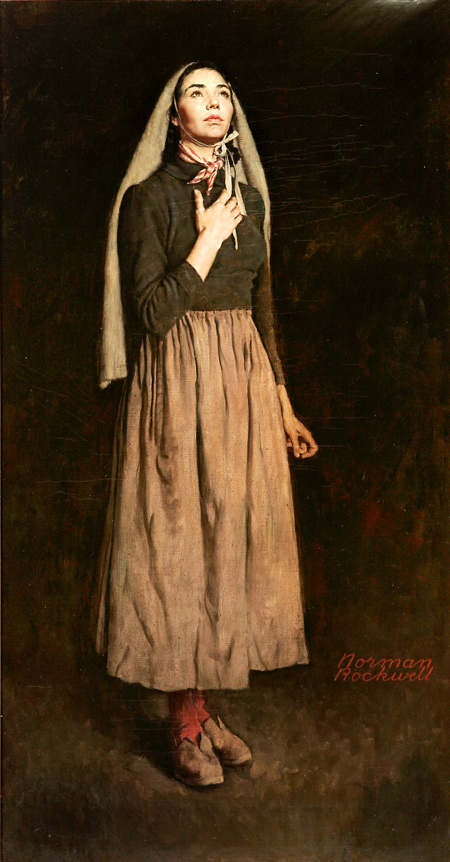
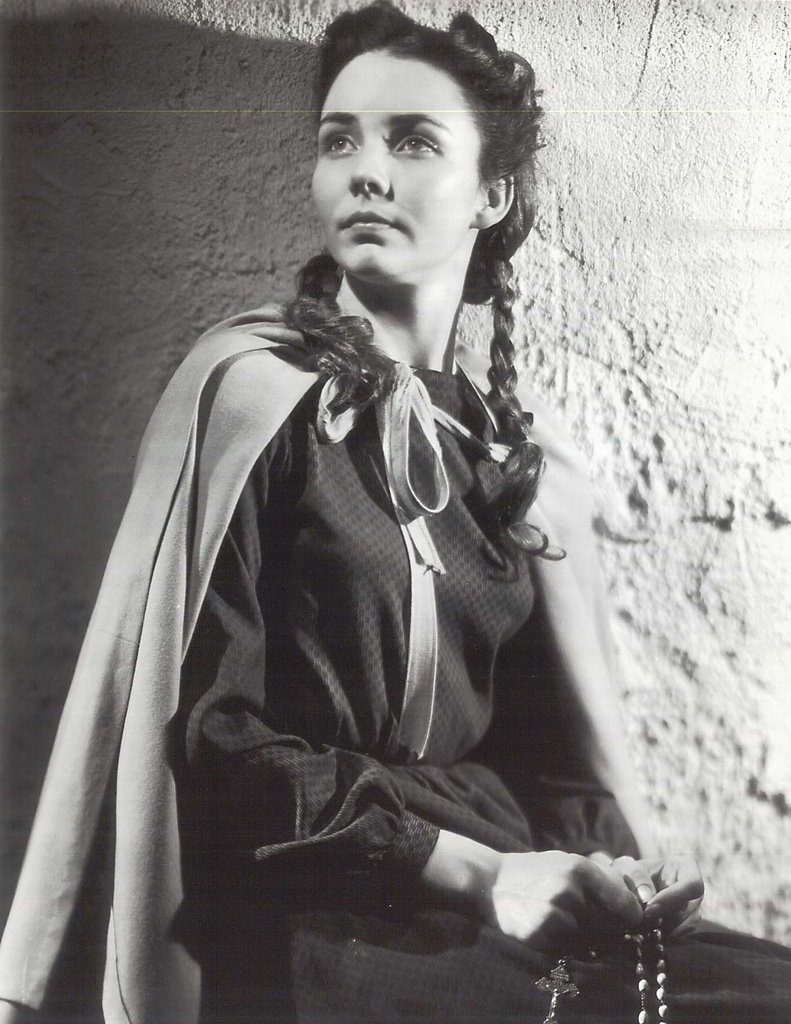
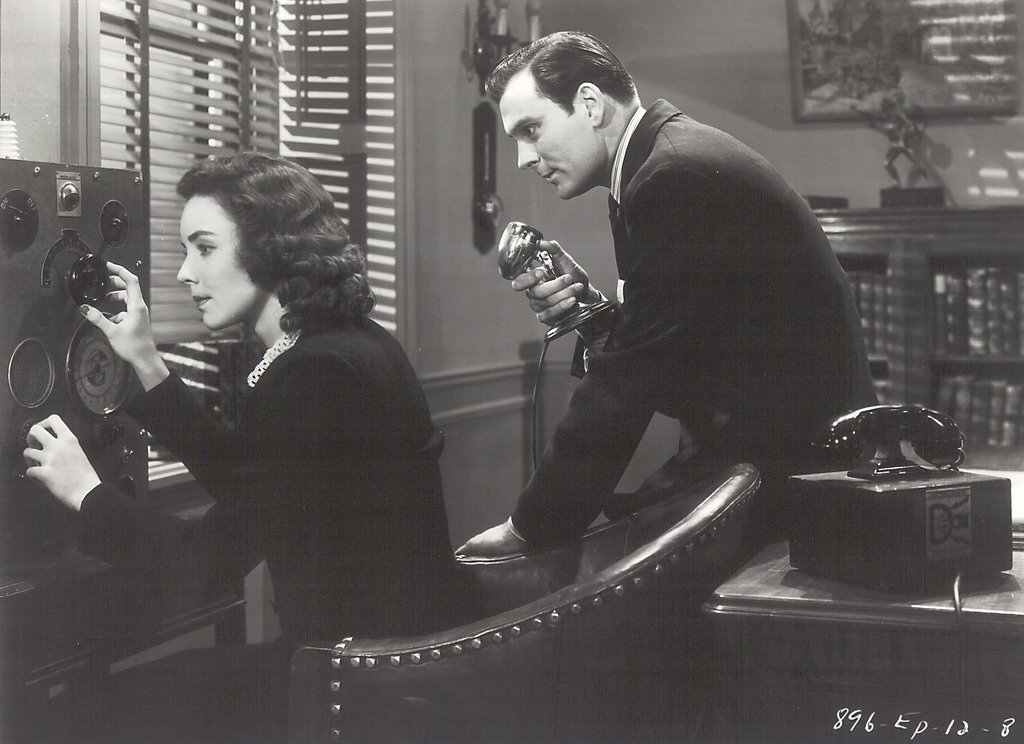
Selznick was not a sort of producer to inspect the latest Three Mesquiteer westerns, so how could he know his new protégé had gotten her start, not with him, but in the company of Ray Corrigan, Raymond Hatton, and a pre-major stardom John Wayne (in Republic's New Frontier). This was a shameful past Jennifer concealed for months, though Selznick met her eventual and tearful confession with equanimity. He was by now committed both professionally and personally to her nascent career. Established majors abetted in the creation of Jennifer Jones. Fox gave her the coveted lead in The Song Of Bernadette, an assignment every woman, outside of Maria Ouspenskaya, desperately wanted. Bernadette fairly reeked of prestige. Jones had volunteered as a nurse’s aide prior to its release. Fame put the brakes on that. Robert Walker was getting a big push at Metro around the same time. His Boy-Next-Door Goes To War was reassurance to mothers nationwide --- if this timid on-screen recruit could survive the fight, their own sons might as well --- and the gals, particularly teenage ones, went gaga for his non-threatening persona. Bob’s 4-F classification kept him out of real-life uniforms, this not altogether an advantage, for he now co-starred with a distracted wife in Since You Went Away, three-hours of home front drama written and intensely supervised by the man who had every intention of taking her away from him.

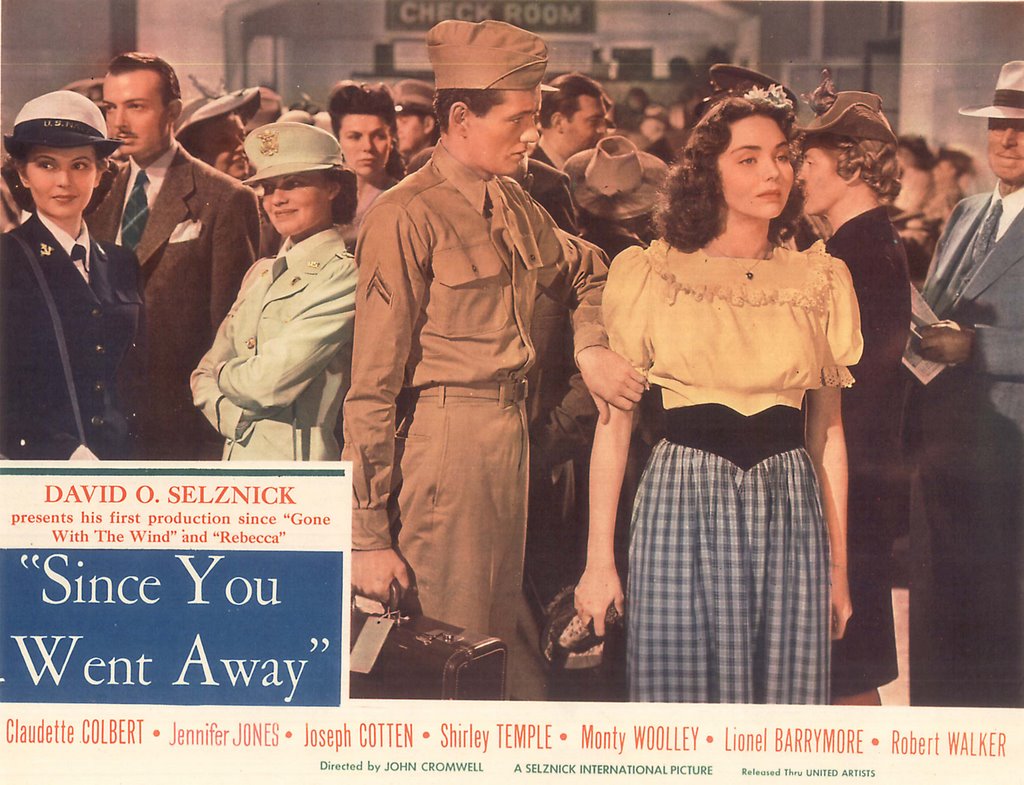

Since You Went Away was to be the home front Gone With the Wind. Jennifer Jones would be one of two teenage daughters (the other Shirley Temple) representing a Saturday Evening Post concept of the American family. Publicity groupings of she and Temple with Claudette Colbert might have been captioned What We’re Fighting For, so idealized was this portrait of what Selznick referred to as the Unconquerable Fortress, home. The producer’s behind-the-scenes conduct with regards family values, not only the Walker’s but his own, was grotesque parody of what he depicted onscreen, emotional fall-out felt by its participants for years to come. Walker had to play Selznick-constructed love scenes with his wife as the usurper of her affections stood on-set and watched. Surviving cast members would recall the almost unbearable tension five decades later. By the time Since You Went Away wrapped, and it seemed at times it never would, Jennifer Jones and Robert Walker were separated, him laden with a torch and a bottle. He’d carry both for the rest of his short life. Selznick was a reluctant evictee from the home he’d shared with wife Irene Mayer Selznick, daughter of Louis B. Watching Since You Went Away can unsettle when you’ve just come off reading biographies of these folks. What a raw deal Walker got.
Part Two of Jennifer Jones is here.
Photo Captions
Robert Walker
Jennifer Jones
Phylis Isley with Ralph Byrd in Dick Tracy's G-Men
Jennifer Jones gets some more stage experience after her move to California
Jennifer Jones and Robert Walker
Poster Art of Jennifer as Bernadette by Norman Rockwell
Portrait of Jennifer as Bernadette
Robert Walker and Jennifer with David O. Selznick
Lobby Card --- Since You Went Away
Jennifer reads the novel of SYWA
posted by John McElwee at 5:30 PM









3 Comments:
john:
it's not enough that i awake each monday in "wild anticipation" of what the glamour starter will be, it's not thrilling enough that i woke today to find it was one of my all-time favorites jennifer jones, & a two-parter at that, but then you had to go & in the midst of a thoroughly brilliant piece of writing, include what is perhaps one of your greatest sentences ever: "we'll see jennifer mulling over the career with robert osborne on tcm about the same day deanna durbin checks in for an hour with larry king, which is to say, none of us are going to live that long."; i roared--i believe the phrase "the career" & more specifically the word "the" instead of "her" conveys with all-too appropriate world-weariness & resignation the fact that we will miss that opportunity; you are wonderful!
Robert did get "hosed" in this situation, but instead of finding another love and rising above the grief went into the spiral of self-destruction....hey, if I would have taken to the bottle every time a woman screwed me over, I'd have been dead 20 years ago!
Jennifer Jones, Robert Walker, and Selznick have been research subjects for me for four years. Using books, newspaper articles, ancestry archival documents i have learned a lot a lot about them. I remember two accounts about Jennifer the person, she was much to introverted and avoided celebrity, who was intuitive, kind, and had a temper. But when you think about Bob it is very sad. I believe that their relationship was affected by their young age, innocence, and their lack of worldly experience, When they came west and were plunked in the middle of Babylon I think they both had difficulties coping with the situations they found themselves in. The “columns” sometimes had a sentence or two that made sense. One said the a friend said that ob was one of those adult babies who couldn’t make up his mind about what he wanted and she was tired of picking up the pieces and making things work. But by the time she married Selznick she had figured out that he was a heel, they argued a lot and there is a chilling account in Michael Powell’s book “Million Dollar Movie”. She claimed that. Selznick had forced himself into her life uninvited, was repulsed again and again, broke her marriage, destroyed her husband, a,ienated her from her children. He thought his personal attentions could make up for all the harm he had done.and told her they must be married because he told everyone they would.and if it didn’t happen he would e a laughing stock.
The details I have found about Jennifer are fascinating. She was an intelligent woman who used something like The Method to construct her characters. Robert Osbourne did an interview with her and it is the forward of the book Jennifers life and films by Paul Green. An interesting and complex person who was very insecure in her acting and in her station. Never calm about it until latter in her 50’s. Selznick loved her for her beauty and SpNorton Simon love her as a person. I’ll never forget a blog post just after she died . . .the man said she was rhe kindest person he had ever known.
Post a Comment
<< Home