Classic movie site with rare images (no web grabs!), original ads, and behind-the-scenes photos, with informative and insightful commentary. We like to have fun with movies!
Archive and Links
grbrpix@aol.com
Search Index Here


Sunday, April 30, 2006


Old Movies In The Classroom

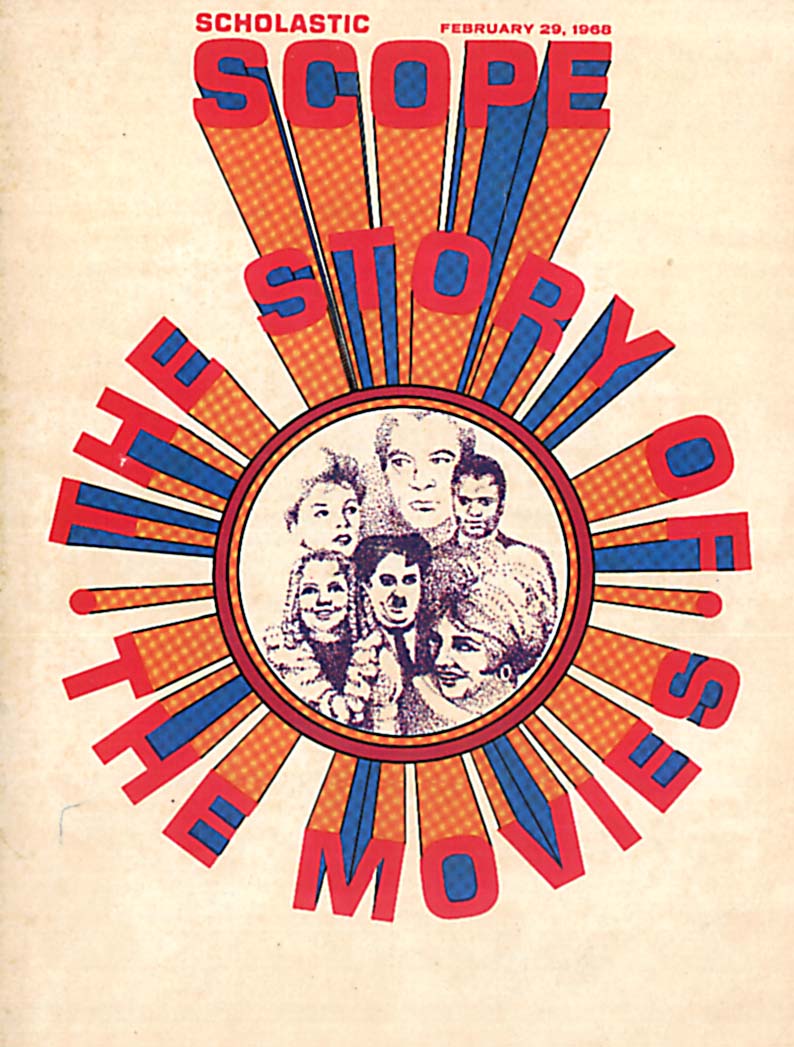
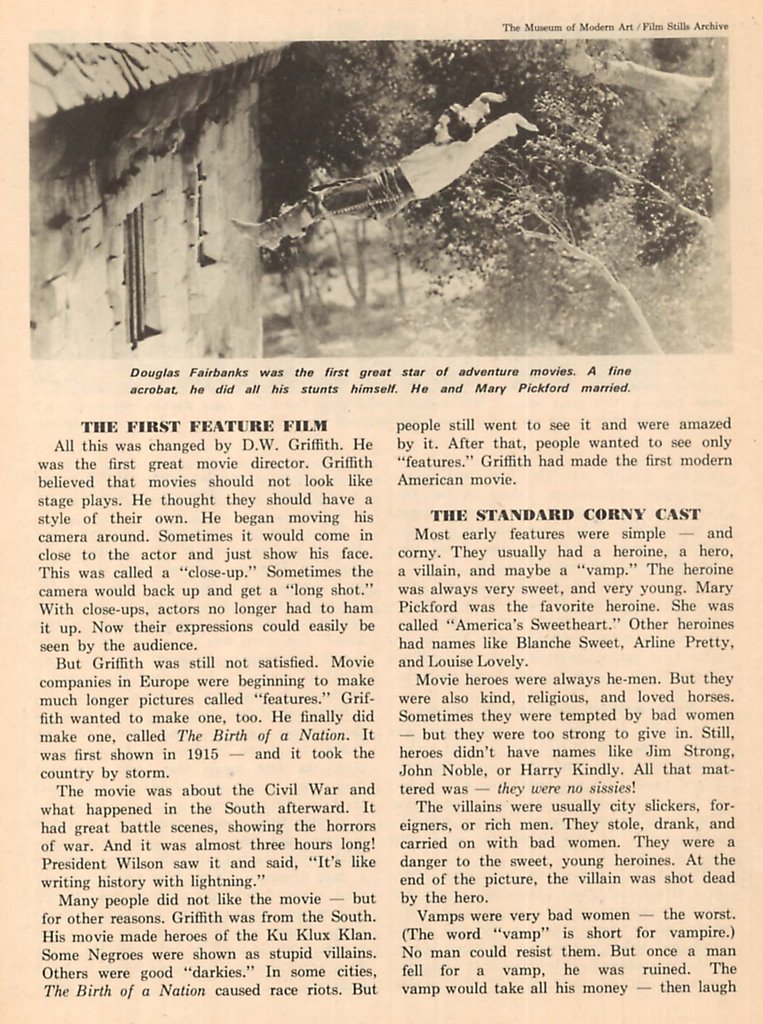
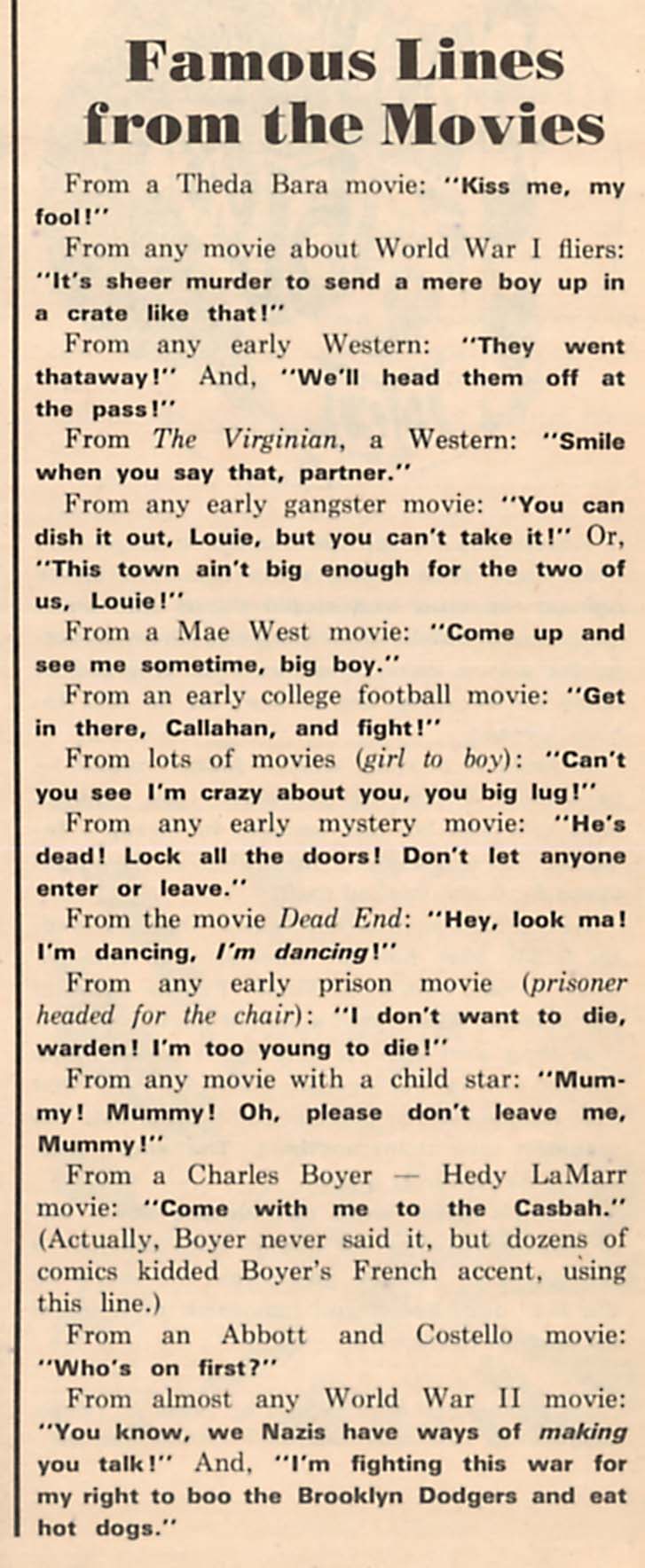
Anybody recognize this little magazine? We got them every week at school when I was in the eighth grade. This issue came across my iron maiden of a bubble-gum encrusted desk the week after my fourteenth birthday, and I’ve kept it close to my bosom ever since. It was the first time in my memory that movies were sanctified by the educational establishment. Oh yes, we’d watched Paramount’s Williamsburg – The Story Of A Patriot in the sixth grade, but this was reading of which my stern-visaged teacher/sadist would approve, and there was even a class discussion on the subject! Scholastic Scope was generally a crashing bore of a "news" weekly for adolescents --- often as not it would focus upon the Suez Canal, curing molasses, stuff like that. For the sake of context, I’ve included this Kellogg’s ad from the inside cover (what other possible reason could I have for featuring The Monkees at the Greenbriar?). I wonder if the winner of the contest got to be on that episode Lon Chaney, Jr. did? Anyway, The Story Of Movies is standard issue pabulum best left, I suspect, to the kids who were making their second or third go-round through the eighth grade. Just read these sample paragraphs under the "Standard Corny Cast" header and see what I mean. That’s pretty much the tenor of the article as a whole. So few books were available on the subject at that time --- sadly it was this sort of thing that people relied upon for their film history. We may have global warming now, but at least we’ve also got TCM. Recognize those "Famous Lines from the Movies"? Neither do I, but we took them for the truth then. By the way, Bill Everson once said, rightly I suspect, that the most oft-used line in westerns was not either of these, but the simple "Let’s get out of here!" which was spoken (eventually) in virtually every horse opera they ever made. Scholastic Scope also featured a helpful letters column in each issue, "What’s On Your Mind?" and in this particular number, there was a spirited debate as to a "disgusting" article which had been previously published on hippies. The writer suggested that he could not face a society that refused to embrace them (he should have been here this past weekend for our big annual music festival --- hippies were everywhere! --- possibly the same ones he was referring to). Another scribe lamented the criticism of boys with long hair. After all, he said, George Washington and Abe Lincoln had long hair (Abe did? I’d never noticed!). Anyway, having preserved the magazine for going on forty years, it seemed appropriate that I share the enrichment with Greenbriar readers, and I welcome comments from other Scholastic Scope readers and collectors.


Selling, Chasing, and Collecting The Mummy

When it comes to the subject of Universal horror films, critical objectivity is quite beyond me. Sentiment and nostalgia are guiding principles in any discussion I may have regarding these pictures. Whether good or bad by anyone else’s measure is quite beside the point. My expectation at age fifty-two is that I will spend at least a few moments of my dying day, whenever that happens to be, ruminating over happy boyhood hours when I first came upon Dracula, Frankenstein, and The Mummy. A casual search of the Internet will confirm that I'm not alone in my enthusiasm. A surprising number among my generation seem to have experienced similar reaction after these began showing up on television in 1957. How one package of features, the content of which even at that time was between eleven and twenty six years old, could have so completely captured the imagination of fifties and sixties youth is a continuing paradox. There’s certainly been nothing like it since. Part of this was sheer difficulty in seeing the things. Most TV markets carried the "Shock" group (a syndicated umbrella covering most of the Universal horrors), but you were lucky if your station ran them twice in a year. A few miserly channels in our area went two years or more between broadcasts, and you had to rely upon Famous Monsters Of Filmland magazine to refresh memories of beloved icons such as Boris Karloff, Bela Lugosi, Lon Chaney, and the rest. Some of us can recite day and date of each encounter with Bride Of Frankenstein, The Black Cat, and other classics. They were ones we saw when it was possible to be truly impressed by a movie, long before regrettable onset of maturity when one applies critical standards, and nothing’s capable of really exciting you anymore. I saw it coming at fourteen, and recognizing signs even then. Sneering at The Green Slime, walking out on Destroy All Monsters, even turning my back on a Hammer film, Frankenstein Must Be Destroyed. Childhood’s warm embrace of all things horrific would not last beyond 1968 for me, and yet, the essentials remained dear, and of all these, perhaps The Mummy remains most cherished.


The chase after The Mummy was launched with 16mm collecting. This was long before videocassettes. Why wait for the thing to show up on television when you can score your own print, preferably one of those rare originals? Now an original was that elusive specimen generated through the legitimate auspices of the current copyright owner. In this case, it was Screen Gems distribution, the syndication arm of Columbia. They had leased the horrors from Universal and supplied individual TV stations with 16mm prints. Your hopes of getting one of those were pretty nil. A few got pilfered out of storage rooms and distribution terminals, but you didn't want to get your hands too warm handling contraband like this. Better to settle for a "dupe" (a bootlegged copy made from an original) or an older legit print that had cooled off by virtue of its having been with the same collector for a number of years. This was how I finally got my bonifide 1957 original of The Mummy. Collecting comrade Robert Cline and I ventured forth once again into that bizarre netherworld of obsessive film hoarders who’d long since retreated from society as we know to a place largely unknown among normal, functioning adults. Our host on this occasion was the male counterpart of Miss Havisham, his darkened home filled with hundreds of loudly ticking antique clocks. He must have spent all day every day winding the things. I don’t know how he slept among all those timepieces. Actually, I don’t think he slept at all. One or two of his cats resided in the refrigerator, as I recall. Their means of ingress and egress were not explained to us. His print of The Mummy resided in yet another of those suffocating basements so beloved by collectors. You couldn’t read the titles on the reels without a flashlight, and naturally, his had dead batteries. You see, Vitus, the batteries are dead. Even the batteries are dead. So, was it worth all this? Emphatically yes! Big yes! That liquid, silvery Kodak safety positive looked like a vintage woodcut. I could almost read those hieroglyphics right along with Bramwell Fletcher during that opening sequence. Would I go through something like this again? No. Decidedly no. DVD’s have made my collecting life simpler. But nice as the DVD of The Mummy looks, it’s still not quite the same experience as watching that 16mm beauty I once owned.


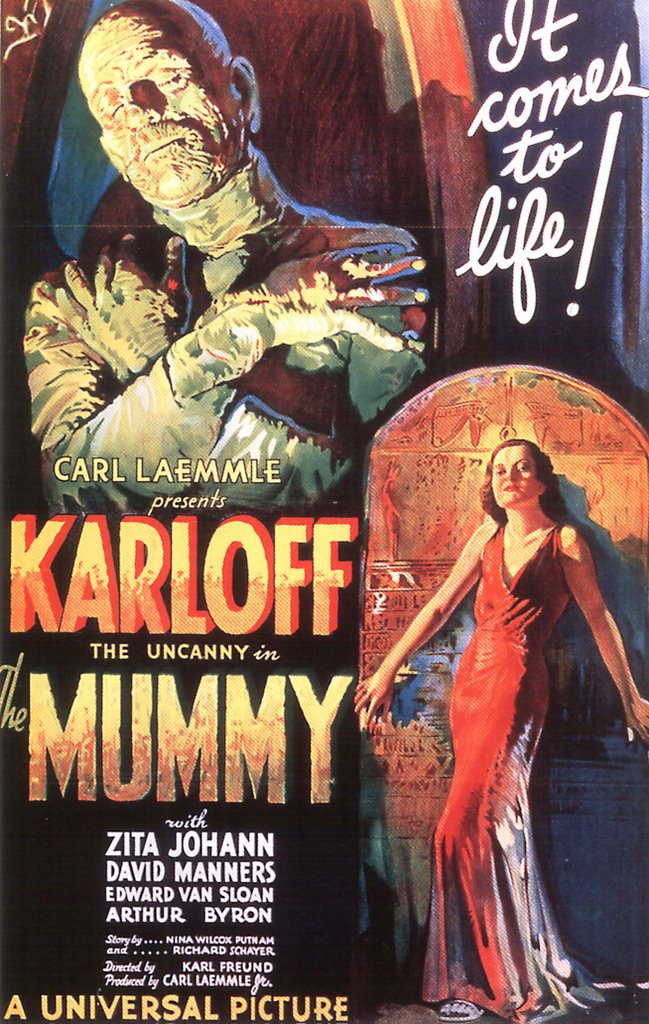
The Mummy pursuit wasn’t confined to 16mm. There were also original posters, at least those few that actually survived. A friend of mine found out about one of them by sheer happenstance. Seems there was a handyman who’d done yard work for an elderly woman with whom he’d become friendly after several seasons of lawn and gutter work. One day over a tall glass of Lipton’s, she casually mentioned an old movie poster which had been given her as a wee child by a kindly old exhibitor way back in 1933. Would he care to see it? Not wanting to appear rude, the tradesman feigned interest as the old lady unfurled the folded original one-sheet for The Mummy she’d had for the last sixty years (here’s what one of those looks like). His reaction was calm. He neither tried to barter for it, nor dispatched her with a claw hammer to steal it. Instead, he went about his business, and only mentioned it to my friend’s father weeks later because he knew the man had a son who was into movie posters. My friend (who shall remain nameless, as he wishes to avoid being tortured into revealing the woman’s name and address) immediately commissioned said handyman to return to the woman with an offer. This time her radar was up. It wasn’t just no, but hell no! She’d been pestered by these would-be purchasers before, and she wasn’t about to be done out of her priceless Mummy poster by any guy that raked leaves for a living! Needless to say, the deal went cold. That was over ten years ago. My friend told me yesterday it’s still cold. In fact, for all he knows, that old lady might be cold as well. It’s a cinch you won’t get any updates on her from that handyman. He’s clipped his last hedge at her place. Meanwhile, there’s a one-sheet for The Mummy unaccounted for. But please, you rabid poster collectors. Don’t bother torturing me for her name and address. I asked my friend never to reveal those --- for my own protection.


Were they still with us, you could ask David Manners and Zita Johann about The Mummy chase. Both of them lived long enough to experience it, though I’m not so sure they enjoyed the experience. After all, how do you evade an army of fans when you’re pushing ninety and all of your pursuers are hale and hearty mid-lifers (and even the most fragile of us monster acolytes are capable are breaking into a dead run at the sight of a surviving Universal horror star)? Boris Karloff and Edward Van Sloan were the lucky ones. They died before us monster kids grew up. Neither of them had to face the prospect of anxious would-be interviewers banging on their nursing home door. Poor Dave and Zita made it into the 1990's. Manners lived to a ripe ninety-seven. He got to where he was telling fans he’d rather die than submit to another interview. He just wanted to eat pancakes in the dining room with the rest of the seniors. Telling yet another horror fan what it was like working with Bela Lugosi was worse than a rectal exam for him. Not that I’m setting myself above his inquisitors, mind you. I once wrote Mr. Manners a fan letter, back in 1969, and wouldn’t you know it? He didn’t want to talk to me either. Zita was more receptive. In fact, she even supplied the forward for a really neat book about the production history of The Mummy (written by that ace researcher Greg Mank). Zita dished all sorts of inside scoop on that long ago month she spent in the company of Boris Karloff (a true gentleman) and director Karl Freund (total bastard). She was living in Nyack, N.Y., her serene retirement interrupted only by a gentle tapping, someone rapping, at her chamber door. Sure enough, another fan with questions about The Mummy. Zita almost made it to ninety. I suspect a lot of those Mummy-philes would have gladly followed her over to the other side, if only such a thing weren’t so --- permanent. Hey --- could be worth it at that --- just imagine, a full cast and crew Mummy reunion! Can Heaven really hold the promise of such delights? Let's hope so!


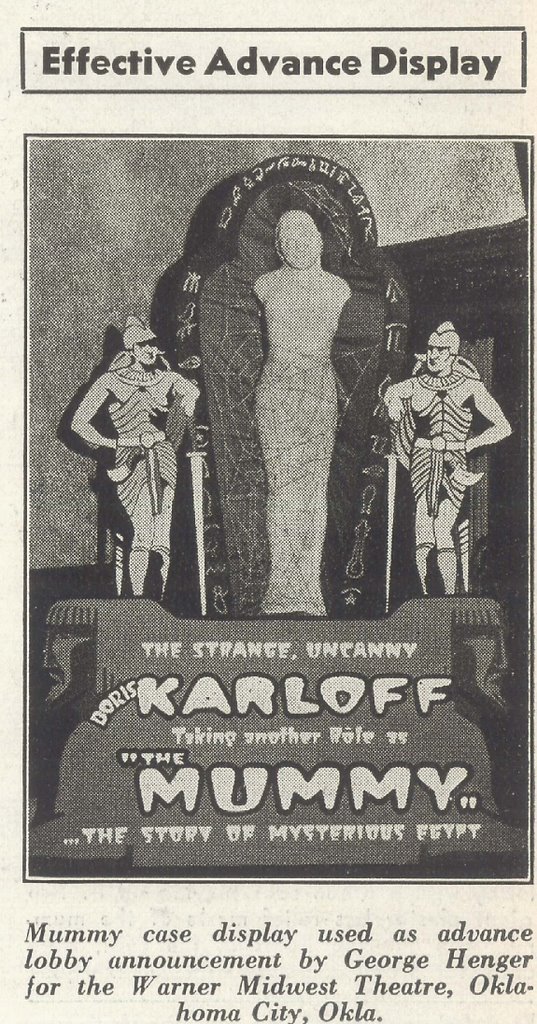
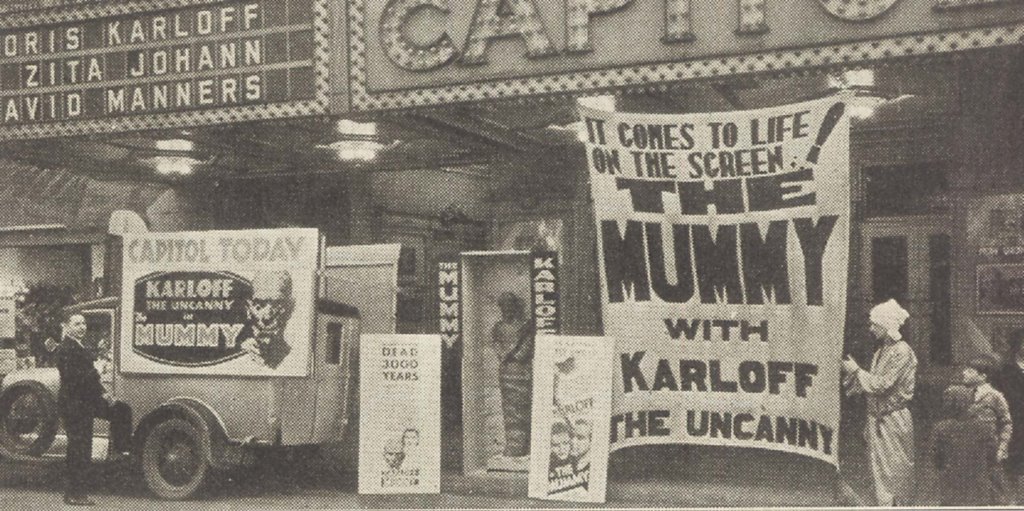
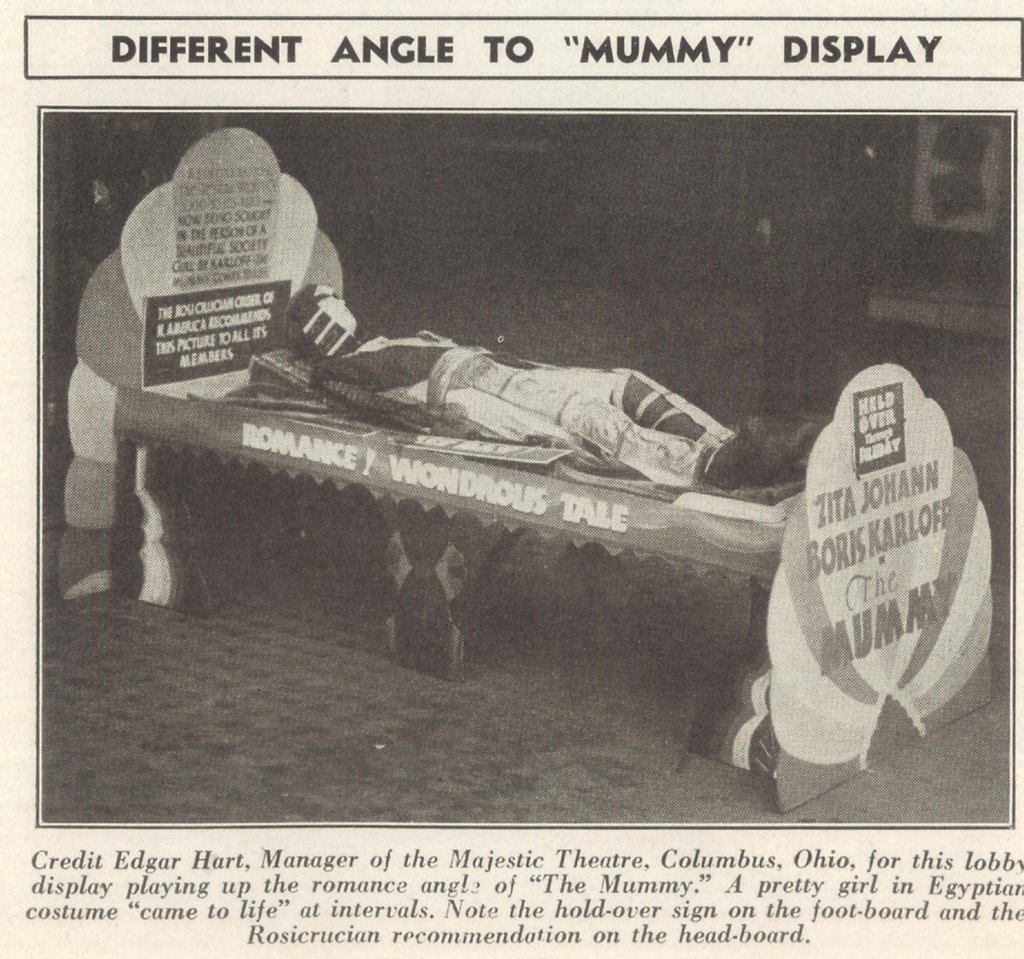
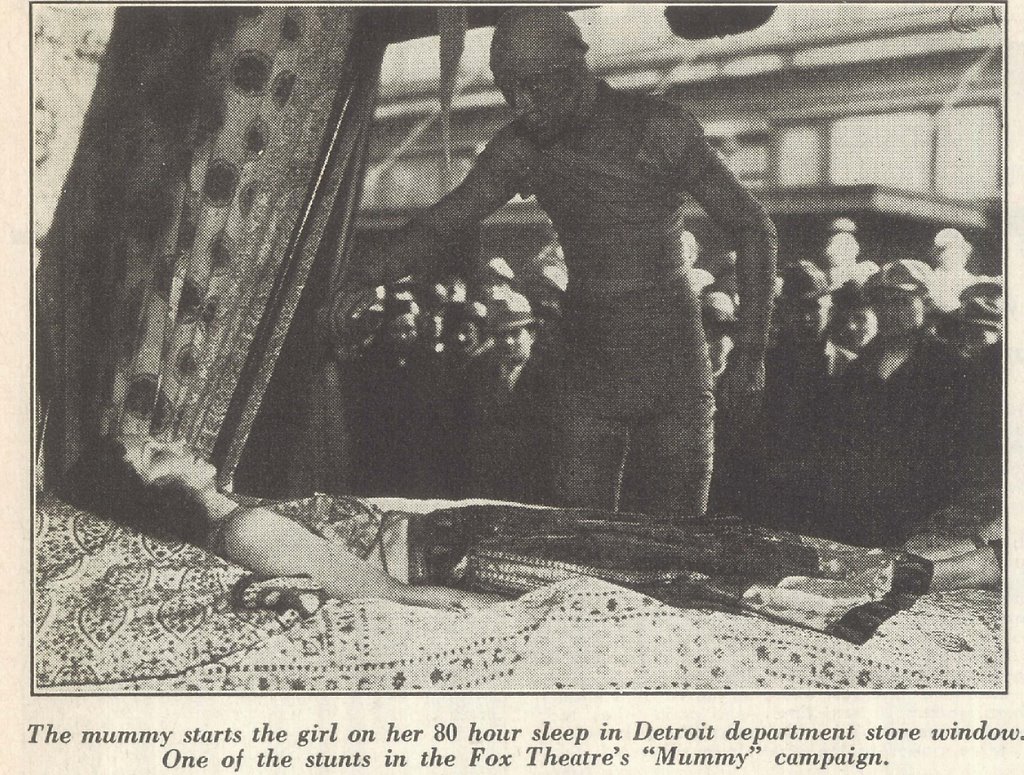
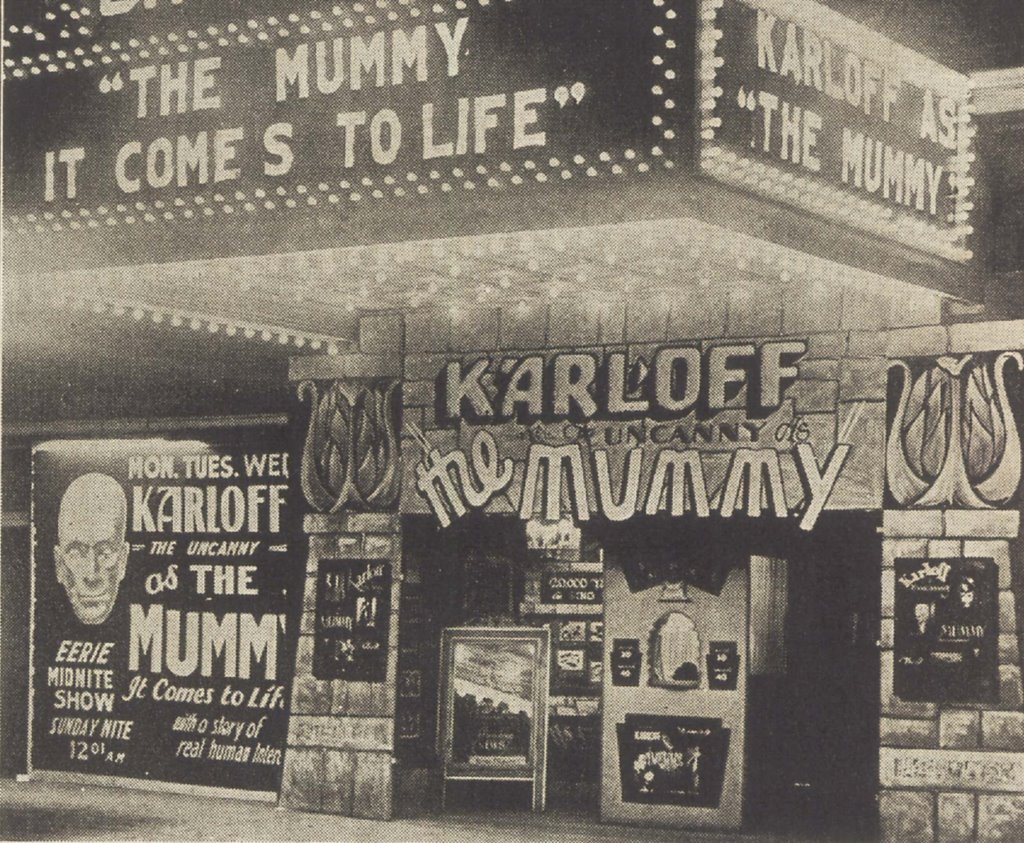
And now --- these pictures. I know I harp a lot on going back in time, but honestly, wouldn’t you just give anything to have walked down good old Main Street, past the starving depression folk selling apples, and encounter theatre-front displays like these? How about facing that store window with the live Mummy and "sleeping woman" tableau (those spectators look fascinated)? And that girl who "comes to life" in the lobby? Did she lie there all day? Wonder what they paid her. Roving mummies in the street --- mummies giving out dollar bills (Wow! Bet those mummies were more sought after than an octogenarian David Manners!). Over in England, they had two dozen guys with sandwich boards taking to the sidewalks, in addition to the street mummies. Those UK showmen sure knew their onions. Closer to home, that marquee that reads, "The Mummy – It Comes To Life" is Charlotte NC’s own Broadway Theatre, now long leveled and gone. To think, I could have walked to that show from where I live. Only ninety miles. Yeah … easy walk.


Saturday, April 29, 2006


Monday Glamour Starter --- Bebe Daniels
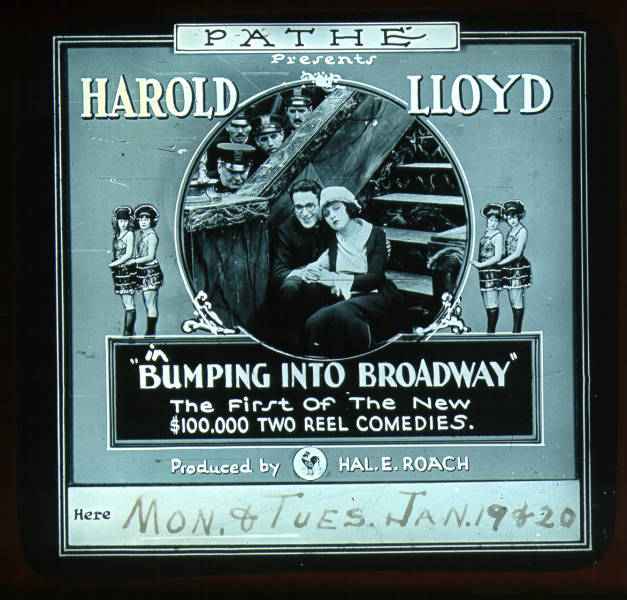
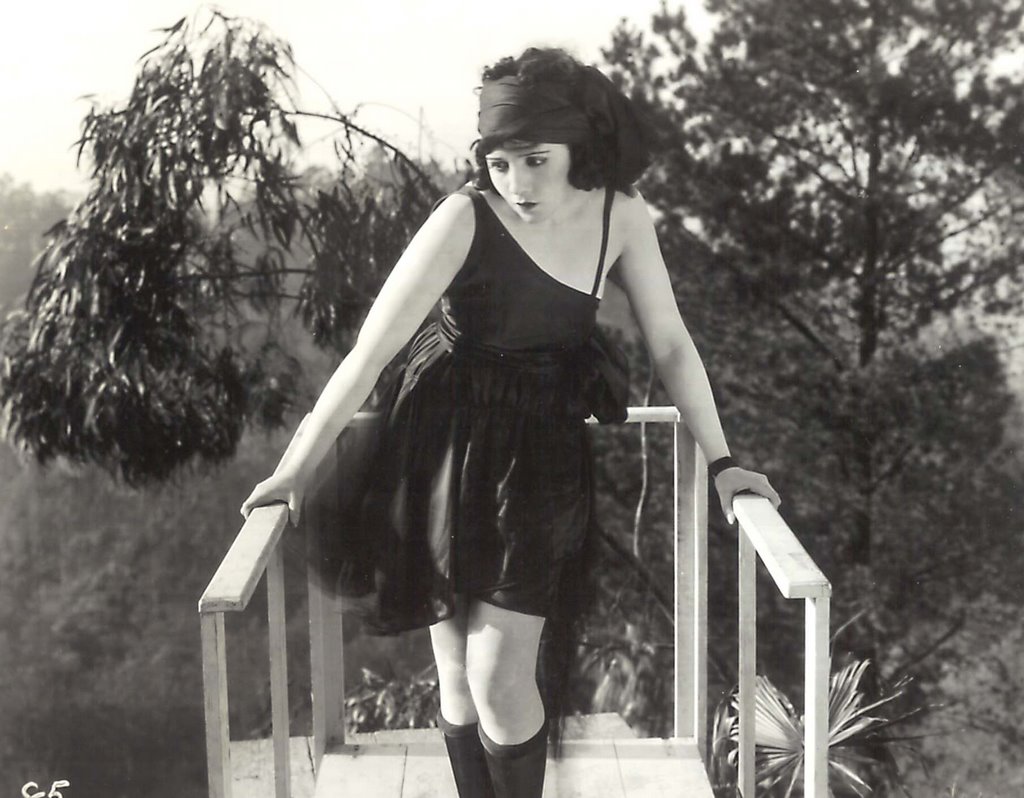
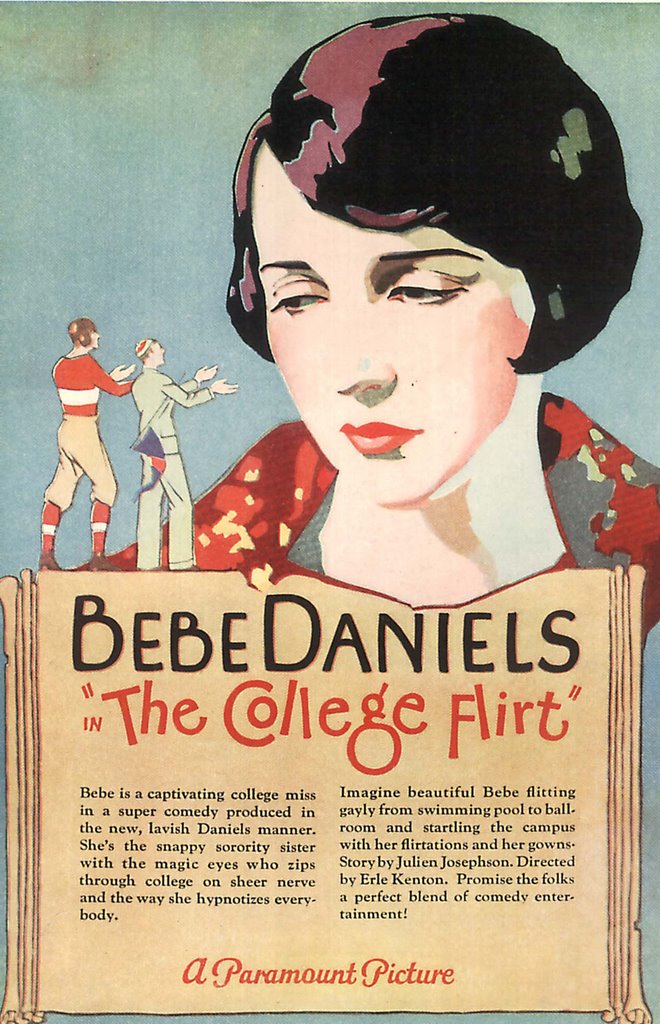
It wasn’t so extraordinary in 1915 for fourteen-year old girls to play leading lady opposite silent comedians. It was extraordinary that one of those adolescents, already a veteran of stage and screen when she signed on to play "the girl" in Harold Lloyd’s "Lonesome Luke" one-reelers, would go on to enjoy a career that lasted into the sixties, one which would successfully embrace virtually all twentieth-century media. Why someone hasn’t written a major biography of Bebe Daniels is an ongoing paradox to me. I should think that at the very least, some woman’s studies professor would get hep to the fact that here was a feminine dynamo who masterminded a series of amazing careers --- each of them enormously profitable --- and none of them possible had it not been for Bebe’s creative guiding hand. If the movies had a Renaissance woman, she was it. One of the big reasons we don’t know her better is the fact that she and husband Ben Lyon took the show across the pond in the mid-thirties, and the phenomenal popularity she garnered over there was all but unknown stateside. By the time she died in 1971, we’d forgotten all about Bebe Daniels. Indeed, she was little more than an obscure name who’d once shared the bill with Rudolph Valentino and Harold Lloyd (that’s her with Rudy in 1924’s Monsieur Beaucaire). We were just too provincial to realize how much territory her stardom took in. To this day, we still don’t get it.


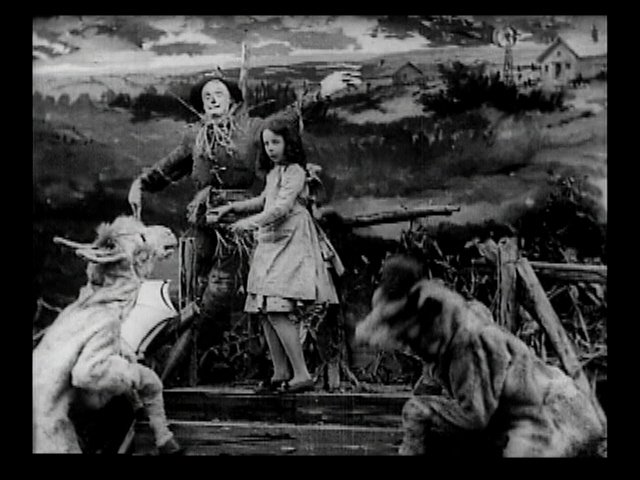
That neat set of DVD’s called More Treasures From The American Film Archives contains a hitherto lost subject from 1910 called The Wonderful Wizard Of Oz. They say it’s the first screen adaptation of the L. Frank Baum stories, and the nine-year old kid playing Dorothy is Bebe Daniels. That’s her with the Scarecrow and others in the fuzzy shot, and get this, she’d already trod the boards five years when she made it. Convent school was a drag because the other girls with their dollies were unfamiliar with Shakespearean passages, which Bebe could by now quote. Precocious was hardly an adequate word to describe the nubile teen who stormed the Hal Roach lot and defied the studio’s preference for a blonde ingenue to act as foil for a twenty-two year old Harold Lloyd. Brunette Bebe got the job through sheer force of personality and made a staggering 144 short comedies with the comedian before decamping in 1919 to go work for Cecil B. DeMille
. In the meantime, she and Harold had a thing going which might have led to the alter were it not for her ambition and his ambivalence. Career minded Harold met his match in Bebe. He liked his women passive. She was anything but. Chances are he loved her, because he wore a ring she’d given him until the day he died (Harold and Bebe passed within eight days of the other in ’71). DeMille and Jesse Lasky had noted her popularity with Harold and tried to poach her away from Roach, a major breach of protocol in those days. When her contract was finally up, Bebe headed over to Paramount and $1000 a week, up from the $100 she was pulling down at Hal’s "Lot-A-Fun." Shrewd tactic, for this was where the serious Stardust would gather on her.


Crazy publicity stunts were the order of the day in the twenties, and Bebe pulled off a doozy when she got herself arrested for speeding (72 MPH in a 50 zone) and was sentenced to ten days in a podunk jail within hailing distance of Hollywood and its non-stop press brigade. No sooner was she ensconced in the hoosegow than a procession of celeb friends arrived to relieve her anguish. A Persian rug and ivory bedroom set adorned her cell, and the guestbook she maintained during the incarceration eventually netted 792 signatures (bet that would be quite a collector’s item today!). Abe Lyman and His Orchestra serenaded her from outside the barred window. The whole silly business culminated with Bebe’s next vehicle following her release, The Speed Girl. That one’s lost, as are virtually all of her Paramount features. These images and trade ads can only suggest what all those pictures might have been like. At least one of them, Senorita, does survive, but good luck seeing it, as it’s only been unspooled at one US silent movie gathering I’m aware of. As you can see, Bebe plays a kind of female Zorro in it. She was quite the athlete on screen, forever running, swimming, riding --- in a seemingly endless series of college comedies, romantic farces, costume capers --- whatever sold. She was also going in at night and helping edit the movies, plus writing, then producing. Eventually, she had her own unit at Paramount, and near complete autonomy to do the pictures as she saw fit. Bebe had a way of lucking into headlines that earned her the (benign) nickname of "The Good Little Bad Girl." On one occasion, her jewelry was stolen during a stopover in Chicago. Mob capo Al Capone got wind of it and sent out the word that Bebe’s baubles had better be returned --- or else. Legend has it that Big Al himself delivered the ice next day. Talk about landing in a field of clover! Was it any wonder that Bebe was the hottest Mama in movies?


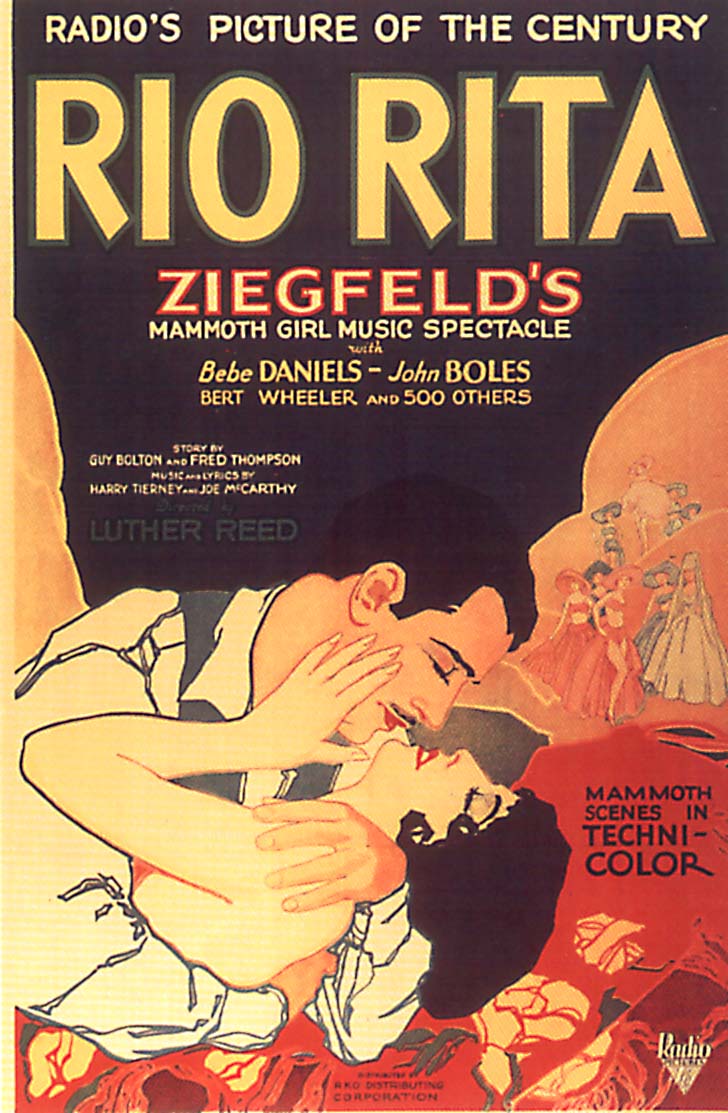
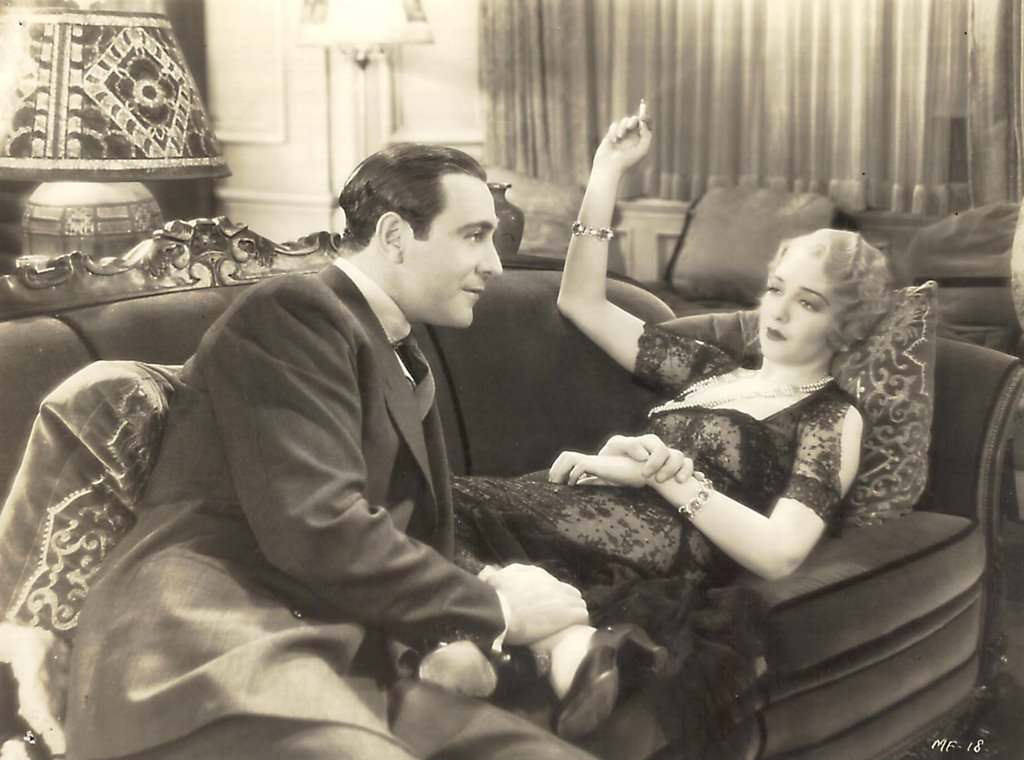
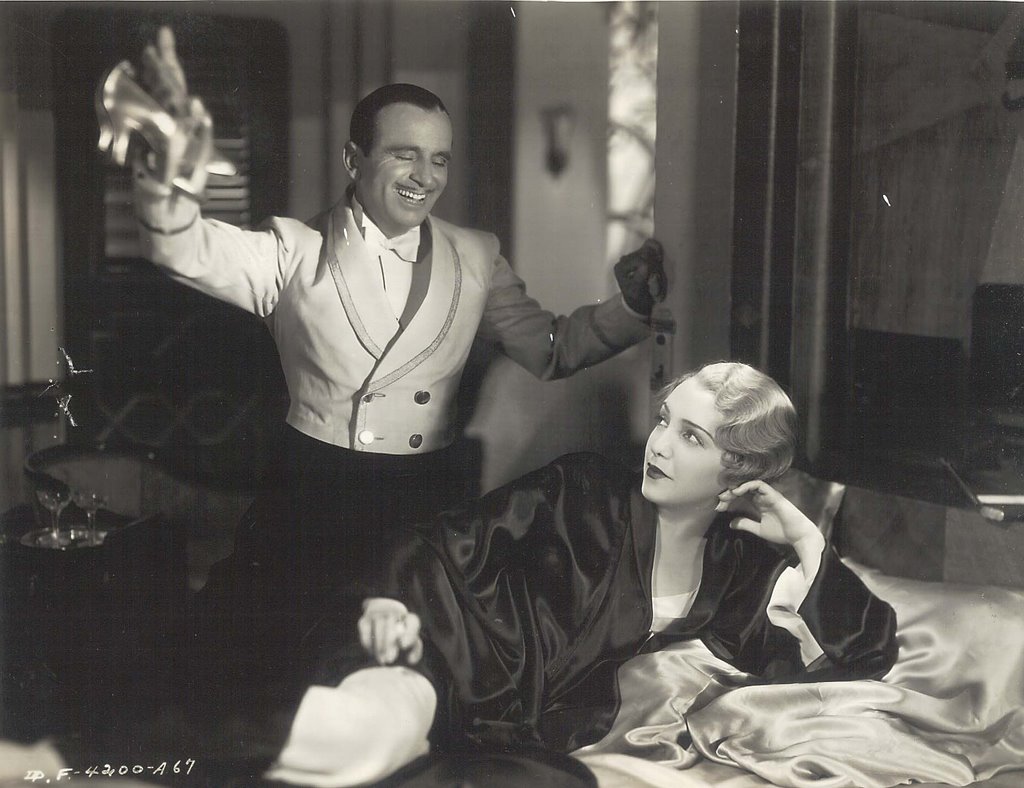
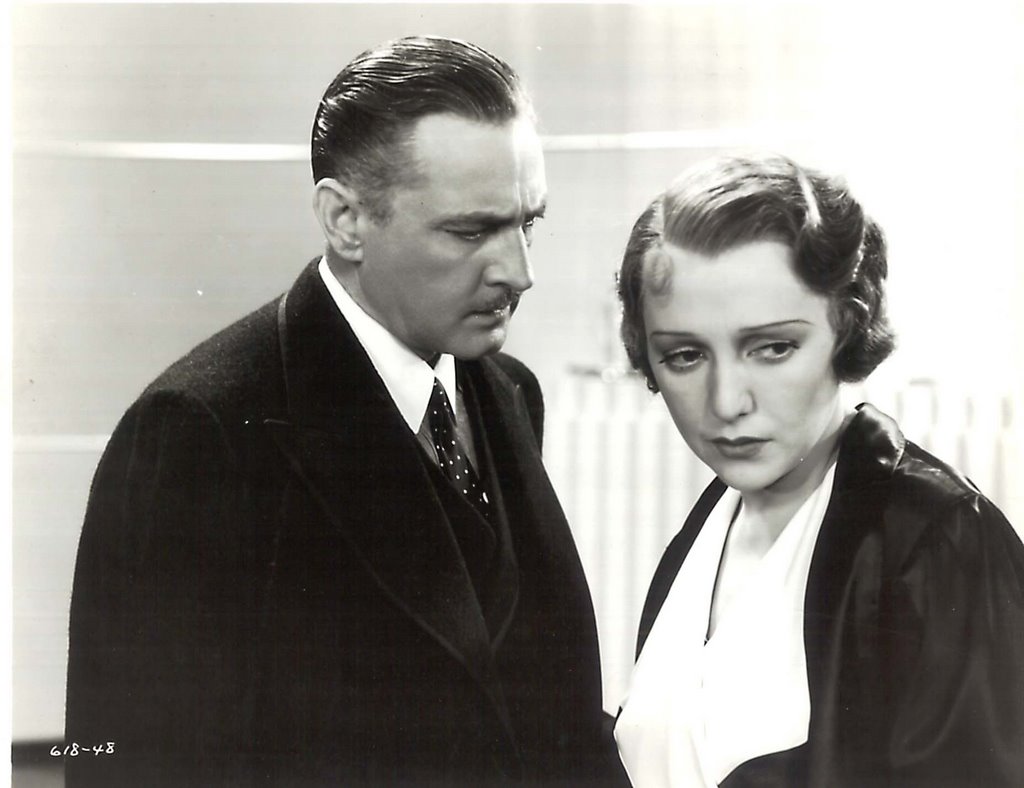
Talkies dealt a cruel blow when Paramount inexplicably refused to give Bebe a voice test. Part of that was anxiety over sound prospects for silent stars, and the studio’s belief that stage players would naturally supplant former idols, with the happy outcome of paying unknown legit players far less than established names like Bebe Daniels were getting. Efforts to get before a microphone were rebuffed, so Bebe bought out her remaining contract, then headed for RKO, where she scored a triumph as the singing lead in Rio Rita, a smash hit (hey, it out-grossed King Kong!) which led to a brace of musicals culminating with the one she’s best remembered for, 42nd Street (1932). Bebe was a stirring presence in a number of pre-code favorites --- some of them illustrated here --- The Maltese Falcon with Ricardo Cortez, Reaching For The Moon opposite Doug Fairbanks, Sr., and as romantic vis-à-vis to John Barrymore
in a great one, Counselor-At-Law. Despite good work in these, her leading status had diminished, and the move to England in 1935 seemed a good opportunity to regroup. That it would lead to an entirely new, and fantastically successful second career, could not have been anticipated.


Any performer who would broadcast through a London air raid was some kind of alright as far as the British public was concerned, and it was this sort of courage under fire that made Bebe and husband Ben Lyon (married since 1930) national institutions around the U.K. They started in music halls, where man-and-wife variety acts enjoyed great popularity during the late thirties, but it was radio that really put them over. The real-life bickering (but ultimately devoted) show-biz couple formula was still fairly fresh at that time, and Hi, Gang! was a wartime ritual for listeners throughout the isles. The Lyons would even take a leaf from Ozzie and Harriet Nelson’s book when they converted the series into a family sitcom shortly after the war. Real-life son and daughter Barbara and Richard teamed with their parents for Life With The Lyons, and there would be two features (produced by Hammer Films
!) and a television series spun off from there (here they are on the set). This was the first program of its kind in England, and Bebe Daniels co-wrote all the episodes. She maintained a vault of jokes and comic situations accumulated over her forty plus years in the business. Harry Truman awarded Bebe the Medal Of Freedom for wartime work on behalf of our allies. She was the first woman to come ashore at Normandy after the invasion. It’s really a shame Bebe Daniels isn’t better known today. Her death in 1971 came just short of what might have been a major rediscovery by writers and historians, and a book-length investigation of her life and accomplishments is certainly a thing now long overdue.

Our thanks to poster dealer and collector Bruce Hershenson for his kind permission to use the very attractive one-sheet image of Bebe Daniels in Rio Rita, which we found in Bruce’s excellent compilation, Musical Movie Posters (you can order that
HERE).


Thursday, April 27, 2006


Photoplay Editions On Parade


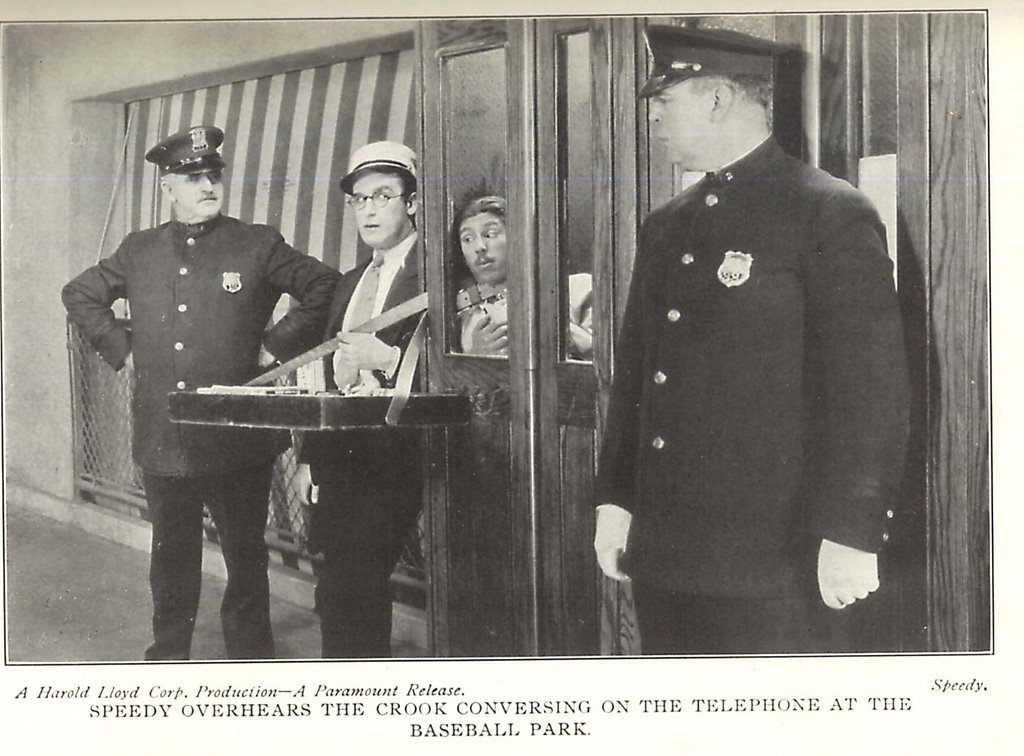
Among book/movie tie-in collectibles, the Photoplay editions are sought after primarily for their attractive dust jackets, and the photo plates generally featured with the text. They began to appear in 1913, and were at first designed to promote and accompany the ongoing serial adventures of stars such as Pearl White and Ruth Roland. They later became novelizations of feature stories and screenplays. I found one for Beyond The Rocks at a local sale for the public library, and it had a neat image of Gloria Swanson on the still-intact dust cover. The rarest ones are for things like Dracula and King Kong --- no surprise there. Photoplay editions died out by the mid-thirties, but books based on movies continued right along until paperbacks became dominant after the war. The ones shown here were issued in tandem with the release of The Freshman and Speedy, and these colorful editions must have been quite a lure for Harold Lloyd fans in the book stalls. The photo from Speedy was included as an illustration plate in the novel --- note the caption and credit. Though Lloyd was high on Photoplay editions, Charlie Chaplin apparently was not, as there are no Photoplays extant on Chaplin’s features. These little books can still be had at a right price, but beware those without dust-jackets. Condition’s a factor too. If you’re going to bid on one, make sure all the illustrations are intact. Otherwise, these are fun books, and nice souvenirs of a tie-in device that has largely disappeared.


Bill Powell's Fishing Expedition


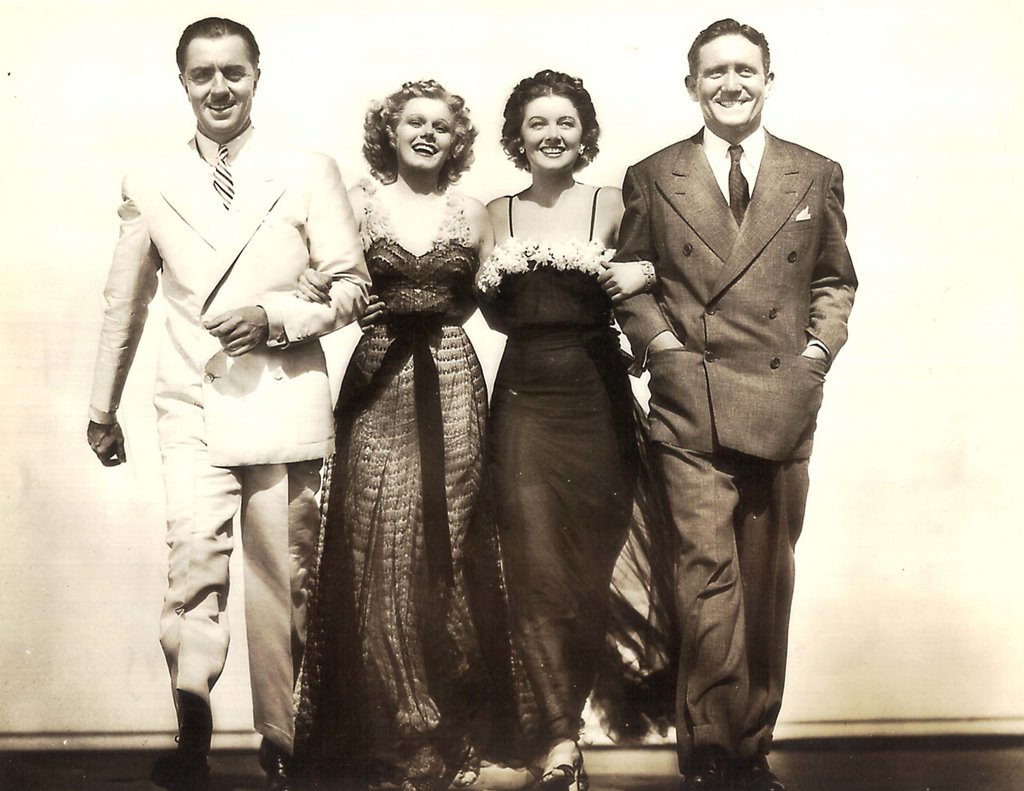
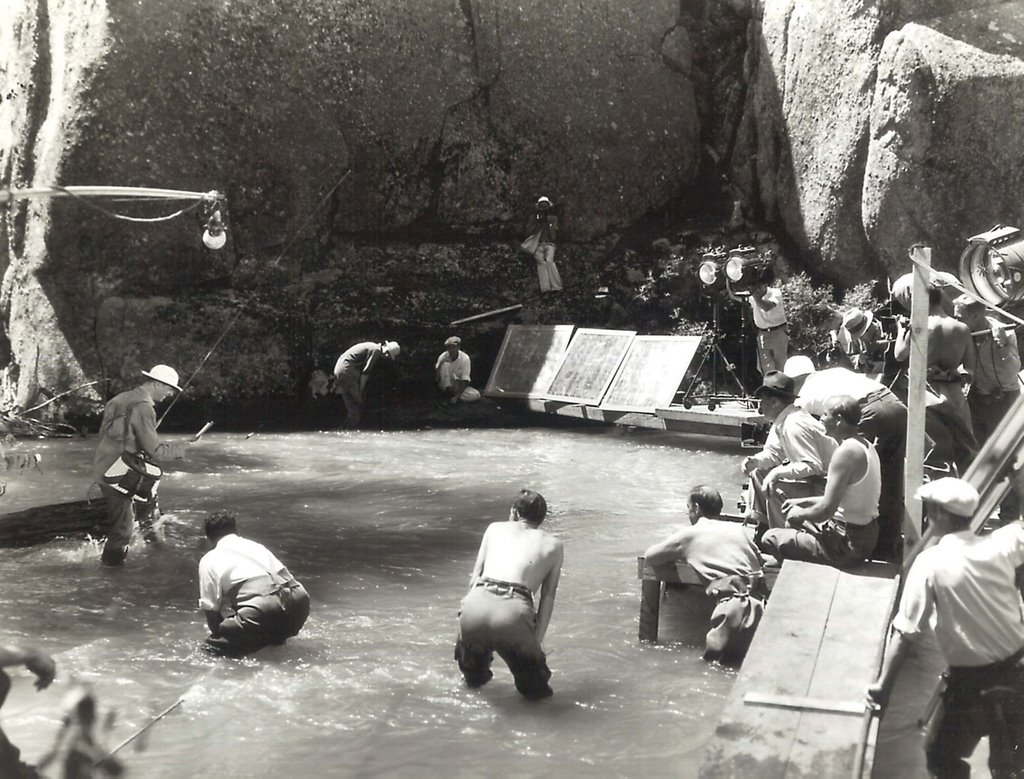
It’s August of 1936, and we’re on location with director Jack Conway and star William Powell as they prepare to shoot Bill’s comedic fishing foray for that MGM howl-fest, Libelled Lady, also featuring Jean Harlow, Myrna Loy, and Spencer Tracy. A lot of crew guys are getting soaked, as you can see, and judging by the duration of that very funny sequence in the finished movie, they must have spent several days, if not the week, treading water to get the whole thing down on finished film. Trouper Bill’s taking it all with a good-natured smile, but wouldn’t he have been surprised to learn that we’d still be watching, and enjoying, Libelled Lady some seventy years later. Anyone know just where this outdoor stuff was shot?


Child Star Supreme --- Jackie Coogan

Jackie Coogan is the only motion picture star I’m aware of who actively participated in a lynching. Perhaps there were others, but after all, this is not something you would find in official studio bios. Jackie was also the first international child phenomenon. You might even go beyond that and call him a religious figure. No one of our generation can possibly comprehend the level of stardom this kid enjoyed (and by all accounts, he really did enjoy it, even if the whole thing did come crashing down later). Jackie rang the opening bell for an age of child worship which would utterly transform the way in which society viewed its young. The fact he was idolized and pampered on the public stage while being systematically robbed and exploited at home was an irony that would galvanize a nation when those shocking headlines broke on April 11, 1938. In his heyday, Jackie was an adorable puppet for a set of vaudeville parents from Hell who’d somehow lucked into siring the most remarkable money machine the screen had known up to that time. The mother was called Lillian. She silenced a crowded banquet hall once when she referred to herself as "the goose that laid the golden egg." Some joke, huh? The father was Jack, Sr. He was a vaude vet gone to seed with a line of cruel practical jokes and the usual baggage that went with the biz --- liquor, gambling, reckless spending. With role models like these, what chance did Jackie ever have?


Charlie Chaplin should have gotten a piece of the action, because he sure enough invented Jackie Coogan. In fact, it was Charlie’s Kid character that J.C. would continue to play, with only slight variation, for the rest of his career as a child star, even down to the costume. It’s a testament to Chaplin’s genius that the public would be willing to continue buying what was essentially his product so long after he stopped personally manufacturing it. Opportunist producers like Sol Lesser (he of the much later Tarzan
pics for RKO) snapped up Jackie as soon as The Kid made the six-year old a worldwide sensation, and from there it was just a matter of recycling all the stuff that had worked in the Chaplin show, namely comedy, pathos, beleaguered child shtick --- whatever would keep the train on track. Some say Jackie represented the plight of war orphans. Others put forth a theory that merchandising, at least as it’s directed toward kids, was born with Jackie Coogan. Still more will say that when we embraced Jackie, we finally shuffled off that quaint Victorian concept about children being seen and not heard, etc. If you want to throw in notions about Jackie’s popularity being borne of increased leisure time resulting from the machine age and the availability of labor saving devices, you can go ahead and apply for an Ivy League Master’s program and eventually start your own Jackie Coogan Cultural Studies Department at Yale!


They found out quick you couldn’t take Jackie out in public. Lillian carried him along to a department store two-for-one and wound up with three thousand crazed shoppers swarming over the hapless child. It took police intervention to extricate them. By the time he signed with Metro in 1923, Jackie (or I should say his parents) were scoring $1.35 million a year. A lot of that came from product endorsements. In those days, they had Jackie toys and dolls up the wazoo. His cherubic face graced song sheet covers you could look at while banging out I’m Just A Lonely Little Kid on the upright piano. Jackie hung out with Doug Fairbanks, Rudolph Valentino, Babe Ruth --- all the biggest names. They were thrilled to be seen with him. Dad kept ruder company, and it was these that really influenced the boy. Jack, Sr. brought his son along for drinking bouts with Bill Fields, Ben Turpin, Roscoe Arbuckle
--- nobody’s idea of fit company for a growing lad. Wicked Uncle Bill gave Jackie a crash course in the use of profanities, which the child would later apply in more polite conversation, causing no end of embarrassment for studio publicists. The lowdown parental house of cards finally collapsed when Lillian took up furtive canoodling with one Arthur Bernstein, who’d lately become business manager for the Jackie Coogan Corporation, itself little more than a clearing house to siphon off Jackie’s earnings for the parent's own use and gratification. While these bejeweled parasites drove fancy roadsters and hovered over roulette wheels, Jackie worked twelve-hour days, six-day weeks. Even after the movie thing faded, they had him hustling from a music hall stage over in England, where big money could still be had for star names, even those on the wane. The awkward age dealt a growth spurt that transformed Jackie into a Tom Sawyer that 1930 audiences barely recognized, and from there it would just be a matter of time before he would he finally realize what Mom and Dad had done to him.

Jackie’s parents knew from nothing about a college education, but it seemed a reasonably good way to harness the young man’s excess energies, so it was off to Santa Clara University, where the most alarming episode of Jackie’s life, and the one most completely hidden from his public, would take place. The year was 1933, and carefree Jackie was majoring in alcoholic studies and advanced cheerleading when he made friends with a popular local youth from a prominent Santa Clara family, Brooke Hart. During this era of sensational kidnappings, the public’s outrage was daily renewed by horrific incidents of abduction and murder (the Lindbergh case still fresh in collective memories). It was against this background that Brooke Hart was taken by a pair of local nincompoops, unceremoniously beaten to death and thrown into a river before a ransom could be collected, a botched job down the line, but one which awakened mob frenzy that culminated in both men being taken out of their cells and hanged in the public square before a cheering crowd of 10,000 Santa Clara witnesses. Although he wasn’t photographed at the scene, there were those who recognized Jackie preparing the noose and lending an enthusiastic assist to the deadly enterprise. Although Jackie would never mention it during his lifetime (no one was ever prosecuted in connection with the incident), the truth of his involvement would finally reveal itself in an excellent "true crime" book, Swift Justice, which was published in 1992. Jackie’s own situation went from bad to worse when his father crashed the brand new Ford coupe he’d just given Jackie for his twenty-first birthday, killing himself and three passengers. The only survivor of the horrific 1935 crash was Jackie. His next crash would come in 1938, and that’s when he finally sued his mother and now stepfather --- only to find they’d converted all his fortune and left him stony. A bitter Coogan later told interviewers he’d netted only $35,000 from the ordeal, out of the four million he’d earned as a child actor.


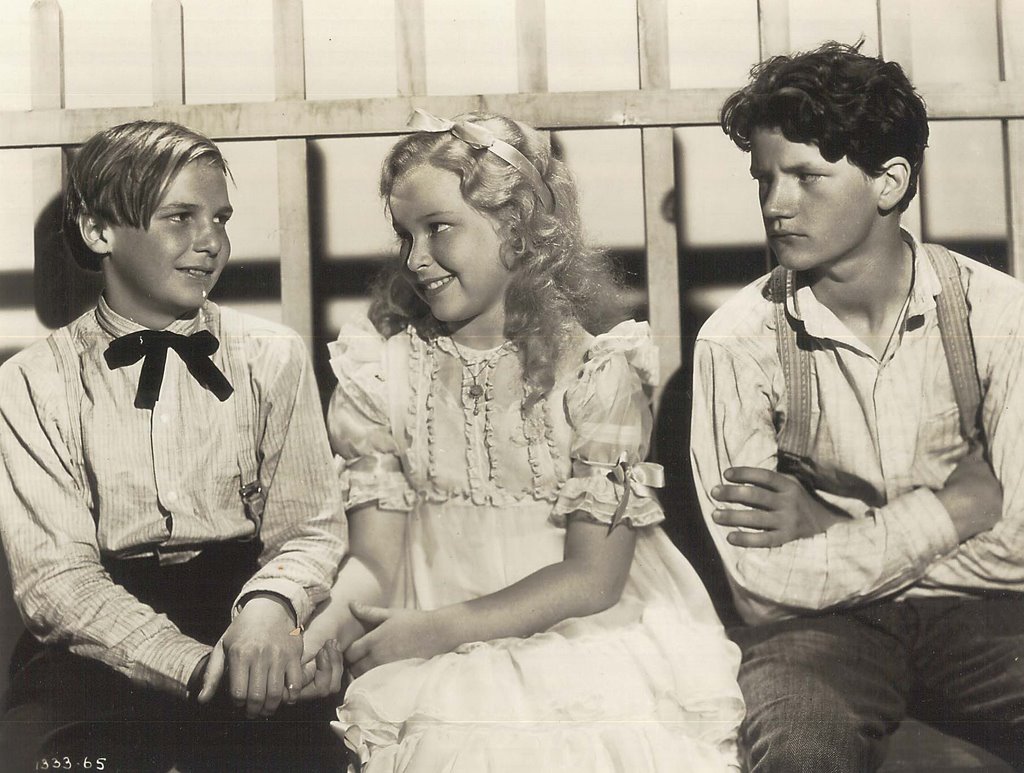
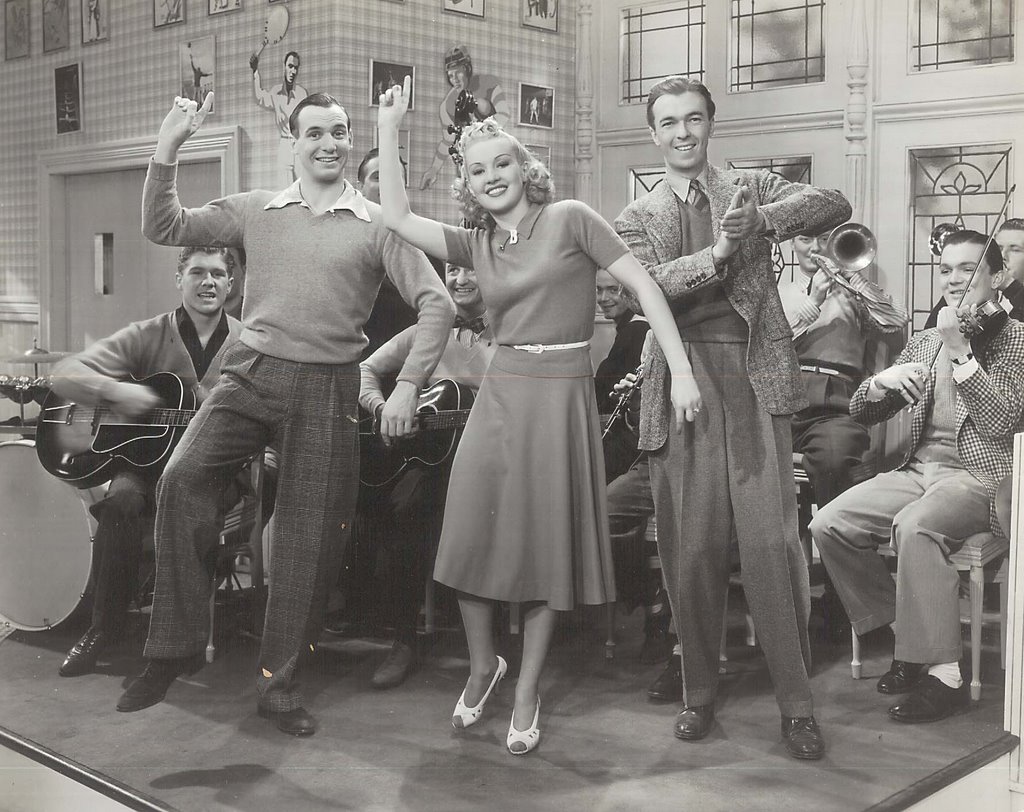
The single most enduring image of Jackie Coogan is the one he shared with Charlie Chaplin in The Kid. When Jackie went broke (the first of many such occasions), a sympathetic Chaplin spotted him ten G’s. Who says Charlie was stingy? That’s Jackie and his expensively tailored parents on the Metro lot --- watch-chain, spats, and fur courtesy the kid. Jackie wasn’t the title character in The Rag Man, but it seems he was always dressed in them. Audiences preferred him in ragamuffin attire and circumstances for most of his shows, but Metro tried something different for two shown here in trade ads --- Long Live The King and Little Robinson Crusoe. Both are out of circulation today, though it’s rumored Warners preserved some Metro Coogans, but won't run them because of rights issues. Part of Jackie’s settlement with the crook parents gave him rights to negatives of these features. Is it possible his estate owns them yet (he died in 1984)? Maybe a meeting of minds between Warners and the Coogan family can put some of Jackie’s starring vehicles back in circulation. My online copyright search couldn’t turn up any reference to them. Orphan movies, just like most of Jackie’s roles. This exhibitor ad with Jackie in military garb came toward the end of his starring career. The Bugle Call and Buttons were both profitable, but talkies and adolescence, not to mention Louis Mayer’s antipathy, combined to scuttle him. Tom Sawyer at Paramount was a brand new Jackie, seen here with Mitzi Green and Junior Durkin, a close friend who would later die in that infamous wreck that killed Jack, Sr. Newlyweds Betty Grable and Jackie Coogan are whooping it up in College Swing. When someone asked her years later about the failed marriage to Jackie, Betty paid moving tribute when she said, "Listen honey, Coogan taught me more tricks than a whore learns in a whorehouse." You go, Jack!! Finally we have a couple of down-on-their-luck kid stars teaming up to pay the rent --- the Jackies Coogan and Cooper
in Kilroy Was Here, a flea-bitten Monogram special they did in 1947. Coogan would have a comeback of sorts as Uncle Fester in The Addam’s Family, but the once beautiful boy hated playing it grotesque. The stardom of his youth was now so remote, he couldn’t even persuade his grown daughter of how big he’d once been. What a life this guy had. By far the best bio is the one by Diana Serra Cary (a former child star herself) called Jackie Coogan --- The World’s Boy King, and it’s a terrific read.


Monday, April 24, 2006


It's Always Fair Weather
It’s Always Fair Weather is best enjoyed by middle-aged viewers who can identify with the malaise and disillusionment of the three principal characters, and since this has never been the primary demographic among moviegoers, it was probably inevitable this movie would fail. That plus the fact MGM musicals were beginning to pall at the wickets --- for every Seven Brides For Seven Brothers, there were six like Brigadoon, Hit The Deck, Athena, Deep In My Heart --- such a reservoir of red ink raises the question as to why they kept doing them at all. Here’s a surprising factoid for Gene Kelly’s fans --- every single feature he did for Metro after Singin’ In The Rain lost money. A few of the specific losses, in millions --- Brigadoon ($1.4) --- It’s Always Fair Weather ($1.5) --- Invitation To The Dance ($2.4) --- and Les Girls ($1.5). You begin to wonder how he even got a pass to drive on the lot. I’m awfully glad he did though, because It’s Always Fair Weather is one terrific MGM musical, the Little Big Horn of valiant song and dancers staging one more big show as their fickle audience retreats home to their televisions and rock ‘n roll platters. Its domestic rental was a woeful $1.4 million. Within a year, a black and white piece of cheese called Love Me Tender would take home $4.2. Times and tastes, they were a-changin’.


A lot of people like this musical because of its "dark" aspects --- that’s probably gotten it through a lot of revival house and university doors where it might otherwise have been snubbed. It’s mostly Dan Dailey’s character hauling that baggage, and all because he’s been "reduced" to designing animated commercials for television! Now maybe I’m misinformed as to the definition of success on Madison Avenue in the fifties, but I would think any guy who’d developed a nationwide ad campaign, in any media, would have to be considered an up-and-comer, if not an already-got-there. Greg Peck’s Man In The Grey Flannel Suit could have fixed up that shabby old house and gotten Jennifer Jones
off his back had he pulled off such a coup. I suspect poor Dan’s despair lay in the fact that he’d whored himself out to television, and that in itself was enough to bring on (well deserved) alcoholism and ulcers for any character in an MGM feature. Every depiction of TV here is a withering putdown, whether it be Dolores Gray’s hostess gorgon, or a barroom cutaway to those inane cartoon ads Dailey’s Doug Hallerton has inflicted upon a nationwide audience. It’s even implied that Doug’s marriage might become a direct casualty of his misdirected creative energies. His whole "life of degradation" speech at the end is really Doug’s confession of having degraded himself through an association with television. In fact, all three principals react to their video debuts as though they’d been tossed head-first into the ninth ring of hell. Only a questionably motivated donnybrook and full-scale disruption of this vulgar broadcast can redeem their integrity.
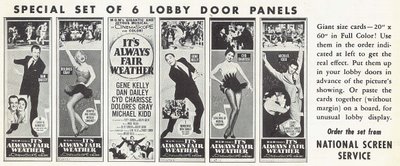
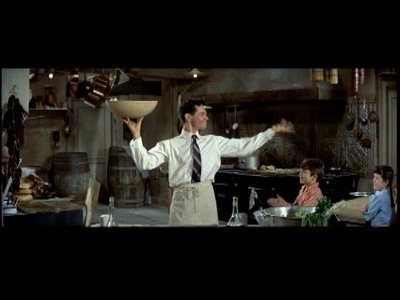
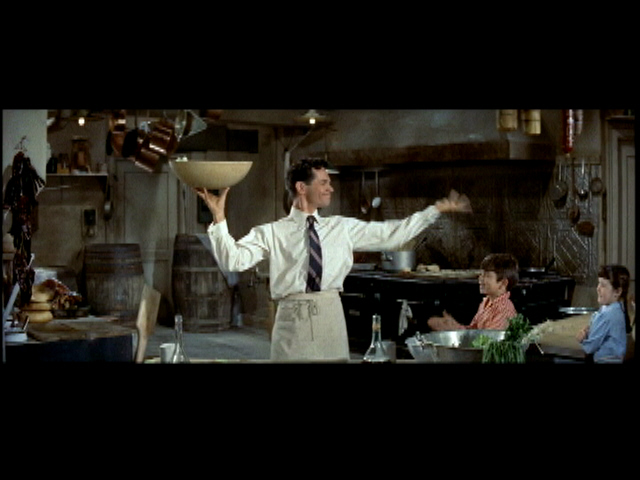
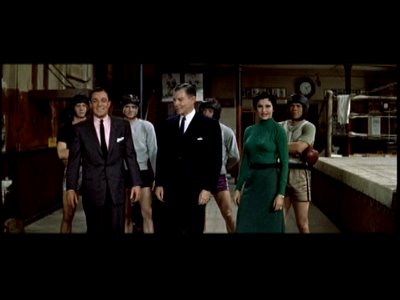
Michael Kidd had to feel some resentment after four day’s rehearsal and a day and a half shooting on his solo number, "Jack and The Space Giants" (shown here), only to see the number excised at Kelly’s insistence. The footage is included as an extra on the DVD, and Kidd’s dexterity with kitchen utensils is a sight to behold --- he actually reminded me of those acrobatic routines Roscoe Arbuckle
used to execute when playing a cook and/or waiter in the silent days. They say Kelly nixed the act because Kidd employed little kids as an appreciative on-screen audience, and Gene couldn’t abide the notion of anyone else using moppets for props. That was his specialty. Dan Dailey’s big lampshade routine nearly went into Gene's dustbin as well, but co-director Stanley Donen fought to keep it. He described the job with Kelly thus: It was an absolute, one-hundred percent nightmare, and this within twenty years after the 1955 experience, when both men were still active in the business and would presumably encounter one another (at least socially) from time to time. You’d have to assume Kelly was a real pill on this show, but that roller-skate number sure redeems him for me. It’s got to be among the top three of any dances the man ever performed. Even if It’s Always Fair Weather were an otherwise lousy movie (which it certainly is not), this segment would place it among the immortals.

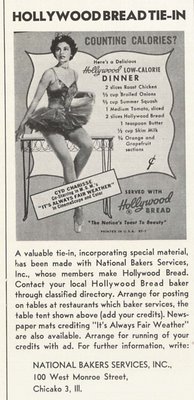
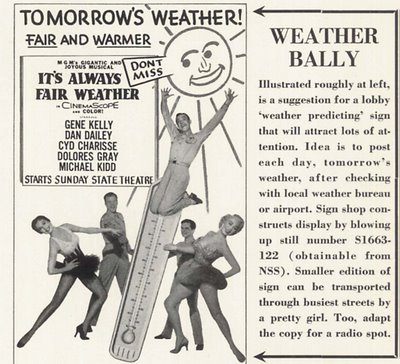
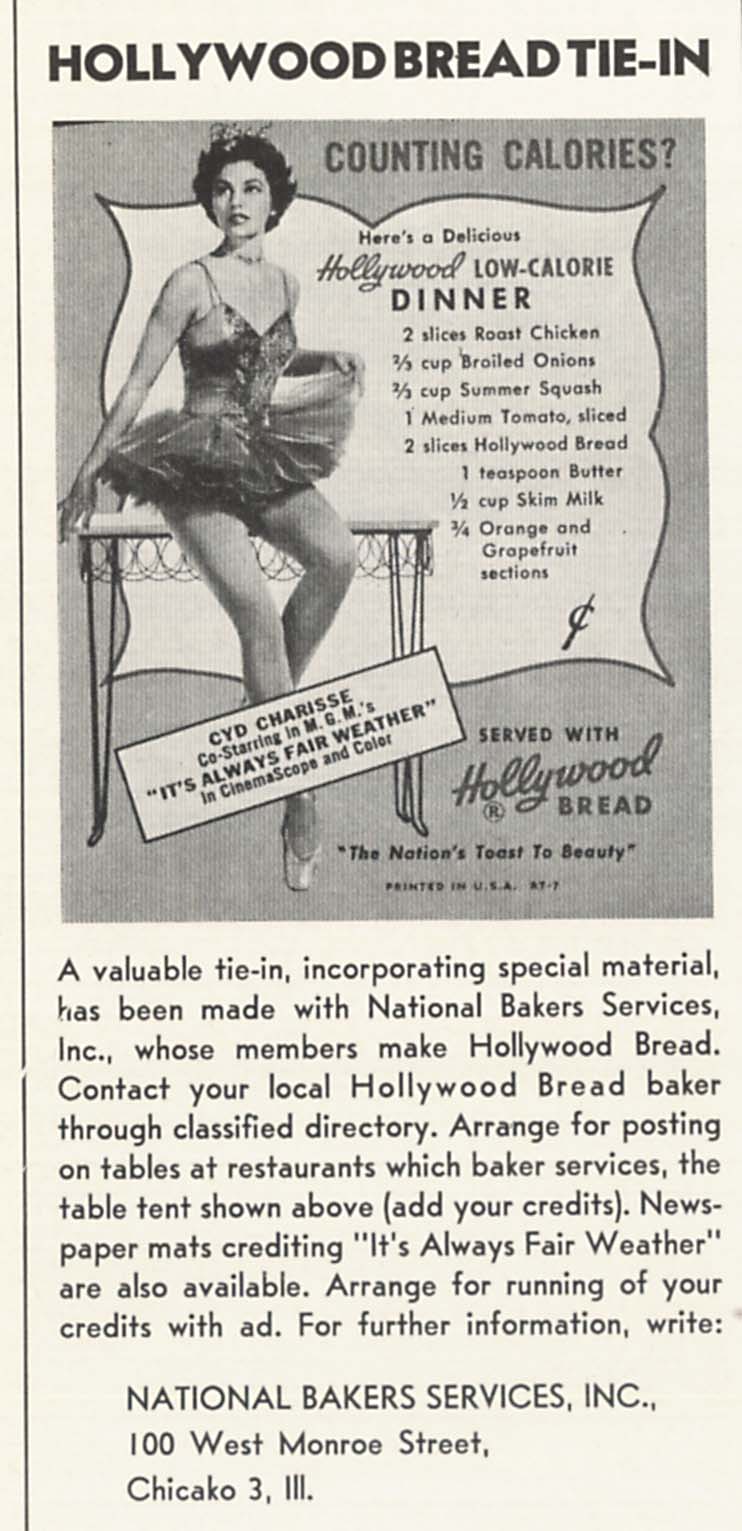
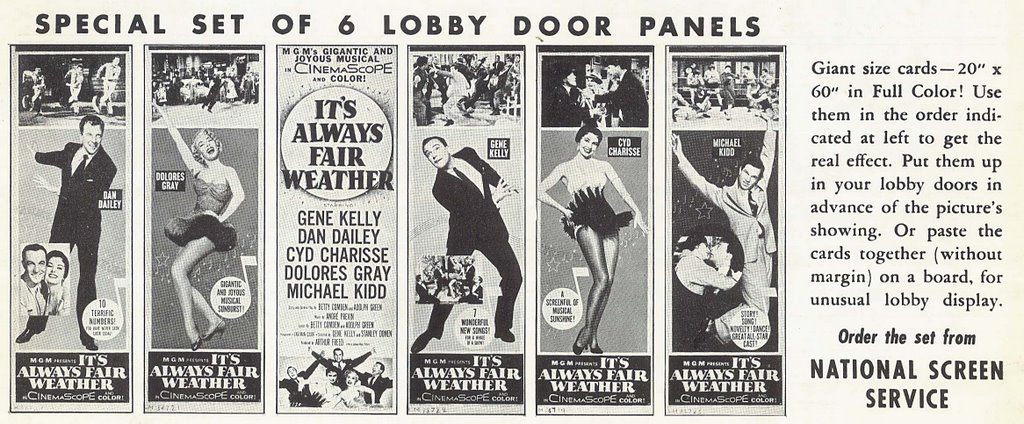
The expansive ad you see here was actually a fold-out herald inserted into newspapers, grocery bags, mailboxes --- you name it --- and the cost to exhibitors was $5.25 per one thousand. A price increase went into effect on July 1, 1955 --- from that date they'd be $9.25 per K. The stars with outstretched hands around the title were a less than inspired marketing image used for virtually all the poster art, even making its way to the recent DVD cover. Overrall a pretty anemic campaign, and that probably had something to do with resulting weak attendance. One remarkable exception are the fantastic door panels illustrated here. Each of these six in the set were full color and stood sixty inches high, by twenty inches across. They are gorgeous and almost impossible to find today. Metro provided these on most of its big pictures between 1950 and 1955. None of them were cheap, so exhibitors used door panels sparingly. I found a bunch scrounging an old theatre some thirty years ago, and believe me, they’re incredible. This Wonderbread tie-in with Cyd Charisse
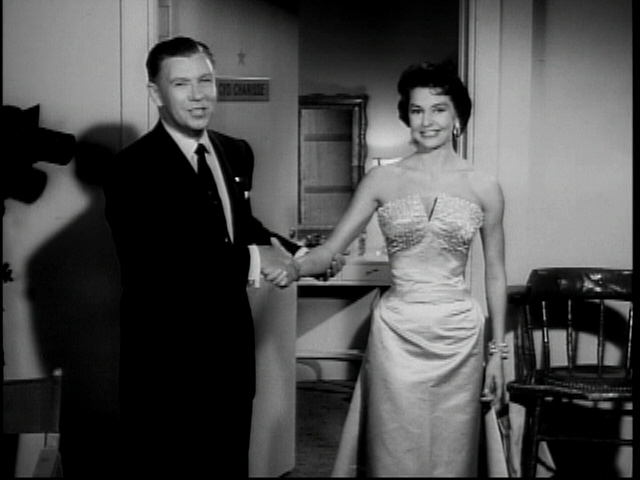
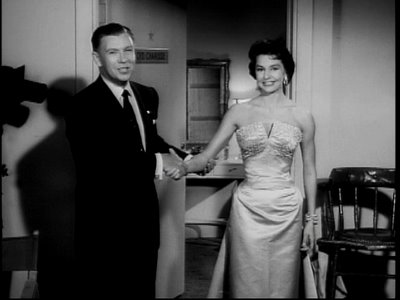
makes me wonder --- was Cyd informed as to each ad bearing her image? I suppose she signed a release. Maybe not. Probably sitting at home reading Woman’s Home Companion, and there it was. The "Weather Bally" was inevitable, I suppose, but would it have lured patrons? Doubt it. If anything drove off business, it was probably the fact George Murphy was giving away the movie on TV’s MGM Parade, an 1955-56 ABC series operating on the assumption home audiences would happily sit through old theatrical shorts, heavily abridged features, and random clips just to get a glimpse of Metro’s forthcoming releases. Two of the episodes featured the best songs from It’s Always Fair Weather in their virtual entirety (that’s George Murphy and Cyd Charrise setting one up for the viewers). Schizophrenic Metro was feeding the video monster even as they tried so desperately to resist the erosion it was causing for their boxoffice. Yet another number was a gratuity for audiences in an MGM Cinemascope short made the same year, Salute To The Theatres, in which Murphy visits the set (shown here) and persuades Gene Kelly to make with a free song and dance. Poor George was like the tent show barker that gives up the whole show on the outside before anyone has a chance to pay for the privilege of coming inside.


They Photographed Nicely In Color Too


I’m no expert in color photography, but I know what I like. These images from various mid-thirties publications fairly leaped off the page toward me. I was resolved to share them here, and promise there will be many more to come. I’m told that three-color photography really started to come into it’s own around 1935, and this was about the time Hollywood began to embrace color as a means of publicizing stars and the movies featuring them. Fan magazines were slower to incorporate color. It was an expensive feature for otherwise cheap publications, but what a thrill it must have been for Photoplay readers to open a 1939 issue and find Bette Davis in a full-color fashion lay-out, or Kay Francis, or Merle Oberon. A lot of magazine purchases were probably inspired by a glimpse of these striking figures. By the forties, color was much more commonplace, but never common. Studios competed to provide the most stunning muti-hued portraits for insatiable collectors to paste in their scrapbooks. Here is but a sampling, but rest assured, we’ll be back with more of them!


Sunday, April 23, 2006


Judgment At Nuremberg

One thing that always diminishes the suspense for me in a Spencer Tracy picture is the fact that Spence always gets to be right --- especially in those later ones when he’s an old man (albeit one in his sixties who looks to be in his eighties), and gets all the zinger lines that invariably end arguments in his favor. That happens a lot in Judgment At Nuremberg. People are constantly coming at Spence with well reasoned positions that seem perfectly sensible --- only to forget they're dealing with Spencer Tracy, and Spence is never wrong. He’s the font of wisdom for every occasion, and I don’t wonder that a little of that bled off-screen, as they say Tracy didn’t like contradictions there either. It’s really a good thing he was such a great actor, cause he sure was a truculent sort from everything I’ve read. Long-suffering columnist Bob Thomas thought he and Spence were buddies when he visited the Nuremberg soundstage, but all Bob got for his trouble was a sound cussing and a tail-between-legs exit off the set. Seems the hapless scribe had made the mistake of joshing with that intensely serious ac-tor Burt Lancaster, inquiring as to which among the all-star cast would "out-ham" the rest. Affronted Burt took the matter to Spence and the chill set in. I was actually thinking of chills when I observed those opening scenes of Tracy touring the Nuremberg locations. He’s wearing an overcoat, as are a number of extras and townsfolk in the distance, and I wondered momentarily if the notoriously fragile Tracy might get pneumonia on those damp streets. What if he’d been laid low after the first two or three weeks? Stanley Kramer and United Artists would have had to file an insurance claim, then replace their lead actor. It would have been Solomon and Sheba all over again. Well, clearly I wasn’t into the story of J.A.N. at this point --- I was thinking about movie stars --- but what to do, when there were so many more of them to come?

We’re not a reel into this three-hour monster when the door opens and young Bill Shatner walks in. You know what? He’s good in this show --- and if I ever meet Bill, I’m going to tell him so --- and he’ll thank me for not jabbering on about all his Star Tricks, which has got to be the most boooring subject in the world for him (sure is for me). Neophyte Bill was ringside for a thespic showdown where each contestant made their way up to that witness stand to be sworn in by his character, who then sits quietly by as they shout, blubber, collapse, twitch, and tremble their way through the most extraordinary series of nakedly determined bids for an Academy Award this viewer has ever seen. A number of them would be nominated, but only Maximillian Schell would win. Max got special recognition for Best Supporting Performance Where Everyone Shouts A Lot. Jim Cagney
ran them all a close second for One, Two, Three, but Academy voters tend to prefer dramatic shouting over merely comedic exertions, so a disillusioned Jim retired to his farm and didn’t make another movie for twenty years. You know you’re in trouble with Judgment At Nuremberg when opposing sides start raising voices from the trial's very outset. I don’t know what kind of direction Dick Widmark got, but he comes in roaring like a lion, which is all well and good, I suppose, but with three hours left in the marathon, what do you do for a climax?

That tragic wreck of a once fantastic actor Montgomery Clift is frankly exploited here as his walking wounded role calls up any number of disturbing parallels with the devastation of Clift’s own life. 1961 audiences had to be shocked by the horrific effect of those few years since he was the most promising young romantic star in movies. Watching him struggle through what amounts to an extended cameo is a painful thing to witness, especially if memories of Red River and A Place In The Sun are fresh in the mind. The long speeches were an impossibility by this time, so Spence lent a hand by advising Monty to wing it as best he could and direct his "testimony" to Judge Tracy. Kinder critics lauded Clift’s interpretation, but this may have been one time when an actor got a little too close to the truth. After one more disastrous lead (Freud), Montgomery Clift was pretty much through in the business. Judgment At Nuremberg came during the third act for Judy Garland as well. Her character takes the stand twice, and you know they’re just warming us up with that first round because Judy’s all subdued and that, of course, is not in keeping with the histrionic powderkegs they’ve been lighting so far in this movie. Sure enough, when she gets up there the second time, all hell breaks loose with an emotional breakdown that again crosses the line between artifice and reality. Two great "confessional" performances, but neither Clift nor Garland would really benefit from them. Even wily Burt Lancaster seems defeated by a miscast old-man impersonation where his German accent wavers and the pressure to bellow out his long-awaited speech is just too great for Burt to resist. The most effective performances are ironically those of supporting players, and it’s nice to see veterans like Ray Teal and Virginia Christine lending understated expertise to an enterprise that can sure use it.


Old-fashioned ballys for this kind of show would have been frowned upon, so exhibitors were advised to go the dignified route. No doubt a lot of thoughtful readers would have acted on Eleanor Roosevelt’s endorsement and bought a ticket, but how many thoughtful readers were still going to movies by 1961, a year in which The Absent-Minded Professor and The World Of Suzie Wong were counted among the most popular? I like that telephone display, but notice that showmen were advised to "rig up" one themselves, and by the looks of this rather elaborate model, that would have been a pretty tall order for the smaller houses (my sister had one of those Princess phones in 1961, by the way, and they were sure enough neat). The stills give us a glimpse of most of the names we mentioned earlier, though it’s worth noting Marlene Dietrich’s rather pinched expression in this shot with Spencer Tracy. She’d had (another) face-lift just before production, and the usual lighting tricks she demanded would betray her this time, as they’d cruelly emphasize, rather than conceal, the lack of mobility in her facial features. This final candid was taken at the premiere of Judgment At Nuremberg in Berlin, where a hostile German press merely exacerbated the already bizarre behavior of Montgomery Clift
(bearded here for his role in Freud), who, according to one observer, "showed up stoned and drunk out of his mind, jumping on Spence’s back." Things got worse when Monty crawled on his hands and knees between the aisles, and "screamed all sorts of crazy things," causing Tracy to flee from the auditorium. Judgment At Nuremberg ended up with what had to be a disappointing $3.9 million in domestic rentals, with an additional $2.2 foreign, for a worldwide total of $6.1 million.


Saturday, April 22, 2006


Monday Glamour Starter --- Norma Shearer --- Part Two


Having set her cap for Irving Thalberg, Norma endured any number of insipid parts in the silent features he produced with a saintly patience, hoping (or perhaps knowing) he would eventually marry her. Thalberg was another one of those dual personalities peculiar to Hollywood. That stuff about his being a genius supervisor seems to have been on the level. They say you could take an insurmountable story problem into his throne room, and minutes later, you'd have the solution. He sat on the repair bench for virtually every picture Metro released during the early thirties. Any employee who thought he/she was last leaving the lot at night would look up and see Thalberg’s office lights still burning. When he’d finally get home, Mother would have pajamas neatly laid upon his bed. The matriarchal influence extended to dates as well --- it was strongly suggested that marriage to Carl Laemmle’s daughter Rosabelle would be a useful alliance, but this mating of eagles would not take place. Neither would a union with Constance Talmadge, which would have netted in-law status with Joseph Schenck, Norma Talmadge, and Buster Keaton, among others. Instead, Thalberg wed Norma Shearer, thus rescuing Irving from Mother’s permanent clutches (although she’d remain a powerful influence) and providing Norma a career impetus that rescued her from the fate of a Constance Talmadge, whose own star blinkered out as soon as talkies arrived.

These sexed-up portraits of Norma were the fruit of her collaboration with photog George Hurrell, and the story goes she furtively arranged to have them taken, then flung the sizzling portfolio into Thalberg’s lap one morning at the breakfast table. Torrid pre-code Norma was thus born that day. Makes a good story whenever you’re introducing The Divorcee or Strangers May Kiss, and who knows, it may even be true. The trade ad shown here confirms her status. Serious studio rivals were Joan Crawford and Greta Garbo
--- Crawford more so because hers was a bitter competition --- neither woman enjoyed being one-upped. You can only imagine what it was like when these two passed one another in make-up. Their mutual antipathy was probably borne of the fact that they’d both been cut from similar bolts of cloth --- gentility on the surface, ferocious ambition within. Today’s workplace tensions would no doubt seem prosaic beside the ongoing struggles at Metro.


Kitty Carlisle rented Norma’s beach house one summer and availed herself of an attic search during a rainy afternoon. This was some years after Norma’s retirement, and what Kitty found was the King Solomon’s Mine of Shearer ephemera --- dresses, scrapbooks, more dresses, many more scrapbooks --- all of it hidden behind a locked door and no doubt discarded when Norma eventually sold the place. What becomes of a star’s treasures once stardom's gone? If they make it to old age, are there even any fans left to care? Norma may have asked herself that question during those forty years following her final screen appearance (here she is with Dick Powell and June Allyson on a mid-fifties skiing holiday). Thalberg had died in 1936 when he was only thirty-seven, leaving Shearer to the tender mercies of Louis Mayer
--- he and fellow execs tried to hoodoo her out of the percentage deal Irving had wangled out of Loew’s a few years before. This is where Norma’s steely resolve asserted itself, and her very public battle with studio brass ultimately yielded the lifetime of gravy she had coming (forty years later, she’d still conduct inquisitions of MGM bookkeepers --- even chiding them for failure to mount a seventies re-issue of that "sure money-maker", the silent Ben-Hur!).


If you’d been a Nibblers patron during the seventies, chances are you would have seen Norma and her second husband (the ski instructor) having lunch at the counter. Up until then, they were fairly active socially. Norma even got down with the latest dances --- imagine her doing the twist in a sixties club --- yet there she was, and Shearer sightings around town were not uncommon. She’d aged, but not alarmingly so. Still, she was consumed with the dread of aging, and of sharing her sister’s fate. Friends who’d shown Norma home movies in which she appeared were later besieged with letters asking that unflattering footage be edited out, and while sister Athole (pronounced "Ethel") found relief through recently available medications, Norma herself would be plunged into depression and the same sanitarium her sibling had occupied. Brother Douglas Shearer, longtime sound engineer at Metro, seems to have been spared the family curse, and lived into a peaceful old age (he died in 1971). Norma became increasingly addled in later years --- she wrote angry letters to MGM when they included but a glimpse of her in 1974’s That’s Entertainment, and regularly drove dinner guests over to the Culver City for yet another screening of Marie Antoinette, her favorite of the Norma films. She’d been calling her husband "Irving" for some time, and finally, after she’d been placed in the Motion Picture Country Home, she greeted every man the same way, Are you Irving? --- Were we married once? That’s where she died, in 1983. Shearer was at least eighty, maybe more, perhaps less, depending on which account you believe. She died too soon to enjoy the Norma pre-code renaissance that would come in the following decade, joining that circle of greats, including Bela Lugosi, Oliver Hardy
, and a few others who just missed the applause of a whole new generation of fans.


Thursday, April 20, 2006


More Samplings Of A Showman's Art


Just a couple of nicely designed theatre ads that bespeak the fine showmanship that characterized the early forties. I really like "Forget The War!" as a header --- and that twenty-one cent admission must have been quite a lure. The kid on the telephone for the Valentine Theatre is a nice touch as well, and what a surprise it must have been for Mr. and Mrs. Bob Goldenetz to open the newspaper and discover that they’re to be admitted free with the ad and a "service charge". That last proviso has me a little baffled --- just what is a service charge for a movie theatre? It had to be a nominal amount, since the admissions were so low to begin with.


Wednesday, April 19, 2006


Those Wonderful, Waning Days Of Showmanship


Dateline November, 1963. The place is Indianapolis, Indiana’s Circle Theatre, where 2,500 anxious kiddies showed up en masse for the biggest Three Stooges Saturday Morning Movie Party the city had ever seen, or sad to say, would ever see again. Grassroots showmanship was making a glorious final stand here, but chances are few of these happy participants realized it. That sideshow pitchmaster out front is WFBM’s Harlow Hickenlooper, host of the weekly TV Stooge-fest, whose own frenzied promotion over the preceding weeks resulted in the twenty-five hundred free ducats now being redeemed at the crowded boxoffice. The feature was Three Stooges Go Around The World In A Daze, admittedly a step down even from the none too exacting standards of Harlow’s video inventory, but, hey, when the show’s a freebie, with a stage show besides, who’s kicking? The Greater Indianapolis Amusement Co., of which the Circle was a flagship venue, put all their best showmen on this project. Kids were writing in a month ahead of the playdate for their tickets, and within a week, they were gone-eroo. That stage show must have rocked. WFBM radio microphones were at the ready to record "exciting moments", which included improvised hijinx with Hickenlooper and his on-air stooges, Captain Star and "Curly". The whole thing culminated with a pie in the face for "Happy Harlow", his traditional TV sign-off. What a blast. WFBM-TV cameras were on hand "to take motion pictures of activities" at the event, with the footage to be unspooled on weekend newscasts and later on the Saturday Hickenlooper show. I wonder if this reel could have possibly survived (chances are it was shot on 16mm). What a priceless artifact that would be!


Tuesday, April 18, 2006


Jack Benny and The Fox Team Players
Sometimes in the workplace, it’s necessary to get all the employees together for a real group effort --- one of those one-for-all-all-for-one projects where everyone hauls the freight together. Here we have the happy family at 20th Century Fox putting their shoulders to the wheel on behalf of Charley’s Aunt, Jack Benny’s 1941 remake of that venerable war-horse familiar to most anyone who’d ever bought a theatre ticket. They really put the big sell behind this one, and every major name on the lot seems to have kicked in. I’d first noted the unusual campaign for Charley’s Aunt some fifteen years ago as I walked down a hotel corridor during a Syracuse Cinefest. Through a partially open door, I heard the familiar chatter of a 16mm projector, not an uncommon thing at Cinefest --- but this one was firing up on a deluxe trailer for Charley’s Aunt, and there on the somewhat off-white far wall of the room was a galaxy of Fox stars endorsing Jack Benny and his new comedy. Having never seen the feature, I couldn’t imagine it measuring up to this trailer. Some time later, I did finally see Charley’s Aunt, and I laughed --- no, I really laughed. This is one terrific Jack Benny performance. Rumors are afoot that Fox is considering a DVD release of this and The Meanest Man In The World (Jack’s other Fox vehicle, and a good one). I hope this rumor pans out.

Now all of you no doubt wonder, as do I, if these caricatures of Jack Benny were really drawn by the artists credited. Alice Faye? Tyrone Power? Rochester? I mean, who knew? John Barrymore
, yes, as he was somewhat accomplished with a sketchpad, and had indeed considered a career in commercial art before the lure of family business proved irresistible. I wonder how Jack might have fared if they’d just let go his own way as a young man. Would he have been content drawing ads for Carnation milk and Arrow shirt collars? As it is, Barrymore is once again spoofing his own glory days behind the footlights with a Shakespearean spin on his artistic contribution ("Alas, Poor Bennick"). Having recently done The Great Profile for Zanuck , for which he received a much needed $200,000, Jack probably recognized a certain obligation to the studio that had, by now, sustained a considerable loss on his account (The Great Profile went $250,000 into the red).


You’ll note the convenient mentions of other Fox productions --- Tyrone Power jots down his depiction of Benny while awaiting the next set-up on A Yank In The R.A.F., while Alice Faye whiles away the time between takes on Weekend In Havana. I’d really like to know if they actually drew these things. Actually, I think the caricatures are pretty good. Maybe too good --- know what I mean? Rochester’s contribution is the oddest --- what’s with the padlocks? I suppose it was inevitable that Betty Grable would be pressed into service for a little comparative leg art with Jack. For that matter, all these people shared criss-crossing paths between sound stages and broadcasting studios. Benny always liked to promote his movies with guest appearances of movie star friends, and based on his gigantic listening audience, it behooved these personalities to play ball. Mutual back scratching between motion pictures and radio was at a near peak when Charley’s Aunt came out. It must have been a pretty good plan, because the movie, with a negative cost of $889,000, brought back domestic rentals of $1.5 million, foreign was about half that at $737,000 (well, they had a war on over there, and didn’t have Jack Benny on the radio). Worldwide rentals were $2.2 million for a total profit of $722,000.


That supporting cast in Charley’s Aunt is an interesting mix of young ones moving up, and veterans headed down. Ann Baxter was a teenage ingenue having just completed The Great Profile with Barrymore. James Ellison was getting another chance at Fox after that bid for stardom in Paramount’s The Plainsman failed to launch. He’d be an ingratiating addition to The Gang’s All Here a couple of years later, but Fox would eventually cut him loose, and from there it was back to budget westerns where he’d gotten his start in the 1930’s. A welcome addition to Charley’s Aunt is Laird Cregar, lending a deft comedic touch he’d later apply to Lubitsch’s Heaven Can Wait. Finally, there is Kay Francis
, her major league status well past, and now approaching retirement from the screen --- her last would be a handful for Monogram before a final exit in 1946. Other than a few cameos, Benny himself would abandon movies even sooner with 1945’s The Horn Blows At Midnight.


Monday, April 17, 2006

Hollywood Family Moments


I tend to wonder what was going through the minds of the kids when these Hollywood family shoots took place. Were they "made" to sit still and pose for these home invaders from Daddy’s studio? Did the tranquil domestic scene as captured by the still photographer in any way reflect the reality of their home lives? Celebrity offspring memoirs have been an ongoing industry for many years. In the wake of Mommie Dearest, we tend to forget the earlier, respectful ones penned by the sons and daughters of Leslie Howard, Ronald Colman, and others. Most of these kids elected to mind their own business and hoped that others would do the same. A lot of us would be surprised to find one of them living quietly next door. It’s been known to happen. Last year I read that William S. Hart’s son had just died. William S. Hart’s son!! I'd have thought he was born around the War of 1812. Somebody told me that Leslie Howard’s aforementioned daughter was living in quiet obscurity somewhere in South Carolina. I just saw an old fan mag piece today where she and Dad are posed together --- he’s boasting of her dramatic prowess on radio, and promises she will carry on the family’s dedication to Thespus. So what happened there? How did she wind up in S.C.? Any of these kids could tell amazing stories. Some of them have. Gary Cooper’s daughter gave us a splendid picture book a few years ago with photos from the family archive and affectionate commentary. That’s her with both parents around 1960, not long before Coop’s passing. She related an anecdote once about a birthday party in the early forties where the kids got to see The Plainsman, with Dad manning the 16mm projector. When they got to the scene where indians had Coop trussed up over a cooking fire, she had to look back to the operator for reassurance. His wink and smile assured her of an eventual screen rescue. Such things must have happened a lot when kids went to see their famous parents at the movies.

Let’s start with the least likely perfect husband/father and work up. We’ve addressed Gary Cooper, and his various wanderings are sufficiently well known so as not to require a recounting here. Suffice to say that by the time this picture was made, Coop had settled in for the third act curtain, which would not be long in coming. But what of Bob Mitchum
? Notorious, roustabout Bob, late of a hoosegow sojourn after an admitted flirtation with the cannabis weed. The same Bob whose noirish screen exploits and lurid off-screen dalliances would seem to disqualify him for any Father Of The Year awards --- and yet he remained married to the same woman till the day he died. Story is that whenever a dish of the moment pressed the marriage issue, Bob would always respond by assuring her that it was alright with him, but, You’ll have to ask Dorothy first (Dorothy being the wife, natch). Now how’s that for disarming? Even Shirley MacLaine, a notable Bob paramour, was at a loss for words when confronted with such unassailable Mitchum logic.

John Wayne
had a passel of kids that spanned a couple of generations. Here he is with a few of the second group. The older ones were grown and serving, for the most part, under the Batjac flag. That’s the third wife, Pilar, and this pose tied in with the release of True Grit. Wayne’s firmly ensconced in elder statesman status by now. For a star of his magnitude, it’s remarkable how often he’d found himself flat broke. It happened during the mid-fifties (investment counselor gone bad) and again when he sunk everything into The Alamo. This was one actor who had to keep working to maintain the fuel supply in that yacht. I read once that Wayne’s adolescent daughter often preferred mall shopping to afternoon boat rides with Dad. I’m just sitting here trying to imagine any circumstance wherein I’d pass on a day spent in John Wayne’s company. Nope --- can’t think of one.


Finally --- the perfect husband and father. At least I thought so until I checked out that recent Peter Bogdanovich book, Who The Hell’s In It? Seems there were cracks in the idealized James Stewart marriage --- and what’s this about Kim Novak? Maybe I’ve been naïve, but this was like the time I found out Santa Claus wasn’t on the level --- don’t read it unless you’re prepared to have some illusions shattered. All of which reminds me that we’ve done too little on James Stewart here at the Greenbriar, which is odd considering how much we enjoy his westerns, not to mention the Hitchcock
shows. For that matter, we’ve done virtually nothing on westerns, despite our long-standing fondness for them. Did I hear they tore down Stewart’s old house in Beverly Hills? I would imagine a lot of those old star mansions are beginning to crumble. Anybody know the status of the residences along that street?


Angie Dickinson Day

Today we’re participating in another "Blog-a-Thon", this one called by Dennis Cozzalio at his website (HERE) and dedicated to Angie Dickinson. Now, first off, I never saw a single episode of Police Woman, and while I do recall Big Bad Mama and Dressed To Kill, two of Angie’s major cult favorites, I would have to say that these two came a little late for Greenbriar bookings. Besides, I’m sure other contributors to the Angie-A-Thon will provide better illumination where these titles are concerned. My greater fascination with this actress revolves around those first films in which she was featured --- valiant efforts to launch a new star, but at a time when the studio machinery was in such decline and disrepair as to make it near impossible to introduce, let alone sustain, a new big-screen personality. The boneyard of distaff discards reads like the guest list at a 2006 Collector’s Autograph Show --- Pamela Tiffen, Carol Lynley, Paula Prentiss, Stella Stevens --- the lucky ones got a vid series --- the rest got a one way passage back to anonymity. Angie was one of the lucky ones, but only marginally so. Most would say she never got the career she deserved. I say she was planted right behind the eight ball from the moment Howard Hawks sold her contract to Warner Bros., not long after Rio Bravo. How could anyone get an even break at WB in the early sixties?


She’d done buckets of TV before Hawks "discovered" her for Rio Bravo. A lot of people think she’s really bitchin’ in that western. Candor forces me to admit that I fast-forwarded through some of her stuff the last time I watched it. No doubt H.H. considered her hot stuff, and heaven knows there wasn’t a better director in the business than Howard, but he does let Angie go on … and on … in her scenes with an indulgent John Wayne. A blue pencil to some of her dialogue might have helped. For that matter, a little more scissor application to Rio Bravo would have been a welcome thing as well (am I alone in thinking El Dorado the better show?). Angie was quite the starlet trophy on an otherwise all-male project, so you can’t really blame them for wanting to show her off. Wayne seems attentive here as they chat between set-ups (always that damned cigarette in his hand --- why didn’t somebody make him quit?), and old Howard looks like the cat that swallowed the canary at this cocktail reception --- Angie says he snubbed her royally a few years later when she sought work in another of his pics. She was a fish flung back to the sea when Hawks peddled her to Jack L. Warner, where she’d henceforth ply her trade in support of major talent (Frank and Dean!) and minor fads (Troy Donahue
).


Ocean’s 11 was a good one --- I personally think it’s very underrated --- but am also willing to concede Angie’s having had such a thankless role in it. That it could have been a better picture is obvious enough --- Peter Lawford actually had a hand in setting up the project --- he made an honest effort to develop the story and make something worthwhile of it, but cool cat Frank saw the whole thing as a slumming party, telling Lawford to order another drink and forget about it. There’s not much Hollywood embellishment on those cramped and seedy casino locations --- that authenticity may have been purely inadvertent, but it's there, and I for one like it --- and isn’t Caesar Romero the coolest thing ever in this? His style and presence makes the Rat Pack look like pikers much of the time. Rome Adventure is a movie we never hear about anymore, let alone have an opportunity to see, but there are those of a certain age group who remember it fondly, and not a few of them rushed out to buy that soundtrack album of Max Steiner’s romantic score. This was another of director Delmer Dave’s plush vehicles for the Warner youth, which now (1962) counted Angie Dickinson among its membership. Those clinches with Troy (one of them shown here) were benign enough, but things got considerably rougher when steely Lee Marvin
took over leading man duties in The Killers and Point Blank, two for which Angie’s fondly remembered. We watched The Killers not long ago and really liked it --- a modest little Universal crime thriller that looks as though it escaped from television into the theatres (in fact, I understand that’s exactly what happened). Ronald Reagan slaps Angie silly in it. Come to think of it, Angie took a lot of punishment as a hangover from the Code-compliant fifties gave way to the baser elements of late sixties filmmaking. I wonder if she regarded that as progress.


Sunday, April 16, 2006


Some April Birthdays
They may have typed Florence Bates (b.1888) in dowager parts, but when it was a good dowager part, there was none better than Florence to play it. I thought she was great, though unsympathetic, in Rebecca (with Joan Fontaine here), but never was she so well served as in Saratoga Trunk (here she is with Ingrid Bergman in that). Her part started out in standard gossipy old woman mode, then, thanks to some really crisp dialogue, takes on a depth that makes you regret the overall waste of such a fine actress. Part of the problem lay in the fact that Florence was late getting into the game --- she was over fifty when Rebecca launched the career. Till then, there were other occupations. She’d been licensed to practice law in 1914 (one of the first female attorneys in Texas), and this must have been one smart woman, cause she passed the bar exam after just six months of private study! Ups and downs included marriage to an oilman laid flat on his uppers by the Crash, then it was the bakery business (!), at which she excelled well into the Hollywood sojourn. Delighted co-workers on the set looked forward to Florence’s daily fix of pastry goodies, which she generously provided on all her shoots (with this kind of incentive, I’m surprised Hitchcock didn’t use her in all his films!). She could speak German, Portuguese, French, Spanish, and Hebrew. She read Latin and Greek. I feel like an idiot just writing about this woman. One time she was driving to the studio when some kid in a hot rod nearly sideswiped her. "You old bitch!" he shouted. "Hi, son!" she called back, with a wave.


William Holden (b.1918) started drinking during the war to relieve the boredom of guard duty. By the time he got back home, alcohol really had him by the throat. The "Smiling Jim" persona dogged the first ten years of his career till Billy Wilder rescued him with Sunset Boulevard (as shown here with Gloria Swanson). By then, Bill was himself just dissipated enough to make it work. Stardom gave him little satisfaction. He was another of those who regarded the acting profession as an unmanly pursuit. Pity he felt that way, but that’s probably the very thing that lent so much conviction to all those establishment-men-torn-apart-by-modern-compromise parts he played so well. He was hip-deep in corporate corruption in Executive Suite (shown here with the ensemble cast), reluctantly making the ultimate sacrifice for duty’s sake in Bridges At Toko-Ri, caught up in extramarital torments in Love Is A Many Splendored Thing --- always the decent Joe trying to do the honorable thing in a world that kept letting him down. In short, the perfect fifties star, and with the cut-loose sixties, a suddenly irrelevant one. Old Bill was still trying to do the right thing, even as an outlaw, in 1969’s The Wild Bunch
, the one undisputed classic of his autumn years. I think he’s one of the great post-war actors.


Monday Glamour Starter --- Norma Shearer --- Part One


Has anyone here ever bathed in a tub filled with ice water? Norma Shearer did. Often. That was but one of her defenses against the encroachments of age. The others included midnight calisthenics, obsessive dieting, hours in front of a mirror before she’d go out to walk her dog around the neighborhood --- all of this decades after the stardom had faded and gone. Living that fairy tale life of Norma Shearer the movie star was great when the public cared, and indeed they did for a very long time, but eventually that party had to end, leaving everyone to go home --- except Norma. In the end, she gave up her sanity for the sake of maintaining appearances, and died, I suspect, without ever knowing how great she really was.

Most of us knew Norma Shearer only from the stills. Movie books published in the sixties and seventies would include tantalizing images from A Free Soul or The Divorcee, along with that breathless account of how the audience gasped when Clark Gable "slapped" Norma in their first movie together. How were we to know that intervening years had transformed a shove into a slap in the public’s recall? I never saw any of Norma’s films until Turner began broadcasting them in the wake of their MGM library purchase. Yes, I know they were syndicated prior to that, but we sure didn’t have access to them down here. Why would a local station play an obscure relic from the early thirties when they could reach a much bigger audience with another run of Teahouse Of The August Moon or It Happened At The World’s Fair? People wanted color on their TV sets by the mid-sixties, and an MGM field man would have a lot more success peddling the newer feature packages than those ancient "Pre-48 Greats." So it came as quite a surprise when Turner Classic Movies unveiled all their pre-code Shearers --- it was as though sunken treasure had been brought up from the deep, and a new old star was born. Forty-dollar coffee table books celebrated Norma’s legendary portrait sittings with George Hurrell. Lines formed around the block to see Let Us Be Gay at the Castro in San Francisco and The Divorcee at New York’s Film Forum. As is so often (and sadly) the case, we’d only discover Shearer more than a decade after her commitment to the Motion Picture Country Home, by which time even Norma had forgotten those days when she was "like a cork on a sea of wantonness."


The strong mother and weak father --- stardom’s recipe for more names than we need recount here, but Norma’s differed only to the extent that both her parents, and a sister as well, endured lifetimes of mental illness of one form or another, and it was this spectre that would haunt, and finally overtake, Norma as well. She’d begun as a typical movie-struck kid in Montreal, Canada --- on one occasion chasing serial queen Pearl White’s limousine during a personal appearance stopover. Shearer’s mother was the pushy sort and trained the girls to act in kind. The three of them, minus Mr. Shearer, bailed out of hearth and home (Dad seems to have gotten a pretty raw deal in all of this) and made their way to New York, where cold-water flat accommodations no doubt resembled something out of The Godfather – Part 2. She taught me how to take it on the chin was Norma’s latter-day tribute to Mom, but potential employers like Flo Ziegfeld weren’t interested, despite letters of introduction brandished by the girls. Chubby legs, a "lazy eye" (that would always be a problem), and bad teeth were just some of the deficiencies spelled out by a tactless Ziggy. Indefatigable Norma soldiered on with what crumbs she could gather modeling (such as this tire ad she posed for in the early twenties), or doing extra work on Long Island (she’s an extra in Griffith’s Way Down East). Coming up the hard way only stiffened her resolve, and Shearer merely shrugged off rejections that would have sent most of us turning tail for home.


Being a motion picture actress is the pitch of ecstasy, she once said, and toward fulfillment of her goal, Norma left no obstacle standing. Her embryonic stage, viewed here in a 1927 silent, The Demi-Bride, was not the Shearer we’d come to embrace. At least we assume she isn’t, based on the handful of pre-talkies we’ve seen (some are lost), wherein Norma appears to have been a standard issue leading lady in largely indifferent roles. The legs on view here would be artfully concealed by the time she took greater control of her screen image, an objective she’d reached by October 13, 1928, the day this shot of Norma conducting an on-set tour was taken (wonder if she understood the workings of that camera as well as she pretends here). Triumph in talkers meant prominence in the sales annual, so Norma got her own page, and mention of her first two hits with sound --- The Trial Of Mary Dugan and The Last Of Mrs. Cheney. That’s Broadway vet and made-for-the-talking screen Basil Rathbone sharing the roadster with Shearer’s Mrs. Cheyney --- this glorious antiquity shows up from time to time on TCM. Norma’s transformation to pre-code siren will be more the subject of next week’s Part 2, but for a sampling, here she is with Clark Gable
, the man who did not slap her, in A Free Soul. Finally, Shearer and husband Irving Thalberg are dressed out in accordance with Marion Davies’ New Year’s Eve invitation --- guests were instructed to arrive in kids-wear. Well, old Hollywood was nothing if not weird at times, and "baby parties" were not uncommon during those years. A psychologist might explain what motivated movie stars and studio executives to parade about for an entire evening in rompers. It sure beats me. Anyone got any theories?


Friday, April 14, 2006


No Wonder They Smoked So Much Back Then!


Judging by the neat stuff they used to give away with cigarettes, it’s a good thing I wasn’t around during the early thirties, otherwise I might have been lured into that pernicious habit. Imagine opening a pack of Ogden’s smokes and finding this fabulous collectable card with Karloff as The Mummy, with that smiling cameo inset of a smiling off-screen Boris. Ogden’s was a branch of the Imperial Tobacco Co., "of Great Britain and Ireland." This itty-bitty Mummy souvenir is only two and a half inches tall and one and a third inches wide! What follows is an excerpt from the biographical notes (!) on the reverse side (and believe me, you need the eyes of a Falcon to read them!) --- "Here is Karloff’s intricate make-up in The Mummy, the detail of which shows how much more thoroughly this sort of thing must be done for the camera than for the footlights." We actually scanned the back of Jean Harlow’s card (wasn’t easy --- hers was even smaller than Karloff’s!), and as you see, it was part of a series of 96 issued by Carreras Limited (could this be the same Carreras family that later formed Hammer Films?). The Errol Flynn/Olivia DeHavilland pose from Dodge City was part of a series available in both English and South African editions. You could also order a "magnificent book" containing all 132 cards in this group from "Max" Cigarettes. Finally, we have the largest specimen I’ve run across --- a three and a half by five and a half image of "The Late Rudolph Valentino," which was issued as a picture postcard. The back caption credits the owner of Rudy’s mount, Jadaan, "the last horse ridden by Valentino" in the actor’s final film, Son Of The Sheik.


The Dawn Of Technicolor


With so little two-color Technicolor surviving, it’s almost depressing to even talk about it, but the examples we do have are so fascinating to look at --- so unusual in the way they reproduce color --- that I for one can’t get enough of them. This trade ad from 1930 is misleading in that the images imply a fuller range of colors than the movies themselves could actually deliver, but this sort of puffery was only to be expected from a company still trying to establish an exhibitor (and public) demand for Technicolor. Golden Dawn, pictured here, is today only available in black-and-white, and most of the others mentioned in the ad are gone altogether. These creaky old shows, a lot of them musicals and operettas, would no doubt be hard to get through for any audience other than dedicated buffs, but I suspect that, with color, they’d spring to life readily enough. I still remember seeing Mystery Of The Wax Museum at a college showing in 1975, and what an absolute thrill it was to see this long-thought-lost horror film (in color too!) for the first time. TCM has shown a handful of two-color samplings over the years. It’s always fun to turn on the end of a feature and have some oddball MGM short turn up --- The Devil’s Cabaret comes to mind. That’s the one where a satanic Charles Middleton presides over a distinctly pre-code, muti-hued Hell. They’ve also shown Dixiana, pictured here with Bebe Daniels, though Song Of The West, our split-screen photo illustrating color vs. black-and-white, appears to be a lost film.


Thursday, April 13, 2006

Easter Parade Weekend
Ann and I sat down and looked at this DVD recently. To my not so great surprise, she had some reservations about it. So what is it with these musicals? I know there are a lot of people who are nuts about ‘em, but for a lot of others, they’re strictly poison ivy. Ann said she couldn’t accept the idea of Judy and Fred ending up together at the end. Was Fred too old? No, she said, the problem was largely Judy. That again? Now, having been down this road before, I won’t belabor the Judy question, except to note that where this actress is concerned, opinions are most assuredly divided. Still, she was the colossus that bestrode Metro's musicals unit --- the only female singing lead they could absolutely depend on to deliver an audience. Based on what I’ve read, it would seem that every conceivable effort was made to save her career in the wake of on-set breakdowns, public tantrums, and suicide attempts. When the talent was switched on and channeled properly, there was no one who could approach Judy, but after numerous commitments and rehabs, the bad outweighed the good to a point where reason dictated her dismissal. In short, MGM did the only thing they could do under dire circumstances. It must have torn those executives up to watch so much talent and money walking out the door. The only financial bust she’d had was The Pirate, and that was more Minnelli’s fault (although surprisingly, the one released after she’d gone, Summer Stock, lost money as well). With Judy out, Metro had to make do with the junior varsity, and that meant, among other things, the continuation of a starring series with Jane Powell, whose shows were modest earners beside the Garland grosses. The second team looked all the more vapid on those occasions when one of them was teamed with Astaire --- Powell in Royal Wedding (scheduled for Judy), Vera-Ellen in The Belle Of New York, and so on. Judy may have seemed age-inappropriate for Fred (by now, who wasn’t?), but talent-wise, no one could have accused him of slumming.


The Easter Parade DVD has one of those "making of" documentaries that are fun enough to watch if you’ve got oodles of time on your hands, which brings up the essential question for all disc collectors. How are we supposed to watch all these extras and listen to all these commentaries? When is there time left to feed the dog, buy groceries, spend time with significant others? There’s at least eight hours of entertainment content on the Easter Parade double-disc (I’m sitting here looking at the box right now), and there’s no way I’ll live long enough to get through all that, let alone the hundreds of other DVD's littering the shelves, nor the hundreds, if not thousands more, to come. Of course, had I not watched this particular behind-the-scenes extra, I might never have known that Ann Miller did all her strenuous Easter Parade dances after a drunken lout of a husband threw her down a flight of stairs when she was nearly nine-months pregnant. Now that was a cold splash of water in an otherwise frothy little piece --- and what about that story on how Gene Kelly was knocked out of the picture after breaking his ankle? I’ve heard at least three different versions of that accident. He was rehearsing, he was playing football --- no, volleyball --- or maybe he was rescuing children from a burning orphanage like Mr. Joseph Young of Africa. Who knows where the truth lies anymore in these oft-told tales?


Do these musicals actually play better as excerpts? You’ve got to wonder when you compare the best of Easter Parade as seen in That’s Entertainment 1,2,3…infinity with Easter Parade the stand-alone feature. The songs are still there, but so are the contrivances, the misunderstandings (and always over things that could be cleared up with a single line of dialogue if only someone would speak up!), and the tedium of musical comedy convention. Were the outcomes such a foregone conclusion when these pictures were new? I’m sure they were, but the folks undoubtedly had a little more patience then, though that’s hardly an adequate excuse for your own guests twitching in their seats as they watch this movie. Judging by the sockeroo business it did, Easter Parade pleased all generations of moviegoers, with youngsters buying tickets alongside their grandparents who remembered the Irving Berlin standards revived for this occasion. When would any movie re-unite such a disparate audience under one umbrella again? Within less than a decade, rock n’ roll would splinter us into warring niche groups, and barring one or two exceptions (The Sound Of Music being the most notable), that’s the way it would stay.


This splashy color magazine ad was part of Metro’s assurance to exhibitors of a hefty gross for Easter Parade. Nobody went hungry with this one in the house. Against a negative cost of $2.6 million (A figure actually surpassed that year by Julia Misbehaves, Cass Timberlane, and Green Dolphin Street), Easter Parade brought back $4.1 in domestic rentals and $1.7 foreign for a worldwide total of $5.9. Profits amounted to $950,000. The only 1948 release to surpass it in black ink was Homecoming. Loews State looks like the place to be in this glimpse of premiere night in NYC. Boy, what a thrill that must have been. I never heard of Wiley Paden before, but his "It’s True!" newspaper feature was fairly typical of publicity plants made more palatable for readers by the use of attractive art and design. Hard to believe Judy was only in her mid-twenties when she did this portrait sitting with Fred. She seems older. What a price this woman paid for stardom, and you get the impression she never even wanted it that much. Notice how Ann Miller regards Judy in this next one --- Yeah, sweetie, I can dance rings around you and sing besides. I know Ann’s in character for the still, but she had to resent all that fuss and bother that swirled around pampered Judy, while troupers like her bled in their tap shoes. With Judy’s expulsion from the lot less than two years later, a lot of them would have a grab at that top rung, their patience only fitfully rewarded, as Metro and its musicals would themselves be headed for commercial, if not artistic, collapse.


Tuesday, April 11, 2006


Some Pre-Code Paramounts

Mae West was still plenty hot stuff in the sixties, riding the crest of new-found popularity among the "protest" youth crowd that would also embrace W.C.Fields, Humphrey Bogart, and The Marx Brothers. She was fashionably anti-establishment because she made saucy movies back in the thirties and still wielded a nasty tongue in her dotage, a thing borne out by her embarrassing turns in 1969’s Myra Breckingridge and the later, even more execrable, Sextette. I used to see her as a kid on Channel 8 in Belle Of The Nineties, the one Mae West title they owned, and alas, the first of her vehicles to be hollowed out by Code enforcement. Mae’s comeback during the Age Of Acquarious seems to have shared its emergence with that of the Motion Picture Ratings System, which finally and for all time wiped out the Code. Up until then, her early pictures still packed a wallop in terms of raunchy content, though it would be only a few years before "Now Generation" fans would move on to the next fad. Thirty-five years later, we’re left with a rather odd feminine screen presence that seems not of this earth --- or at least not the earth we occupy today. Were there ever women like Mae West? I mean, even in the Gay Nineties, which was the inevitable setting for virtually all her movies? Maybe the real-life Jenny Lind or Maud Adams were like this --- Sarah Bernhardt in her youth perhaps? Even in the early thirties, she must have seemed peculiar, though wildly popular (but that’s cause her pictures were so saucy). That generous, if not corpulent, figure seemed to adhere to the conventions of an earlier day (the gay nineties again), not to mention studied theatrical posing in costumes that must have weighed sixty pounds in the box. We were reminded of this as we unspooled Universal's DVD of Night After Night, Mae’s 1932 motion picture debut. This isn't much of a movie, but it may well be the best thing she ever did, and for all that, it’s worth a closer look.


Night After Night was intended to launch George Raft as a leading man. He’d played in support of Paul Muni in Scarface, doing a coin-flip routine that would become grist for every impression and caricature of him thereafter (WB would even resurrect it ten years later when they spoofed Raft in Tex Avery’s cartoon, Hollywood Steps Out). Truth to tell, George didn’t have a lot to give beyond the coin gag, but somehow he managed to flip the gals in the audience, as they went for his swarthy appeal in a big way. In Night After Night, he’s one of those half-hearted denizens of the underworld that studios were forced to soften up in response to public outcry over the hard-edged gangster stuff of Little Caesar, The Public Enemy, and George’s own Scarface. Cagney, Robinson, and now Raft were obliged to play it for either comedy or sentiment. Thus we have The Little Giant, Hard To Handle
, and Night After Night, among many others. The latter seems slow at just 70 minutes, and you could run a Studebaker on all the oil in this man's hair. Just at halfway point, when it looks like time to bail out, comes Mae West, and she’s just dynamite. I’d not seen this show since it was on a Tennessee channel back in 1970, so it came as a shock to realize just how good West could be when she let her hair down, something that wouldn't happen again once she got near-total control of her Paramount vehicles. In this one, Mae’s relaxed and seems to actually enjoy her interplay with other actors. You don’t get that aloof quality she displays in the later pictures. There are really only two big scenes for her, and word is the actress took over her own dialogue after expressing disapproval of the script. For the whole second half of Night After Night, you just keep waiting for her to come back. It was the same way for folks in 1932. Based on the fantastic response of patrons, Mae’s graduation to leads was swift and sure.


I’d have been happier with the Carole Lombard set if they’d stayed with her pre-code stuff. A combo of White Woman, Sinners In The Sun, Supernatural, and No Man Of Her Own would have been sweet, but in this DVD business, we have to settle for what we can get, which in this case is Man Of The World, the lone pre-code amongst a brace of mid-thirties Lombard comedies. The titular figure is our old friend Bill Powell, and he is magnificent. The two of them got married the year they made this --- she used to call him "Philo," after the sleuth character he’d played --- but they split soon afterward as Bill really wasn’t into the night-life scene (when you’re the coolest sport in town, you don’t have to go out of the house to prove it). Man Of The World starts out like gangbusters. Bill’s got such a smooth line in blackmail, you’d almost pay the guy off just to get to hear his spiel. That scene with Guy Kibbee in the first reel is just too priceless. In fact, there’s lots of fun to be had … until the payoff … and that’s a real letdown. So as to avoid a spoiler, I’ll merely recite the cardinal rule for all Bill Powell
movies, and that is this --- Bill must triumph. He must walk away with the woman, the money, his rival’s dignity --- everything. Defeat for Bill is just unacceptable, and that’s the reason I just couldn’t embrace Man Of The World. Give me Lawyer Man, Private Detective 62, and especially The Road To Singapore (what a delicious ending that had!). It seems all of Bill’s Paramount vehicles had bummer finishes. That’s probably because they still thought of him as a heavy, as he’d been in the silent days. Bill certainly rolled up a gallery of sleazy characterizations while at that studio. The difference, and it’s a crucial one, between a Paramount Powell and a Warners Powell, is that he could be sleazy at WB and get away with it; in fact come out smelling like a rose … and that’s only as it should be!


Poor Old Henpecked Bob

That war couldn’t have come soon enough for some guys. Check out Bob Taylor acting all sad and wistful for the fan photographers on the eve of his departure for Naval service. I’m betting the guy never gave a better performance in his life. First off, note the nightclub still taken the week before Bob checked out on civilian life. No caption needed here. "Yes, dear", "No, dear", "Certainly… I’ll write every day, honey…" He probably had that palm print on his chin for the next two days after all the hectoring he got. So is he going to talk back to this woman he referred to as "the Queen"? Not likely. Look what happened to Fred MacMurray when he tried to talk back! And remember what she did to all those other guys --- Kirk Douglas in The Strange Love Of Martha Ivers, Tony Quinn in Blowing Wild, Eddie Robinson in The Violent Men --- men defied Barbara Stanwyck at their peril! So Bob’s no doubt sitting there quietly and thinking about how cool it’s going to be to get into one of those snappy uniforms (not to mention the bitchin’ leather jacket and scarf shown here) and head into that Wild Blue Yonder.

First things first. We gotta make this separation look good for the saps buying into the "perfect marriage" scenario dished out by the Metro flacks. These two stayed together twelve years, but it was turbulent. Bob was the outdoor type. Not Babs. She didn’t like his buddies hanging around the house, drinking beer, and gabbing about the fish they just caught. Bob was forever blowing the domestic sphere for hunting and camping ventures, a thing that nettled Stanwyck to no end, but after all, how could she and her rolling pin out-pace that wicked motorcycle? I like the shot with the telephone. It’s authentic in that Bob always refused to answer the thing when it rang, causing the wife to make a mad dash across the house for the receiver, even though he was sitting within an arm’s length. Bob always explained that Babs handled calls more efficiently because she "lies better" (it’s those intimate flatteries that make marriages work). This pose with the framed pictures baffles me a little. I mean, if they’ve been hanging there all along, why would Barbara pick this late date to conduct a gallery tour? And it’s just a horse. Bob’s got live ones out in the barn. Why fuss over this?

"The luxury of having his cigarette lighted for him will be but a memory for Bob when he begins training for the stiff routine of the Navy. He’s just another fighting American!" That’s the original caption, but Bob’s big Naval letdown lay in the fact that, being thirty-one, he was considered "too old" for combat, and besides, that civilian pilot’s license made him too valuable as an instructor (one of his plebes was a youthful Roy Fitzgerald, a.k.a. Rock Hudson!). His distaff fan following was a source of ongoing vexation for Bob --- one pair tag-teamed him in a hotel lobby and snipped off his Navy tie. As things turned out, it wasn’t the enemy that inspired battle fatigue --- it was fear of the wife back home. Seems Bob and another pilot were out doing some rolls in a training craft one day when he suddenly got the vapors. It wasn’t the upside-down flying that turned Bob’s stomach, but the fact that his cigarette lighter, a $300 gift from Babs, had fallen out of his shirt pocket and into the river below. The pilot friend laughed it off, but his mirth was leavened as a distraught Bob considered the punishment that would await him at home --- "You don’t know Barbara", said he with grim anticipation.


The flowering of Bad Bob took place after the war (see our previous Robert Taylor story about that) when cracks in the marriage awakened a wandering eye that fastened upon nubile co-stars like Ava Gardner and Eleanor Parker. Bob was even beginning to squawk about his film roles, again maintaining he was no actor. Louis Mayer got tired of that mantra one night at dinner and promptly dragged him into a projection room for a screening of Waterloo Bridge (Bob had never seen it!). Emerging from the show, Bob had to admit that maybe he was an okay actor after all. Well, we could have told you that, big guy! Stanwyck finally brought the connubial kettle to a boil when she showed up unexpectedly at the Italian location for 1951’s Quo Vadis, interrupting another of Bob’s casual assignations (he liked dining at the Italian girl buffets). When Barbara threatened divorce this time, Bob called her bluff. By the end of the year, they were split.


Monday, April 10, 2006


Laurel and Hardy Fox Comedies On DVD
Those of us who love Laurel and Hardy are willing to make all sorts of allowances for them. We’ve even come to embrace their 20th Fox comedies, something quite unthinkable during old collecting days with our 8mm Hal Roach shorts (their best work) and Blackhawk Bulletins. Maybe it’s because those later features, weak as they are in so many ways, afford us a glimpse of our own frailties, as we grow older along with the films. It's well known what Stan and Oliver went through in making them --- the compromises, insensitive producers --- all those parallels with what we’ve had to put up with in our working lives. There’s a poignancy about these near-the-final-bow features that no one at that time could have appreciated. Laurel and Hardy’s popularity (with the public if not the critics) during the war was considerable. Their act may have creaked a little, but no one was better loved, and all eight of their wartime features were solid moneymakers. Stan by all accounts regretted the loss of creative control, but he and Babe were still major names to be reckoned with.


Service comedies are well and good, unless you’re doing them in your fifties, and competing directly with a juggernaut like Abbott and Costello, just out of the gate with Buck Privates, and now widely accepted as the template for screen comedy. Lois Laurel says that A&C actually came to her father for gag counsel prior to their starring bow, so it’s doubly ironic that L&H would now run such a distant second to these upstarts. Great Guns is admittedly a "B", though production trappings surpass the last few they did for Hal Roach and United Artists release. There’s just no way that a 1941 Stan and Ollie can run as fast or fall down as hard as Bud and Lou. That age issue is front and center in our consciousness most of the time. I found myself noticing Laurel’s weight in one scene --- he’s 51 here, and it’s up --- but hey, so am I and my weight's up as well. That’s where much of the drama lies for lifelong fans as we watch and rewatch these things. We identify with the boys to the point of projecting our own lives and experiences onto theirs. Is that unhealthy? May-be, but it sure enriches the viewing experience. Everybody derides the romantic subplots in Laurel and Hardy features. It’s surplusage, yeah, but when the girl is Sheila Ryan, the whole enterprise becomes a lot less painful. That’s Sheila with the team in a typical comedy plus leg art sitting that undoubtedly became routine on all the L&H Fox releases. You might also note the leaf tattoo on Hardy’s forearm in the barracks shot --- he’d had it most of his life, and you can detect it occasionally in stills going all the way back to the onset of their partnership, though I’ve never noticed it on the screen --- have any of you? The old gags are dredged up from silent days, but we take notice only because of our decades-long exposure to earlier L&H subjects, an advantage 1941 audiences definitely did not share. Chances are they wouldn’t recall that bit with Stan carrying both ends of a board from as far back as 1927’s The Finishing Touch. It’s not as though theatres were still running silent shorts in the forties, and Blackhawk Films was years away from releasing L&H on home movie formats. I’ll bet that hoary old gag brought down the house, as in fact, according to exhibitor reportage, all of Great Guns did. The boxoffice money tree was blossoming --- against a negative cost of $280,000, Great Guns took $514,000 in domestic rentals and $575,000 foreign, for a worldwide total of $1.0 million. The final profit of $511,000 was assurance that Laurel and Hardy would continue to be a welcome presence at Fox.

Jitterbugs is generally regarded as the best of the six at Fox --- it’s pleasing most of the time, and only the absence of incidental music drags the pace. A lot of scenes go by altogether mute, other than the dialogue, and I found myself wishing someone would switch on a radio, or better yet, bring in the old Hal Roach instrument ensemble to pep things up. Hardy goes whole-hog on a Dixie colonel impersonation, presumably drawing upon his own Georgia background for an even more pronounced Southern accent than was customary for him (query for L&H experts --- did Babe maintain the accent in his normal, off-screen conversations?). Vivian Blaine’s okay, but why couldn’t they showcase Sheila Ryan instead? I always thought she had a lot more on the ball than Vivian. Oh well, fate handed V.B. the career, and S.R. got Pat Buttram. Them’s the breaks. I’m not up on my Bob Bailey trivia, but just what is it with these male ingenues in the L&H Fox movies? "Dick" Nelson in Great Guns --- "Bob" Bailey in Jitterbugs --- that’s sort of putting both guys in the bantamweight class right from their first credit billing. No wonder their careers stalled! At least Fox accountants were still smiling. Laurel and Hardy were nothing if not sure fire. Jitterbugs, with a $310,000 negative cost, scored a happy $468,000 in domestic rentals, with foreign accounting for another $585,000 (L&H were big overseas). The worldwide $1.0 million yielded a $403,000 profit.


Critics had never been kind to Laurel and Hardy. The establishment press offered them little more respect than it might bestow upon cartoon characters, as these boys had plied their trade for going on two decades, and that was longer than virtually anyone in the business at the time. To say they were taken for granted would be putting it mildly. A Laurel and Hardy routine seemed positively stately beside a frenetic Danny Kaye scat number, and the near-hysterical pace of the Abbott and Costellos made Stan and Ollie all the more prehistoric by comparison. Since they’d never attained the critical cache of a Chaplin or Keaton
, there were no James Agees waiting in the wings to rehabilitate the team. Most of these camp followers were as pleased to see Laurel and Hardy disappear altogether, and indeed, their retreat to the British music halls in the late forties must have seemed like precisely that. For all intents and purposes, they were through with movies in the United States by the end of the war. An ill-advised Euro film project and illness prevented L&H from seizing the advantage of early television as Keaton, Abbott and Costello, and The Three Stooges would do, and by the time a deal was put together, Oliver Hardy’s health was such as to render the whole thing impossible. From the time of his death in 1957, it was largely the Robert Youngson compilations that would keep Laurel and Hardy alive in the minds of the public, that plus the constant exposure of their old shorts on television. The fanbase cultivated by those revivals has been the sustaining force since then. Whether or not these DVD releases continue to renew Laurel and Hardy’s following among younger generations remains to be seen.


Sunday, April 09, 2006


Monday Glamour Starter --- Veronica Lake

Veronica Lake was one of those hard-luck gals that had no business getting mixed up in the showbiz jungle. Talk about chewed up and spit out! Difference is Veronica knew how to chew back, leaving lots of beaten but unbowed enemies behind when she finally quit the battlefield upon her premature death (at 51) in 1973 (hey, whaddya know --- I’ve passed her!). So the thing people talk about, if they talk about her at all, is the Peekaboo hairstyle, and how she cut it off for the war effort (war working femmes were getting theirs caught in machinery --- ouch! --- must have looked like old Scar after Ethan Edwards got through with him). This may be more myth than truth, but one thing’s sure --- cutting that hair was cutting a lifeline between Veronica and her paying public --- and the decline from there was precipitous. Till then, she was quite the 5’ 1’’ package, weighing in at less than 100 lbs., and the object of what she candidly, and publicly, referred to as the masturbatory fantasies of every male in the country. Well, you'd not sustain a career long on just that, especially if you were as haughty and off-putting as Veronica could sometimes be. Later inquiries revealed she was actually a paranoid schizophrenic, which goes a long way toward explaining some of the wildly irrational behavior that ultimately put her career against the shoals. At the lower ebbs, she used to lie in her room all day listening to the Miklos Rozsa soundtrack album for Spellbound (some creepy theremin numbers in that one, friends). No, I’m not making this stuff up, and yes, it does get worse.


I suspect a lot of the treatment Veronica needed was unavailable in those days when she was spiraling down the Frances Farmer highway toward oblivion. Paramount underpaid and exploited her, as was their custom, but she gave as good as she got, and didn’t even wait for stardom’s opening bell to stage her rebellions against studio authority. She’d walked off her breakthrough pic, I Wanted Wings, went over a snowbank in an effort to get to the husband she’d secretly married --- studio detectives found her laid up and unrepentant in a hospital. She was one star who could go to the fish market without concern over fan intrusions --- as long as she braided or otherwise concealed the hair. Studio employees agreed to a man that Veronica was very much a plain Jane without the full beauty treatment, but once she came out of make-up --- look out! --- the star was born. They also dubbed her the most obstreperous b-i-t-c-h on the lot --- not since Joe Von Sternberg had anyone at Paramount
been so despised. A clash with would-be seducer Fredric March made a permanent enemy of him, though she did cement fast friendships with tyro directors Preston Sturges and Rene Clair. Her mother claimed Veronica "tossed me out like an old shoe" and sued. Veronica herself took a flyer on motherhood and hated it. The accounts of her child rearing are pretty horrific. "Veronica Lake’s hair blamed in fisticuffs" were the sort of headlines Paramount didn’t need, but you'd have needed a twenty-four hour guard to keep Veronica away from low dives she frequented and the unsavory types she often brought home from same. These dark alley sojourns walked hand-in-hand with visits to the White House (Eleanor Roosevelt privately informed Veronica of FDR’s final illness months before its public disclosure). The studio was getting fed up and all of a sudden pulled the rug out on the good parts. When Eddie Bracken’s your romantic vis-à-vis, what’s a girl to do? Her drinking was chronic, husbands went from bad to worse (one was House Of Wax director Andre De Toth), and the skids got slicker.

Post-war Paramount was like a Gong Show of failed starlets, each venturing forth with the studio band sounding in their wake, only to be met with resounding patron indifference. Remember Mary Hatcher, Mona Freeman, Joan Caulfield? Well, some of us do, but these were marginal names even then, and yet one and all, they were threats to Veronica Lake, particularly Caulfield, who schemed, successfully, to purloin Veronica’s star dressing room (seems Joan was a very good friend of Bing Crosby, using his studio clout to trump her rival). De Toth set up a few independent projects for the wife in response to Paramount’s inattention, and Ramrod, with Joel McCrea (well sick of Lake’s behavior by this time), is actually a very good western. From there, the work was catch-and-catch-can. Early television was the port of last resort --- appearances on Milton Berle’s Texaco Star Theatre, then a Sid Caesar show --- pawning her jewelry in the afternoon, then live TV at night. She trod the boards as Peter Pan (!) with The Rogue Song’s Lawrence Tibbett as Captain Hook (hey, I bet he was pretty good in that!). Meanwhile, the drinking was altogether out of control, and her now-adolescent son aroused the local constabulary when he went after Veronica’s then-current husband with a butcher knife. She was running Barbara Payton a close second for degrading public spectacledom. Was it any surprise for press hounds when they found Lake at a hotel bar --- cocktail waitressing? The confessional memoirs weren’t long in coming --- nor was the low-grade horror film (Flesh Feast), the bane of so many fading actresses during the sixties. She stunned genial daytime host Mike Douglas by referring to herself as a "sex zombie", but she was game for stage work all the way to the finish --- imagine Veronica as Blanche DuBois in Streetcar, with Bronco’s Ty Hardin as Stanley! Twern’t Lunt and Fontaine, but boy, would I love to have been there! Hepatitis took her out within a few years after. There was a comeback of sorts when her name cropped up as a plot device in the recent L.A. Confidential, but no one went running for Veronica’s old films, and even today, there’s only a couple of them on DVD.


These portraits of Veronica speak for themselves. She probably spent twice the time sitting for these as she ever did in front of a movie camera. Here's one actress that really looks best in stills. "Hold your hats, folks, and await a surprise", says the breathless caption on this Sullivan’s Travels portrait ---reams of publicity accompanied the offbeat casting of V.L. in her "hobo boy" get-up. This is hands-down Veronica's greatest legacy --- the only bonifide classic she ever got in. The moody shot with Freddie March (in I Married A Witch) reflects the distance maintained by the two after Veronica rebuffed horndog Fred’s unwelcome advances. According to studio wags, all he got for his efforts was a foot in the groin (yipes!). The powerhouse trio of So Proudly We Hail includes Claudette Colbert and Paulette Goddard
. Veronica’s glacier-like moods put the kibosh on close relations with co-stars, but she had the distinct advantage here over distinctly mature war nurses Claudette and Paulette, both by years her senior. Frequent partner (but not off-screen) Alan Ladd liked ‘em real short, so Veronica was a little bit of leading lady heaven for the diminutive star. Here they are in The Blue Dahlia, and again doing a radio gig, which was sheer hell for mike fright beset Veronica, whose discomfort with the broadcast format is all too apparent here (Ladd, on the other hand, was a seasoned vet of the airwaves).


Thursday, April 06, 2006


"Widest Screen In North Carolina!"


Somebody had to have the widest outdoor screen in North Carolina, and it looks like Raleigh’s Forest Drive-In, here celebrating its August 1, 1963 Grand Opening, was the place. Might not seem like much from our vantage point at the back of the lot, but that monster’s 8,784 square feet --- that’s 120 feet wide, mind you. Just imagine watching A Girl Named Tamiko on a hoss like that! 800 cars were accommodated on the twenty-acre site, and opening night was gala. Note the two-lane boxoffice and the clown on hand "to delight the kiddies" (nowadays all the clowns seem to be manning projection booths). That concession complex certainly looks spacious and modern, doesn’t it? The caption reassures us that all hot dogs and "charco hamburgers" are wrapped securely in tin foil. That would have been bad news for me, because every time I’ve ever gotten tinfoil in my mouth, there’s a magnetic reaction with the fillings in my teeth, and boy, that hurts like hell! Home office bigwigs held a cocktail reception the night before opening "at the city’s luxurious Velvet Cloak Inn for business and civic leaders." That place was sure enough luxurious. My parents used to talk about it whenever they had to go to Raleigh. Do you suppose those business and civic leaders got passes? Maybe to bring the family over to the Forest to see Vampire and The Ballerina, or Werewolf In A Girl’s Dormitory? On opening night, the screen program was preceded by two hours (!) of live entertainment. Sounds exhausting, unless The Beach Boys or Four Seasons were there. A "hootenanny songfest" was also on the entertainment menu. Now there’s an inducement to show up! "Miss Wake County" of 1963 made the scene as well. Her name was Carolyn Byrd. I’ll bet she still lives down there. What memories she must have of that night!


Speaking Of Scary Things ...


Edgar Bergen seems to have come up with something truly distinctive in the way of grotesque and repulsive dummies. Well, after all, you don’t smack it out of the park every time you step up to the plate, and I’m sure Edgar would have been the first to admit he had a real loser in Effie Klinker, a "gossipy spinster" character that more than lived up to her name (she didn’t last long with the act). Bergen added her to the gallery in 1944, but listeners noticed right away that Effie’s voice was awfully similar to Charlie’s, and on the radio, such a thing can cause real confusion. That reaction might be preferable to sheer terror, my own likely response were I to encounter this unholy, grinning visage. Maybe it’s a peculiarly male response, but she looks fully capable of stepping off that couch, walking across the room, and disemboweling you. Far creepier than any Devil Doll I’ve ever seen. Perhaps it is for the good of all that her whereabouts are unknown. You might consider this as you lie in bed tonight. Perhaps Effie will come and visit you there. When it’s dark.


Ads That Sell The Shorts!

My hat is off to Chief Artist William Elliot and Managing Director Paul Short of the Majestic Theatre in Dallas, Texas. Chances are they’re no longer here to take a bow, since these ads date back over seventy years, but each one is a work of art by Greenbriar standards, and deserve to live in our Hall Of Fame. Exhibitors in those days knew how to prop a "weak sister" (as they referred to indifferent features) with a stellar shorts program. Patrons would very often attend a show just to see the cartoon or comedy extras, and with Popeye, Betty Boop, and Laurel and Hardy on the bill, who could blame them? That Diamond Jim ad promises a full plate of delightful miniatures. The Dionne Quintuplets were the absolute rage in 1935. Any footage of them was as much gold dust for exhibitors. Fox actually made several features with the baby phenomenon --- it was enough for audiences just to watch them gurgling and crawling around the floor. See Popeye Throw Bluto For A 20 Yard Loss! Well, didn’t he do that every time? No matter, the folks couldn’t get enough of it. By now, there were Saturday morning Popeye clubs across the nation, and they were packed. I knew a collecting old-timer who was a member of one. He’s stay all day and watch an avalanche of cartoons, serial chapters, westerns, horror pics --- plus contests and prizes on the stage. Must have been heaven. Maybe there was a depression outside those theatre doors, but life couldn’t have been much better on the inside.
Romance In Manhattan may not have been much of a lure, but Dallas’ own Spanky (McFarland) in his new Hal Roach Our Gang comedy, Mama’s Little Pirate? Now that’s something else again! Seeing one of those brand new with (at least) a thousand people --- well, it’s just hard to imagine --- and then Betty Boop on top of that! Sure, the Code had de-fanged her by this time, but I wouldn’t have asked for a refund.


You gotta have a strong constitution to get through 99 minutes of Katherine Hepburn’s preening as Alice Adams, but look at those extras! Laurel and Hardy in their last ever short subject, Thicker Than Water, plus Mickey Mouse in "gorgeous third-dimension technicolor" --- and as cartoons go, Pluto’s Judgment Day is what Charley Chase
would call a "darb." Finally, that short in its "2nd sensational week" (with The Richest Girl In The World) was the first live-action three-color Technicolor subject, La Cucaracha. "No featurette has ever caused as much comment and excitement." I can believe that. Must have been a stunner. One of the news sites this week quoted a scientist who predicted that there would be time travel "within this century." I hope they’ll let me know whenever they get that project off the ground, because I have an idea of what my first destination is going to be …


Wednesday, April 05, 2006


The Lost Little Women

For all that’s been written about David O. Selznick, I’ve found virtually nothing on what must have been one of that producer’s most expensive abandoned projects --- the 1946 remake of Little Women. There’s every indication that shooting, in Technicolor, went on for several weeks under the direction of Mervyn LeRoy. This would have been during September of 1946. Selznick had announced the project on April 10, and the drumbeat of publicity began in earnest shortly after. I stumbled across this color image of Shirley Temple quite by chance, and that’s what inspired me to look into the thing. Costume tests supposedly exist, but that seems to be all. Whatever footage was taken that September appears to have been junked. Of course, the whole thing was designed as a vehicle for Jennifer Jones. She would play Jo, the Katherine Hepburn part. Her sisters would be Shirley Temple, Diana Lynn, Bambi Lynn, and Rhonda Fleming.


Labor strikes caused the whole thing to shut down on September 30, 1946. By Christmas, Selznick had announced the shelving of Little Women, and announced Portrait Of Jennie as Jennifer Jones’ next picture. As if to cinch the deal, he then sold the property to MGM, thus paving the way for Metro’s own remake, which would be released within three years. Judging by the grinding and horrific failure of Portrait Of Jennie (a commercial failure as opposed to an artistic one --- I happen to think it’s great), DOS and Jennifer might have been better off plowing ahead with Little Women.


These images offer both the Little Women that might have been, and the one that was. First, there’s Jennifer Jones in a costume test still. Selznick spared no expense on preparation, but I guess that goes without saying where this producer is concerned. The blurry group above includes Ann Revere (in the part eventually played by Mary Astor), Diana Lynn, and Bambi Lynn. The last shot from the abandoned Little Women is
Shirley Temple in modern dress, but the picture is credited. Until today, I’d not seen this anywhere, but it was apparently part of the Selznick pre-production campaign. An image search for anything on the aborted Little Women came up empty. Guess we’ll have to make do with these, unless readers out there know something. The remaining two stills are the Metro 1949 version. Their casting was more along conventional lines. I saw this once in 16mm. It made Meet Me In St.Louis look like an Italian neo-realist street picture. They must have bought up every box of oatmeal in L.A. to come up with all that patently phony "snow". June Allyson was Jo. She can be hard to take weeping over James Stewart in those Jimmy-gets his-leg-shot-off-or-goes-down-in-a-plane shows, but here she’s in perky mode, and that can be deadly. The blonde wig on Liz Taylor looks like something Jack Benny might have worn in Charley’s Aunt, and Mary Astor does a virtual reprise of her St.Louis matriarch role. Peter Lawford stops by long enough to remind us all of why he never became big-league leading man material. This was C.Aubrey Smith’s final film. I understand they celebrated his 127th birthday on the set. For your pleasure, we submit this rather alarming candid of a seemingly mummified Sir Aubrey between takes on Little Women (at least we think that's him!). There’s a DVD available from Warners. Maybe I should give it another chance. By all means, feel free to chastise me for my sarcasm toward this picture. For all I know, it may be someone's all-time favorite.


Tuesday, April 04, 2006

Roger Corman Day

Had I been called upon in the spring of 1964 to name the greatest motion picture ever produced, my answer would certainly have been Roger Corman’s The Haunted Palace. Not that I’d have given him a possessory credit --- at that time, I didn’t know Roger Corman from Mr. Dill Pickle, but it wouldn’t be long (only months in fact) before I would recognize that name in the many Poe adaptations he directed. My childish delight in the Corman/Poes (and I still love ‘em) drove me toward a sixth-grade commitment to social activism peculiarly suited to those turbulent days of sixties upheaval. At a time when our country was being torn apart by Viet Nam and civil unrest, I was distributing a petition among my classmates. Bring Back The Haunted Palace! was our demand, and it was these incendiary words, bearing the signatures of at least twenty-five largely indifferent twelve-year olds, that I flung into the face of the Liberty Theatre’s management that day in 1966. My entreaties on this account were no more successful than my efforts at persuading Colonel Forehand to bring in the Dr.Evil stage show (I still say that would have been a sensation!). It would be eleven long, tormented years before I would see The Haunted Palace again. By that time, it wouldn’t even be my all-time favorite movie anymore.

Now why this senseless, self-indulgent rambling on an otherwise peaceful and uneventful day? Well, because this is no ordinary day for starts. It’s Roger Corman’s birthday --- and he’s eighty, which is cause for celebration among a lot of fans who were raised on the countless pics he’s produced and/or directed over five decades plus. Video Watchblog’s Tim Lucas called for a commemorative blog-a-thon just yesterday, so we’ve had to hustle up these images to get in on the web gala (by all means, head over to Tim’s site HERE for more Corman). There’s no way any of us can cover Roger’s entire career in a single posting, so my own humble effort will focus on my favorites among his oeuvre, the Poe series.

American-International topper Sam Arkoff used to describe the Poe thrillers as studio evergreens. Indeed, this was one group he strenuously withheld from TV release. It would be December of 1970 (or was it ’71?) before Pit and The Pendulum became the first Poe to appear on a network. Sam always said he could sell these things to drive-ins in near-perpetuity. My own research suggests he was right. Here’s a statistic from Greensboro, NC in 1964 --- Tales Of Terror played six separate times, often bouncing back-and-forth between drive-ins and hardtops within the same week --- Premature Burial had four runs that year. Not so extraordinary in a large city, perhaps, but this was a mid-sized town of under 140,000 at that time, and both movies were going on two years in release. The way Sam tells it, the exchanges never discarded a print. Instead, they would cannibalize usable reels and assemble complete features, enabling two worn and splicy prints of, say, The Raven, to eventually become one slightly less worn and splicy print. This kind of salvage operation made it possible for American-International to keep these Poe titles in service for many years. An exhibitor friend of mine recalls playing Premature Burial at his drive-in around 1977. The 1962 Pathecolor print had already turned pink, but by that time, and for a flat rental of no more than $20, no one was complaining. Outdoor theatres could still pack the lot with dusk-to-dawn Vincent Price Poe marathons --- five features end-to-end --- and the total film rental was probably less than $100 total. No wonder these pictures played non-stop for so many years.


The Poe series was a major profit center for AIP as long as the vogue lasted, and Roger Corman was in for the first eight of them. House Of Usher garnered $1.4 million in domestic rentals, a near-record AIP number exceeded only by that year’s Goliath and The Barbarians (!), which did $1.8. Pit and The Pendulum was slightly better, and captured a whopping 13,627 bookings, more than a lot of major studio features were getting. American-International really knew how to push its product back then, and they worked hard at good exhibitor relations. Tales Of Terror was the first one to fall below a million, but Corman’s comedy approach with The Raven got good word-of-mouth among the kids, and the rentals spiked to $1.2. After that, it was a slippery slope. The Haunted Palace was down to $797,000 --- Masque Of The Red Death tumbled further to $535,000 --- and Roger’s last, Tomb Of Ligeia bottomed out at $348,000. Bookings for Ligeia were less than half in number to those of Pit and The Pendulum. It was a great series, but as Sam Arkoff often pointed out, when a thing has run the course, bring down the curtain. Poe was back with AIP within a few years, but these were stand-alone features from new directors, and stylistically very different from Roger Corman’s formula. After years of wandering amidst faded 16mm prints and cropped TV runs, the Corman Poes were finally reborn, first on laserdisc, then on DVD, where they can at last be seen in something like their original incarnations. Roger himself has provided informative audio commentaries, and it’s great to see (and hear) the venerable maestro accompanying these high-quality releases.


John Gilbert's Last Hurrah

Robert Osborne is a friend to all movie lovers. His intros on TCM are always engaging. I respect his knowledge, and admire his enthusiasm. This having been said, I would respectfully address a few of his comments that led into last month’s showing of Desert Nights (originally titled Thirst), John Gilbert’s last silent film. Bob related the story of how the movie opened and closed within a week at New York’s Capitol Theatre, which was Metro’s flagship house in Gotham. He said it flopped because everyone, by this time, preferred talking pictures. After seven days of play to empty seats, Desert Nights was yanked and declared a boxoffice failure. All of this came as a surprise to me, as I’d assumed that Gilbert’s troubles began with talkies. With the huge following he enjoyed in the wake of such hits as The Big Parade, Flesh and The Devil, and others, it seemed odd that his public would abandon the star in what seemed a tailor-made vehicle. Could this be another Gilbert myth? Perhaps not so pernicious as those never-say-die "white voice" slanders, but one that should be addressed and put straight. After all, hasn’t this fine actor’s reputation taken enough of a beating over the last seventy-five plus years?


First off, Desert Nights was no flop. It made money. Against a negative cost of $209,000, there were domestic rentals of $590,000, with foreign producing an additional $211,000. Worldwide rentals brought $801,000 for a final gain of $292,000. These profits exceeded those taken for a number of late silent Metros, including Lon Chaney’s Where East Is East and Thunder, Joan Crawford’s Our Modern Maidens, and Gilbert’s own Masks Of The Devil. One-week engagements were not unusual at the Capitol, or any other first-run house during the late twenties. That in itself did not indicate failure. Any notion that silent films were dead by March 9, 1929, when Desert Nights opened at the Capitol, are not supported by the facts. There were scarcely enough talking features by that time to supply even those comparatively few theatres wired for sound. Yes, the deluxe Broadway houses were equipped, but by no means finished with silent films in the late winter of 1929 --- and never mind those small-town venues across the country still using silents during the winter of 1930! When Desert Nights opened in March, Metro had only just released their first all-talking feature, The Broadway Melody. That had bowed the month before, and was a smash. MGM wisely delayed their debut talkie, and exploited that distinction with trade ads boasting of superior quality, ridiculing those companies who’d made precipitous leaps into sound. All of Metro’s popular attractions for the 1928-29 show season were otherwise silent. Most of these were available with music and effects, on film and disc, and a few had dialogue sequences. "Talking sensation" Alias Jimmy Valentine had come at the end of 1928, and was indeed a sensation, but the talking was minimal, and limited to a few odd sequences. The competition for Desert Nights during the week of March 9, 1929 included talkies from rival producers --- Coquette, Alibi, Weary River, The Canary Murder Case --- all had played, or were playing, around this time. Chances are, each of these pictures found a larger audience than Desert Nights --- such was the novelty of sound --- but the public was far from ready to abandon their silent favorites.


In a New York Times article dated April 18, 1929, MGM production chief Irving Thalberg announced the "majority" of that company’s forthcoming releases would be available in silent versions, in the event of the failure of talking pictures to catch on. By this time, Metro had opened its second all-talkie, The Trial Of Mary Dugan, a March release, and was getting ready to unveil The Idle Rich and Madame X for later in April. Otherwise, it was silents as usual. Those music and effects were starting to come in for a drubbing from critics and exhibitors, however. Outspoken Pete Harrison, rebel publisher of Harrison’s Reports (Pete wouldn’t compromise his integrity by accepting ads from the film companies) said the theatres would be better off cobbling together their own scores from records rather than submit to lousy "canned" music provided with the features (those scores on disc increased film rentals as well). Another trade critic was disappointed when he went to the Capitol in October of 1929 to see Metro’s Speedway with William Haines, only to witness a live orchestra file out of the auditorium following a rousing overture, leaving the audience to enjoy Speedway with "electronic" accompaniment. This would have no doubt been the case with Desert Nights as well. Theatres viewed those recorded scores as a hedge against the expense of live musicians, and were determined to impose these upon the audience whether they were wanted or not.


My own small town didn’t have sound until December of 1929. That may seem unusual, over two years after The Jazz Singer, but the money involved in wiring even rural houses was astronomical in those days. You could expect to spend a minimum of five thousand, and that was enough to close down a lot of already struggling venues. Our own Orpheum Theatre (which became the Allen
in 1941) was retrofitted, while the poverty-stricken Rose simply gave up and shuttered its doors. Throughout that year, we’d had a number of talking pictures --- silent versions of talking pictures. Desert Nights would have played with a local accompanist on an upright piano (one of my aunts sat at the keyboard in a similar small-town situation) --- music and effects scores were quite unknown to us. Ironic to note here that our Orpheum installed its sound equipment within a few weeks after MGM released its last silent feature, The Kiss.

I’ll be coming back to John Gilbert in future posts. In the meantime, I'd invite you to check out a brand new webpage (
HERE) dedicated to Jack --- there’s nice images, interesting commentary, and even video clips. A real labor of love, and as we all know, Jack’s worth it!
grbrpix@aol.com
  • December 2005
  • January 2006
  • February 2006
  • March 2006
  • April 2006
  • May 2006
  • June 2006
  • July 2006
  • August 2006
  • September 2006
  • October 2006
  • November 2006
  • December 2006
  • January 2007
  • February 2007
  • March 2007
  • April 2007
  • May 2007
  • June 2007
  • July 2007
  • August 2007
  • September 2007
  • October 2007
  • November 2007
  • December 2007
  • January 2008
  • February 2008
  • March 2008
  • April 2008
  • May 2008
  • June 2008
  • July 2008
  • August 2008
  • September 2008
  • October 2008
  • November 2008
  • December 2008
  • January 2009
  • February 2009
  • March 2009
  • April 2009
  • May 2009
  • June 2009
  • July 2009
  • August 2009
  • September 2009
  • October 2009
  • November 2009