Classic movie site with rare images, original ads, and behind-the-scenes photos, with informative and insightful commentary. We like to have fun with movies!
Archive and Links
grbrpix@aol.com
Search Index Here


Monday, July 29, 2024

Who's For Pioneer Spirit in 1930?


Nothing So Far Was So Big


Does a red flag become less red once hoisted? The Fox Corporation was tentative raising theirs for big-spent The Big Trail in August 1930, most aware Fox had this time gone a bridge too far. James Granger, “Jimmy” to showman pals across the USA, was distribution whiz for the company. What he didn’t know about sales was not worth knowing. Jimmy had been handed a big elephant that had cost his employers “in excess of $2,000,000,” so he was told, and for all he knew, maybe The Big Trail really did. Certainly it was elephantine for using a wide frame process few theatres could be expected to utilize, but that was engineering’s problem. Jim was for getting The Big Trail into conventional theatres and raking off “fair return” which he and managers knew meant ruinous percentage of what came through double doors. He loathed to use dreaded “Roadshow” terminology, for this was by 1930 a profanity among exhibitors, another word for withholding product until it was stale, a biggest house having exclusive access until the attraction no longer attracted. No, Fox would let go The Big Trail on grind or whatever basis, letting individual exhibitors rely upon their own judgment. This sounded fine in principle, but wiser eyes saw code Granger used to let them know policy would be painful, so in essence, prepare to pay dear if you want The Big Trail. Granger’s Paragraph Two rang an alarm bell: “The Big Trail will be shown solely on percentage and the writer feels confident that every fair-minded exhibitor will be only too glad to give to Fox Film Corporation equitable terms to enable us to show a fair return on this huge investment.” Such a declaration flew in the face of naturally suspicious showmen who first of all wondered if Fox really spent two million on The Big Trail. Was this merely a first of many misleads their natural enemy was planting?


Doubters were right of course as The Big Trail had actually cost $1.7 million, but puffery being expected made that at least forgivable. What rankled was Granger pretending to deplore roadshows while he reached deep into management pockets for what he hoped would be as-extravagant rentals. This after all was 1930, a still good year thanks to ongoing novelty of talkies, though uncertain because what would ultimate effect of the ’29 Crash be? The Big Trail seemed to many like a wrong extravagance for cautious times, and besides, it had no meaningful stars. When you rely upon El Brendel to fill seats, what is good of two million behind this or any venture? If Fox had sure things, they were Gaynor/Farrell, Flagg/Quirt, maybe George O’Brien in action. The Big Trail was a long chance as Just Imagine was also for that year, but Fox never shrank from a long chance, having pioneered sound when only Warner among rivals was willing to do so. “How Fox Helps the Showman” reads a November 1930 trade ad, Iowa having been a site where “all records for business were broken.” A lavish pressbook was credited for helping make this possible, plus Midwest natural interest in a frontier saga lavishly told. The Big Trail rose or fell largely on terms of territory. At some places it broke enormous. Others, it just broke. Cheerleading came largely from circuit heads doing regular business with Fox Film Corp and wanting always to grease that relationship. Not that they would outright lie, for plain evidence would easy enough reveal that, but putting good as possible face on product was fair so far as they and benefactors with Fox viewed it. Smaller showmen in meantime realized too well that big boys would always stick together.


Complaint was heard re ticket prices, for they had crept up. “First-run theatres charge anywhere from fifty cents to one dollar and sixty five cents for regular pictures,” said Pete Harrison of his Reports, him speculating further as to “Why the Child Trade Had Been Lost.” Pete blamed “Filthy Pictures” (what we lovingly refer to as precode) among other abuses, feared state and local censorship would ramp up to levels where no film would be spared a chop block. The Big Trail represented hope, its Oregon Trail a cleaner avenue for children to travel. They showed liking for westerns in any case, added Motion Picture News on 10/4/30, The Big Trail up youth’s alley, voting block which Harrison said had much to do with what picture families might choose. Fox had clicked with a George O’ Brien, The Lone Star Ranger, which took $729K on $282K spent. “This type of program will continue in the ascendancy during the new season,” the News expecting The Big Trail “to bring on big outdoor pictures built along road show lines from every major studio on the coast.” Were trade magazines vessels for hope, or a source increasingly disbelieved? At least Pete Harrison spoke plainer, as was his habit. Youngsters were in fact estopped by talkies “to give vent to … feelings,” Harrison felt screen chat “interferes with their emotional outburst” as healthily expressed during past westerns where screens kept silent so kids could react boisterously. We’ve had sound far too long now to realize this among so much sweeping change talkies brought, but even if The Big Trail answered fully a need to restore outdoor action back to forefronts, still there was alleged two million to recover, and junior tickets would not by themselves achieve that.


Fox had already given up ghosts of road showing and wide exhibition on wide, wide screens. Practicalities as forcefully expressed by exhibitors put kibosh to that, as who’d pay for retrofit of theatres? Roadshows had been discredited by distributors thinking they could label everything a roadshow and advance prices accordingly. Such format was poison oak by latter 1930 months when The Big Trail was ready, so Fox stood down without argument, its only roadshow set for Grauman’s in Hollywood, and enlarged frames seen only there and at the Roxy in New York. Precious few beyond coasts saw The Big Trail on spectacular terms as envisioned by makers, so why asked many should Fox have bothered with the cumbersome process to begin with? Blame BBB, that is decisions made during Boom Before Bust, time preceding the October 1929 Crash which none but the most perceptive saw coming, but which effect chilled ambitious notions of any sort to further revolutionize movies. Still there was bigness in terms of landscape for The Big Trail to sell, and no one denied impression of that, plus clear hardship suffered in production of it. Reviews were lush with praise, at least ones excerpted by Fox for trade ads. Where sour note was struck was in notices at the two wide venues, critics noting that imagery was too wide for eyes to fully take in, anyone outside sweet seating at a distinct disadvantage. Sitting too close, or at extreme right or left, was ruinous to the experience of seeing The Big Trail or any other of “Grandeur” presentations. One could as easily dust off these notices twenty years later when Cinerama, then later Cinemascope, came along to fight wide wars again.


Films were the more admired where shot under hardship conditions. By miracle of chance, home movies of The Big Trail on location, hours of them, turned up on You Tube via archivist Jeff Joseph. They are stunning evidence that indeed these ’30 pioneers knew harsh nature much as forbears, even if supported by Fox-supplied chuck wagons more like super markets on wheels. Raoul Walsh as director is shown at work, supremely relaxed under daily pressure, obliged to stage harshest conditions of overland travel which meant he and cast/crew had to relive hard times w/o benefit of fakery that would see jobs modernly through. There is lowering wagons off sheer cliffs, fording angry rivers, pushing through mud like quicksand, Walsh the while rolling another cigarette as though he'd done all this and more over a hazard-laden so far career. Fan magazines breathlessly recounted the odyssey. Readers respected more those filmmakers that walked the walk. “Not one scene … shot in a studio” they said, “14,000 miles traversed seeking locations.” Walsh being hardiest of modern pioneers “traveled by dogsled through the Blackfeet country, over snows twenty feet deep.” Sounds like whoppers the veteran would himself tell in retirement, but essence of all was true … there was steel on his part that no modern maker could readily duplicate. Fourteen-hour workdays were the norm. “Just a bed and stove,” and on good days electricity in the wild. We may criticize The Big Trail for pace or dramatic failings, much aspect dated sure, but not for a moment should mere finish of such a massive job be underestimated. How they did it, let alone how it could be done today, makes for ongoing astonishment.


Business terrific here might prove flaccid there. An engagement coming out like stampedes could as readily retire in quiet. McVicker’s Theatre in Chicago never saw such crowds for a first week, nor ones more absent for a third. Trouble for any attraction during the Classic Era was so many other attractions bidding for play time and audience engagement. If The Big Trail was so special, why not hundreds of others vying for leisure coin? That last was a bugaboo, as where was leisure save that bestowed by unemployment, itself on increase as The Big Trail played into 1931. What if new-minted star John Wayne did appear in your town dressed in buckskins? Others of broad-defined celebrity might do a same and on same days, for publicity shoveled a mighty load to that crowded marketplace, and like on the Oregon trail itself, only the strongest survived. Wayne found that out for himself, The Big Trail no kickstart to stardom, his lot for nearly a next ten years either cheap westerns for minors or bit parts at majors. No wonder he’d grow hard bark it took to survive in a pitiless business. Raoul Walsh later took credit for discovering Wayne, The Big Trail a “first picture” for the youngster, notion which made John Ford see red, this part-cause for Ford snubbing Wayne for long haul till mercy called Stagecoach came in 1939. For The Big Trail there was final accounting of $945K in domestic rentals, with $242K foreign, actually very good numbers for Fox given fact this was 1930-31. The million that was lost may be chalked entirely to fortune that was spent, failure forgot as The Big Trail flourishes still for marvel of pushing such odyssey through, a frontier recount most like what we imagine frontier’s reality to have been.


Tuesday, July 15, 2008


Pulling Down Those Wide Screens --- Part Two


Wide screens would soon enough become the 30’s equivalent of electric cars. To allow them to flourish was to invite chaos and untold expense. Would it matter so much to the public either way? They wanted talking pictures, for that was progress whose time had come. Stretched out movies was something else. Harrison’s Reports said it was like trying to watch a three-ring circus. That annoyance is caused to one by the shifting of his head to direct his eyesight to other parts of the screen. Our field of vision had its limits, after all, and besides, said Harrison, a third of the seats in any auditorium would discomfit patrons on extreme sides or those sitting too close to the front. Let the producers give you good pictures on standard size film, and they can keep their wide film. The Motion Picture Academy’s technical branch met in September 1930 with hopes of setting policy for studio members. Sound pioneer Lee de Forest and MGM’s Douglas Shearer suggested 70mm wide negative, with high quality 35mm prints reduced from these. That would save exhibitors the cost of new projectors. It would also enhance film clarity and enable a wider image. Sounds a lot like Vistavision we’d encounter in 1954, only this was full 70mm pre-print and thus superior to Paramount’s later horizontal negative. New screens would be required to get the full effect, but exhibitors disinclined to spend for that could always cheat with alternate lenses and a letterbox effect. Attempts to rebuild existing projectors so as to accommodate both gauges were dismissed as unworkable, despite assurances from some manufacturers that such a thing could be delivered. The determining factor, of course, would be a public’s interest, if any, in wider screens, with all eyes upon Fox and The Big Trail. It was hardly a fair litmus, with only two theatres equipped for Grandeur. Exhibitors playing it in 35mm figured The Big Trail for more of the same old beans, only these were being sold on percentage way out of line with the picture’s modest drawing capacity. By December 17, barely two months into release, Variety was sounding the death knell. Wide Film Is Ruled Out, said the headline, with The Big Trail stamped a failure in both Grandeur and standard release. A troubled Fox Films was bailing out of the revolution. They’d close shop on wide screen photography within the newsreel division, once thought a sure thing for capturing our collective imaginations. Babe Ruth and marching bands would henceforth do without Grandeur. The Academy clamped further down on wide projection. Companies would be limited to twelve playdates for any feature unspooled in large gauge. Wide play beyond said limits was adjudged too disruptive for an industry frankly doubtful of its prospects. The Big Trail finished with $945,000 in domestic rentals against the $1.7 million spent. There was $242,000 in foreign rentals. This sort of money wasn’t bad in itself, but so much more was expected … and needed … to break even. One million dollars would be lost, the company’s worst drubbing thus far in its history and one that wouldn’t be surpassed until the 1945 post-merger debacle of 20th Century Fox’s Wilson.


Accounts of both Raoul Walsh and John Wayne falling upon swords for the failure of The Big Trail are borne out by the wilderness both traveled through much of what was left of the thirties. Wayne took the bruising hardest. They had made him dress up like Buffalo Bill for publicity junkets and walk through hotel lobbies as folks pointed and laughed. Second guessers chided Fox for failing to use real stars in The Big Trail. Why not Charles Farrell and Janet Gaynor as pioneering lovebirds? Casting had been a long shot, for Wayne and leading lady Marguerite Churchill (shown here in a pleasing precode alternative to severe frontier costumes she wore in The Big Trail) were at best unknowns and clearly learning on the job. Some critics recognized El Brendel as singular highlight in an otherwise dreary pageant (note his favored billing on the marquee below). Were 1930 sensibilities so perverse as to delegate this mincing oddity as leading apostle of all things comedic? Evidently so, for he enjoyed a vogue brief but incandescent. The ad shown here dates from mystifying apex of Brendel-mania, him front and center with full résumé of rib-ticklers that presumably convulsed Depression audiences. Who’s to account for tastes indulged so many years ago? Raoul Walsh should have got bushels of recognition for heroic efforts he made getting The Big Trail completed. Proper credit might have come, if belatedly, had not the film disappeared so utterly. There was never a reissue. Stock footage of the indian attack and other highlights were sold to Republic for serials and westerns. Historian Conrad Lane told me he saw portions turn up in Fox’s Brigham Young (1940). William K. Everson saw a revival in Germany of their foreign language version shortly after World War Two. When Fox made its library available for non-theatrical rental through Films Inc. in 1948, The Big Trail wasn’t included, nor was it made available through lessor National Telefilm when that distributor began packaging old Fox titles for syndicated television in 1956. It was archivist/producer Alex Gordon who rescued the 35mm version of The Big Trail in the early seventies. Much of vintage Fox would not survive but for Alex. His accumulated work made up the Golden Century package that was syndicated in September 1971. The Big Trail finally had its television debut along with fifty other titles, forty-two designated as "first run" by virtue of having been essentially lost for the last forty years. By remarkable chance, the 70mm negative of The Big Trail had survived and was donated by Fox to The Museum Of Modern Art. MOMA made a 35mm anamorphic print from that negative and played it before an audience in November 1985. Ronald Haver wrote about this in the May 1986 issue of American Film magazine. The 35mm print, and the DVD made from it, are a revelation for modern viewers, but they are not Grandeur as 1930 patrons experienced it. Possibilities of true 70mm projection of The Big Trail are probably lost to us now, as there’s no information available with regards the condition of that large format negative. Has it deteriorated beyond hopes of generating one more true Grandeur print?


Those Academy limits on large gauge runs foreclosed possibilities of selling 70mm to a nationwide audience. Outside of newspaper ads for cities running wide features, there was little press or publicity for the new processes. Companies shooting wide had no guarantee of an audience beyond insiders and those rounded up for test previews. Exhibiting in big format became an unwelcome afterthought for producers once confident of new eras they’d usher in. Most features shot in 70mm would end up shown in 35mm. MGM launched Realife with Billy The Kid, opening the same month (October 1930) as rival The Big Trail. King Vidor directed the western with John Mack Brown in the title role. Like all wide features, it was also shot in a standard 35mm version. Metro’s Detroit premiere trumpeted Realife as vanguard for The Most Amazing Invention Since Talking Pictures (see ad here). Who better than the father of film, Thomas A. Edison, to endorse their achievement? No famous personality is too great to be tied in with a local campaign, said management at the Paramount Theatre, adding that Edison was the logical choice to dignify such an important event. Knowing he rarely slept, they dispatched an invite to Edison by midnight telegram so as to avoid secretarial intervention. To everyone’s astonishment, he played ball. Hosannas went up when the inventor tapped the key in his West Orange, New Jersey laboratory, closing the circuit that started projection rolling on Billy The Kid --- Realife via remote control by the man who’d given us movies. There is question as to whether Billy The Kid was ever shown in 70mm. Modern sources say wide prints on 35mm were reduced from the larger negative, in accordance with those recommendations made by MGM’s Douglas Shearer when the matter was before the Academy. Billy The Kid had a negative cost of $605,000, far less than The Big Trail, but domestic rentals were less as well, stalling at $709,000. With foreign rentals at just $131,000, the picture ended up losing $119,000. A 1988 book, Widescreen Movies, claimed 70mm prints of Billy The Kid were still extant (the 35mm version is shown from time to time on TCM). I checked with a Warners source and was told of a glimmer of hope for the film’s survival in 70mm, and that the situation was being explored. Let’s hope those efforts bear fruit.


Paramount and Universal experimented with wide photography, but never committed to features in the format. There would be more openings during the remaining months of 1930. United Artists’ The Bat Whispers was a spooky thriller shot mostly indoors by director Roland West. Elements from this survived best of all the wide shows, with the 65mm negative yielding 35mm anamorphic prints via UCLA’s preservation facility. A Milestone DVD containing both the wide and standard frame versions (that disc needs anamorphic remastering for maximum effect) is also available. The Bat Whispers was shot in the Magnifilm process, and had a negative cost of $467,000. It earned domestic rentals of $561,000. Chicago’s State-Lake Theatre hosted the premiere of RKO’s Danger Lights, which was shown in Natural Vision on a forty-six by twenty-six foot screen (ad shown here). As with some of the previous wide shows, there were promises of stereo effect. The World Sees For The First Time Pictures That Show Not Alone Height and Width, But Also Depth. Patron skepticism obliged State-Lake management to modify its definition of Natural Vision --- Danger Lights would merely be quasi-stereoscopic. The November 15 program began with a short comedy on standard 35mm, followed by the opening of curtains to reveal the full expanse for 65mm projection. Another scenic of Niagara Falls (this one green-tinted) got the requisite applause, but an air pressure system had to be added to projectors when heat caused buckling of the wide film. Like The Big Trail, Danger Lights would play but one other large gauge venue before finishing up on standard 35mm. Warner’s Vitascope run of The Lash in late December 1930 would lower the curtain on wide screens. Again there were two bookings in 65mm with the rest standard. The Lash lost $210,000. Industry edict handed down that month forbade continued exploration of large screen formats. They had amounted to more headache, expense, and upheaval than an already stressed industry could manage. Best to shut it down and move on. Wide screens would return in the fifties, and even some of the original equipment was put back to use, albeit in support of newly named systems. This time, exhibitors (desperate) and public (fascinated) were ready. You’d not need new projectors to run Cinemascope and Vistavision. 70mm found a congenial home in roadshow palaces with size and seats to justify installation of new equipment. The promise of Grandeur and the rest had seemingly been fulfilled at last, even if most of what had been shot wide in 1929-30 was now lost. Of the little we still have, The Big Trail is most accessible, thanks to Fox’s outstanding DVD, still a startling and impressive show even on our modest home approximations of Grandeur.


Tuesday, July 08, 2008


The Grandeur Of It All --- Part One


What a kick it must have been to walk into theatres during those wildly experimental days of the late twenties! Revolution was afoot among studio alchemists mixing newly arrived sound, color, and screen shapes. Anything was possible beyond theatre fronts promising the newest glimpse of filmmaking things to come. Upturned convention was for this briefest moment the norm. Had not the stock market crashed, and a timid industry retrenched, we might have had most, if not all, of our classic favorites shot, and maybe released, on 70mm film. As it was, that highest of high definitions would wait another quarter century to again make landfall. The technology folks sampled in 1930 beat the pants off Cinemascope and Vistavision we’d later settle for. Good as it looks on the new DVD, imagine seeing The Big Trail in full 70mm on the New York Roxy’s forty-two foot wide by twenty foot high screen, and this was seventy-eight years ago! I’d have been no more surprised riding home that night on the Space Shuttle. We’d understand better such seismic events had viewership exceeded the comparative thimble-full present when these doomed leviathans roared to but fleeting life. For so little as survives of them, such experiments are as retrievable to us now as Broadway and vaudeville turns played live and consigned since to the ether. Most of what was shot widescreen between 1926 and 1930 is lost. Those bold initial strokes at color are largely gone as well. Who cares to save experiments once scuttled and written off? Names their inventors dreamed up are enticing still --- Grandeur, Realife, Magnifilm, Vitascope --- were these puffed up gimmicks or harbingers of greatness derailed by chance and worse timing? Good as movies have looked since the thirties, think of King Kong, Gone With The Wind, and Citizen Kane on 70mm negative. It could have happened. The technology was available to make it happen. Had William Fox’s Grandeur vision succeeded, I wonder how long we’d have waited for broad use of three-color Technicolor and implementation of stereophonic sound. Both could have been utilized by the late thirties, if not before. See how easy it is to be carried away with a dream? Somebody pinch me if I’ve overshot what potential came (and went) with Grandeur. For my money (but not, as it turned out, Fox’s), this was Hollywood’s most audacious leap toward a future we’ve still not met (2008 and we’re exhibiting yet on 35mm!). In an industry so tumultuous as it was in 1929-30, how could Grandeur, Realife and the rest end in anything but glorious failure?


Paramount toyed with expanded screens from 1926 in flagship runs of Old Ironsides, Wings, and other big vista shows. Their Magnascope was simply blowing up 35mm, grain and all, to fill prosceniums where space for such expansion was available. These were essentially cheaters, but arresting ones. Some exhibitors even Magnascope'd trailers to put over bally for otherwise conventional features like The Mysterious Dr. Fu Manchu (an account of one such memorable push here). William Fox gambled and had won with sound on film. His Movietone was out the gate well ahead of everyone's talkies save Warners. Emboldened perhaps by that, plus theatres he was buying up like no tomorrow (and things would turn out something like that), Fox put his own cash into developing a for-real expanded screen process with clarity the equal of its size. Grandeur would shun the use of standard 35mm for both shooting and exhibition. It was a plan sufficiently grandiose (why not just call it that?) as to oblige users just upended by sound conversion to reinvent their wheel all over again, using a 70mm format patented and to be licensed by Fox. Here was a mogul drunk on prospects of eventually controlling all Hollywood. For a few months, he owned even Loew’s, parent company of MGM. A car crash precipitated the tailspin dooming Grandeur and its architect’s extravagant dream before a first public demonstration on September 17, 1929. The picture, Fox Movietone Follies, was familiar to Roxy patrons over previous weeks, having been shown there in standard 35mm and headed comfortably toward final profits of $380,000. The wide version would bow at the Gaiety Theatre, recently re-equipped for 70mm projection and a new screen thirty-five feet wide. The capacity audience of 811 enjoyed a show destined to find its way into motion picture history, according to The Exhibitors Herald-World. Wide film was little short of a sensation. Awestruck ovation greeted the program of shorts designed to arouse just that. There was footage of Niagara Falls (stunningly effective) and remarkably clear shots of Babe Ruth batting homers. A wider soundtrack seemed to have licked problems Fox was experiencing with its Movietone sound-on-film format (greater tonal range, according to them), and the picture, as illustrated here with 35-70mm frame comparisons, was said to be about twice as wide as high. Publicity gilded an already impressive product by implying the effect of third dimension upon Grandeur, and announced the company’s intention of equipping Fox theatres with 70mm projectors and wide screens, foreseeing a time, not far distant, when all Fox productions will be made in the new dimensions. For a trade press and audience that night, it seemed Grandeur was poised to put motion pictures of today into the peep-show class (according to the Herald-World). Conventional 35mm would thus seem hopelessly inadequate as of September 17, 1929.


Grandeur ran a three-legged race from its opening bell. The promise of Fox Theatres conversion to 70mm would not be fulfilled. The market crash of October 24, 1929 put paid to expansions prophesied but weeks earlier (although the Depression wouldn’t generally hit the film industry until 1931). William Fox was forced out by April 1930. The second Grandeur feature, Happy Days, had opened two months previous at the Roxy. Audiences elsewhere saw it in 35mm and as nationwide ad and poster art didn’t mention Grandeur, few realized what they were missing (the film took $132,000 in profits). Logistics of retrofitting several thousand theatres so soon after having done so for talkies was a frightful enough proposition in boom times. Now Fox was barely able to make mortgage payments on real estate they’d overbought. The Big Trail had been on drawing boards since better times suggested viable possibilities of epic filmmaking with sound. Enough money was already spent as to make cancellation inadvisable, and besides, such a frontier saga might still work (hadn't The Iron Horse clicked?). Universal announced The Oregon Trail (trade ad shown here) for its 1930-31 season in June, but dropped the project in deference to Fox’s already in progress The Big Trail. Raoul Walsh would direct newcomer John Wayne and Fox boasted of two million earmarked for the production. Walsh was a sensible choice. He’d painted on large canvases before (The Thief Of Bagdad, What Price Glory?) and more recently made talking westerns pay with In Old Arizona, a picture he’d not complete due to a freakish auto mishap that cost him the starring role plus his right eye. Walsh recovered sufficiently to direct two more major profit pictures for Fox release. He was by far the company’s leading money director. In Old Arizona had realized a $566,000 gain, The Cock-Eyed World was a certified smash with a million in profit, and Hot For Paris finished with $375,000 in black ink. The six-month odyssey that was The Big Trail seemed less a gamble with Walsh at its head. From March to August of 1930, he’d ramrod the biggest overland trek Hollywood had ever attempted. There would be a staggering six versions of The Big Trail filmed. One would be 70mm Grandeur, another was standard 35mm. Walsh directed both. Four more Big Trails were prepared for foreign territories. Shooting on these began in November 1930, over a month after the domestic version opened in theatres. The French edition was La Piste des géants, directed by Pierre Courdere. A German version, Die Grossen Fahrt, was filmed during December 1930 and directed by Lewis Seiler. Variety panned it following a Berlin showing in April of 1931, citing clumsy German dialogue and haphazard scenes. The latter was grafted onto action and outdoor footage Walsh had supervised. Such was the case with all four foreign versions. La Gran Jornada, for instance, generated its own negative costs of $200,000 for an alternate cast and dialogue segments in Spanish. There was $7000 in domestic rentals for La Gran Jornada, as it played, like most foreign-language derivations, in metropolitan areas with large ethnic populations, plus an additional $344,000 from territories outside the US, yielding La Gran Jornada higher foreign rentals than the $242,000 collected by The Big Trail’s English-speaking version (Wayne is shown above with four actors essaying his role in the foreign versions).


Fox actually had $1.7 million in the US negative of The Big Trail. That was more money than was spent on any of their previous output, and indeed no picture Fox made during the 1930’s, before or after the merger with Twentieth-Century Pictures, would cost so much. October 1930 opening dates for The Big Trail saw only two theatres hosting Grandeur prints. Hollywood’s Grauman Chinese was the October 2 premiere site (President Hoover enjoyed a private White House screening just prior to this). October 24 would be opening day at New York’s Roxy. Every other engagement of The Big Trail was in 35mm. Fox’s goodwill outreach to exhibitors promised it for immediate general release bookings (see trade ad here). The Big Trail would not be roadshown outside of the exclusive to Grauman’s Los Angeles territory. Initial receipts from the two Grandeur runs were encouraging. Mordaunt Hall’s New York Times review was rhapsodic. The views on the wide screen are so compelling that when one goes to see an ordinary sized screen … it looks absurdly small. Variety was less generous. You had to wonder if someone there had it in for Fox. Referring to The Big Trail as a noisy "Covered Wagon", the reviewer took even Grandeur to task, referring to photography dimmed by the widened screen and ensemble scenes indistinct. Were technical problems hobbling Grandeur and The Big Trail? Focus issues were mentioned in the trade press. 70mm nitrate film was said to occasionally cup and buckle during projection. Such complications seemed fairly minor after breakdowns endured with early sound systems. Fox spokesman Harley Clarke was nevertheless confident of a four million dollar gross. October 1930 would represent a summit of industry optimism for Grandeur. Wide Screens For The Future (as shown in the ad here) were promoted during the heady week preceding New York’s opening of The Big Trail. Showmen were encouraged to update and get in on ground floors of wall-to-wall projection. Warners was preparing Vitascope to answer perceived demands for 70mm. The last week of October saw that company’s announcement of wide screens for every Warner theatre (in fact, as with Fox, only a handful would be equipped). MGM had its Billy The Kid opening that month as well. It was filmed in 70mm Realife. Were movies so recently given to speech on the verge of another revolution? Was a wide new era about to unfold? The answer to both questions wouldn’t be long in coming …


Part Two of The Big Trail at Greenbriar Archive HERE.


Tuesday, January 17, 2006


Just Another Madcap John Wayne Kollege Komedy


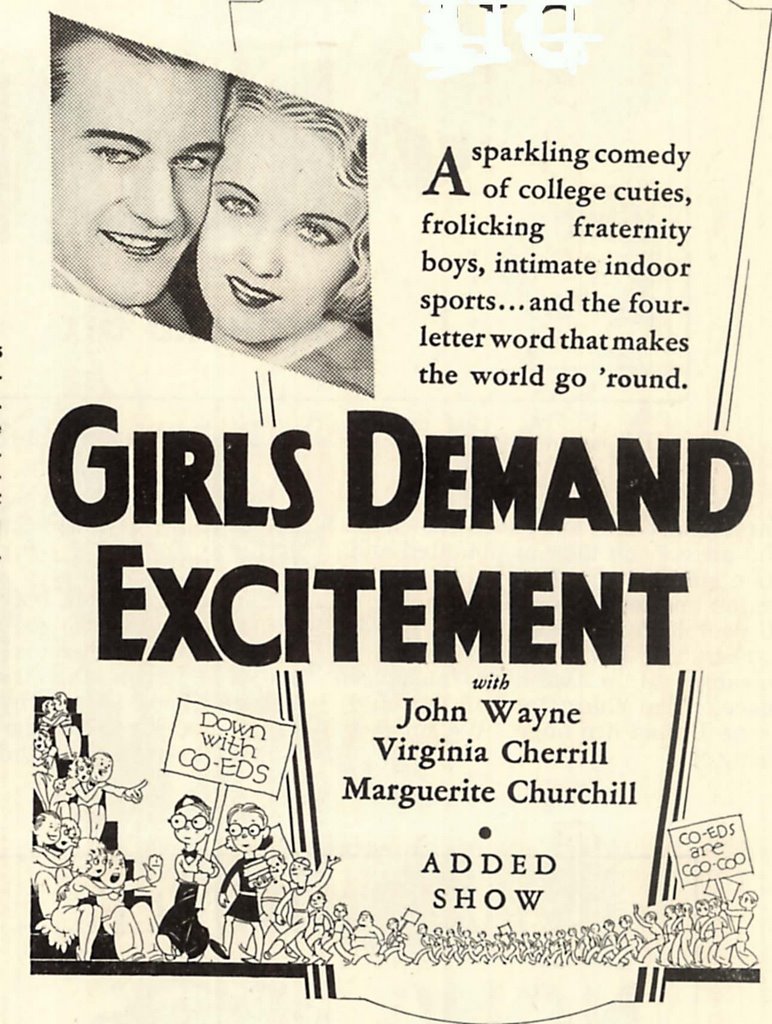
Did anyone have a tougher climb to stardom than John Wayne? After several years of crew and extra work, he’s "discovered" by director Raoul Walsh, and cast in Fox’s The Big Trail, but that one’s a disaster with a million dollar loss, and part of the blame is laid at the fledgling actor’s doorstep. We remember an interesting Wayne interview where he talked about having to go on publicity tour for The Big Trail, and how they made him dress out in his buckskin costume for the press gatherings. He never forgot everyone making fun of him, and how it felt to walk through a hotel lobby in such a rig. As it turned out, his humiliation was just beginning, since the failure of The Big Trail would leave him rudderless at Fox, like spoiled meat left too long on the butcher’s counter. His next one was a "hey-hey" college romance called Girls Demand Excitement, which we at the Greenbriar would dearly love to see, but does it even exist? We’ve not heard of any screenings, but hope springs eternal, and in the meantime, we did run across these neat stills and ads to whet our appetites over the prospect of John Wayne as "a Master of Arts in osculation". Exhibitors of the day were encouraged to construct a cardboard devise which would "measure the fervor of a kiss". Patrons were discouraged, however, from demonstrating its effectiveness in the lobby. As to "the four-letter word that makes the world go 'round" as referenced in this vintage ad, there might well be a lively modern debate as to what that word might be! Wayne’s co-star was Virginia Cherrill, and her forthcoming appearance with Charlie Chaplin in City Lights was a big part of the publicity build-up for her debut effort here. She would be wed to Cary Grant around this time. Marguerite Churchill was another refugee from The Big Trail --- she’d co-starred with Wayne in that. For the rest of his life, Wayne would cite Girls Demand Excitement as perhaps the worst film of his entire career, but without having seen this "breezy and frothy comedy", we can't help but wonder ... can it be any worse than The Barbarian and The Geisha? No, we won’t pass such harsh sentence until we’ve looked at the evidence, so the ball’s in your court, Fox! Start digging in those vaults, and let us have a peek at John Wayne as a "frivolous, frolicking, freshman fraternity boy".


Monday, October 04, 2010


Metro's (Deadly) Trail Of '98


Untold stories are seldom really that. Especially when they involve Hollywood. I’ve had an ongoing curiosity about on-set incidents where lives were lost, especially ones that took place during the silent era. My imagination conjures accidents and bodies carried off with everyone agreed to say no more about it. Crews were smaller then and unions toothless or non-existent. What we actually know about casualties on Noah’s Ark or the 1927 Ben-Hur might fill a thimble. A few participants talked many years later, well after a point of worrying over lost jobs for doing so. I've not heard of anyone brought to account for negligence or indifference to safety. Surely these factored into risk taking we associate with much of early filming. Metro’s fatality list from The Trail Of ’98 was the last thing they wanted publicized. I’m still trying to figure numbers lost on that misfired 1928 epic. Three we can be sure of. That many more was suggested by a reliable source three decades on. Did that make MGM's a record? Here’s a trivia question maybe not so trivial. What movie did claim the most lives in its making? I’ll stand on The Trail Of ’98 for now, remaining open to other candidates should anyone submit them.


The Trail Of ’98 was conceived to surpass Ben-Hur, with even more cast/extras promised and delivered. Production units were dispatched to seemingly every inch of frozen ground between California and Alaska. Chief ramrod was Clarence Brown. This would be the second feature he’d direct for Metro. Brown said the ordeal lasted a year and was ungodly harsh, but crews were tougher then and stood hardship better (my impression of silent movie-folk in general). Actual shooting days as indicated by records total 116, from March 7 to July 13, 1927. For director Brown, half that time spent in below zero conditions must have seemed like a year. One of several crews was sent to Cordova, Alaska to get footage of stuntmen shooting the rapids. At least five of them were set upon the treacherous Copper River in primitive boats. The idea was to replicate conditions during Gold Rush days. Three of the group were killed, one in an effort to save the others. There was brief coverage published in The New York Times on July 1, 1927, their first mention of The Trail Of ’98 and the last time the accident would be referenced, despite a number of later NYT articles focusing on MGM’s project. Another contemporary account mentioned assistant director Harry Schenck as having been in charge of the Copper River shoot. Schenck would later be mentioned in studio publicity for second unit direction in Skagway, Alaska and Lake Bennett, but no mention was made of his participation in the Copper River mishap. Metro-generated publicity for The Trail Of ’98 omitted any reference to the deaths, emphasizing safety measures taken by the company and perilous situations where accidents were avoided. Those early mentions of Harry Schenck intrigued me. I’m guessing he was related to Loew’s boss Nick Schenck. A sometimes actor, writer, and assistant director (according to imdb), Harry died in 1953, presumably taking the truest account of what happened on the Copper River with him.


Metro was intent upon The Trail Of ’98 doing Big Parade business on Broadway. The latter had played 96 weeks at the Astor Theatre. With even greater investment in Trail’s negative ($1.538 million), MGM devised a roadshow policy with tickets selling for two dollars. Irving Thalberg told reporters in February 1928 of Trail’s Astor premiere set for late March and his enthusiasm for the company’s newest SuperSpecial. Well-known manager of high-profile attractions J.J. McCarthy would take charge of the opening. He had guided past roadshows Way Down East, The Ten Commandments, and The Big Parade. This kind of exhibition was strictly boom or bust, however. Overhead to maintain roadshows could be ruinous. Only one out of four broke even. Less than twenty percent saw profit. The Trail Of ’98 had Dolores Del Rio for marquees, but little else. Its epic scale was bolstered by the Astor’s installation of a Fantom screen, yet another variation of Magna-scoping Paramount tried on specials down the block. Variety described the Fantom as a device on rollers where the picture can double its size by moving down front and then reduce to normal as it retreats up stage. The stunt was used twice in The Trail Of ’98, both times filling the entire proscenium as audiences marveled at snow slides and raging rapids. Astor’s live orchestra performed a score which was later recorded for music and effects versions made available on general release prints. A love theme, I Found Gold When I Found You, was compensation for human-interest qualities that Variety felt were lacking. Sheer size, it seemed, left characters on the margin. Several reviews mentioned this as a possible barrier to a public’s embrace needed to sustain extended runs. Also, it was long. Variety referred to a running time of 127 minutes, minus intermission, on the Astor’s two-a-day schedule. Length was later trimmed to under two hours. What’s left today is 87 minutes with several obvious story gaps and chunks missing.


Variety prophesied The Trail Of ’98 would roadshow through Fall 1928, and did not foresee disappointing returns on two-dollar admissions at the Astor. Motion Picture News reported Trail going at a brisk pace as of April’s first week and predicted it would continue to pile up gratifying grosses for some time to come (MPN also ran, and was compensated for, weekly multi-page MGM ads). Harrison’s Reports filed a positive review and initially saw bright numbers for The Trail Of ’98, but was apparently unaware of what had taken place on the Copper River: It seems as if those who rode the rapids did so at the actual risk of their lives … one can see fully the danger to the lives of those in the frail boats. By early July, Harrison amended placement of The Trail Of ’98 among safe two-dollar admission bets and warned exhibitors that roadshow prospects were shaping up grim. Not that the picture is bad, but … there are many things that work against it, he said. For instance, pictures with Alaska as locale have been done to death. Indeed they had. Numerous Klondike actioners based on James Oliver Curwood stories were in circulation, and Universal's Grip Of The Yukon nibbled at potential playdates. Even MGM’s own Tide Of Empire appeared to offer a too-similar bill of fare. It began to look as though the company was in agreement that The Trail Of ’98 would play better as a program picture at regular prices, per Harrison’s tip from showmen’s grapevine: I understand that Metro-Goldwyn have abandoned the idea of roadshowing it. Going forward minus special handling meant MGM could save considerable amounts in promotion and weekly theatre overhead. Now came the challenge of selling The Trail Of ’98 to doubtful exhibitors aware of its having stumbled as a SuperSpecial. Would they agree to advanced rentals MGM sought for the film’s general release?


Paid special price for this and it wasn’t worth a cent more than program, said Avard J. Sloat of the Roseland Theatre in Pleasant View, RI. Metro hooked me plenty on this … don’t let them tell you it’s a world-beater because it isn’t. Didn’t draw film rental, was A.L. Lighter’s Orpheum Theatre experience in Mellen, Wisconsin. Such were realities behind puffed-up trade ads like ones shown here. MGM salesmen promised the moon, but results were closer to parched earth. You could charge more armed with the perception of a hit off Broadway, the Astor’s ultimate letdown with The Trail Of ’98 well concealed by the fact it had played there to much hoopla and promotional noise. January 1929 proved to be less than ideal time for this silent film to go into general release. Urban and first-run curiosities were better satisfied with talking screens. Consequent avalanche of failure for The Trail Of ’98 was as ruinous as those that swept away characters in the film. Domestic rentals of $839,000 came nowhere near replacing moneys spent, and foreign was worse ($739,000). MGM’s loss of $756,000 was surpassed only by disaster that was Mysterious Island of the same year. Like so many final season silents, The Trail Of ’98 faded into memory retained by increasing few. Looking back from 1940, director Clarence Brown maintained that his crew suffered a good deal more than original Gold Rushers that swarmed Alaska. Was he smarting yet over Metro’s abandonment of roadshowing efforts? Story rights complication kept The Trail Of ’98 out of circulation for years to come. We can probably be thankful that it survives at all. A big reveal came in the mid-sixties when Kevin Brownlow went to interview Brown for The Parade’s Gone By, which was published in 1968. Maybe enough time had passed for the director to fess up as to full extent of casualties from The Trail Of ’98. We went to Alaska to do the rapids scenes, he remembered, an interesting departure from 1927 accounts that placed traveling units at Klondike locations, including the one supervised by Harry Schenck where the three deaths occurred. Most startlingly, Brown referred to other crew members that perished on the film’s Colorado location: When I left Denver, part of the company stayed behind. A large section of snow fell and two or three more men were killed. That’s a total of five, maybe six, people lost on The Trail Of ’98. All for a picture that wasn’t too hot, according to Clarence Brown. Storywise, directionwise, and actingwise, I was never too happy with it. Whatever his indifference to The Trail Of ’98, Brown put enormous effort into researching for authenticity. When I visited the University of Tennessee’s Clarence Brown Collection in Knoxville, there were banker boxes filled with vintage photographs he’d collected of Alaskan scenes and Gold Rush participants taken in the 1890’s. At least for that year Brown spent preparing and shooting The Trail Of ’98 (and losing twenty pounds in the laborious process), this director was as committed as he would ever be to a project. The film endures today as his most spectacular, one of the silent era’s great unsung epics.
grbrpix@aol.com
  • December 2005
  • January 2006
  • February 2006
  • March 2006
  • April 2006
  • May 2006
  • June 2006
  • July 2006
  • August 2006
  • September 2006
  • October 2006
  • November 2006
  • December 2006
  • January 2007
  • February 2007
  • March 2007
  • April 2007
  • May 2007
  • June 2007
  • July 2007
  • August 2007
  • September 2007
  • October 2007
  • November 2007
  • December 2007
  • January 2008
  • February 2008
  • March 2008
  • April 2008
  • May 2008
  • June 2008
  • July 2008
  • August 2008
  • September 2008
  • October 2008
  • November 2008
  • December 2008
  • January 2009
  • February 2009
  • March 2009
  • April 2009
  • May 2009
  • June 2009
  • July 2009
  • August 2009
  • September 2009
  • October 2009
  • November 2009
  • December 2009
  • January 2010
  • February 2010
  • March 2010
  • April 2010
  • May 2010
  • June 2010
  • July 2010
  • August 2010
  • September 2010
  • October 2010
  • November 2010
  • December 2010
  • January 2011
  • February 2011
  • March 2011
  • April 2011
  • May 2011
  • June 2011
  • July 2011
  • August 2011
  • September 2011
  • October 2011
  • November 2011
  • December 2011
  • January 2012
  • February 2012
  • March 2012
  • April 2012
  • May 2012
  • June 2012
  • July 2012
  • August 2012
  • September 2012
  • October 2012
  • November 2012
  • December 2012
  • January 2013
  • February 2013
  • March 2013
  • April 2013
  • May 2013
  • June 2013
  • July 2013
  • August 2013
  • September 2013
  • October 2013
  • November 2013
  • December 2013
  • January 2014
  • February 2014
  • March 2014
  • April 2014
  • May 2014
  • June 2014
  • July 2014
  • August 2014
  • September 2014
  • October 2014
  • November 2014
  • December 2014
  • January 2015
  • February 2015
  • March 2015
  • April 2015
  • May 2015
  • June 2015
  • July 2015
  • August 2015
  • September 2015
  • October 2015
  • November 2015
  • December 2015
  • January 2016
  • February 2016
  • March 2016
  • April 2016
  • May 2016
  • June 2016
  • July 2016
  • August 2016
  • September 2016
  • October 2016
  • November 2016
  • December 2016
  • January 2017
  • February 2017
  • March 2017
  • April 2017
  • May 2017
  • June 2017
  • July 2017
  • August 2017
  • September 2017
  • October 2017
  • November 2017
  • December 2017
  • January 2018
  • February 2018
  • March 2018
  • April 2018
  • May 2018
  • June 2018
  • July 2018
  • August 2018
  • September 2018
  • October 2018
  • November 2018
  • December 2018
  • January 2019
  • February 2019
  • March 2019
  • April 2019
  • May 2019
  • June 2019
  • July 2019
  • August 2019
  • September 2019
  • October 2019
  • November 2019
  • December 2019
  • January 2020
  • February 2020
  • March 2020
  • April 2020
  • May 2020
  • June 2020
  • July 2020
  • August 2020
  • September 2020
  • October 2020
  • November 2020
  • December 2020
  • January 2021
  • February 2021
  • March 2021
  • April 2021
  • May 2021
  • June 2021
  • July 2021
  • August 2021
  • September 2021
  • October 2021
  • November 2021
  • December 2021
  • January 2022
  • February 2022
  • March 2022
  • April 2022
  • May 2022
  • June 2022
  • July 2022
  • August 2022
  • September 2022
  • October 2022
  • November 2022
  • December 2022
  • January 2023
  • February 2023
  • March 2023
  • April 2023
  • May 2023
  • June 2023
  • July 2023
  • August 2023
  • September 2023
  • October 2023
  • November 2023
  • December 2023
  • January 2024
  • February 2024
  • March 2024
  • April 2024
  • May 2024
  • June 2024
  • July 2024
  • August 2024
  • September 2024
  • October 2024
  • November 2024
  • December 2024
  • January 2025
  • February 2025
  • March 2025
  • April 2025
  • May 2025
  • June 2025
  • July 2025
  • August 2025
  • September 2025
  • October 2025
  • November 2025
  • December 2025
  • January 2026
  • February 2026
  • March 2026
  • April 2026
  • May 2026
  • June 2026
  • July 2026
  • August 2026
  • September 2026
  • October 2026