Classic movie site with rare images (no web grabs!), original ads, and behind-the-scenes photos, with informative and insightful commentary. We like to have fun with movies!
Archive and Links
grbrpix@aol.com
Search Index Here


Friday, September 29, 2006


A Little Something To Disturb Your Sleep


The more I look at this bizarre portrait of Jimmy Durante, the more creeped out I get. No doubt the idea was to spoof his self-promoted image as an irresistible magnet for beautiful women. Must have been taken sometime in the late fifties. Buster Keaton fans were never able to warm up to this guy. Durante really walked all over Keaton in those MGM features they did together. I’m looking for the best word to describe Durante beyond his first five minutes in any movie --- irritating? A little of this comic goes a long way for me…


Michael Powell's 101st Birthday


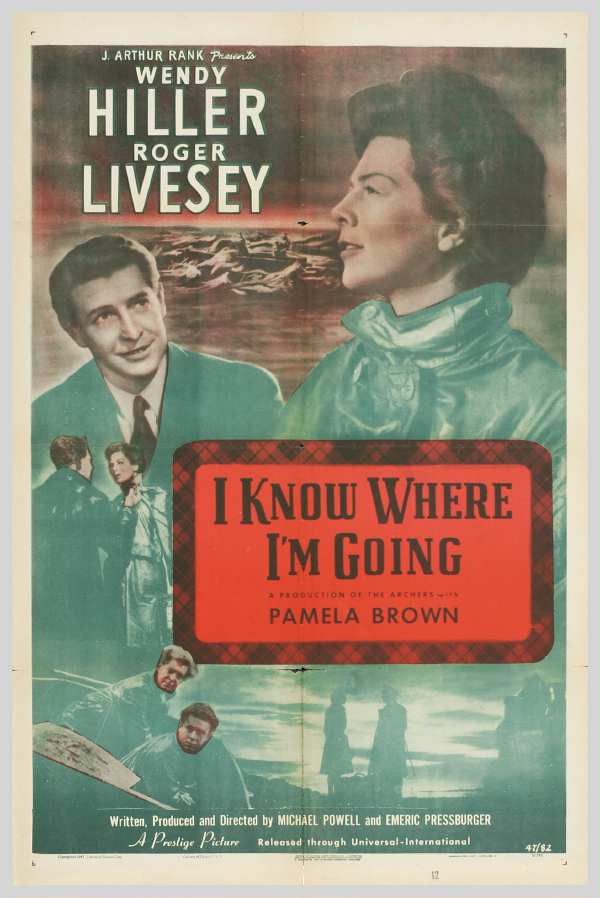
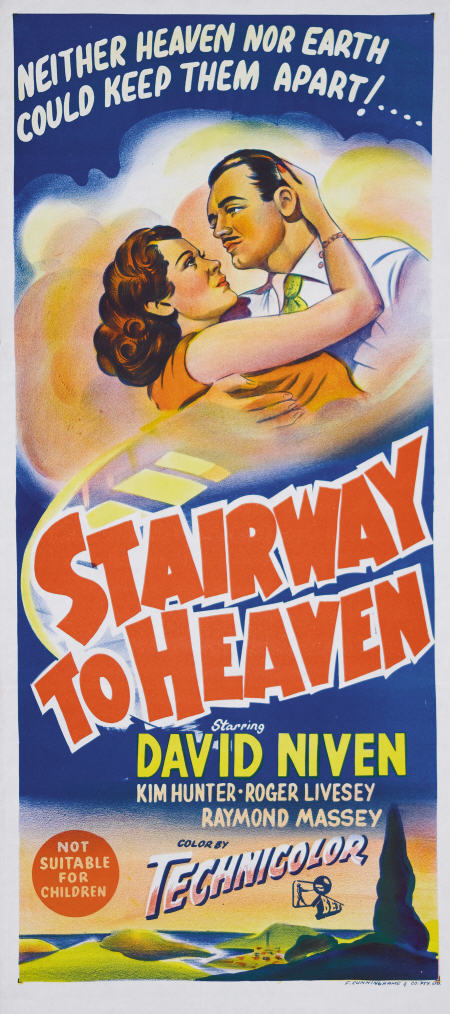
A small salute today (September 30) for Michael Powell . He was born 101 years ago today. For Powell and his partner Emeric Pressburger, it was just one masterwork after another for nearly twenty years of joint filmmaking. My favorite is I Know Where I’m Going, while runners-up include A Canterbury Tale (recently out on DVD), A Matter Of Life and Death (Stairway To Heaven in the US), Black Narcissus, and The Red Shoes. Rarities like The Small Back Room and Battle Of the River Plate (in widescreen) can be had on Region 2 DVD from Amazon UK. Powell’s unexpected downfall came with Peeping Tom --- a thriller so disturbing that it made him a pariah throughout the industry. Critical embrace for the film came too many years later to do him much good, but at least Powell enjoyed festival recognition and plaudits for an outstanding memoir he wrote during retirement.

Speaking of birthdays, today is also Deborah Kerr’s eighty-fifth. She worked with Michael Powell in The Life and Death Of Colonel Blimp and Black Narcissus. The Innocents was another terrific film she did in England during the early sixties. Anybody know how she’s getting along these days?


Thursday, September 28, 2006


We Want Our Fu Manchus!

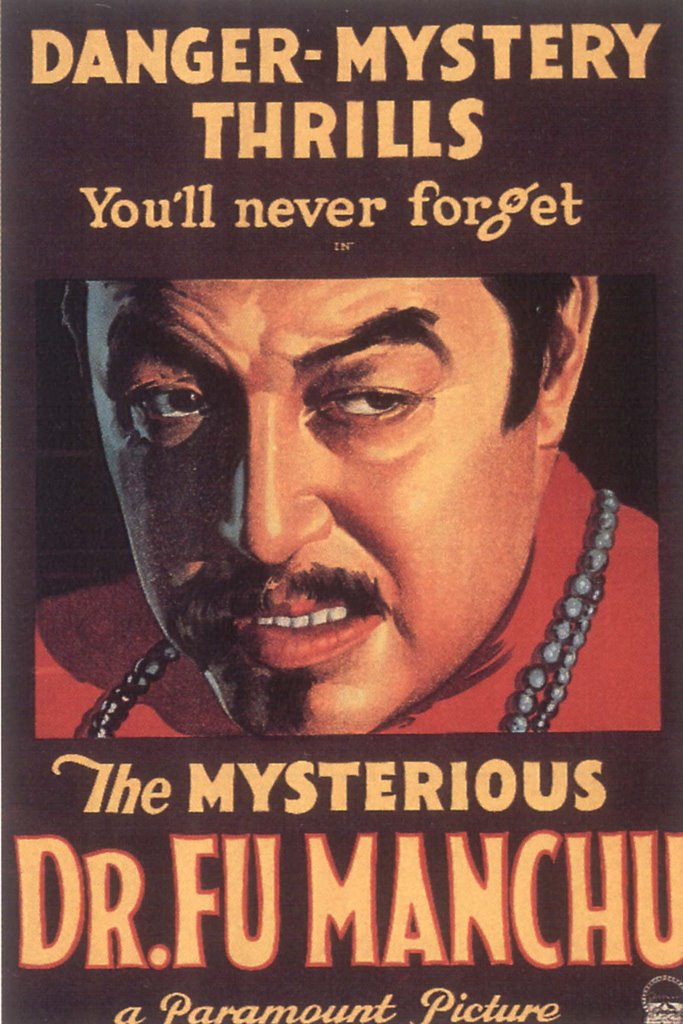
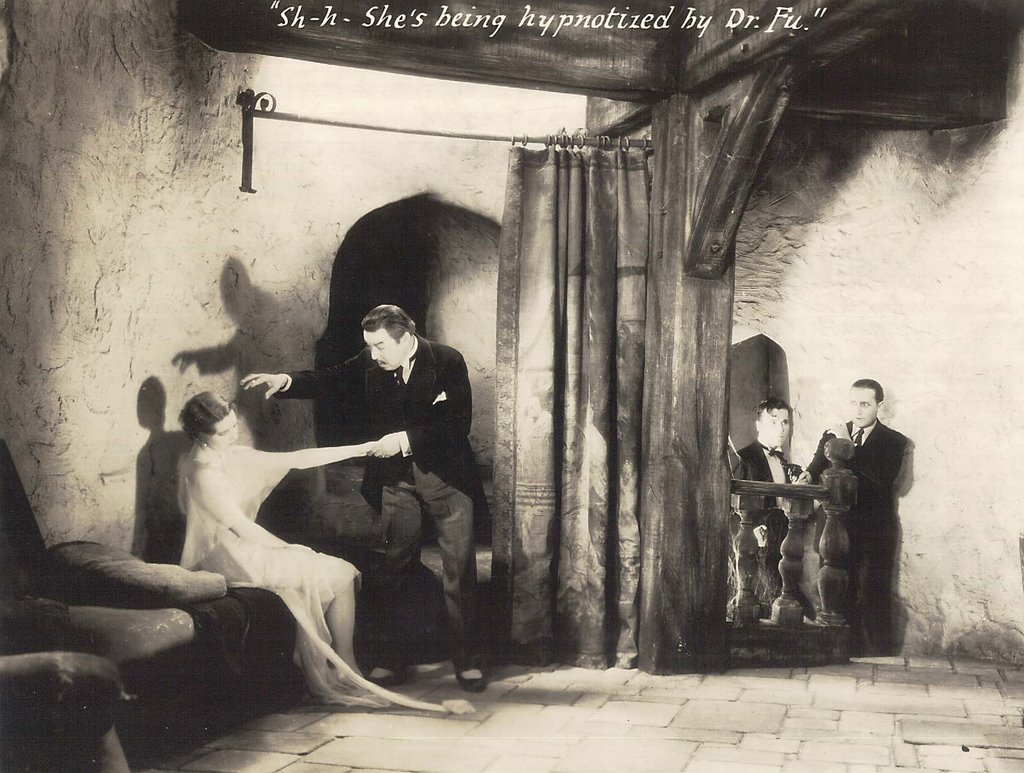
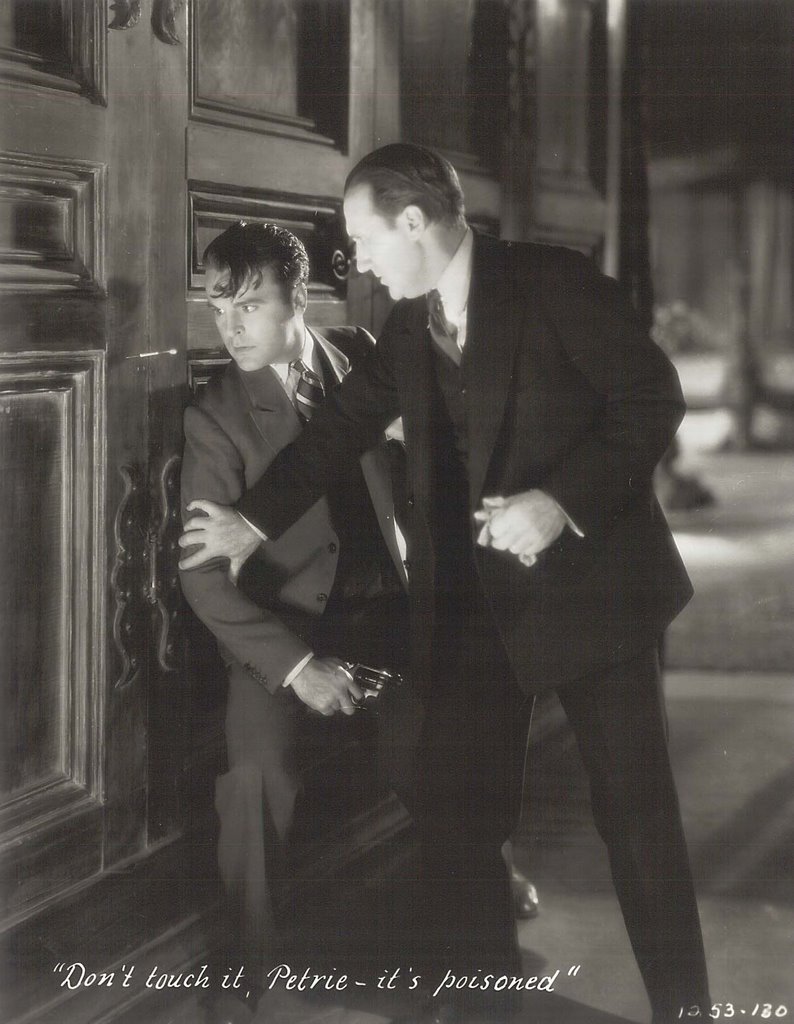
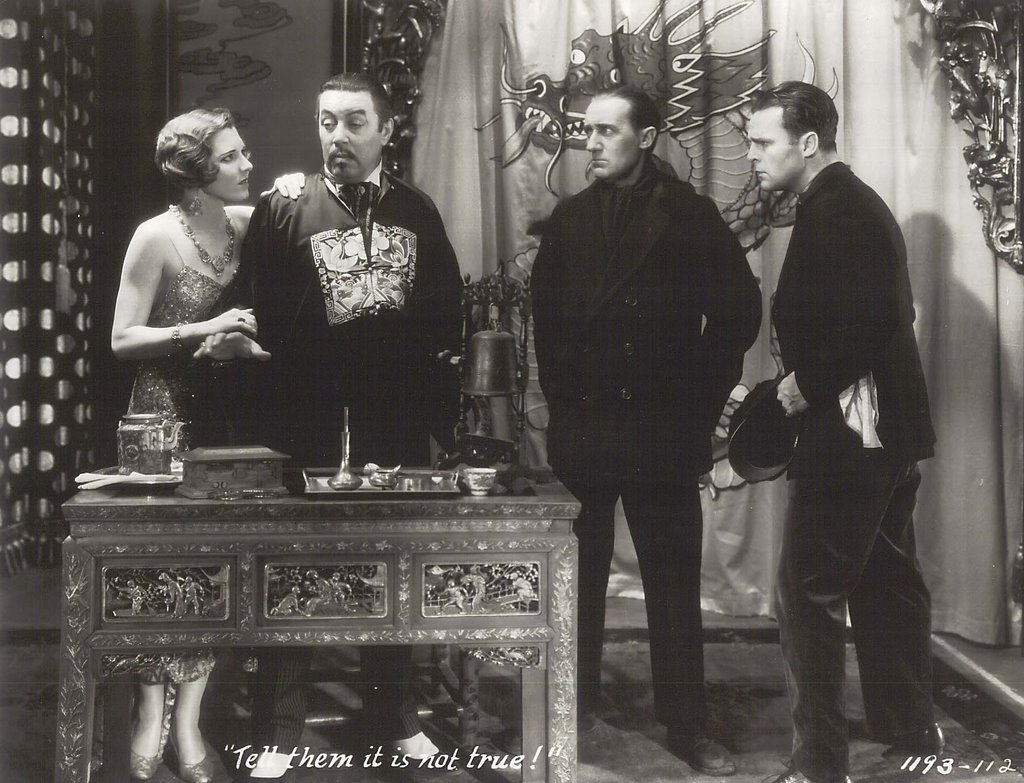
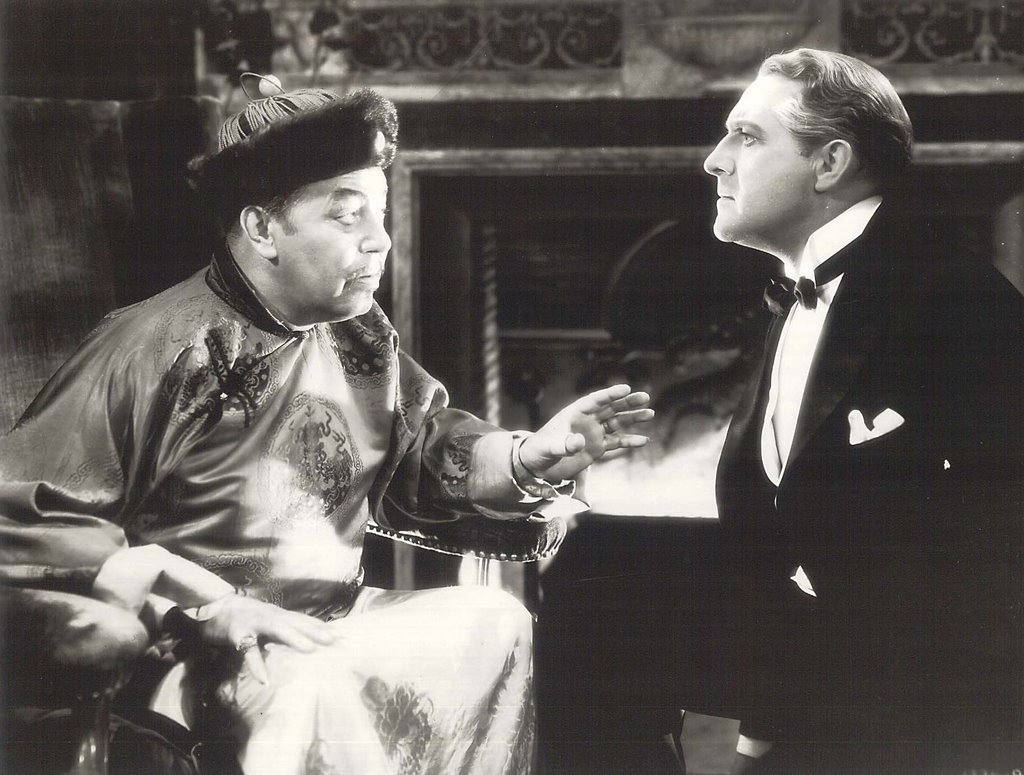
It's frustrating to write about films we can't all see. I’d read about the Paramount Fu Manchu series for years, but had never gotten to look at any of them, other than a bootlegged DVD of The Mysterious Dr. Fu Manchu I viewed just today. So what’s the holdup with these early sound thrillers? Why are all three unavailable beyond occasional archival showings? The problem apparently lies with the Sax Rohmer estate. He conceived the character and wrote the novels upon which the movies were based. It would seem that Paramount’s use of the properties was limited to the initial release of the three features they produced --- those being The Mysterious Dr. Fu Manchu (1929), Return Of Dr. Fu Manchu (1930), and Daughter Of The Dragon (1931). The literary rights reverted back to Rohmer and consigned the films to a sort of ownership Twilight Zone wherein all three exist, but none can be televised or distributed on DVD. The same cloud hovers over Republic’s 1940 serial, Drums Of Fu Manchu, a fan favorite that has only been available on gray-market discs of indifferent quality. UCLA Film Archives has excellent preservation materials on all these subjects, but must confine their exhibition to on-site festivals and infrequent loans to other institutions. Even though they hold the original nitrate negative for Drums Of Fu Manchu, UCLA has been unable to confirm the current rights holder, and any concerted effort to do so would be both time-consuming and expensive. The question ultimately becomes --- is any Republic serial worth this? Universal is the present owner of the three features; this goes back to MCA’s acquisition of them along with the rest of Paramount’s pre-1949 package in 1958. The Fu Manchus could not be released to television at that time, although Daughter Of The Dragon did go into the syndicated package by mistake, the absence of Fu’s name in the title allowing it to slip through. Consequently, there were nice 16mm prints of this one in circulation among collectors. The Mysterious Dr. Fu Manchu and Return Of Dr. Fu Manchu were, to my knowledge, not shown on television, and never available for rental, theatrical or otherwise. Preservation for the three features was made possible by donations from publisher Hugh Hefner in the late nineties, and they were shown at UCLA’s annual festival in 2000.


I’d like to report that progress is being made toward a general revival of the Fu Manchus, but Universal isn’t likely to expend that sort of time and expense for the benefit of such relics as these. Never mind the racial and ethnic sensitivities involved --- these are seriously dated shows. Folks that read Greenbriar Picture Shows might well stand on line to see them, but for civilians, they’d seem beyond ancient. Maybe I’ve dwelled in cinematic tombs too long, but I was actually surprised at what a vigorous film The Mysterious Dr. Fu Manchu turned out to be, even in my disadvantaged position of watching a lousy third-generation DVD. Candor forces me to admit that Warner Oland could read the daily classifieds and I’d be entranced. He’s one of those actors who need merely enter a room to dominate it. His Fu Manchu is much like the genial Charlie Chan with occasionally sinister overlays. The Mysterious Dr. Fu Manchu was released in August 1929, so we must naturally make allowances for Paramount’s uncertainty with sound, but it’s a tremendous advance over talkies of only a few months earlier, and has a lot more energy than, say, The (glacial) Canary Murder Case. There’s a dynamic first reel that sets up Fu’s motivation for a lifetime of seeking revenge against the accursed white race, and plenty of cliffside mansion suspense later on. Maybe I was just in a good mood when I watched this, because I even enjoyed Neil Hamilton’s occasional tripping over his lines. There’s an indefinable charm to these lurching, show-must-go-on early talkers --- actors and directors giving their all against what must have seemed overwhelming odds.


One of the great exhibition miracles was performed in August 1929 with the trailer for The Mysterious Dr. Fu Manchu. Ernest Morrison of Dallas’ Greater Palace Theatre followed his customary newsreel with a bath of weird green light throughout the auditorium as his screen opened up to full Magnascope proportions. This was basically a matter of blowing up your picture to fill the entire proscenium and was used primarily for spectacular action scenes, such as the dogfights in Wings. Morrison filled the theatre with sounds of police sirens as the preview for The Mysterious Dr. Fu Manchu flashed on the screen. The Greater Palace’s live orchestra then went into an agitato theme until the first talking sequence of the trailer began. All the house lights were extinguished at this point, and red footlights began flashing on and off, with the further enhancement of two green spotlights operated from the booth --- roaming across the stage and all around the auditorium. The impact caused women to scream, and an otherwise unassuming trailer became the highlight of the program.


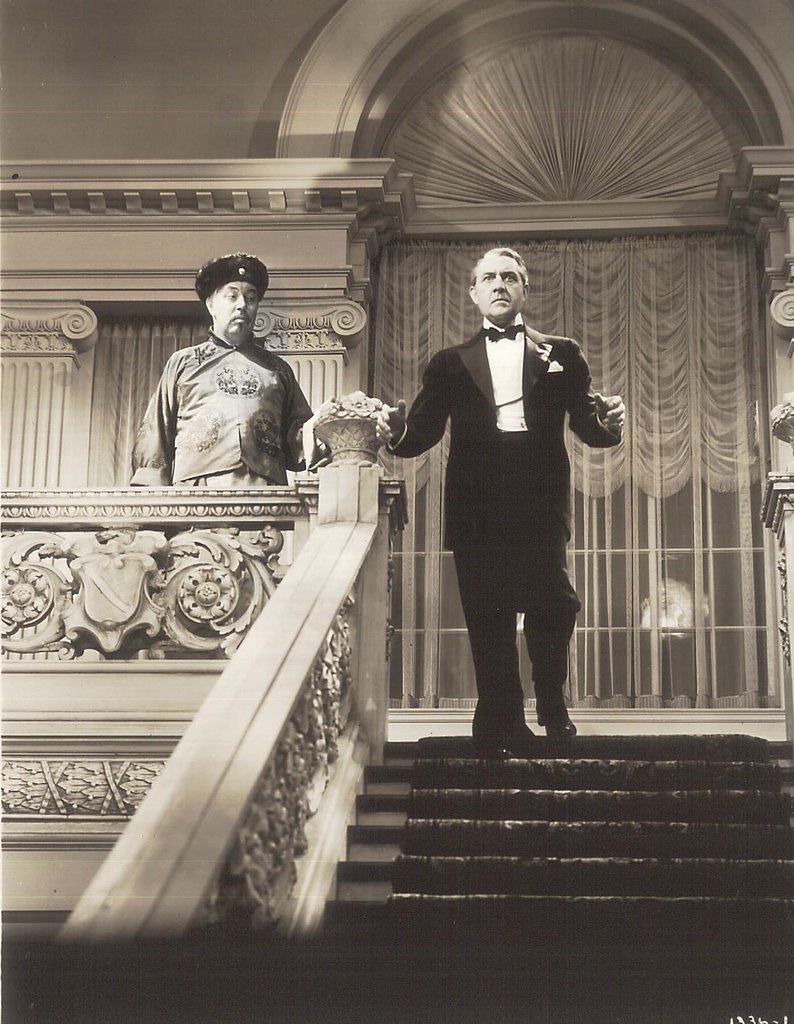
Sax Rohmer died in 1959. Most of his Fu Manchu stories were written in the twenties. Some of these are now in the public domain, but the character of Fu Manchu is still protected. If Universal, or anyone else, were inclined to pursue the rights for the three Paramount features or the Republic serial, they’d have to track down the legal representatives of Rohmer’s estate. From the best I could determine, his interests are represented by The Author’s League Of America (HERE). There’s also a British concern, The Society Of Authors, HERE, that specifically lists Rohmer’s estate on their website. I don’t know if anyone’s approached these entities about clearing the way for a DVD release of these titles, but it would be a wonderful thing if they could. These orphaned shows have been out of circulation far too long. Paramount’s features would make a nifty box set (they could even include Oland’s comedic skit as Fu Manchu in Paramount On Parade as an extra), and the Republic serial would make a lot of chapterplay enthusiasts very happy indeed. In the meantime, those of us not within driving distance of UCLA will have to make do with the enticing images shown here and whatever bootlegged videos can be scrounged up on e-bay.


Wednesday, September 27, 2006


Fads and Flaps Of Yesteryear


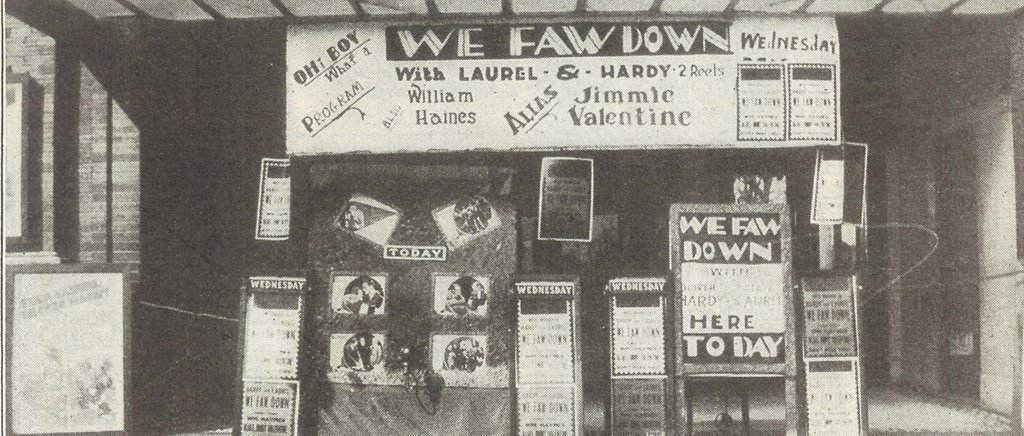
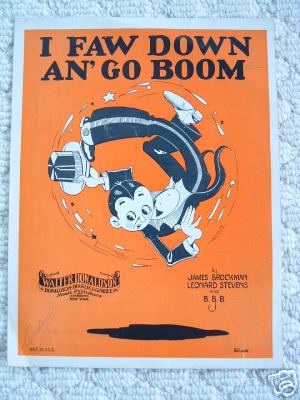
Having grown up in a world saturated by media, we’ve all seen the overnight assault of new fads and catchphrases inspired by music, movies, and television shows. I can remember walking through my neighborhood in the Fall of 1965, wondering why all the kids now prefaced observations with, Would you believe …?, and footnoted every conversation with Sorry About That, Chief. By the fifth such encounter, I’d finally assembled the puzzle. Seems everyone had watched Get Smart the night before, and I was the final initiate to a whole new vocabulary shared by every hep kid on the street. We assume these pop cultural tom-toms beat exclusively for our generation, but the Roaring 20’s had its own complement of hep kids as well, all of them hot wired to radios and Victrolas long before there was TV and internet downloads. Exhibitor Wally Akin of Kennett, Missouri had his own Get Smart experience in April 1929 as he ambled down the main street of that small town trying to figure out how to sell his upcoming program at the Palace Theatre. I overheard a little girl say, "We faw down and go boom", Wally recalled. Before I walked three city blocks there were at least ten more children saying the same thing … Looking over my bookings, I found we had Stan Laurel and Oliver Hardy in a two-reel comedy titled "We Faw Down." This phrase being on the public’s tongue, I decided to feature the comedy instead of the long feature. The photo above shows the front display Wally came up with. His full-length show was Alias Jimmy Valentine with William Haines, but the real attraction was We Faw Down. We packed the theatre to the door on our worst night in the week. There’s no doubt but what showman Wally knew his onions --- surely Hal Roach's hot new comedy team caught the wave of that popular slang phrase as well. The thing had actually originated with a jazz tune called I Faw Down An’ Go Boom, by a pair of songwriters, James Brockman and Leonard Stevens. It flew up the charts by virtue of having been recorded by top artists of the day, including Billy Murray and The Midnight Ramblers, Annette Hanshaw, Eddie Cantor, and Cliff Edwards. By December 29, 1928, the day They Go Boom was released, everyone was whistling the nonsense ditty and borrowing variations of its title for conversational merriment.


The only thing Laurel and Hardy borrowed from I Faw Down An' Go Boom was (part of) its title. None of the lyrics would have lent themselves to silent comedy, as there were the usual naughty references common to jazz age songs, comical voice effects, and even a bit of japery about Wall Street. Actually, We Faw Down included its own music and effects score on recorded disc, being the second Laurel and Hardy with sound accompaniment. I Faw Down An’ Go Boom does not figure into the track, however. Instead, we hear That’s My Weakness Now over the titles, and again during the body of the short, along with several other popular tunes of the day. The short itself is the usual L&H domestic farce. If anything a little more ribald than usual, We Faw Down inspired this diatribe from an exhibitor in Spearville, Kansas. A comedy with just as suggestive scenes as it is possible to show without showing the real thing. Dirt, vulgar, obscene, and any other filthy name you wish to call it, it will fit every reel. W.J. Shoup’s furious manifesto ended with a call for industry, if not government, intervention --- What is needed in the making of pictures today is to clean house of most of the present producers, so we can have something to show our patrons that is entertaining and pleasing, without being so filthy. It’s possible Mr. Shoup of the DeLuxe Theatre was provoked by that closing gag where all the men jump out apartment windows sans trousers --- Where, oh where, was our censor board when this was passed? So not only were Laurel and Hardy current with pop culture references --- they were cutting edge in matters of bawdy content as
well. Looks like we’ve been underestimating these boys!


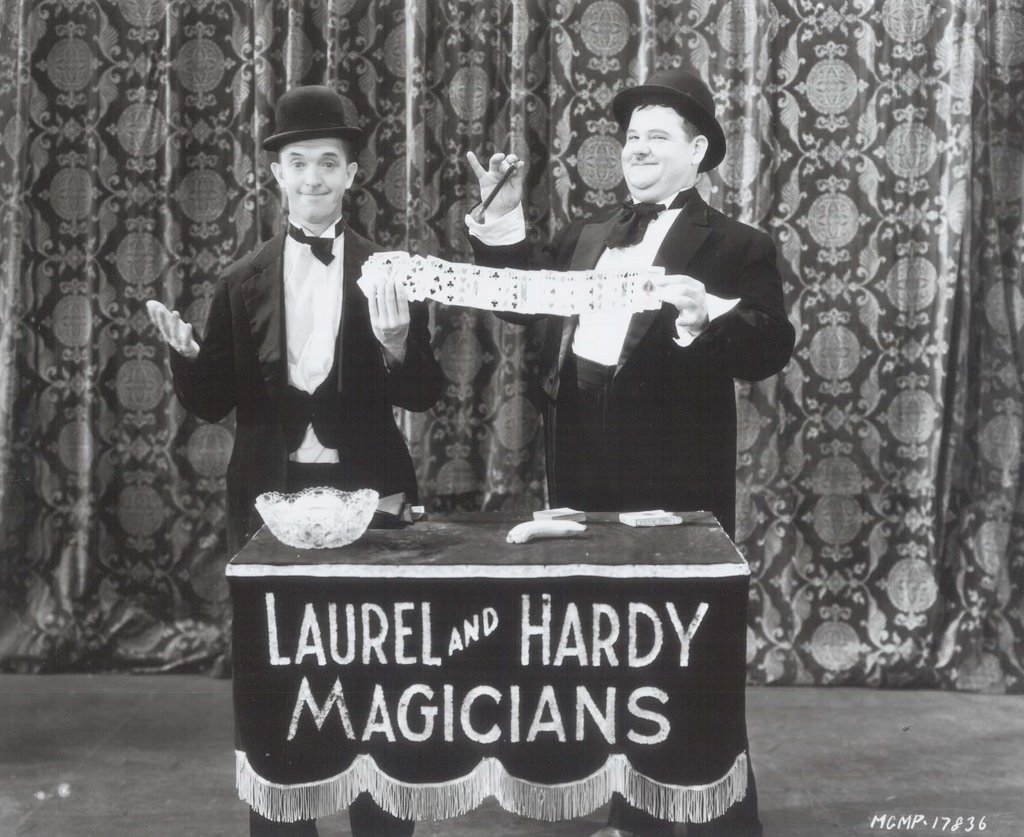
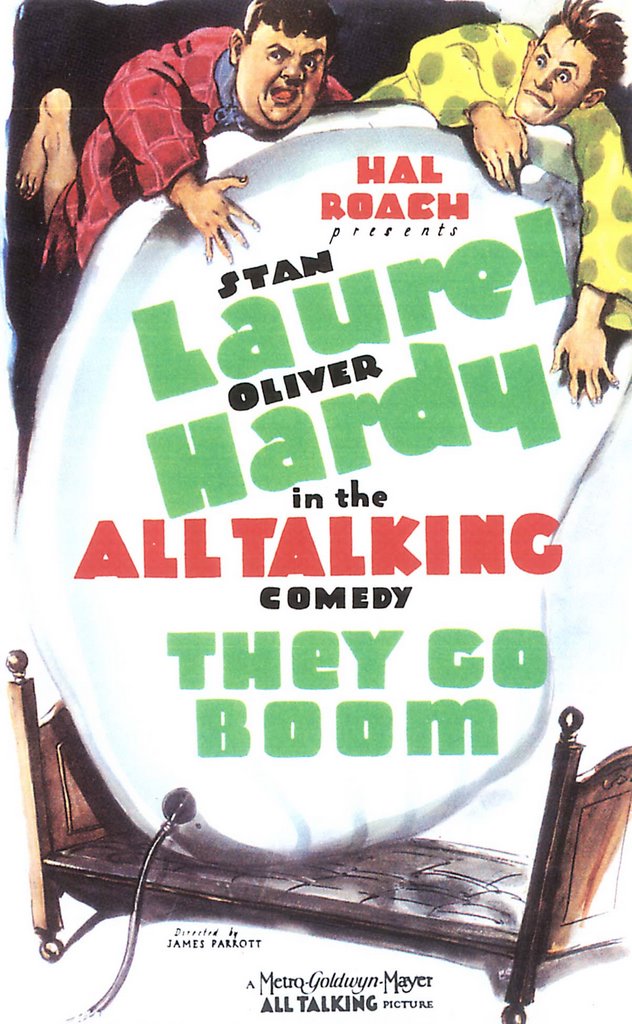
As more bands covered I Faw Down An’ Go Boom, its prominence continued through 1929. Laurel and Hardy would go back to the well at least twice. The Hollywood Revue Of 1929 found the comedians engaged in a bungled magic act that culminates with Oliver Hardy falling into an oversized cake, then plaintively looking at the camera. I faw down and go splat, he says. To modern viewers, it’s an uncharacteristic (if not off-putting) line, but 1929 audiences got the joke and surely had their laugh. September 21, 1929 saw the release of They Go Boom, a talking Laurel and Hardy that utilized another spin on the song title but nothing else. Fads had more longevity in those days when it took longer for them to penetrate the marketplace. Even as late as 1945’s Warner cartoon
, A Gruesome Twosome, Tweetie Pie was lamenting the poor putty tat that fell down and went boom. Google the venerable phrase right now and you’ll find numerous modern references. Referencing We Faw Down and They Go Boom will take you to a DVD series called The Lost Films Of Laurel and Hardy. These are, for the most part, silent comedies, but a few talkies turn up in this group as well, including They Go Boom (on Volume 4). The only source for We Faw Down with the original music/effects score is a German DVD (the one included in The Lost Films Of Laurel and Hardy has a random track culled from other discs). If you have a multi-region player, it’s well worth the trouble to get the German DVD. We Faw Down was the last of the synchronized scores awaiting rediscovery. It plays much better with this original accompaniment. There’s no dialogue, of course, but plenty of knocks on doors, telephones ringing, etc., and even dubbed laughter for both Laurel and Hardy in several scenes (not their own, but a neat effect). Tracks for seven of these comedies have now been retrieved after years of apparent loss --- Habeas Corpus, We Faw Down, Liberty, Wrong Again, That’s My Wife, Bacon Grabbers, and Angora Love. Each are enhanced by the vintage music and sound punctuation. I’m told that all of these, plus the balance of Laurel and Hardy’s silent output, is being remastered for a forthcoming DVD box set. I hope this will come sooner rather than later. A lot of us are surely looking forward to that release.


Tuesday, September 26, 2006


Pre-Code Photography


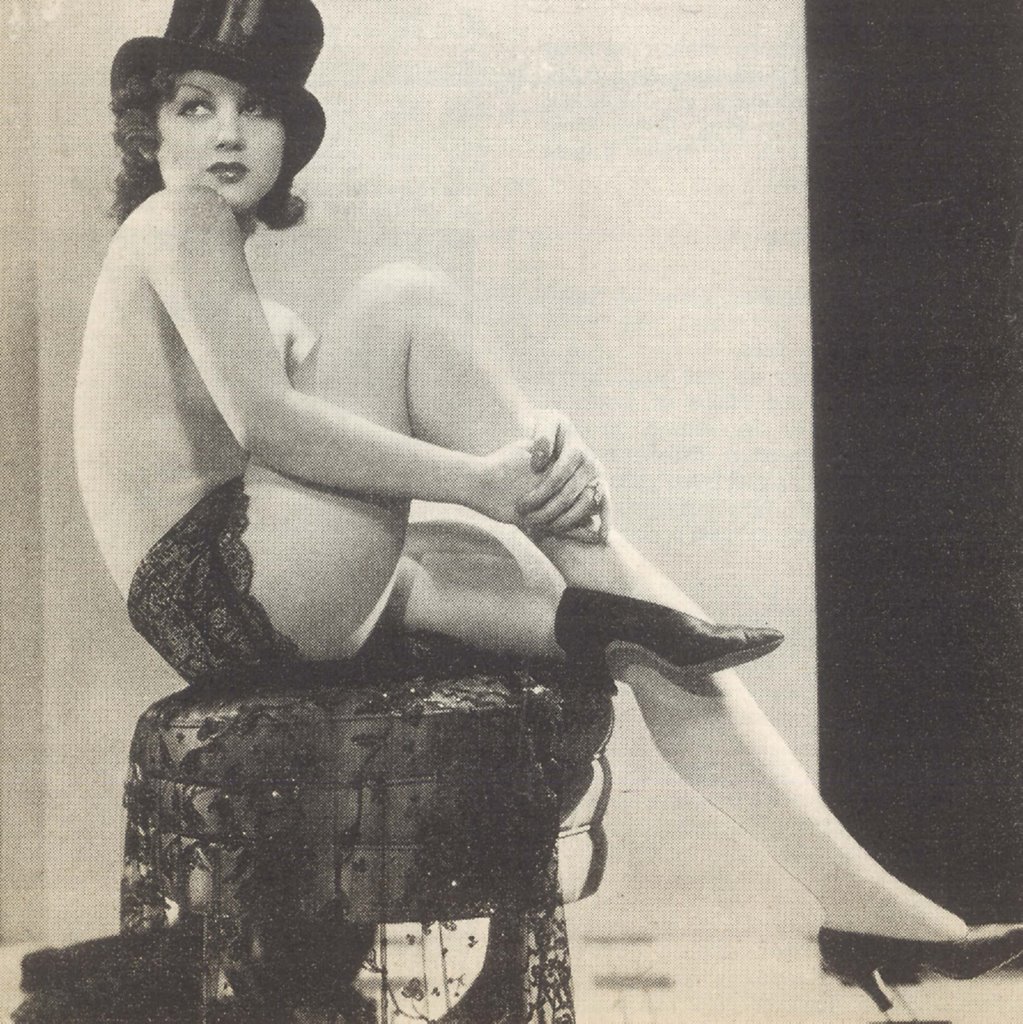
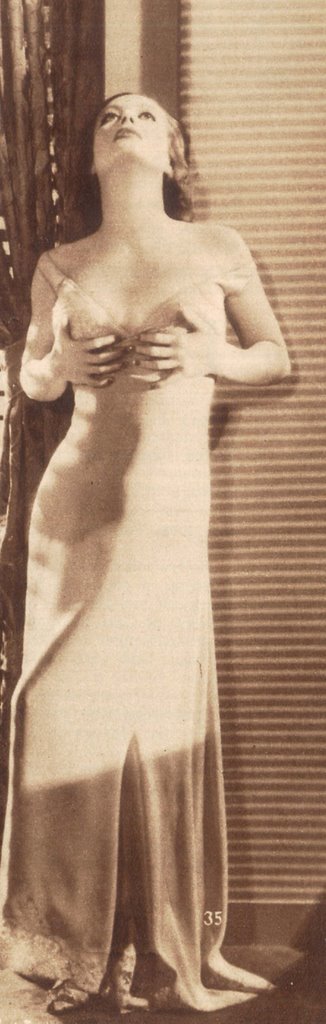
Not much justification for publishing these, other than the fact that many of us like Pre-Code (I know I do!), whether it be on film or in rare images like the ones shown here. The lady in the top hat is Grace Bradley. The former wife of William "Hoppy" Boyd just turned 93 and I understand she's still going strong. That’s Ginger Rogers in an early shot before she became a major name. I imagine this sort of layout would become verboten once Ginger began securing leads. Meanwhile, Joan Crawford strikes an artful pose around 1932. More of these to come as I run across them. There can never be enough Pre-Code at the Greenbriar!


Monday, September 25, 2006


Life Was Cheap On Noah's Ark


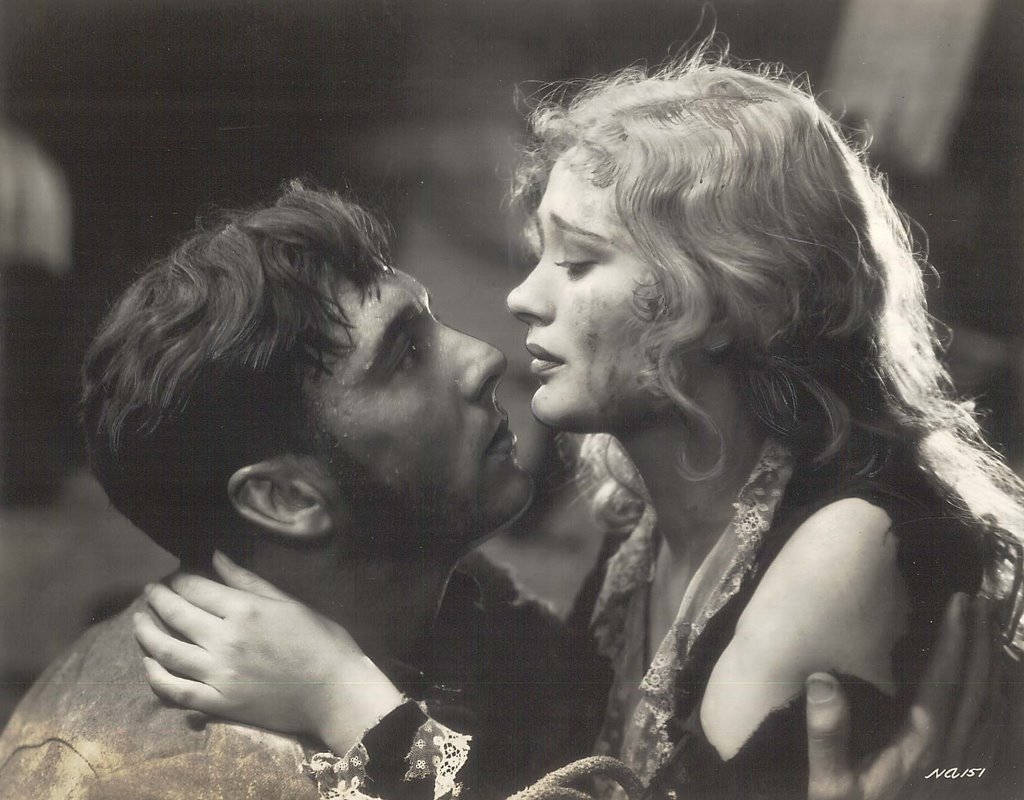
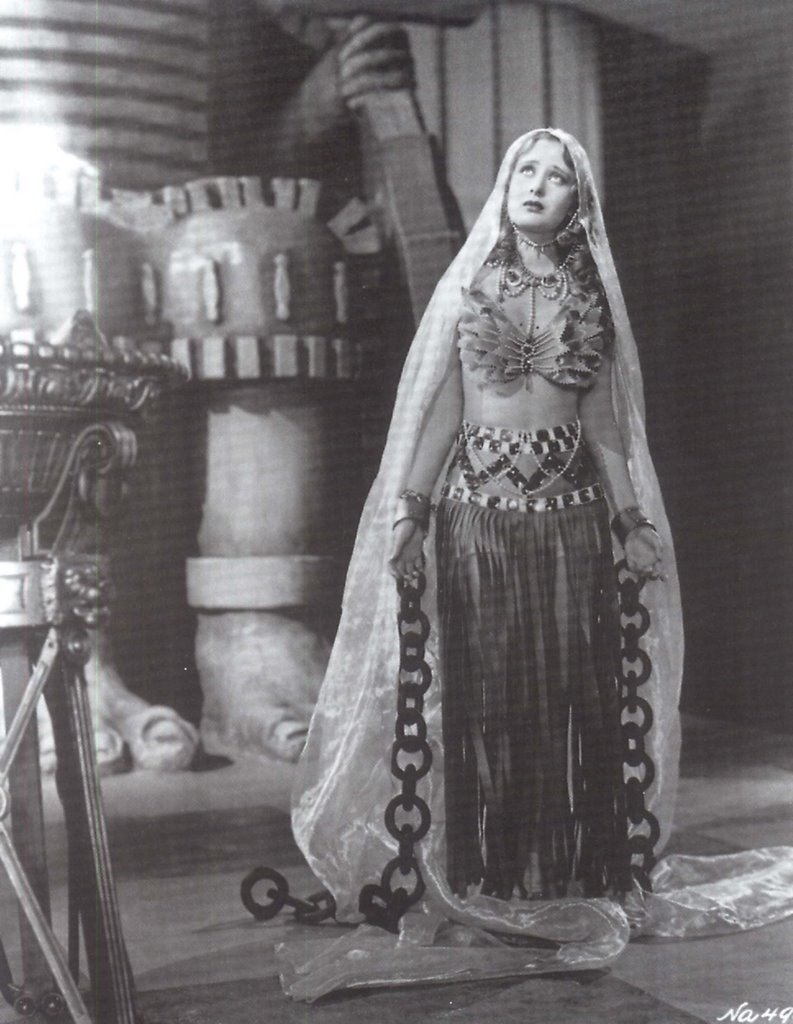
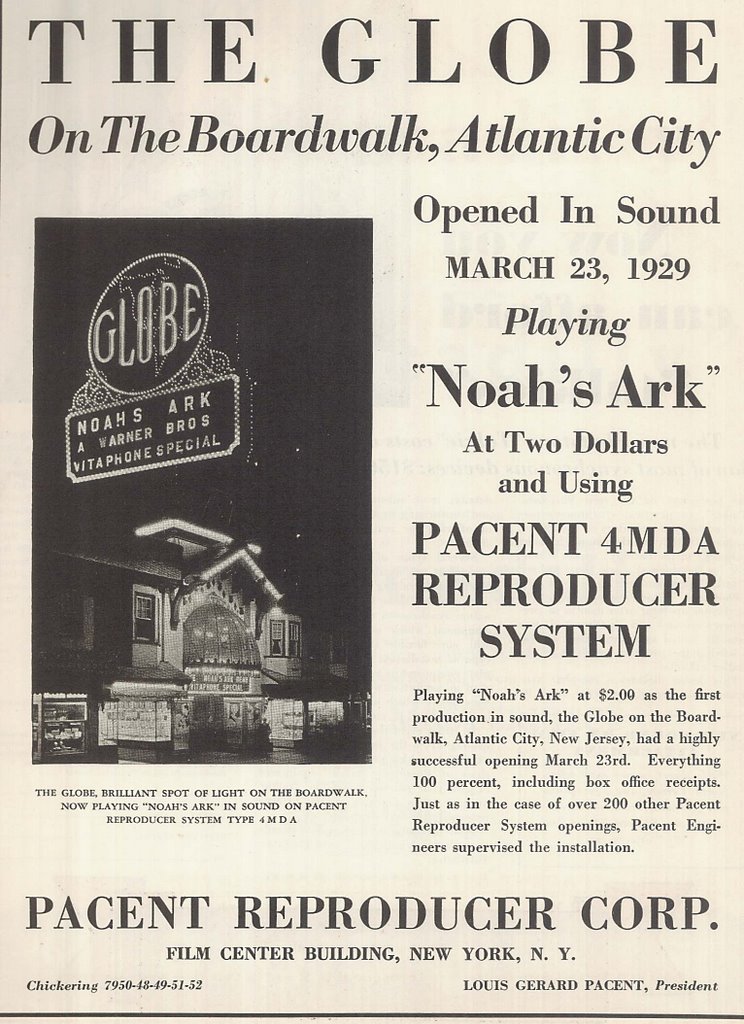
Once upon a time there were epics like Noah’s Ark. So many, in fact, that we took them for granted. This particular one cost a million dollars and at least two lives. The money spent was well publicized. Those who died or were injured were not. Their names as well as their specific fates are unknown today. One man was said to have lost a leg. None of this story got out at the time. Whatever documentation arose from the incident was no doubt purged from studio files long ago. It’s often said they got away with murder in Hollywood --- here’s a show to back up that assertion. Director Michael Curtiz turned massive drums of water loose on 5000 screaming extras, and it was every man for himself. In a latter day landscape faked up with computer generated cataclysms, it’s truly startling to see a real flood enacted on screen, with people actually struggling for their lives. I got fascinated with this movie all over again while looking into Dolores Costello’s career with Warner Bros. She still remembered the horror of Noah’s Ark fifty years after it was completed. Mud, Blood, and Flood was what she called it. Wounded extras laid outside her dressing room door as fleets of ambulances carried away victims of the carnage. It must have taken some adroit handling on Warners' part to keep all this under wraps.


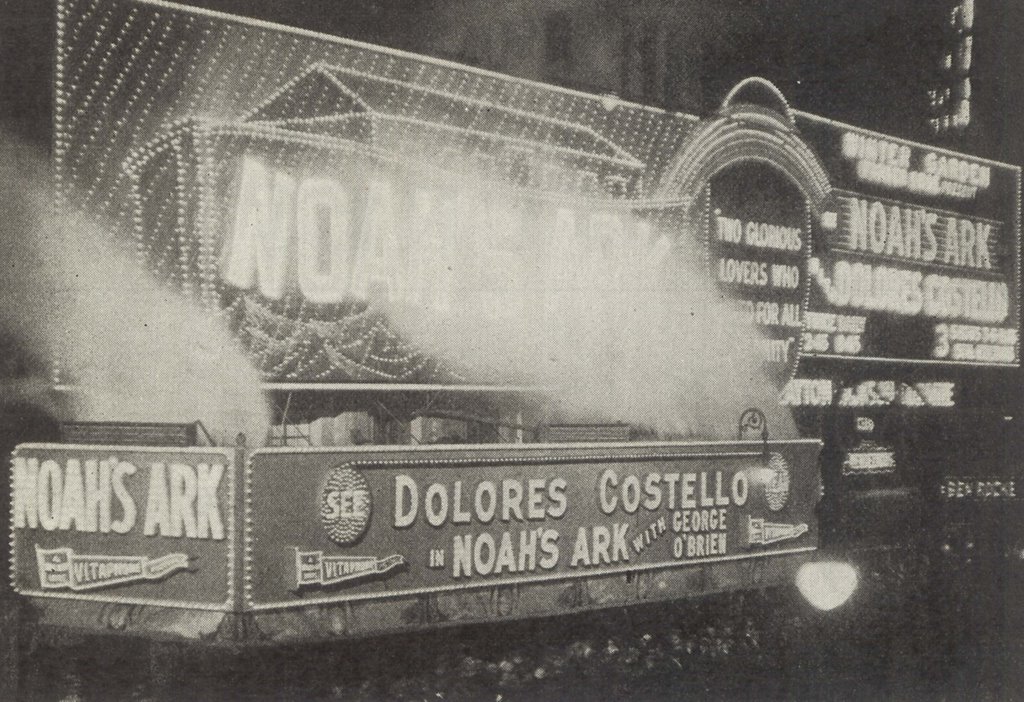
Noah’s Ark was designed for all-out showmanship. The show started outside New York’s Winter Garden Theatre with lighted displays and a forty-foot blimp hovering over the marquee. Eight "sunlight arcs" poured changing colors on the leviathan as wires caused it to dip and sway toward a giant replica of the ark electrified with rain effects and clouds of steam. Inside the auditorium, more deluge greeted the audience as wind and water signaled the Vitaphone overture. First-nighters paid eleven dollars a seat, and all were filled. Subsequent tickets went for two dollars, which caused resentment among reviewers whose own lukewarm response to Noah’s Ark was in part a rebuke of Warners for having oversold what these critics considered an ordinary and derivative picture. Seventy-seven years have a way of changing perspectives however --- were it remade today, Noah’s Ark would no doubt invite all sorts of controversy, considering the social agenda set forth in its dynamic opening reel. After a sobering glimpse of biblical era excesses, we’re treated to a montage of jazz age depravity. The Worship of the Golden Calf Remains Man’s Religion is the title preceding a frenzied day on Wall Street, where the barter and loss of fortunes results in bloodshed on the very steps of the exchange. Is this chaos and immorality the natural consequence of capitalism gone mad? Further dissolves depicting suicide, prostitution, and alcohol abuse suggests it is. Here’s a society badly in need of overhaul --- and this was months before the stock market crash. Was Warners looking into a crystal ball? Theirs is a merciless commentary. Skyscrapers are modern Towers of Babel. America’s headed down a ticker tape highway to hell. If anyone tried selling a philosophy like this today, the very least they’d get is a good media spank for playing politics. Unsubtle as it is, Noah’s Ark packs a mean wallop with that opening, so much so that we’re almost sorry to see it veer off into a more prosaic World War One story for the hour or so that follows.


That wartime and biblical stuff rang a bell for 1929 audiences. They’d seen most of it before in The Ten Commandments, Ben-Hur, The Big Parade, and any number of inbred blockbusters that had so far racked up huge grosses. Noah’s Ark never pretended to be anything other than grand spectacle. What it stole would later be stolen from it. Pagan soldiers burn out George O’Brien’s eyes and bind him to a gristmill. DeMille got even for Warners’ pillage from his own biblical epics by lifting this plot device wholesale and using it in Samson and Delilah --- twenty years hence. Producers knew better than to be too original with this sort of material --- patrons came with certain expectations and expected them to be met. In Noah's Ark, trains are wrecked, maidens are abducted, and villains die horribly. Truly an exhibitor’s dream picture. Even against that million dollar negative (Warner’s biggest outlay as of that year), there was a profit of $523,000. Foreign sales were stimulated when director Michael Curtiz appeared on camera and narrated a series of Vitaphone trailers (in the appropriate language) for Hungarian, French, German, and Austrian theatres. Dialogue sequences spurred the domestic boxoffice. Isolated here and there, and accomplishing nothing other than bringing the narrative to a dead halt, they were a necessary evil and useful sop for fans expecting at least a little recorded bang for their buck. Poor Dolores Costello once again took a critical rapping (emotionless, stilted delivery), but the climactic flood more than put over the sock everyone had paid to see. For all his culpability regarding those doomed extras, Curtiz surely knew how to construct his epics. What a shame this Noah’s Ark had to run aground for sixty years after its initial release. It’s only by way of UCLA’s restoration miracle that we now can now recapture some semblance of what audiences enjoyed in 1929.


Noah’s Ark’s initial deliverer was Robert Youngson, who’d championed the film during the early fifties when he was employed in Warner Bros.’ short subjects department. A lifelong film buff and later producer of all those fabulous comedy compilations, Youngson edited a group of one-reel subjects culled from silent spectaculars such as Don Juan, Isle Of Lost Ships, Old San Francisco, and Noah’s Ark. When Associated Artists bought the Warners pre-49 library for television release in 1956, they ended up with the surviving silent negatives as well, including Noah’s Ark. While 16mm prints were being prepared for TV sales, AAP established a subsidiary called Dominant Pictures, whose mission was to squeeze whatever theatrical bookings they could out of the old Warner product before the video dump. Youngson approached Dominant with his idea of re-editing and "modernizing" Noah’s Ark for a 35mm re-issue. Since they now owned the picture anyway, there was little to lose. The 1957 version would be shorn of all intertitles and talking sequences. Newsreel narrator Dwight Weist provided non-stop explanation and commentary throughout a truncated Noah’s Ark, but this was all the access we’d have to the film until Robert Gitt and the UCLA restoration team got hold of the project in 1988. What’s now shown regularly on TCM is their handiwork, and other than a little missing footage here and there, it’s the complete 1929 general release version. If ever there was a title worth canvassing your TCM schedule for, Noah’s Ark is it. I’d like to think there’s a DVD release somewhere in the offing as well.

The definitive production and restoration history of Noah's Ark was written by Scott MacQueen and published in Issue 12 (Winter 1991-92) of The Perfect Vision. A great piece of scholarship and highly recommended.


Sunday, September 24, 2006


Monday Glamour Starter --- Dolores Costello


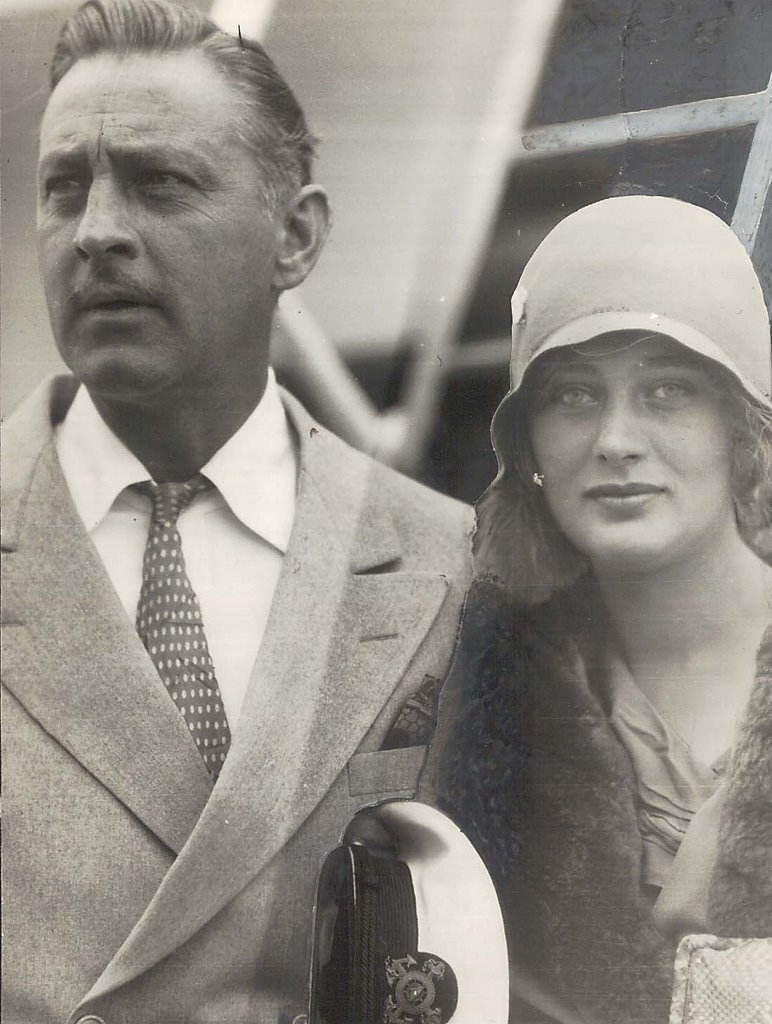
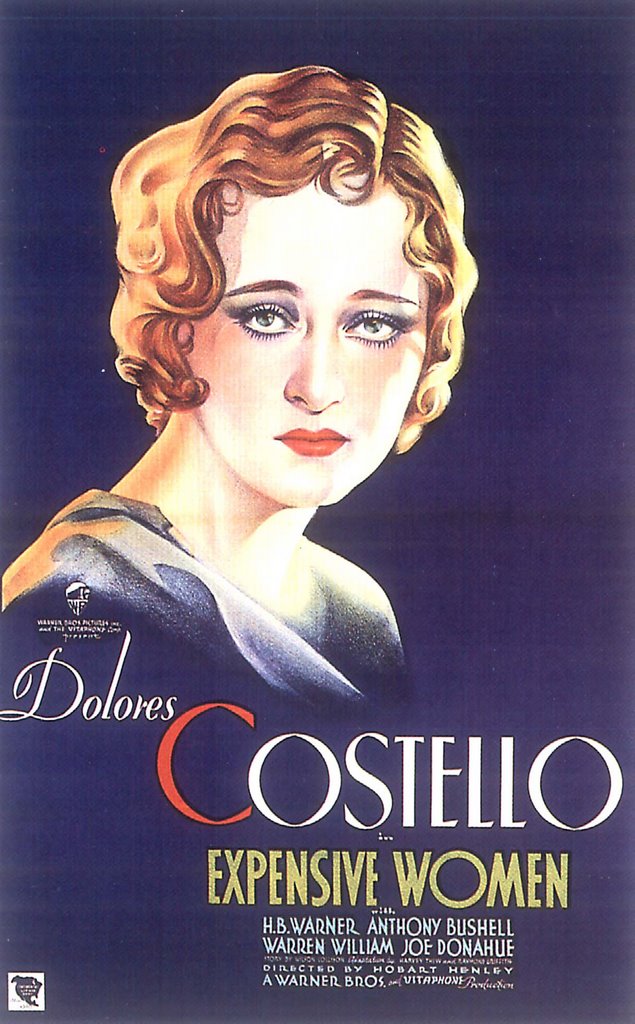
Dolores Costello was another of those silent stars that had a bad talkie experience. She also had a bad John Barrymore experience, as had others. Life between the two was pretty harrowing for those years when she was Warner Bros.’ biggest feminine lead and married to that profile of profiles. By the time she was in her mid-thirties, Dolores was disposed of both Barrymore and her own stardom. Surely there were lessons along the way for her to pass down to various troubled offspring in that tormented theatrical family, though she’d share few of these with a public who’d by now forgotten the most preposterously lovely creature in all the world (John Barrymore’s initial words in describing Dolores). Her fashion in dewy-eyed, patrician beauties was a vogue that came and went as quickly as talkies arrived to supplant the silents. Were it not for the all-too brief rapture of marriage to J.B., she might have suffered the career loss more grievously, but in the end, she was content in her retreat to the modest quiet of an avocado ranch in Fallbrook, California. There were shelves of Jack’s old first editions if a quick infusion of cash was needed, but otherwise, I’d like to imagine Dolores enjoyed a largely secluded retirement after the fashion of Harold Bissonette among his orange groves at the happy end of It’s A Gift.


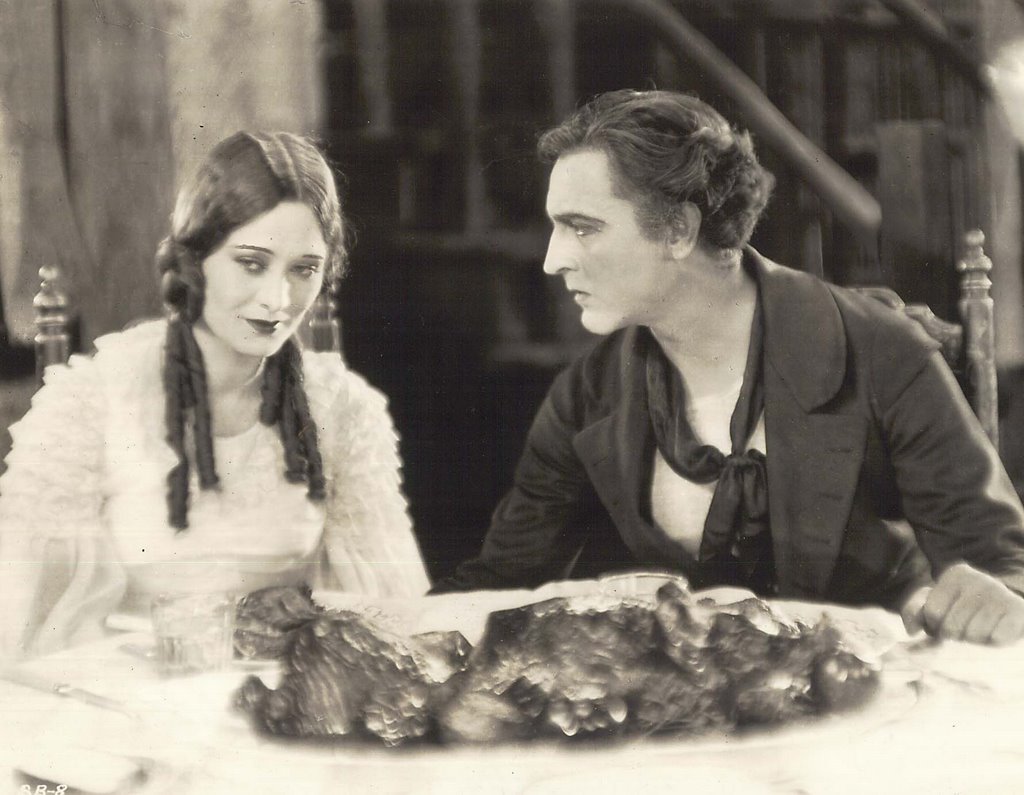
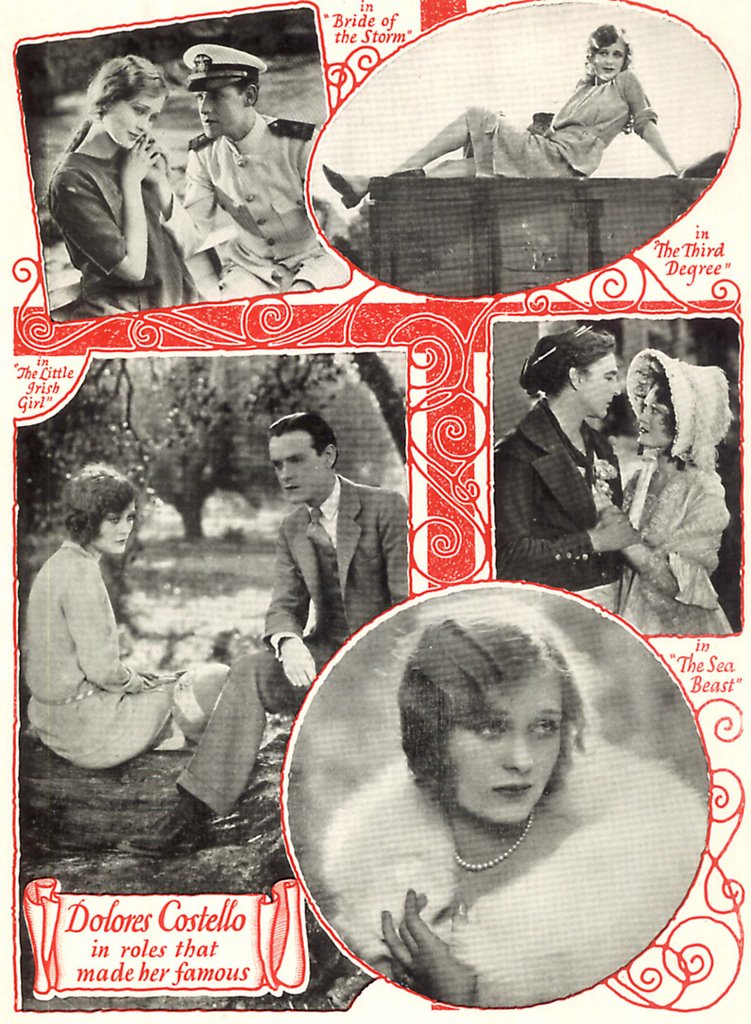
Dolores was predisposed to tolerate Barrymore’s excesses by her background, if not temperament, for she’d been born to a theatrical dynasty of her own. Maurice Costello was an ac-tor of the grand tradition being gently ushered offstage by changing audience tastes and his own proclivities toward roustabouting and cork removal. His brief respite with silent melodrama paved the way for little Dolores and sister Helene to enact child parts opposite their father, while bulldozer matriarch Mae Costello laid plans for eventual family life sans Maurice. Sure enough, by the time the girls were teens, he was off on permanent caprice and Mother took over. Dolores blossomed in the role of precocious chorine with George White’s Scandals, and made a fetching model for James Montgomery Flagg’s commercial art. These were the paths to a Warner contract that brought her into contact with John Barrymore, who immediately drafted Dolores as leading lady in The Sea Beast, his silent adaptation of Moby Dick. Dolores’ co-star, twenty plus years her senior, inspired the dead faint that ensued when he insisted on shooting their scorching love scenes first. Jack’s impassioned pursuit continued off the set as well, but it took three years, and a determined end run around Mae Costello, before Jack’s dream of a final consummation could be fulfilled. By this time, Dolores had become Warner’s most valuable feminine asset. With the arrival of sound, her prospects seemed limitless. Indeed, she would become the first major star recorded on Vitaphone after Jolson, but would Dolores share Al’s triumph on disc? She would not.


Dolores Costello got almost as raw a deal in talkies as Jack Gilbert, but it never bothered her as much. Neither she nor the technicians were prepared for the rushed debut of Tenderloin and Glorious Betsy, two that opened by the Spring of 1928, well before kinks were ironed out of Warner’s revolutionary sound process. Indeed, she got blame for much of what went wrong in the booth, be it scratchy discs, bad sync, or poor amplification. Mercy, mercy, have you no sister of your own? was a line delivered without incident on the set of Tenderloin, but it would achieve immediate catch-phrase immortality by the time it filtered through those speakers. Merthy, merthy, have you no thither of your own? Everyone assumed this was Dolores’ natural voice. Granted, her delivery needed work, but no more so than a hundred others in an industry filled with untrained and uncertain voices. Reviews now led off with "Poor Dolores…." Ridicule was heaped atop scorn. Director William DeMille caught Glorious Betsy in its Hollywood premiere and observed that Poor Dolores Costello’s excellent voice came out at times as a deep rich baritone, while Conrad Nagel thundered in a sub-human bass. It was obvious she’d been delivered up as a stalking horse to launch Vitaphone. After all, they had to put someone’s name on the marquee. Overexposure in hurried vehicles killed off many a lesser name, but few had withdrawn amidst such embarrassing catcalls. Poor Delores --- there are two opinions in Hollywood as to what her mike voice sounded like. One clique says it sounded like the barkings of a lonesome puppy; the others claim it reminded them of the time they sang "In The Shade Of the Old Apple Tree" through tissue paper folded over a comb. That was Photoplay’s assessment as of December 1930. By then, Dolores was on sabbatical --- undergoing intensive voice training, according to Warner publicists. By the time she came back (after a two year break), the parade had rushed her by. Even the studio’s assurance of a "new voice" could not dim audience memories of a faded star they’d laughed off the talking screen.


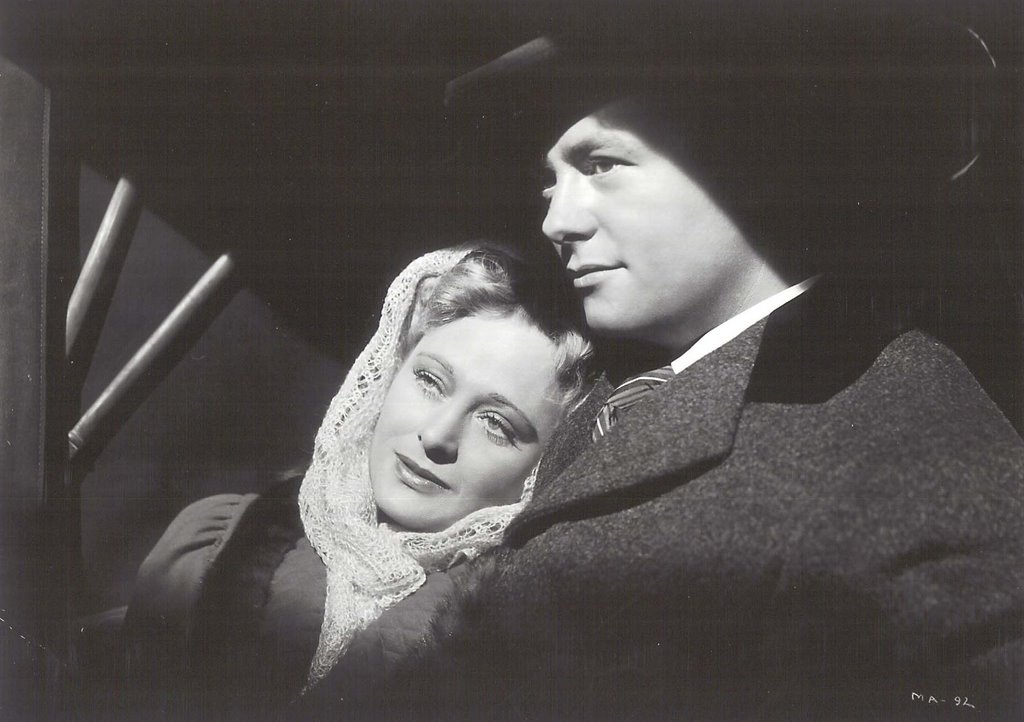
There were seven years with John Barrymore. She was said to have been positively saintly in her determined efforts to straighten him out, but as brother Lionel put it, Jack couldn’t stand monotony and he had a dread of being possessed by people. This was not a man capable of settling down, except with his drinking cohorts and a willing, short-term, concubine. Dolores tried again at performing, but age weighed heavier upon her than most, and that stoic beauty took on a matronly cast altogether suitable as Freddie Bartholomew’s mother in Little Lord Fauntleroy. Work was sporadic after that. There were unsettling stories about harsh make-up having damaged her face. Those unblemished cheeks were now deteriorated --- disintegrated (!) --- almost eaten away (!!). It all depended upon whom you read on the subject. The effects weren't apparent in The Magnificent Ambersons, but Orson Welles’ casting of her was more a matter of paying homage to the silent era than any recognition of talent. She would bow out for keeps after This Is The Army in 1943, and shunned interviews for decades thereafter. When Barrymore biographers approached her in the late seventies, Dolores was finally ready to talk, but no one seemed interested in her own career, other than Kevin Brownlow, whose Hollywood series captured the first and only on-camera appearance she’d make during the retirement years. Uncharitable observers said she looked like an old Irish washerwoman, which begs the question as to how many of us have had any actual exposure to old Irish washerwomen. If nothing else, she seems to have assumed mother Mae's role as stern family matriarch, and much of her old age was spent trying to extricate Barrymore children and grandchildren from various compromising situations. The lavish scrapbooks of her life with John Barrymore eventually saw publication in a recent oversized book celebrating the first family of acting, and it’s available HERE. Dolores died in 1979 at the age of seventy-five.

Photo Captions

Warner studio portrait
Participating in a beauty contest with sister Helene
With John Barrymore in The Sea Beast
With Warner Oland in Old San Francisco
Montage of Warner Bros. roles
Honeymooning with John Barrymore
Exhibitor Manual page on Dolores
With husband John Barrymore
Trade Ad promises a "new voice" for Dolores
One Sheet --- Expensive Women
With Freddie Bartholomew in Little Lord Fauntleroy
With Tim Holt in The Magnificent Ambersons


Thursday, September 21, 2006


Penny Postcard Promotional

Back in those hallowed days of grassroots showmanship, and long before TV and internet saturation became the norm, local exhibitors often got the word around by way of direct mailings. Colorful heralds would go out with the post, or with newspapers, to potential patrons, but economy-minded theatre men relied on simple postcards such as this one to spread the word. Boom Town was Metro's biggest special of 1940, and I suspect a five-day booking in Fort Smith, Arkansas would have been considered a long run in that community.


Dateline : January 23, 1954

The big noise in Fort Smith, Arkansas is the opening of 20th Century Fox's newest Cinemascope special, How To Marry A Millionaire, and judging by the size of this ad, the Temple Theatre clearly expects boffo attendance. That stereophonic sound would have been as great a lure for me as the wide screen. Fox required exhibitors to install the sound system in those early days of Cinemascope. They didn't want the public to experience anything less than the fullest impact of their amazing new process. Note the dollar adult admission for the evening show, a pretty steep ducat for 1954.


The Adventures Of Tom Sawyer --- Part Two


The Radio City Music Hall premiere was February 11, 1938. Tommy Kelly and Ann Gillis (Becky Thatcher) were brought in for guest appearances with several local tie-in merchants (here they are at Wanamaker’s Department Store for a Lincoln’s Birthday luncheon attended by NYC kids and parents). Selznick’s zeal for perfection resulted in the usual cost overruns. The Adventures Of Tom Sawyer ended up costing $1.2 million, and getting that back would prove difficult. Domestic rentals stalled at $1.1 million, and foreign returned a modest $743,000. The final loss was $302,000. I checked out the ledgers for a small-town North Carolina house that played The Adventures Of Tom Sawyer in April of 1938. That exhibitor paid United Artists a flat rental of $100.00, this being one of the highest outlays for a single feature that year (only Test Pilot commanded a higher price --- $163.60). In addition to Tom Sawyer, there was a cartoon from Paramount (Educated Fish at $4.80) and a Metro newsreel ($3.00). $12.30 was spent on posters and accessories. This particular showman’s loss reflected the nationwide deficit on Tom Sawyer. $78.90 came through his boxoffice for the two days it played. When you consider the total cost of the program ($107.80), plus the usual house overhead, this was clearly a losing engagement. Re-issues would have cleared some of the red ink, but probably not all. Eagle-Lion leased The Adventures Of Tom Sawyer for a 1948 revival, and later there was NTA’s 1958 distribution (our Liberty Theatre played it as their big Christmas attraction that year). A company called New Trends Associates brought it back in 1965. There were cuts made to the negative over the course of time. The 93 minute feature was eventually winnowed down to 77. An extensive restoration was finally made when Disney took ownership in the early nineties. A friend and Greenbriar reader who was involved with that project generously provided the following background information ….


The Adventures Of Tom Sawyer was quite a project. The restoration, perhaps, took the foolish long way around rather than the quick and easy way, and reconstituted the 3-strip negatives. They had been trimmed in several hundred places -- by Selznick himself – in 1952 for the subsequent 1954 reissue (Technicolor’s negative cutter’s notes dated 1952 were still in the elimination cans!). Interestingly, Selznick had Technicolor make him a new safety print just before he had the negative cut up ( that print is now at Eastman House; it has a nasty yellow-red-amber color, like so many late ‘30s IB prints). The evidence suggests that it was made from 1938 matrices, with 1952 matrix pick-ups for damage at reel ends – there will be a definite pre-print splice, and the last 75 feet of the reel suddenly goes from amber pre-war Technicolor to neutral-balanced post-WW2 Technicolor! There seemed to be an edict to get the picture down both for time and to make it play faster with a more modern (1950s) pace -- this is just my assessment looking at how the cuts were made, with entrances and exits truncated, reaction shots removed, everything happening more swiftly in many scenes. The long version existed in 1938 nitrate Y-C-M masters, but they were dreadful quality – what’s been seen before from Playhouse Video and MoMA was from this stuff, just terribly: grainy, dirty contrasty and color shifted. When all of the trims were found, stacked in cans abandoned at one of the archives, it was determined to piece the long version back together even if it meant jump cuts, because the photographic quality was so superior. And some of the trims were 5 and 10 frames at the head and tail of shots. Perhaps the ideal solution would have been 100% digital, but the cost to do that at proper resolution would have been astronomical. Several scenes were done digitally where full 3 strip negatives did not exist, and elements had to be mixed or there was bad damage. Additional clean-up of photographic dirt and tears was done to the high-definition video master (the restored version has not been released in the US, and is not the copy that was shown on TCM, though it sired a beautiful DVD in the UK – get your multi-zone player folks!). The sound, too, was an issue -- it was pulled largely off of Selznick's 1952 safety print, which was the best existing track made from the lost original sound negative. Brief sonic holes were filled with re-recordings in the ABC inventory to fix holes and splices, and an original music and effects track allowed the sonic quality of non-dialogue passages to be upgraded for Signal-to-Noise. Interestingly, the 1954 reissue has an entirely new mix - some music cues swapped around, slap-echo reverberation added to the cave sequence, other changes. We went back to the original mix, and at the same time, we restored the 77m. version as well. If anyone cares to, it makes a nice comparison study. Commercially, the short version is useful as the foreign dubs prepared after the war were of this short version, so we wanted to be certain that those markets that had existing tracks could have the picture in the local language (until the day that new dubs of the long version are done). This short version work was done in Video-Only. The original 1938 trailer, a rather long one, was also restored from a nitrate print located with a collector.


Tommy Kelly (Tom) moved back east, and at last we heard is still alive. The word is that he became a High School teacher (now retired). Disney tried to locate him when they showed the picture at the El Capitain several years ago, but no luck. Ann Gillis (Becky) lives in England (she appeared in Kurbick’s 2001:A Space Odyssey as Gary Lockwood's mother in the video birthday greeting!). Cora Sue Collins (Amy Lawrence) is alive and well in LA – she has a wonderful scrapbook she assembled on the set of Tom Sawyer full of signatures and drawings from the cast and crew. David Holt went on to a successful career as a songwriter (often working with Johnny Mercer) and sadly left us a few years ago. Marcia Mae Jones (Mary Sawyer) lives in Los Angeles, and that beautiful face is still instantly recognizable. Jean Porter, later Mrs. Edward Dmytryk, was one of the schoolgirls. Just recently we learned that Walt Disney’s “Alice” star, Virginia Davis, was also one of the school girls!


There actually is one shot left in the film, in the church when the boys return for their “funeral”, where you can see Spring Byington as the Widow Douglas; she clearly had a large role in the original version. Stills exist of her, lantern in hand, discovering Tom asleep in a haystack at night. And those opening title shots of Tom swimming -- well, that's the sequence Walter Brennan refers to in the jailhouse when he says he's the one that shows the boys the good fishing spots! Again, there are stills that show this was an entire sequence of Tom and Huck swimming, while Muff fishes from his skiff. Stills also reveal that the entire cemetery scene was re-shot on a new set designed by (and I guess the scene may have been directed by) William Cameron Menzies. The original set is a dull four-walled affair hemmed in by a picket fence; the doctor is dressed in a waistcoat and broad hat. Leave it to Menzies to make it a properly horrible scene suitable to grave robbing – tumble down gravestones, bent wispy trees reaching out with leafless branches like fingers, the graveyard silhouetted on a promontory, the doctor now in Inverness cape and top hat. What an orbit this poor picture has had!


Wednesday, September 20, 2006


Favorites List --- The Adventures Of Tom Sawyer --- Part One

Just back from Myrtle Beach, SC, where I was reminded of an earlier trip to the shore with a church youth group back when I was sixteen. At a time when all the other kids were busy cruising the arcades, or worse, trying to score illicit beer and/or cigarettes, I spent our entire first afternoon closeted in the Rivoli Theatre watching (twice) David O. Selznick’s The Adventures Of Tom Sawyer. This being the summer of 1970, we were still a few years short of the dreadful Reader’s Digest remake that would star Family Affair’s Johnny Whitaker as Tom. I remember sitting there and marveling at the fact I was watching a 1938 Technicolor feature on the big screen. How could those other kids waste their time playing miniature golf when they could be in here watching this? The cave sequence had always packed a wallop for me on television. This time I sat and cried when Tom climbed those rocks to a sunlit opening, then returned to rescue Becky Thatcher. I still consider it one of the most dynamic scenes in movies. So why has the 1938 Tom Sawyer become such a bastard stepchild? He seemed to be everywhere during the sixties. In addition to re-issues, we had frequent syndicated runs on television. Sometimes Channel 8 would alternate the Selznick with Paramount’s early talking 1930 version featuring Jackie Coogan as Tom. It was one of the few vintage titles we had dependable access to. I wouldn’t realize until later what a troubled production this was, and how misused it had been ever since its original (and very disappointing) release.


There were several false starts on The Adventures Of Tom Sawyer. Selznick had to begin with black-and-white in March of 1937 when Technicolor units proved unavailable. The process was gaining ground with the studios, and its limited equipment and resources were booked far ahead. Tom Sawyer’s initial director was H.C. Potter, who remained through one production shutdown (during April and May), but eventually quit as a result of Selznick’s ceaseless interference (a fact of life for all helmsmen at this company). Filming in B/W had resumed in June, but was again interrupted when Technicolor suddenly became available in July. Several cast members were replaced (including Beulah Bondi as Aunt Polly), but Selznick’s selection for the title role remained. Tommy Kelly was the non-professional son of an unemployed Bronx fireman (what … so they weren’t having fires anymore in the Bronx?). The twelve-year-old was paid a hundred dollars a week, and his father got a studio policeman job on the Selznick-International lot. The producer had hoped to draft his young players from orphan asylums (!), so as to arouse such a warm public feeling that it would add enormously to the gross of the picture (his memo), but eventually resorted to a cast of pro moppets, Tommy Kelly excepted. Everyone who had a contract with Selznick was expected to pitch in. Seasoned scribe Ben Hecht contributed draft revisions as he was completing Nothing Sacred, while George Cukor supposedly directed portions of the schoolhouse and pirate island segments. By now, Norman Taurog had been brought on as principal director, having had experience with kids on previous assignments. Previews of the completed Tom Sawyer brought screams from the kiddies and complaints from mothers. Seems those cave sequences were too intense, particularly the swarm of bats and Becky’s fits of hysteria. Selznick snipped an unusually horrible close-up of Becky laughing hysterically and in which her mind is obviously completely gone. He went on to observe that she looks like a little witch instead of a little girl. Though the bat attack was among his favorite scenes in the picture, the producer also had it shortened. Two days of retakes were ordered under William Wellman’s direction in December for a planned February 1938 opening.


As is so often the case, favorite movies show up on DVD in other countries long before they reach us. Such is the case with The Adventures Of Tom Sawyer. There’s a Region 2 disc that’s been available for several years, and it’s the complete version all too rarely seen in this country (available HERE). Does anyone else share my longstanding affection for this show? To start with, I love the grim countenance shared by virtually all the adult authority figures surrounding Tom. They come across like authentic nineteenth-century figures --- quick with a hickory rod or a thimble thump to the head, cold and humorless otherwise. All seem rigid and repressed. Are these small-town denizens out of Mark Twain, or are they more reflective of the grown-up culture Selznick encountered in his boyhood days? Tom is routinely beaten, and none of it’s sugarcoated or played for laughs. Selznick never sidesteps the cruelties these adults visit upon children. Injun Joe is perhaps the most frightening villain in all 30’s film --- a nightmarish visage tempered not a whit by conscience or humanity. His pursuit of Tom and Becky in the cave is the equal of any horror sequence I’ve come across. Many of the settings (designed by William Cameron Menzies) are creepy in the extreme. His graveyard, caverns, austere schoolroom --- all cast a baleful shadow and go a long way toward maintaining tension. Humor in The Adventures Of Tom Sawyer is all the more effective as a counterbalance to the suspense. So many of the best comedies score with that combination (one that comes to mind is Some Like It Hot, similar in several respects to The Adventures Of Tom Sawyer). Tomorrow’s Part Two takes up the reception and rentals on T.A.O.T.S., as well as the extensive restoration that rescued the complete version after sixty plus years.


Saturday, September 16, 2006


Olivia Pitches In


I really like this still, and having already Glamour Started Olivia DeHavilland some weeks back, it didn’t seem right to hold a captivating wartime image like this until her next featured posting. It’s those grease spots that really set this off, don’t you think? As I look at it, I wonder if she’d have any recollection of going out to the airfield for this session. Probably not. After all, it’s been over sixty years. Factory, munitions, and mechanic work were much needed during WWII, and there were no more persuasive recruiting tools than beautiful stars posing with tools of those trades. This photo, by the way, was taken during that period when Olivia was embroiled in her legal challenge against employer Warner Bros., wherein she sought release from her oppressive contract. As you’ll note HERE, she won.


Mae West --- Part Two

Nearing forty by the time she stepped in front of her first movie camera, Mae West was a frequently overweight and by now anything but alluring figure who, nevertheless, brilliantly portrayed a sex symbol. It was through an exercise of indomitable will that she was able to present herself as America’s most notorious man-eater. Love scenes were always about build-up, never consummation. When time came for the kiss, her leading man would spin Mae away from the camera so we’d seldom see their lips meet. Her male co-star could always depend on at least one close-up of the back of his head. Sexual excesses always took place off screen, even in the pre-codes. For movies that are all about sex, hers are the most sexless of all. Men lavished her with diamonds and furs, but there was seldom even a suggestive dissolve to indicate what their remuneration might be. Any given actress at Warners scored more illicit fadeouts (if not on-screen couplings) in a month than West would in her entire career, but none of them got so many laughs out of it, and that’s what finally tripped Mae up with the censors.


Mae didn’t just wink at sex in interviews --- she gorged herself on it. A policy of provoking media critics had worked to her advantage in New York, but these were far more provincial movie audiences she was tweaking, and their patience wore thin with ribald tales of West’s legion of lovers. Viewers were laughing with her, but she was laughing at them. It was time to bring Mae down a few pegs. Forceful demonstrations by the Catholic Church got the fearful message across --- either clean up or close down. West had three pictures in release when the newly enforced Code paid a call. Paramount exchanges were obliged to pull these in for shelf duty, while her newest, It Ain’t No Sin, went back to the drawing board. In view of scrutiny applied to this one, there would surely be no sinning by the time it reached theatres. That title was first to be jettisoned --- some were offended by it --- thus Paramount had to yank down billboards and recall a nationwide flock of parrots that had been trained to recite, It Ain’t No Sin! for the benefit of passerbys. Leo McCarey directed, and somehow salvaged a good picture out of the wreckage, though he’d vow, in accordance with colleagues before and after him, never to work with her again. Mae confounded the PCA by shooting highly censorable footage, then meekly submitting to its removal, knowing the stuff she really wanted would be overlooked during the furious exchange of memos. That worked for a while, but you can only fool some of the people part of the time, and these weren’t fools she was up against. Indeed, they would have her movie career on a plate within a few short years.


Throughout nearly fifty years she lived in Hollywood, Mae’s phone number was listed in the book. Not that she was accessible. Fans were never wanted up close. Once she’d been robbed at gunpoint. The lowlife element figured Mae for a walking jewelry counter. Well, she was Diamond Lil after all. Violent crime sometimes walked hand-in-hand with celebrity. Mae’s chauffeur/lover and bodyguard both carried guns, while their employer cradled a pet monkey within the linings of her fur. Similar eccentricities were visited upon business associates as well. Mae knew how to keep opponents off balance with extravagant demands and seemingly irrational behavior. By the time they got back their equilibrium, the deal was done, and she had won. It all worked like a charm until the grosses started drying up. Mae West was suddenly like every other actress who'd scorched 'em in pre-codes --- de-clawed and deadly dull. Klondike Annie varied the formula by having her impersonate a missionary, and this she played without irony or condescension. It might have been the best and bravest screen work she ever did, but it was too late. The finishing touch came unexpectedly when Mae guested on The Chase and Sanborn Hour with Edgar Bergen and Charlie McCarthy --- this night that would live in radio infamy was December 27, 1937. Her own proposed script had been nixed by network standards, and she team-played through rehearsals, but when that live broadcast light went on, Mae threw caution to the wind and plunged forward with double-entendre laced dialogue that had much of the country running for their telephones telling friends to tune in. NBC was apoplectic, and vowed never to allow Mae West on radio again. Resulting bad publicity sent chills through Paramount soundstages. Motion Picture Herald listed her among stars now labeled "Boxoffice Poison." Efforts to surround West with aged low comedians in Every Day’s A Holiday couldn’t rehabilitate her. The combination of circumstances made getting rid of West a sound fiscal decision for the studio.


She found refuge back on the stage. A decade long obsession had been to film her play, Catherine Was Great. Now she would weigh herself down in period costumes (one topped the scales at 75 pounds) and take it on a torturous road schedule that wound a path through the provinces and brought the thrill of Mae West In Person to hundreds of smaller towns she’d not encountered since vaudeville. Hollywood still gave her the freeze --- a teaming with Bill Fields did him more good than her, and The Heat’s On for Columbia was a plain disaster. Canteen work during the war was out --- Mae was no good with small talk and loathed the close contact these spots entailed. She was insulted when Billy Wilder offered Sunset Boulevard, but imagine how scary Mae would have been as Norma Desmond --- poor Joe Gillis could never have survived the opening reel of her not-so tender ministrations. Muscle boys in her Vegas cabaret act found Mae a hard taskmaster as well. One of them was sufficiently traumatized by her insatiable demands (both on and off stage) so as to quit the show and join a monastery. Those platform shoes Mae wore made Karloff’s Frankenstein boots seem like carpet slippers by comparison --- straps cut into feet and left her in agony. Mae's own hair and eyelashes were long since ruined with chemicals and enhancements over the years. Now she was a mannequin that had to be dressed as though for a window display. Sister Beverly was an off and again servant who drank. Resentments festering for years boiled up from time to time. When Mae decided to tackle her memoirs, she found that rats had eaten old documents and records. The play was still the thing. Mae West now spoke of herself of in the third person --- there was little of the first person left. Interviewers began commenting on the eerie and gothic nature of encounters with her, and this would become the rallying point for lazy scribes. She was the only cast member in Myra Breckinridge not to have been utterly degraded in her part (poor John Huston!) and she stayed above that fray by sticking with tried and true material instead of submitting to the gaucheries of a desperate to be with-it Fox. One last starring vehicle at 84 (Sextette) was clearly not in her best interests, but Mae never knew when to quit, and you had to admire her for gamely seeing it through. Performing was the life she knew, and age was a thing to be daily conquered and overcome. That last stay in the hospital found her hauling a 16mm projector into the room so she could screen movies --- Mae West movies, of course. She died in 1980 at the age of 87.

Photo Captions

Ad Art for Klondike Annie
Klondike Annie
Paramount Publicity Portrait
Ad Art for Every Day's A Holiday
Every Day's A Holiday
Publicity Still with Charlie McCarthy for The Chase and Sanborn Hour
With W.C. Fields in My Little Chickadee
Color Portrait for Tropicana --- released as The Heat's On
Newspaper Ad for Mae's Stage Show
With musclemen for her Las Vegas Cabaret Revue
With the cast and director of Myra Breckinridge


Monday Glamour Starter --- Mae West --- Part One


Modern viewers are generally uneasy with Mae West. She’s harder to warm up to with each passing generation. There’s an unearthly quality about her appearance and personality that belongs to an era and mindset our culture will never again embrace. Mae’s battle was won well before she died, the prudes and would-be censors having decades since been routed. Accounts of her bold strokes against long-ago propriety and convention must be accepted on faith, for there’s nothing in her movies to suggest this woman was the twentieth century’s defining threat to public morality. Kids looking upon that overripe figure today would no doubt dismiss Mae West as yet another instance of their ancestor’s peculiar taste in entertainers. As long as there were standards for Mae West to outrage, she’d keep her following, but how could she have anticipated living enough years to see all those standards so blithely swept aside? Mae spent her career advocating a wide-open world, but this was really the last thing she needed or even wanted. She got it, though, even if it came at the ultimate cost of her own relevance.


Mae was born during those Gay Nineties she’d forever hark back to in stage and films. Worth noting is the fact that her Brooklyn address was within two blocks of Clara Bow’s eventual birthplace (they were twelve years apart). Mae’s roustabout father made carriages, among other trades less savory, and the family lived tolerably well. I have this mental image of trotting horses carrying an adolescent Mae by the miserable coldwater flat the Bows occupied, and perhaps she and little Clara exchanging a glance. Might have happened. Anyway, Battling Jack, as the father was known (and not necessarily with affection) wasn’t above taking Mae to any number of low dives where he kept company with boxers, petty criminals, and other brawn over brain types. This is where she nurtured the taste in men that would stay with her a lifetime. As a child, Mae often dreamed of sex with a grizzly bear (no, I’m not drinking, nor is this a typo). She found such eventful sleep relaxing. A possibly unhealthy relationship with Battling Jack might have had something to do with this, though she also developed a yen for lions and their tamers. The only person Mae really cared about was her mother, and their mutual devotion excluded all rivals, particularly a sad-sack sister who was every kind of undisciplined screw-up Mae wasn’t, and both mother and favored daughter let her know all about it. A real Blanche and Jane Hudson thing was taking root, and it would last their lifetimes.


Vaudeville was the same broken glass route for Mae as it would be for any aspirant in those early century days --- the climb up yielded thin air for those made of softer tissue. Mae’s was a leathery resolve, however, and she learned the hard way what worked best for her. Once that formula was laid, no one else would ever be permitted to write her stuff. She’d forever remain a one-woman show. The sex angle was an audience preference she detected early on, but no artist had Mae’s daring for dishing the dirt in otherwise staid theatrical environments. She took the bawdy out of burlesque and put it on Broadway. The plays she wrote celebrated the lowlife element encountered during childhood. They weren’t Ibsen, but SEX, Drag, The Wicked Age, and Diamond Lil gave audiences and readers a slumming tour through back-alleys they’d never venture near in person, and Mae’s own carnal exploits seemed to multiply with each interview she gave. Thumbing one’s nose at propriety in those days carried a stiff price, as Mae discovered when she and her stage company were hauled into court and tried for indecency. She actually pulled a little slam time, but that was nothing but a good thing for a sexual revolutionist like Mae. Gangland links provided funds for expensive mounting her shows required. Owney Madden was a close friend and silent partner. Trusted lieutenant George Raft, his own movie stardom still a few years in the offing, came down each night to check receipts on Owney’s behalf.


Not all her plays were hits, but Mae was. She was a natural for talking pictures. The first of these was Night After Night, which was ironically a George Raft vehicle, his train having reached Hollywood a year or so in advance of Mae’s. Suffice to say she stole everything but the camera (Raft’s tribute), so a starring role was solidly in the bag. That was She Done Him Wrong, and from here on, all Mae’s directors felt themselves done very wrong by this determined and uncompromising woman. The fact is, she just happened to know her business better than they thought they did. Paramount was busy counting the fantastic rentals her pictures were getting, so no argument there. Mae developed a way of taking credit for things she did and things she didn’t do. Her movie act was more or less a refinement of what Texas Guinan used to give patrons in her legendary NYC nightclub, but that potential showdown was averted by Guinan’s premature death --- Mae was like a sponge when it came to overheard wisecracks and repartee. Funny things she heard had a way of showing up in her own routines sooner or later. She’d even incorporate Cary Grant’s stardom into her personal inventory of life achievements. Subsequent interviews found Mae discovering Grant among a herd of nameless extras and bestowing the career defining break of co-starring with her. As Cary himself would later say, she never told the truth in her life, and while that may be a tiny bit severe, Mae herself might have acknowledged a fondness for occasional embroidery, especially when it fostered a good story. A more damning, and poignant, Grant observation pointed out Mae’s construction of her stage personality as having blurred her ability to separate fact from fantasy --- but wasn’t this the fate of most stars in their twilight years?

Photo Captions

She Done Him Wrong
With George Raft in Night After Night
Ad Art for She Done Him Wrong
Portrait --- She Done Him Wrong
With Cary Grant in She Done Him Wrong
I'm No Angel
With one of her real-life pet monkeys in I'm No Angel
Ad Art for Belle Of The Nineties
Art Still from Belle Of The Nineties
Color Portrait from a Paramount Exhibitor's Manual


Roddy McDowall's Birthday


Roddy McDowall would have been 78 today (September 17). He died much too young for so vibrant an actor and personality. Ann considers him her all time favorite. No one took more secrets than Roddy when he left. His letters and papers were deposited at Bowling Green University with the proviso they remain sealed until the year 2100, so you can forget that Amazon pre-order. Everybody liked and trusted Roddy. He was also a major film collector. Rumor suggests he owned a five-hour print of Cleopatra acquired before the film was mutilated for release in 1963. I’d love to see some of those Monogram cheapies he made during his awkward age --- rugged titles like Killer Shark, Big Timber, Tuna Clipper, and The Steel Fist. These sound more like things Richard Dix or Chester Morris would have been doing, but Roddy? To his credit, McDowall really worked at his craft through the fifties, and emerged a seasoned adult performer. There was something vaguely sinister in his manner, and he played psychotics well. I seem to remember him approaching an old lady from behind with a giant set of tongs in a picture called Shock Treatment. His Bookworm turned on Batman in that meteoric first season, so every kid in the land learned his name and remembered it. If that didn’t assure his immortality, those ape planet farragoes surely would. He rode the bobsled of these most of the way to the nadir of Number Five, and wait; didn’t he do the short-lived TV series as well? There was never any question but that Roddy would give a terrific performance, no matter the worthiness (or lack of) in the product. Fright Night was his third act triumph, a tour de force in one of the few outstanding horror films of the eighties. He should have gotten a nomination for that one.


The Glamour In Spark Plugs


I don’t know what Madeleine Carroll has to do with spark plugs, and I wonder if she would have appreciated being linked with them here, since chances are she never had occasion to change one, and probably understood neither their function or application. The tie-in was for her latest Selznick-International release, The Prisoner Of Zenda. That would make it 1937. The Auto-Lite people must have rightly assumed that a full-length color portrait of Madeleine would be more arresting to readers than the mere facsimile of an otherwise undistinguished spark plug. Stars were put forth to sell everything in those days. I never see celebrity endorsements anymore. I understand big names peddle all sorts of product in Japan, but nothing stateside. Is this a lost art?


Thursday, September 14, 2006


Honorable Failures --- The Four Horsemen Of The Apocalypse

If any one film sounded the death knell for whatever was left of Hollywood’s studio system in the early sixties, The Four Horsemen Of The Apocalypse was it. Released (finally) in February of 1962, it harked back twenty years to the sort of wartime melodramas Warners used to turn out so expertly, but those pictures worked because the reality of war itself gave them an urgency The Four Horsemen would lack. Made in the sixties, it was not of the sixties. The resulting disaster helped bring Metro to its knees and greased the skids for any number of forthcoming executive ousters. The Four Horsemen would be Vincente Minnelli's valiant gesture toward the kind of dynamic emotional drama that had long been his specialty, but like Raoul Walsh with A Distant Trumpet, he’d now find himself a prophet without honor in a confused and chaotic industry. The Four Horsemen, along with A Distant Trumpet, is an unfairly neglected picture whose reputation has run on the momentum of negative reviews since it opened forty-four years ago, and that blight’s been further maintained by pan-and-scan bowdlerizations on television and video. The release of a French DVD finally gives us a decent presentation in scope and stereo. I watched it and liked it. To my mind, Vincente Minnelli can do no wrong. He’s up there with Hitchcock, Hawks, Ford, and yes, Raoul Walsh. Any opportunity to see one of Minnelli’s films in its proper ratio is not to be missed, and that particularly applies to so-called disasters like The Four Horsemen Of The Apocalypse.


This version was remade form the silent blockbuster that launched Rudolph Valentino. After Ben-Hur’s success in 1959, it may not have seemed such a bad idea to rejuvenate another aged property, especially one the public had gone for in such a big way. Casting Glenn Ford in the lead was pure expediency. He’d signed a multi-picture deal with MGM and his name would insure bookings. Besides, his fee of $150,000 was reasonable, if not a bargain. The original had dealt with World War One. That wouldn’t do now, so Metro updated it to WWII. Minnelli had reservations about that, but elected not to rock the boat. He’d been rushed into the project very soon after Home From The Hill, and didn’t like the idea of beginning with an unfinished script. If the picture had to be made, I decided it should be as stunning visually as I could make it (and yes, he succeeded). Five months of filming in France helped rocket the costs to nearly seven and a half million. Now that Minnelli was past the harried pre-production, he was determined not to be rushed in shooting. The director would nit-pick at everything. A second unit man was Hank Moonjean, and he’s just out with a memoir of his years with the studios. Moonjean reveals a lot about Minnelli’s sometimes frustrating working methods (particularly on The Four Horsemen) in Bring On The Peacocks, which you can get HERE. The producer was Julian Blaustein, who by all accounts was out of his depth with a picture of this size. He’d previously been at Fox and had done The Day The Earth Stood Still, among others, but never anything on such a grand scale as The Four Horsemen. He and Minnelli went to war, and studio chief Sol Siegel not surprisingly sided with the director. French authorities, for whom the scars of war were still fresh, took umbrage when hundreds of extras in German uniforms crowded the boulevards in a recreation of the Nazi’s march on Paris.


Ingrid Thulin was a Euro actress who’d acquitted herself well in Ingmar Bergman’s art-house fave, Wild Strawberries, but following that up with a lead opposite Glenn Ford was clearly ill advised. So was Metro’s signing her to a five-year pact --- the object being to introduce the next Ingrid Bergman to American audiences. But were we looking for another Bergman? Their quest might better have been to find more Sandra Dees, and indeed The Four Horsemen had even one of those, in the person of Yvette Mimieux, freshly manufactured back in Culver City and enjoying her five or so years of ingenue prominence. As for Ingrid Thulin, her impenetrable accent would flummox preview audiences already disquieted by the over-length of The Four Horsemen, and in a move far less common in those days than now, most of her dialogue was overdubbed by veteran Angela Lansbury. The picture played surprisingly well in Europe, and reviews were uniformly good, but over here it was a real black eye for Metro and Minnelli. Domestic rentals were a horrific $1.5 (even Flipper and Captain Sindbad would come back with more). Foreign was better at $2.5, but the final loss was breathtaking --- $5.9 million. It took another disastrous remake, Mutiny On The Bounty, to surpass that record (that one went $15.1 into the red). Is it any wonder The Four Horsemen has such a blighted reputation? Some movies benefit when they start off at a disadvantage. Against lowered expectations, they can often prove pleasant surprises. Of course, a good Minnelli picture is never unexpected, and this one’s definitely worth another look. The French DVD is available HERE.

And, yes, I know that's a very young portrait of Glenn Ford to go with a posting for a movie he did in 1962, but I wanted to pay tribute on his recent passing with a nice color image of this great star in his prime.


Tuesday, September 12, 2006


My Hero --- Steve Cochran


Information on Steve Cochran isn’t easy to come by. He seems to have floated somewhere outside the Hollywood mainstream. It would be easy to say that, based on his sleazy and clearly untrustworthy screen roles, Steve was held at bay by the town’s social gatekeepers. His conduct during off-hours was typical of fun-loving young men on their way up. Lots of drinking, much whoring, and an ongoing willingness to trade on a handsome, but disquieting, face. Steve always came across like a big bully. He shoved a cringing old man around in a 1959 episode of The Twilight Zone (What You Need) and got run over by a car for his trouble. As an unscrupulous Confidential-inspired publisher, he victimized Van Johnson in Slander, and was shot dead by his own mother for the pay-off. When Steve entered the room, you knew a double-cross was in the offing. His insolence toward a barking David Brian in The Damned Don’t Cry demonstrated Cochran’s talent for effortlessly dominating a scene, and his underplayed treachery in White Heat gave even Cagney
a run for his money.


Steve was known as a notorious womanizer. I’d venture to say the gals did much of the chasing. Dangerous types like Steve always score. The tally sheet included Jayne Mansfield, Mamie Van Doren (could he have gotten them confused? --- I would have), Joan Crawford (well, he worked with her, so natch), Barbara Payton (assignations with male co-stars was virtually written into her contracts) --- many more. He had an unforgettable cameo as a cuckolding lounge lizard in The Best Years Of Our Lives, but was otherwise wasted at Goldwyn menacing Danny Kaye. A temporary movie lull found him playing foil to Mae West for a 1948 legit revival of Diamond Lil. The fact he was able to hold his own opposite Mae convinced the town of his survival skills, if not his thespic ones. Steve had stage experience, was briefly on Broadway, and managed camp shows during the war, so this was no babe in the woods. He was cruelly typecast --- make that typecast for his cruelty, after the high-profile conniving he practiced in White Heat, and Warners exploited his perfidy further in Highway 13, Dallas
, and Storm Warning. For that last one, Klan leadership was right up Steve’s alley, for there was often the coward’s face behind the venal masks he wore. Through force of talent, he often invested these roles with values not suggested on the script’s printed page. The Damned Don’t Cry found him refreshingly sympathetic in an otherwise perfunctory role as a disloyal hoodlum, and Dallas showed a flair for comedy that might well have been explored further were it not for that always threatening countenance of his. From all accounts, Steve wasn’t like that offscreen. Oft described as a big harmless lug, he was a beloved, if bemused, hound for booze and babes. Having seen Come Next Spring, a beautiful slice of Americana he produced for Republic in 1956, I suspect there was a good deal more to Steve than that.


The boneyard that was television guest work became Cochran’s sixties port of call. Just spade jobs a dozen other guys could have filled, but features were tough to come by, and the price of cigarettes kept going up, so what could he do? Steve’s craggy face reflected the seediness that had crept into Hollywood’s post-Golden Age landscape, but on him it looked good. He had a certain brilliantined authority in middle age that should have been better appreciated. When Cochran reached for the decanter with that tired, resigned familiarity, as here in Of Love and Desire with
Merle Oberon, you’re quite prepared to embrace whatever hard pavement truths he’s willing to share. Too bad he never got that chance, for his run was fast coming to its finish.


Steve had recently completed --- what else? --- a Euro crime thriller (Mozambique) when he hoisted anchor for a yacht tour with an all-girl crew (one age fourteen). The stated purpose was to scout for locations, and that might have been on the level too, for he’d lately finished an independent feature which he produced, directed, co-wrote, and starred in, Tell Me In The Sunlight ("A sailor and a stripper fall in love on the beaches of Nassau"). Unfortunately, and disastrously for the girls, their seafaring host collapsed and died on board, and none of them knew how to pilot a yacht. After twelve nightmarish days (one of which was punctuated by a particularly vicious storm), the craft finally drifted into port with three hysterical passengers and Cochran’s badly decomposed body. The official finding said acute infectious edema, but some suspected foul play. Investigations went nowhere, the death having occurred in international waters, so the matter was put to rest (he was 48). A sad and sorry finish for an actor who never got his proper due. Three of his excellent, and seldom seen, Warner noirs would be ripe subjects for DVD revival --- the aforementioned Highway 301, Inside The Walls Of Folsom Prison, and Tomorrow Is Another Day. Maybe we’ll eventually see them in Warner’s outstanding, and ongoing, series of Film Noir box sets.

Photo Captions


Steve Cochran --- Color Fan Portrait

Steve in Highway 301

Virginia Mayo with Steve in a White Heat Lobby Card

With Gary Cooper and Ruth Roman in Dallas

With Joan Crawford and David Brian in The Damned Don't Cry

With Ruth Roman in Tomorrow Is Another Day

With Merle Oberon in Of Love and Desire


Monday, September 11, 2006


Favorites List --- King's Row


Ann and I watched King’s Row last week, and it’s still a wonderful show. There’s dark stuff here that no other picture ever touched. They had to remove the novel’s depiction of incest between the characters of Dr. Tower and his daughter and substituted inherited insanity in order to mollify Code restrictions. If they remade King’s Row today, they’d no doubt be obliged to remove any notions about inherited insanity, but the incest would be front and center. Still a Code in force, but now it’s an unwritten one. Warner’s new DVD is the usual splendid job from them, and there are shorts and cartoons that are alone worth the price of the disc. Once again, I had to concede that Claude Rains is the greatest actor who ever lived, and this time I found myself appreciating Robert Cummings for the fine performance he gives. I understand Tyrone Power was coveted for this role, but of course, Fox wouldn’t loan him, and maybe that’s a better thing in the long run, for Ty’s kind of glamour might have overpowered the rest of the ensemble and upset the balance among the cast of young players. You have to feel sorry for Ronald Reagan, Ann Sheridan, and Nancy Coleman. They’d never have parts this good again. Reagan used to run his 16mm print of King’s Row over and over again at home. Jane Wyman really got sick of it. Maybe that’s why she split. When I met Reagan back in 1975, I mentioned the title just because I knew it would make him pause and talk a little longer. It did. A lot of people will tell you they grew up in a real Peyton Place. Not me. I grew up in a real King’s Row. Check out this great movie --- maybe you did too.


Deanna Durbin --- Part Two


Deanna Durbin’s kind of popularity is unknown today. So few people even go to movies now, let alone read about them the way fan magazine purchasers did in her day. There are still Durbin scrapbooks languishing in attics, lovingly compiled by grandparents when they were teenagers. Hers was the kind of sanctified image that invited the approval of many otherwise indifferent to, or even scornful, of Hollywood. Franklin Roosevelt sent Joseph Stalin a print of His Butler’s Sister as a good will gesture. Axis agencies put the word out among prisoners of war and allied troops in remote combat zones that she’d died; knowing this would reduce morale. Upon Japan’s surrender, American occupation forces chose Deanna Durbin features as the first to be publicly shown, on the theory that their wholesome and non-political content would encourage calm and cooperation among the populace. I’m told she received $400,000 to do It Started With Eve. That seems a lot, even given her enormous popularity, but the status of having been the highest paid woman in the United States seems not to have been challenged. A lot of viewers experiencing Durbin for the first time today will no doubt be skeptical as to the accuracy of that --- what were those people thinking? It's still possible to be won over, however, especially if you follow her from the beginning with Three Smart Girls. There was an ingenious continuity that ran through all the Durbin vehicles. Her Penny Craig character in Three Smart Girls actually returns in two follow-ups, and in what must have a nostalgic moment for moviegoers in 1943, "Penny" and her parents watch home movies featuring scenes not only from the first two Smart Girls movies, but other Durbin highlights as well. These clips are woven into the narrative as if all were incidents in the life of the character she’s playing (in Hers To Hold). Universal was careful not to disrupt the age progression for each new Durbin release, and this provided a comfort level for young viewers whose own maturing and development could be measured against Deanna’s.


It was these intensely personal connections that assured fan loyalty as Durbin transitioned into romantic leads. She encouraged it, of course, but also realized the identification ended at her front door. Friends and family called her Edna May (actual name), and unlike stars who often confused who they were with who they played, Durbin was always quite clear as to the line of demarcation between Deanna and Edna May. When the fans rejected her noirish turn in Christmas Holiday (Durbin thought it her only worthwhile film), she pretty much went on autopilot for what was left of the performing career. This proprietary interest on the part of her admirers made Durbin a prisoner of Deanna. Any future in serious acting was as foreclosed to her as it would have been to someone standing outside those Universal gates. In fact, she’d wanted out after Christmas Holiday, but was talked into staying for the sake of an ongoing war effort. She did manage to throw a few curves, not the least of which was an alarmingly sensual quality often summoned up for adult parts. That underlying carnality looms large in otherwise tepid romantic comedy situations wherein Durbin found herself paired off with Universal contract non-starters of the David Bruce and Robert Paige variety. Image and career stagnation also increased her appetite. Paige would later recall bountiful fried chicken picnics while on location for Can’t Help Singing, and by 1945 and Because Of Him, the effects were beginning to show. The spectre of overweight, real and imagined, persisted into retirement, causing Deanna to suspend her cardinal rule against media exposure when she mailed a current (1980), and svelte, photo of herself to LIFE magazine to dispel rumors of latter-day corpulence.


Deanna Durbin said in that 1983 interview that she strongly considered taking the Broadway lead in My Fair Lady, but by then, was committed to family and retirement, so that offer went unheeded. So did Metro’s bid for her to do Kiss Me Kate. Buckets of money was offered up, but being among that rarified group of one-time child stars not to have been robbed by parents, Deanna turned them all down. Noted historian William K. Everson wrote a career article for Films In Review in 1976 and received her polite acknowledgment, but Durbin still couldn’t understand why people would be interested in a character she found altogether alien in movies that to her seemed utterly artificial. Another unexpected surfacing came in 1987 when she wrote Everson to correct some factual errors in a FIR article concerning Jean Renoir’s involvement with one of her films, The Amazing Mrs. Holliday. Her letter on this occasion was detailed and insightful, making all the more regrettable her ongoing disinterest in writing memoirs or submitting to a detailed career interview/overview.


So where are her movies today? Certainly not on television. TCM has run a handful, but Durbin’s never been Star Of The Month, owing no doubt to Universal’s ownership of, and indifference toward, her films. Warners does own It’s A Date, by virtue of Metro having purchased the negative in the late forties for their Jane Powell remake, so that one’s shown regularly on TCM. A DVD "Sweetheart" pack of six Durbin features turned up several years back, but sales must have been slow, for there’s been no promise of more. Her sustained popularity in Great Britain, which was always the most dedicated outpost in Durbin-land, resulted in the Region 2 DVD release of nearly all her output, excepting one that’s mired in ownership dispute (Spring Parade). On the one hand, I can understand Universal’s disinterest in promoting movies so old and frankly dated as these. You could say there’s not enough revenue to justify the effort of exploiting this franchise, and yet these are corporate assets, and they do have a potential, if modest, earning power. Like any asset, they need to be cultivated. Public awareness and appreciation, even if limited to a niche group, might eventually generate enough sales to increase the value of these long dormant properties. I’m thinking not only of Deanna Durbin, but of other Universal groups as well --- W.C. Fields, Alan Ladd, pre-codes, film noir. None of this would happen overnight. These names and titles have been off the public’s radar too long to expect an immediate consumer embrace of their revival, but the comeback can be achieved by means of satellite broadcasts on Universal’s FLIX channels, licensing to other outlets (such as TCM), and of course, more DVD releases. Universal has gotten a little better about that over the last several months, as we’re seeing DeMille, Lombard, and Cooper groups, plus the Sturges, Cary Grant, and Bing Crosbys to come. Sales expectations should be realistic, though, for it’ll take time for these library assets to find their potential audience and generate meaningful sales. It will also require spending a little money on the front end, without the usual guarantee of immediate pay-off (in fact, the pay-off would be anything but immediate), but over time, which Universal and its corporate empire obviously have plenty of, there could at least be a dependable, if modest, revenue stream. There would also be the favorable publicity attendant upon any gesture a company makes toward its classic output. We’re all realistic enough to know these old films will never again be major profit centers, but with patient handling, they can certainly be something more than buried relics too long ignored.

Photo Captions

With Robert Cummings and Charles Laughton in It Started With Eve
Fan Magazine Comparison --- Deanna and Judy Garland
With Edmond O' Brien in The Amazing Mrs. Holliday
Fan Magazine and Universal Portraits
Title Lobby Card --- Christmas Holiday
Title Lobby Card --- Can't Help Singing
Color Tinted Portrait by Tom Maroudas of Dream Pin-Ups
Deanna at The Hollywood Canteen
Color Fan Magazine Portrait
With Donald O' Connor and John Dall in Something In The Wind
Deanna in retirement with her son in 1958


Sunday, September 10, 2006


Monday Glamour Starter --- Deanna Durbin --- Part One


The road has stretched a long way since Deanna Durbin first came upon the scene, stole our collective hearts, then retreated into a very private life. She’s 84 now, so how old does that make her fans? But what about her new fans, you might answer, the younger ones she’s generated since retiring in the late forties? --- and to that I say, show me. It’d be great to report an upsurge of interest in Deanna, and I say that as an admirer of long standing, but what chance has the woman got when no one’s showing her all but one black-and-white movies? The tiny niche of Durbin-philes grieve a lot more over this than the lady herself, who’s worried not the least about preserving the legacy of a screen character she neither understood nor identified with. Deanna just walked away and never came back. Others did too, but only after their careers had washed out with the tide. Durbin could have stayed in and triumphed another twenty or thirty years. I’ll bet there wasn’t a colleague of hers in show business that didn’t look on admiringly and say smart move, as she packed off to France and blessed anonymity.


I have this image of Deanna walking briskly down the cobblestone street of a little French village carrying one of those yard-long loaves of bread, possibly singing I Love To Whistle, as she makes her way back to a heavily fortified chateau guarded by dogs named Bruno and Gaston. Journalists have sought her from time to time, but the simple folk in their pastry shops and laundries would feign ignorance in deference to their celebrated neighbor. So what made this highest paid actress in motion pictures high tail it out of the US? Deanna explained in the one interview she’s done in 56 years (with British historian David Shipman in 1983). I consider my salary as damages for having to cope with such complete lack of quality, she said, describing her last four Universal pictures as mediocre … near impossible. There had been twenty-one features and one short (plus a handful of Red Cross and war relief spots). She might have said there was one feature done twenty-one times. Being locked into a formula as unyielding as hers would have jangled anyone’s nerves. Worst of all was the fact that Durbin’s screen image was at total variance with everything she was offscreen, and efforts on her part to vary the menu were met with determined resistance, more from her fans than Universal, in fact. What few tentative steps the studio took in that direction (Christmas Holiday, Lady On A Train) saw ferocious objection from the not-so silent army of Deanna devotees. In the end, there was nothing left to do but quit.


The beginning of all this was 1936. That’s when she joined Eddie Cantor on his CBS radio series and became an airwaves sensation. Child stars being the current rave, there was no question she’d be approached by the film companies, and as things turned out, the one that needed her most desperately was the one that got her. Universal was a minor major, one of the little three out of the big eight studios. They had production and distribution, but not exhibition. First-run Universal pictures had to get their bookings on merit. Mostly, they serviced rural houses with westerns and serials. Big shows were big gambles for them. Metro and Paramount controlled enough venues to guarantee a return on their product. So did Warners, RKO, and Fox. Hard-up Universal was already in receivership when they hired Deanna Durbin. They started slow with $300,000 on a musical comedy, Three Smart Girls, in which Deanna was accorded special-billing. Her overnight stardom was something they all anticipated, for this kind of talent was all but a sure thing. The negative cost of the next one, One Hundred Men and a Girl was goosed to $700,000, and the spiral spun to $850,000 for the third, Mad About Music. This wouldn’t abide, of course, even if Durbin was by now responsible for seventeen-percent of Universal’s overall revenue by the late thirties. Unaccustomed to class pictures, the company had a hard time managing its costs. Deanna’s producer-director team was Joe Pasternak and Henry Koster. They understood the Durbin package and knew how to make it pay. With these two on board, quality was assured. It was a rigid formula, but an irresistible one. Would the on-screen Deanna work today? She’s pushy, argumentative, manipulative, and not above lying to achieve her ends. That such a character was such an immediate and lasting favorite says a lot about her audience as well. We needed a go-getter to bring us out of the Depression, and this girl was nothing if not that.


Imitators were inevitable, but who’d have thought Universal would nurture so many of them? The need for a younger substitute to take over child soprano duties for an aging (and increasingly demanding) Deanna resulted in Gloria Jean, but she only emphasized the unique and inimitable ability that was Durbin’s. There was also Susanna Foster, operatic to the point of shattering glassware, but like Gloria, subject to the vagaries of "B" merchandising so typical of the Universal assembly line at that time. I’ve never understood why Foster did Phantom Of The Opera instead of Deanna. Was the idea of a horror film such anathema to the Durbinites? She’d have surely been great in it, and if nothing else would have come away from the career with one movie they’d always remember. All of which brings us to the Judy Garland debate. She ran second to Deanna then, but not now. The Wizard Of Oz took care of that. If we removed Oz from the equation, I wonder how they’d compare. As it is, Judy has survived in the public’s imagination and Durbin has not, yet Judy herself died 37 years ago and Deanna remains with us. Judy also worked to the very end and left still-popular concert albums. Deanna hasn’t struck a note since the forties. Nevertheless, if I had to pick a winner, I’d have to go with Deanna, because, well, she is still here, after all. Before and after Durbin stepped down, there were ongoing efforts to find her successor. Most of them winnowed on the vine or opted for straight parts. Kathryn Grayson was Pasternak’s first attempt to recreate Durbin after he’d decamped to MGM. Seven Sweethearts was merely the Universal formula transplanted to Culver City. Grayson might have echoed Durbin’s very words when she said her own Metro pictures all seemed alike and took forever to make. Jane Powell was that company's post-war swing at a Durbinesque home run, but Three Daring Daughters, Nancy Goes To Rio (a remake of Deanna’s It’s A Date), and Small Town Girl each lost money. Pasternak desperately wanted Durbin to join him at MGM, though I suspect with his second-tier unit, she’d have faced the same boxoffice uncertainties as Jane Powell. Had she been redirected into Arthur Freed’s group, there’s no doubt we’d have had Deanna singing opposite Gene Kelly and Fred Astaire, which might have been a very rewarding thing.

Photo Captions (Top To Bottom)

Deanna profile from a British fan monthly
Color portrait from an American fan monthly
Doing the Eddie Cantor radio show
Judy Garland and Deanna in Every Sunday (1936)
With Barbara Read and Nan Grey in
Three Smart Girls
Deanna in Mad About Music
With Henry Koster and Joe Pasternak
Deanna with her mother
Deanna and fellow students with Universal schoolmarm
Ad art from
First Love
Fan magazine color portrait
With Robert Benchley in Nice Girl?


Friday, September 08, 2006


Some Colorful Nightlife


Nightclub and premiere candids are always welcome at the Greenbriar, and color images are even more arresting, since we get to see so few of them. These appear to date from the early forties, as Robert Montgomery’s in uniform for his evening out with Jane Wyman. It must be some sort of opening, but I’ve got no idea what movie (or play) they were going to see. Bob Hope is sharing a table with gossipmonger Hedda Hopper at a club of undetermined location. Rest assured that, as more of these photos turn up, they'll be published here ....


Neil Hamilton's Birthday

Neil Hamilton was born September 9, 1899, 107 years ago. One day, the principal at his high school told Neil to leave and never come back. That sort of thing went on a lot in those days, I suppose (too bad my own H.S. principal wasn't similarly disposed). He lived until 1985, and at least around the neighborhood, pretty accessible in retirement. I’m told that kids used to come to his door so they could meet Commissioner Gordon. Were it not for Batman, Hamilton’s would be an obscure name indeed, even though for a while, he was a major draw. D.W. Griffith directed him in a group of big-scale silents, and he was a dependable, but not overpowering, leading man for a number of distaff headliners, including Norma Shearer, Joan Crawford, Constance Bennett, and others. Neil had the look and carriage of the Arrow Collar model he’d been before acting took precedence, but talkies revealed a clipped reserve that limited his progress. Suddenly, he was the other man, or a cad. Either way, he wasn’t getting the girl any more. The first two Tarzan pictures found him chasing Maureen O’ Sullivan all over Africa, but audiences knew he’d never stand a chance. Hamilton’s star had indeed risen and set. He was one of those unfortunates wiped out by the Crash as well, and it couldn’t have come at a worse time for him. As work dried up, so did his morale. Having ill advisedly invested in a 1939 World’s Fair exhibit, Hamilton again found himself flat broke and three months behind on rent. He’d decided to jump 500 feet off a Santa Monica precipice when a priest intervened. The road back went through Republic and PRC, but it was work, and age actually lent more credibility to his stern countenance.


The mature Neil Hamilton became one of those familiar and reassuring faces you’d see on a hundred television shows during the fifties and early sixties. He and his wife lived in modest digs in "the old section" of Hollywood and he picked up days on shows like Perry Mason and 77 Sunset Strip. By the time he surfaced on Batman, he was a known quantity among dour authority figures, and he made a perfect Commissioner Gordon. Hamilton was alone in refusing to camp up his performance, though others in the cast often did, to his oft-expressed disapproval. He drifted out of the business within a few years after that series ended. The old Classic Film Collector once approached him for his reminiscences of Griffith and the silents, and he fired off a withering refusal, which the newspaper obligingly published. It revealed a spirited, if cantankerous, journeyman actor loathe to give away his memories of long-ago stardom.


Thursday, September 07, 2006


Walt Disney's Turbulent Year --- Part Two

That Disneyland preview of Sleeping Beauty appearing with The Peter Tchaikovsky Story on January 30, 1959 may have created an audience demand exhibitors couldn’t satisfy. Instead of the usual saturation opening putting popular Disney shows into small towns across the country during holiday or school’s-out weeks, this was a roadshow special with advanced admissions and very limited engagements. Exhibitors were up in arms over what they considered betrayal by a company whose primary audience were loyal kids and their parents filling small-town theatre seats. He is where he is today because he has drawn from the mass market, said Harrison’s Report on February 28, 1959, nearly a month into Sleeping Beauty’s exclusive 70mm release. There was no indication as to when it would become available in 35mm for standard bookings --- we cannot touch Disney nowhe has deserted us at a time when we need him most. Showmen acknowledged the potential of a pre-sold likely hit, but Sleeping Beauty was no good to them if they couldn’t play it. Has he let the public down by trying to erect a monument to himself? Harrison lambasted the inflated ticket prices --- $1.25 to $1.50 for adults, and even more egregious, ninety cents for children. Sleeping Beauty should have been a picture that patrons everywhere could go to their customary local theatre (to see) instead of having to drive fifty miles or so to the local 70mm house and pay through the nose. In Harrison’s estimation, this makes a second class citizen of the small theatre and its owner. Here in North Carolina, our only 70mm venue within a two-hour distance was Charlotte, and as for Sleeping Beauty’s local run, we didn't get that until August of 1959. The Liberty’s ad above reflects the increased ticket price Colonel Forehand had to impose (we are required by the distributor …) for under 12 seating. The usual dime admission for kids was now an astronomical twenty-five cents, neatly depriving juvenile patrons of whatever snack treats they contemplated. Showmen felt Sleeping Beauty’s pinch as well, judging by the cost of lobby displays shown here. Thirty dollars was enough to tip the scale from profit to loss in small situations, and I’d love to know just how many of those lavish standees Buena Vista actually sold.


The Shaggy Dog was previously covered HERE, though at that time, I’d not been aware of a major flap in the Spring of 1959 pitting drive-in owners against Buena Vista. Distributors usually forgave lost revenue for young children in deference to the Under 12 Free policies most drive-ins observed. One of the major attractions for outdoor theatres was, after all, savings in baby-sitting costs parents enjoyed by bringing little ones along in back seats and letting them sleep quietly while Mom and Dad enjoyed the show. Free admissions for kids often made the difference between going to movies and staying home. For The Shaggy Dog, however, Buena Vista laid down new rules. No more percentages based only on adult and/or single car tickets. From now on, each child would be assessed at seventeen and a half cents, whatever the admission price set by exhibitors. The Fresh Pond Open Air Theatre in Cambridge, Massachusetts rejected BV’s terms, and the distributor withdrew the drive-in’s Shaggy Dog license. All this ended up in U.S. District Court with the Fresh Air claiming violations of the Sherman Act and accusing Disney of engaging in price-fixing (as it happens, three of the drive-in’s four owners were lawyers). We have never charged for children and we do not intend to do so, they said. The court ultimately ruled in Buena Vista's favor, saying that since drive-ins could impose whatever admission they chose, it did not amount to price-fixing. The Shaggy Dog would go on to take the highest gross of all Disney’s 1959 releases, despite its having been made for the lowest cost of any of them.


Darby O’Gill and The Little People (released June 1959) and Third Man On The Mountain (November) were both excellent pictures failing to deliver the expected audience. Was Disney’s kind of storytelling outmoded? There’s a lengthy segment in the Disneyland episode, I Captured The King Of The Leprechauns, where Walt listens spellbound as guest Pat O’Brien spins his Irish folklore. Again he’s enraptured when Albert Sharpe tells of further encounters with the little people. Would kids already spoiling on cathode vines be as patient with such celebration of oral tradition? Men like Disney grew up with storytellers, before movies gained a national foothold and certainly before television wiped it all out. I Captured The King Of The Leprechauns was designed to excite interest in Darby O’Gill and The Little People, but I wonder if it might have actually had the opposite effect among that first generation weaned on TV. Third Man On The Mountain was a well-made mountain adventure shot in Switzerland. Disney had to reactivate his British offices in order to get the project started, not having made a picture in the UK since four he’d done in the early fifties. Producer Bill Anderson said the climbing stuff scared off the women viewers. He even reported Walt’s wife as having shut her eyes for fear someone was going to fall. Could this have killed it off, or did a largely British cast and flavor put viewers off? One of the problems with Disneys that disappoint is stigmas they carry from then on. Third Man On The Mountain was released on DVD, but nothing was done by way of restoration, and the widescreen theatrical ratio was discarded in favor of a much less effective full-frame. The Disneyland promo episode, Perilous Assignment (11-6-59) was also omitted. It’s a fine movie not likely to be appreciated until Disney remasters the DVD, but I’m not holding my breath for that.


Bob Thomas reported in his Walt Disney biography record profits of $3.4 million for 1958-59 followed by a loss of $1.3 the following year, the first time in a decade this company had lost money. Considering those pictures released in 1960 (Kidnapped, Pollyanna, Toby Tyler, Ten Who Dared), the slow period had a while yet to run. Swiss Family Robinson (December 1960) would inaugurate a series of hits putting the company back on its stride, with 101 Dalmations, The Absent-Minded Professor, and The Parent Trap following in quick succession. It’s true Disney fell back on safe formulas encouraged by the success of The Shaggy Dog and Flubber shows, but there were nobler experiments all the way to the end of Walt’s life. The real calcification point for his "family" comedies wasn’t reached until the mid-sixties (and they are admittedly pretty dire after that --- I can remember walking out on Monkeys Go Home and Never A Dull Moment, while my willingness to sit through all of Lt. Robin Crusoe, USN was induced by my sister’s willingness to buy me a king-sized Baby Ruth at the concession counter).


Wednesday, September 06, 2006


A Turbulent Year For Disney --- Part One

Walt Disney was always about enriching his audience. He opted for science fact rather than science fiction. Historical Americana was the genre he preferred over westerns. When ABC applied pressure for Disneyland to program more cowboy fare along the lines of Texas John Slaughter, Disney bailed for another network rather than sell out to accommodate a current fad. His total creative control reflected a commitment to a level of quality way beyond what other feature and television producers contemplated at the time. The Disneyland series had gotten its start in 1954 with programming heavily weighted toward vault favorites. Alice In Wonderland had an early television bow here, only three years after theatrical release, along with comparatively recent features So Dear To My Heart, Treasure Island, and portions of Ichabod and Mr. Toad. Original segments included Davy Crockett and the remarkable Man In Space, a science entry with special effects at least as good as anything the major studios were doing for their own theatrical sci-fi efforts. Disneyland was first and foremost a promotional tool for the company’s theatrical releases. Viewers fortunate enough to have grown up during the fifties can still recall the intense television saturation that accompanied every Buena Vista offering. Those thirty and sixty second promos burned images into the minds of youngsters that, for many, still resonate today. By 1959, Disney had the system in place to guarantee every child’s awareness of what he had to offer in theatres. It was merely a matter of translating that awareness into ticket sales. The product ad shown here lays out the studio product for that year. Most of these would prove commercial disappointments, despite the televised push. Only one would break out to become a major hit, its success being by far the most unexpected.


Tonka was a minor western that had been released in the final month of 1958. A vehicle for teen idol Sal Mineo, it was the sort of product one might see on Disneyland, as its director, Lewis R. Foster, had lately supervised a number of Daniel Boone and Andy Burnett episodes for the network. Such an inexpensive venture could still be profitable if only a fraction of Disney’s TV audience bought tickets to see it (and Tonka would indeed find its own berth on Disney’s TV schedule barely three years later in February 1962 under the title Comanche). Sleeping Beauty was something else. This was a six million-dollar investment set for roadshow openings in January 1959. As far back as April 30, 1958, there’d been a Disneyland segment devoted largely to it. An Adventure In Art opened with Walt (shown here) reading excerpts from a book as he hosts this straightforward primer on the history and technique of drawing and animation. Incredible that kids fifty years ago would sit quietly for a sober examination of art and its application --- you’d likelier expect this from one of Disney’s classroom subjects than a TV program designed for a mass audience. It’s a real monument to Walt’s integrity and his refusal to pander to baser appetites --- but how much did this help Sleeping Beauty, despite generous clips from same? The picture had just opened when Disneyland broadcast The Story Of Peter Tchaikovsky, a thirty-minute pocket bio of the composer whose ballet was heavily utilized in the score for Sleeping Beauty. That January 30, 1959 episode also featured an extended preview of the new animated attraction, and in what was billed as a television first, the hour was simulcast in stereo as well (here’s a shot of Grant Williams as Tchaikovsky --- and check THIS previous Greenbriar posting for more about that historic broadcast).


Roadshow engagements of the seventy-five minute Sleeping Beauty were buttressed with a half-hour featurette entitled Grand Canyon. This True-Life derivation sans narration featured only a classical score by Ferde Grofé as background. It’s an oppressively arty subject, though beautifully photographed. No doubt the Technirama projection in a flagship palace would take one’s breath away, but that thirty minutes goes slow. Walt may have envisioned this as a live-action Fantasia using nature subjects instead of animation. There is wildlife, but no lonesome cougars or way-out seals --- consequently, no laughs. Grand Canyon wouldn’t have been a very tasty appetizer for Sleeping Beauty, unless you were that kid on the block that looked forward to his daily violin lesson. The lofty intent seems to have been maintained for the feature ---Sleeping Beauty is by far the coldest animated pageant I can recall seeing from Disney. Having watched it again this week, I was surprised at the weaknesses inherited from rival producer Max Fleischer’s own Gulliver’s Travels (all that labored comedy with would-be in-law kings). Within ten minutes, the whole story, including its resolution, is spelled out. Princess Aurora will prick her finger on the spinning wheel and sleep for eternity --- unless awakened by love’s first kiss. It reminded me of a contemporary movie trailer where they give away the whole story before it begins. Another thing is those three fairies. For some reason, I really gag on them. Always have. They’re not funny, ever. They look alike, act alike, and are so sweet and dithery as to make you wish villainous Maleficent would finish them off in the opening reel. One big highlight of the show is a chase and battle with the dragon at the end, but that’s after an hour where very little happens. I’ve read how Disney recognized problems in padding out this fairy tale to feature length. I’m also informed of his own distractions with Disneyland (the park) and other projects leaving him less time to focus on Sleeping Beauty. You sense all that while watching. The Tchaikovsky music is dynamic, and maybe a few kids in the audience were inspired to go out and buy classical records instead of the latest Ricky Nelson, but aiming upwards toward your public is a perilous direction to take, and I suspect Disney reflected upon that hard truth when he counted the very disappointing receipts from Sleeping Beauty.


Monday, September 04, 2006


Seein' Stars with Feg Murray


Feg Murray’s Seein’ Stars must surely have been something to look forward to in the Sunday sections between 1941 and 1953. Murray’s feature was always colorful and informative. We can assume his data about the stars was at least marginally accurate, but who knows? I'd venture to say that Eskimo actor Mala had to be some kind of amazing specimen to ski down a mountain and shoot foxes as he passed them by, though I’m not sure what the point of that exercise might have been. Murray started out as a sports columnist and cartoonist with The Los Angeles Times in the early thirties. By 1939, he was sufficiently well known as to merit a cameo (playing himself) in a Kay Kyser musical, That’s Right – You’re Wrong. His color strips would have presumably appeared alongside Dick Tracy, Tarzan, and all the rest. Apparantly a man of varied talents, Feg hosted radio variety programs as well, including The Baker's Broadcast, which later introduced Ozzie and Harriet. He died in 1973.

Just for the record, today marks the 300th posting at Greenbriar Picture Shows since December 27, 2005, and I take this occasion to again remind readers of THIS link which will take you to the ARCHIVE and SEARCH page. All of Greenbriar's stories, photos, and reader comments are there, plus drop-down menus of all the names and film titles that have cropped up on the site during the last (going on) nine months. By all means, go there and look up your favorite movies and stars. I'd also like to thank those readers who have taken the time to pass along their comments and information to others. It's great hearing from all of you, and your input is very much appreciated!


Final Trumpet Call For Raoul Walsh

The great action director Raoul Walsh finished his career in 1964 with A Distant Trumpet, branded a deadly bore by New York Times critic Bosley Crowther, and damned with faint praise by Variety (Youngsters are likely to respond to its vigorous image). Crowther caught it first-run with Muscle Beach Party during a saturation booking that saw the combo playing all over the five boroughs. This was considered an appropriate berth for an old-fashioned western from a filmmaker everyone had taken for granted over the last several decades. Disrespect for A Distant Trumpet continues to this day. Troy Donahue stars in this drive-in quality "B" western from the Warner Bros. backlot, says something called The All-Movie Guide in a single sentence review that manages to get something wrong in almost every syllable. What is drive-in quality, first of all? Everything played drive-ins eventually --- Lawrence Of Arabia ran in 70mm on a few outdoor screens, so I don’t get this reference at all. Secondly, "B" westerns don’t carry a negative cost of $2.7 million. Finally, I can’t see where any of A Distant Trumpet was shot on the Warner Bros. backlot. The exteriors, and this picture is generous with them, were done on location in Arizona and New Mexico. It is a criminally underrated movie. There were weaknesses going in, and yes, Troy Donahue’s one of them, but Walsh rose above all that and staged a remarkable farewell to fifty years of direction. A recently released French DVD, available HERE, allowed me to see A Distant Trumpet for the first time in its original Panavision. Maybe I’m just sentimental over Walsh, or composer Max Steiner coming to the end of his career, or even poor Troy going through awkward paces shortly before Warner Bros. let him go. For whatever reason, it really grabbed me. Noble last stands always do.

Raoul Walsh was born in 1887. This was 1964. He’d done a film in 1915 (Regeneration) that challenged Griffith for directorial primacy. His silents included that enduring masterpiece of visual splendor, The Thief Of Bagdad, with Douglas Fairbanks, and The Big Trail was the first outdoor epic of the talking era. The action shows he did for Warners over a long period included The Roaring Twenties, Gentleman Jim, They Died With Their Boots On, Pursued, White Heat --- more greats than any six other helmsmen could claim. Free-lancing in the fifties resulted in more fine work we’re only now beginning to adequately discover thanks to corrected ratios on DVD --- The Tall Men, Battle Cry, Gun Fury, and the forthcoming Band Of Angels. Walsh had some disappointments late in the game, but I suspect it was mostly others that fumbled the ball. Warners wanted him to direct PT 109, but President Kennedy had veto power on that selection, so by way of audition, WB screened Marines, Let’s Go! for him instead of one of the (many) good ones. Walsh lost the job, and Leslie H. Martinson (who?) got it. Maybe A Distant Trumpet was the consolation prize. In any case, it would be a large-scale production. Had the casting been less problematic, this might have been a western much better received (it ended up losing $374,000). Paul Newman instead of Troy Donahue would have been a start. Anybody would have been better than Troy, bless his heart, so why do I enjoy watching him in this?

Donahue represented the Herculean efforts of an army of Warner personnel. How do you get a performance out of this stone monument, wooden edifice, hopeless dishrag? Editors worked nights scrounging for usable footage of him during TV’s Surfside Six, while directors threw up their hands in despair at the sight of his name on call sheets (director of photography on A Distant Trumpet William Clothier referred to Donahue as the stupidest man he’d ever met in his life). Delmer Daves was experienced (and ingenious) enough to prop up Troy with a brace of character veterans for a series of overheated melodramas like Susan Slade and Parrish, but by 1964, Warners was ready to unload. There was much about the changing sixties culture that suggested obsolescence for a star of Donahue’s type, and of Raoul Walsh’s kind of western as well. A Distant Trumpet would be followed within a few short years by ultra-revisionist treatments of the Soldier Blue and Little Big Man variety. The notion of a heroic United States Cavalry would be forever put aside. Walsh and Donahue would become impossible relics in an industry suddenly dedicated to tearing down the sort of convention they seemed to represent. It was much the same for composer Max Steiner. The dynamic scores he’d contributed to a hundred Warner features seemed hopelessly quaint in a minimalist musical landscape soon to be overtaken by pop tune wallpapering and folk song noodlings. It had to be rough on an artist like Steiner to stand before a junior WB executive just before the start of A Distant Trumpet and be asked whether he’d ever scored a western. Meanwhile, Raoul Walsh was seventy-seven and beginning to lose sight in his good eye (the other lost in a 1929 motoring accident). He also had to put up with leading ladies Suzanne Pleshette and Diane McBain, neither prepared to sacrifice Vogue coiffing for the austere look of pioneering days. The director knew the game was up and made it known this would be his final encore. For Max Steiner, there would only be a few more scoring sessions (Youngblood Hawke, Two On A Guillotine, and Those Calloways). Even Troy Donahue got the gate. After one more for Warners, he’d drift around television and low-grade independents. By the time he turned up for a small part in The Godfather—Part Two, few even realized who he (once) was.


One good thing about Jack Warner still running the lot in 1964 was his willingness to roll the dice with old-timers he’d worked with over previous decades. John Ford was entrusted with six million, seven hundred thousand Warner dollars to do Cheyenne Autumn (which then lost $885,000), and Raoul Walsh was heading up an expensive crew in the Painted Desert as though it were 1941 again. A Distant Trumpet was based on a novel by Pulitzer Prize winner Paul Horgan, but Walsh took more inspiration from They Died With Their Boots On, the Custer saga he’d mounted years before. Indian/cavalry battles were depicted in the grandiose Walsh tradition. No one then or now could stage mass action with his kind of flair. Triangular romance and bureaucratic squabbling back at the outpost have a charmingly retro flavor --- you keep waiting for someone like Gary Cooper to walk in and straighten the whole thing out, even though Coop himself had been gone several seasons by the time this was done. For me, Troy Donahue fits comfortably into that so bad he’s good category. One can imagine Walsh’s resigned expression as he turned the camera on this hopelessly inadequate boy while thinking back on better days with Gable, Cagney, and Flynn. Donahue’s nasal line readings and uncertain saddle posture are a grim forecast of things to come in leading men. Suzanne Pleshette would recall A Distant Trumpet as just another movie where I get Troy. Wonder if age and maturity have helped her realize that she was also a witness not only to the passing of an era, but to one of its directing icons as well.
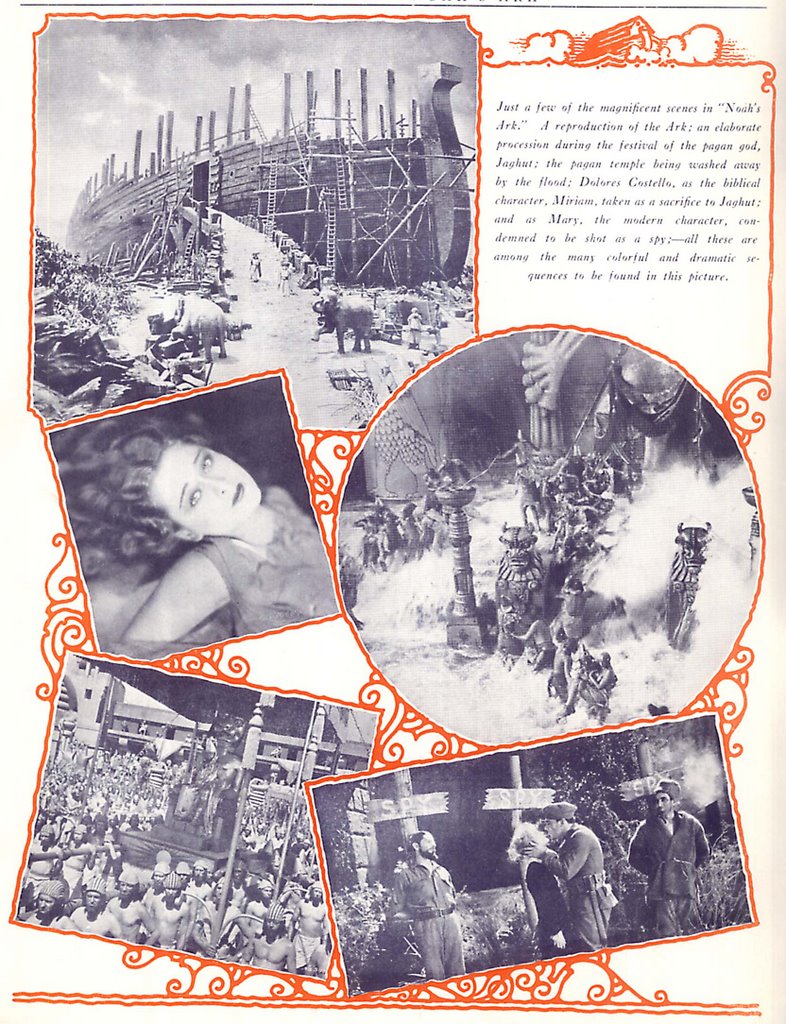
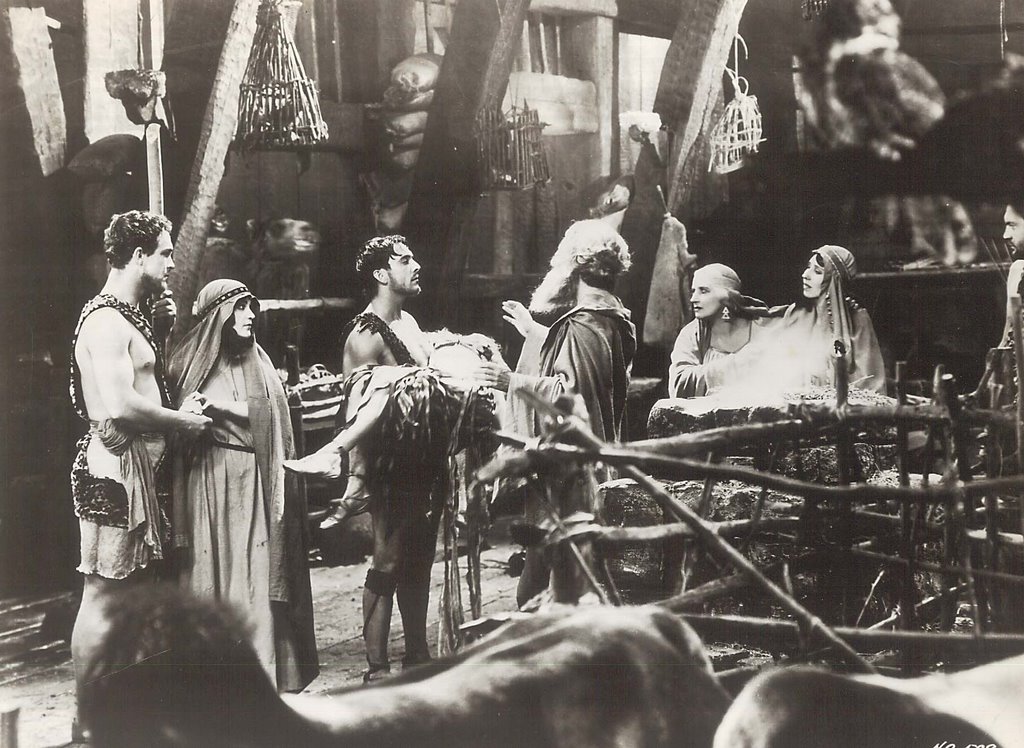


Sunday, September 03, 2006


Monday Glamour Starter --- Ida Lupino


Ida Lupino might have enjoyed a glorious old age had her luck held out a little longer, with a mantle no doubt buckling beneath the weight of awards she’d have collected for pioneering efforts as a director in that notoriously male dominated industry. The women’s studies industry never had the opportunity to knock down Ida’s door for interviews and inspiration either. It’s not that she died too soon. That didn’t happen until 1995, but for at least ten years previous, she’d maintained silence behind the gates and allowed few to enter. The little red devils she’d alluded to often had moved back in to stay, and a personality tormented by dark moods and melancholy finally gave itself over to an anything but splendid isolation. Artistic personalities are often troubled ones, after all --- serenity not among the gifts they’re born to. Ida Lupino was high-strung to the point of caricature. When servicemen encountered her at the Canteen, they asked her to scream. Guests at parties would come up and say, Ida, go crazy, as if this were some parlor trick she could switch on and off like Jimmy Durante doing Umbriago. She had this way of exploding on camera, and off as well. The breakdown she staged in They Drive By Night convinced the town she had to be nearly as cracked in her private life as well. Like Bette Davis, she carried a line in high-octane melodrama, but the public’s taste for that diminished after the war, and like so many actresses who’d had the field largely to themselves during the conflict, Lupino would have to retrench in order to survive. Directing was the invention borne of necessity, and though she’d continue to act into the seventies, it was really behind the camera that she found the greater satisfaction.


There were seven generations of Lupinos in show business. Ida said late in life that she only got into it to please her father and uphold tradition, but judging by her temperament and appetite for flamboyance, I’d say the fruit fell pretty close to the tree. Histrionics were part of her daily routine. As a child in England, she went door to door telling the neighbors of beatings and starvation at home, just to see how they’d react. No truth in that at all, but it did initiate a lifelong habit of embroidering the truth for the sake of impact and showmanship, something she knew all about. There were psychic powers she inherited from her father, and hanged if there might have been something to that, for she managed to anticipate a number of deaths and disasters among friends and family in years to come. Stage and (limited) film work in the UK got her noticed at Paramount, and they brought her over ostensibly to test for 1934’s Alice In Wonderland, but she didn’t want the lead (!) and loudly voiced her desire to play mature parts instead. Being yet a teenager, she did manage to get into adult fare without the encumbrance of ingenue work, but a bout with polio nearly put the whole career aground within months of her arrival stateside. Interviewers found her charmingly arrogant --- I cannot tolerate fools! --- but much of this was just immaturity blossoming in the face of newfound celebrity. The Light That Failed was the 1939 hit with Ronald Colman that really put her over. Edgy, dangerous types became her stock in trade. Warners came calling at $2000 a week, though she reserved the right to do outside pictures at Fox. Rebellion and suspensions at WB were inevitable. She turned down Juke Girl, King’s Row (oops!), and Captains Of The Clouds (come to think of it, she’d have been good in the Brenda Marshall part). Among the ones she did were High Sierra (excellent), The Hard Way (terrific), and The Man I Love (super). Ida Lupino was one fantastic actress in the right kind of picture, but she was luckless in other ways, being accident-prone and out sick a lot. Having Bette Davis around the place didn’t help either, since the best parts always went by we-know-who first.
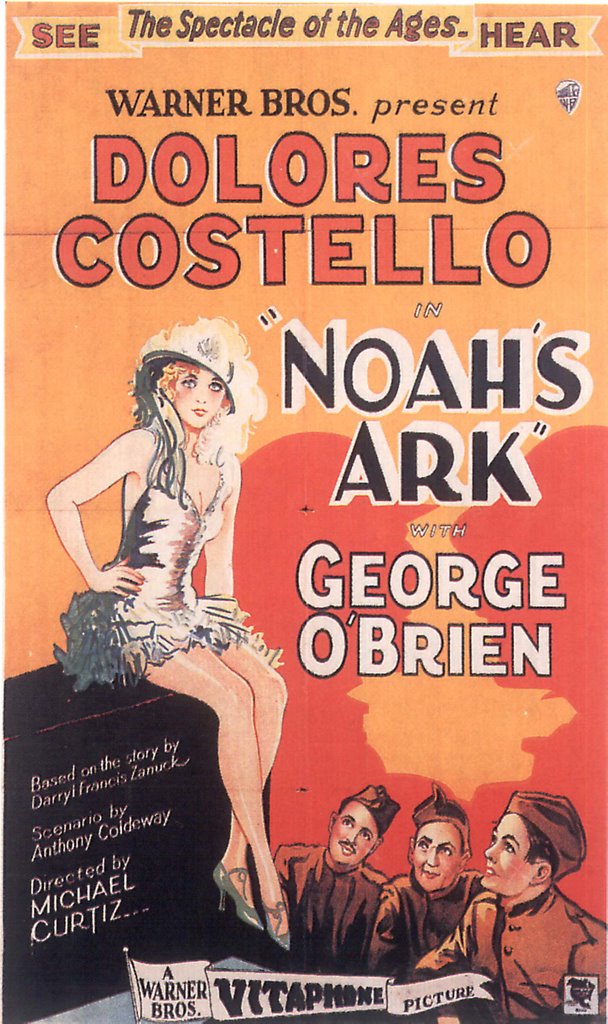


The Warners pact ended on the customarily sour note in 1947, and this is where Ida Lupino got really adventurous. Second husband Collier Young teamed with her in setting up an independent unit called The Filmmakers --- not an unsound venture to go it alone outside those collapsing studio walls, and Lupino still had enough name to get financing for the innovative subject matter she had in mind to film. Not Wanted was a profitable beginning --- a story of unwed motherhood with Ida often filling in for credited director Elmer Clifton --- followed by Outrage, the title of which refers to a rape, and Never Fear, which dealt with polio. In the wake of these, Lupino was the talk of the town, and Filmmakers got a berth at RKO. That might have all been well and good, but wily Howard Hughes took advantage of Collier Young’s negotiating weakness, and locked them in a no-win contract, for which Lupino never forgave her husband. Now even money pictures brought nothing back to Filmmakers. Hughes was skimming the gravy before they could dip their bread. The greater pay-off for Ida came not from features she directed, but melodramas in which she performed, such as Beware, My Lovely and On Dangerous Ground. Young got the idea Filmmakers should distribute as well as produce. Ida knew that would come a cropper. They tried to recoup by accepting product placement in the movies. Coca-Cola, United Airlines, and Cadillac kicked in for The Bigamist, and Ida had to emote in parts of Private Hell 36 with an enormous Pabst Blue Ribbon beer bottle display looming over her shoulder. Independent production was a real salvage operation in those days. It was like prying a quarter off wet cement after the truck’s run over it. Crews opted for location whenever they could. Stage rentals were an unnecessary expense. A noir like Private Hell 36 really benefited from the streets, bars, and trailer parks where it was shot. Those who could survive the 50’s indie race were well equipped to conquer early television as well. At a time when feature prospects were fast rotting on the vine, Ida Lupino made the smart move in that direction.


It was Dick Powell who paved the way of transition for the actress and director, luring her to his Four Star umbrella and giving her valuable experience in the rough-and-tumble ways of hurry-up video production. By now, she’d divorced Collier Young and married actor Howard Duff (here with him in a color shot ). Together they had a hit series called Mr. Adams and Eve, which got back some measure of the on-screen fame Lupino had lost during the interim. Series directing became steady work. Richard Boone used her in a group of Have Gun – Will Travels, and an aptitude for suspense programs got her gigs on Alfred Hitchcock Presents, Thriller, and The Twilight Zone. She was known as the most tactful of directors --- her chair canvas read Mother. All of this carried her right into the sixties. She even called Action for some Gilligan’s Island episodes. On the personal front, Dick Powell called when he found out he had cancer and requested she spend the final months with him (June Allyson was seeking divorce at the time). They got together until the last few weeks when June came back. This was something I did not know until reading the definitive Ida Lupino biography by William Donati, which you can, and should, get HERE. According to Donati, who spent lots of time with Lupino during those sad final years, she pretty much withdrew after memory lapses made it near impossible to retain dialogue. There was a Charlie’s Angels appearance she barely got through, then retreat to the quiet of home. She should have received a special Academy Award for all she accomplished, but why would they do something right all of a sudden? The Filmmakers pics she directed are all over the place in terms of ownership, so who knows if they’ll ever see the light of day again…


Friday, September 01, 2006


93 Years Since Alan Ladd Was Born!


This is to put readers on notice that there will be a further (and more detailed) posting on Alan Ladd in the weeks to come, for no reason other than the fact that I consider him one of the great screen personalities --- an all-purpose definition of what being a movie star is all about. For the meantime, here’s a shot of Ladd in his most famous role to commemorate the ninety-third anniversary of his birth. So few of his films have been released on DVD --- Shane, This Gun For Hire, Whispering Smith, Branded, The Proud Rebel. The Carpetbaggers. Universal owns most of them now. A box set would be a welcome thing indeed. Copyright records indicate that Ladd’s family still owns a few titles, including Drum Beat and one of my favorites, Hell On Frisco Bay. Both of these are in Cinemascope, and I’d hope that some enterprising distributor would make an arrangement with the estate to release them. They may not be Hondo and The High and The Mighty, but they’ve been out of circulation almost as long, and I for one would love to see them again.


Shooting In Technicolor


The old three-strip Technicolor process required behemoth-sized cameras. This one’s pointed at Deanna Durbin and Robert Paige during the production of Can’t Help Singing in 1944. Note the somewhat battered exterior. That equipment looks to have some miles on it. Technicolor cameras were never in abundant supply. They were rented out to studios by Herbert Kalmus’ company --- he owned the trademark and all the hardware. Producers waited in line for the use of his process. The camera shown here may have been the same one that photographed Gone With The Wind or The Wizard Of Oz. I wonder how many of these survive. It’s regrettable the process didn’t. By 1954, most of the studios were shooting on Eastman negative, although prints were often processed by Technicolor and retained that uniquely saturated color we associate with the name today. Universal held out the longest. They used three-strip cameras for several pictures shot in 1954, including This Island Earth and Man Without A Star (here’s the crew on location for that one). Universal’s August 1955 release of Foxfire has been cited as the final feature shot on three-strip Technicolor. The company’s manufacture of dye-transfer prints would end in 1975 with The Godfather-Part Two and a re-issue of Swiss Family Robinson. Efforts to revitalize the system in the nineties were regrettably unsuccessful.
grbrpix@aol.com
  • December 2005
  • January 2006
  • February 2006
  • March 2006
  • April 2006
  • May 2006
  • June 2006
  • July 2006
  • August 2006
  • September 2006
  • October 2006
  • November 2006
  • December 2006
  • January 2007
  • February 2007
  • March 2007
  • April 2007
  • May 2007
  • June 2007
  • July 2007
  • August 2007
  • September 2007
  • October 2007
  • November 2007
  • December 2007
  • January 2008
  • February 2008
  • March 2008
  • April 2008
  • May 2008
  • June 2008
  • July 2008
  • August 2008
  • September 2008
  • October 2008
  • November 2008
  • December 2008
  • January 2009
  • February 2009
  • March 2009
  • April 2009
  • May 2009
  • June 2009
  • July 2009
  • August 2009
  • September 2009
  • October 2009
  • November 2009