Classic movie site with rare images, original ads, and behind-the-scenes photos, with informative and insightful commentary. We like to have fun with movies!
Archive and Links
grbrpix@aol.com
Search Index Here


Wednesday, May 18, 2011

Rocks In My Head

Western locations have suddenly become something I notice. Part of that comes of reading about places like Lone Pine and Corriganville on line and in pages of Western Clippings. There's a yearly festival at Lone Pine, that rock formation horn of plenty over which horse and rider by thousands chased and show-downed against majestic backgrounds. Fans go there because these are actual and largely unchanged sites still host to cowboy spirits who rode but will no more. John Wayne and Gene Autry may be gone, but Lone Pine is forever. They'll not be striking these sets. Trips to Lone Pine amount to pilgrimage for fans who've committed environs to memory. They'll tell you which boulder appeared in what Hoppy, identify a mountain far distant and spell out how many features that peak backgrounded. It matters for me now where screen cowboys rode just as it always did among seasoned watchers. Why did I take so long appreciating nature's role in making these shows great?


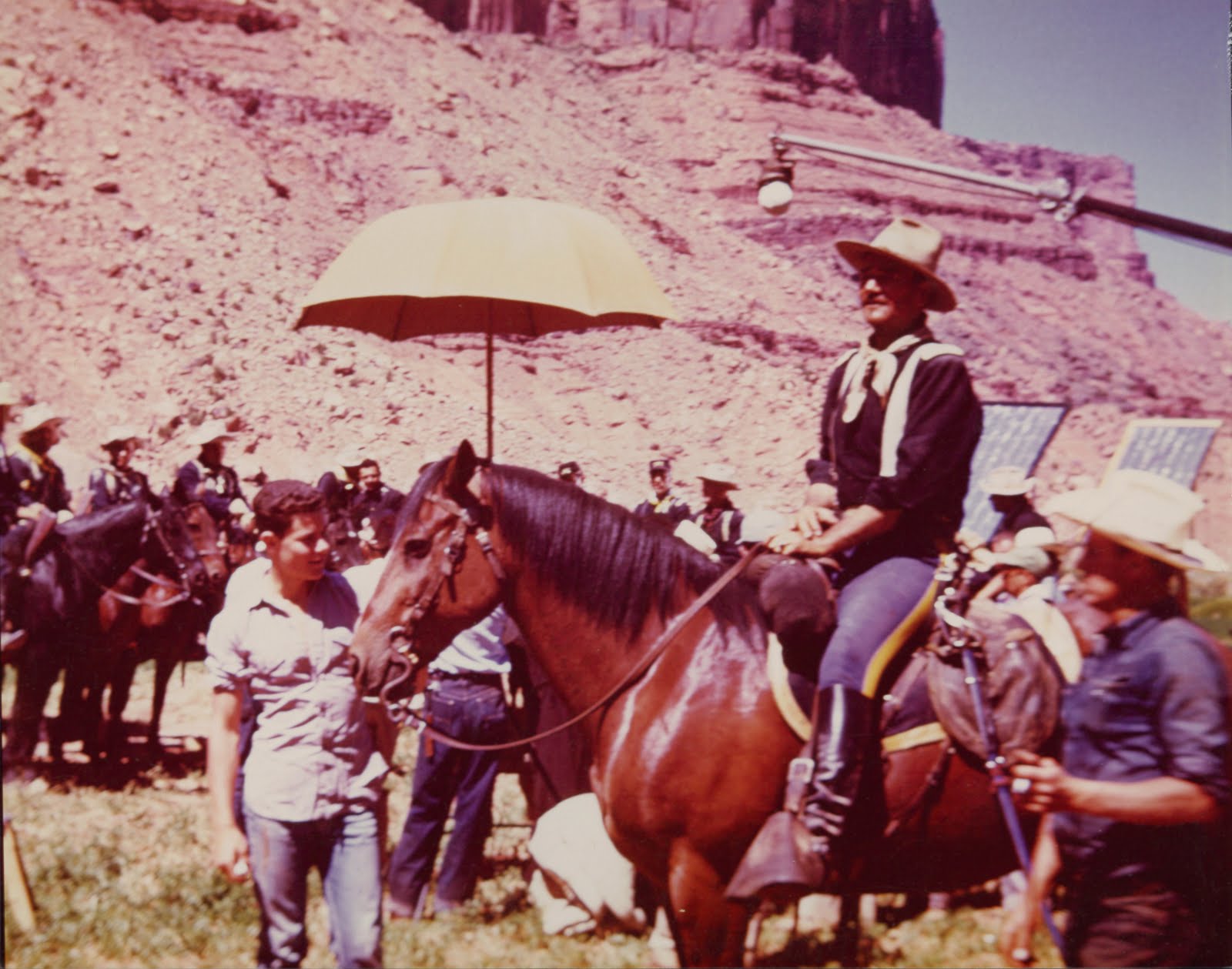
John Wayne Waits Out Crew Preparation for a Next Fort Apache Scene.

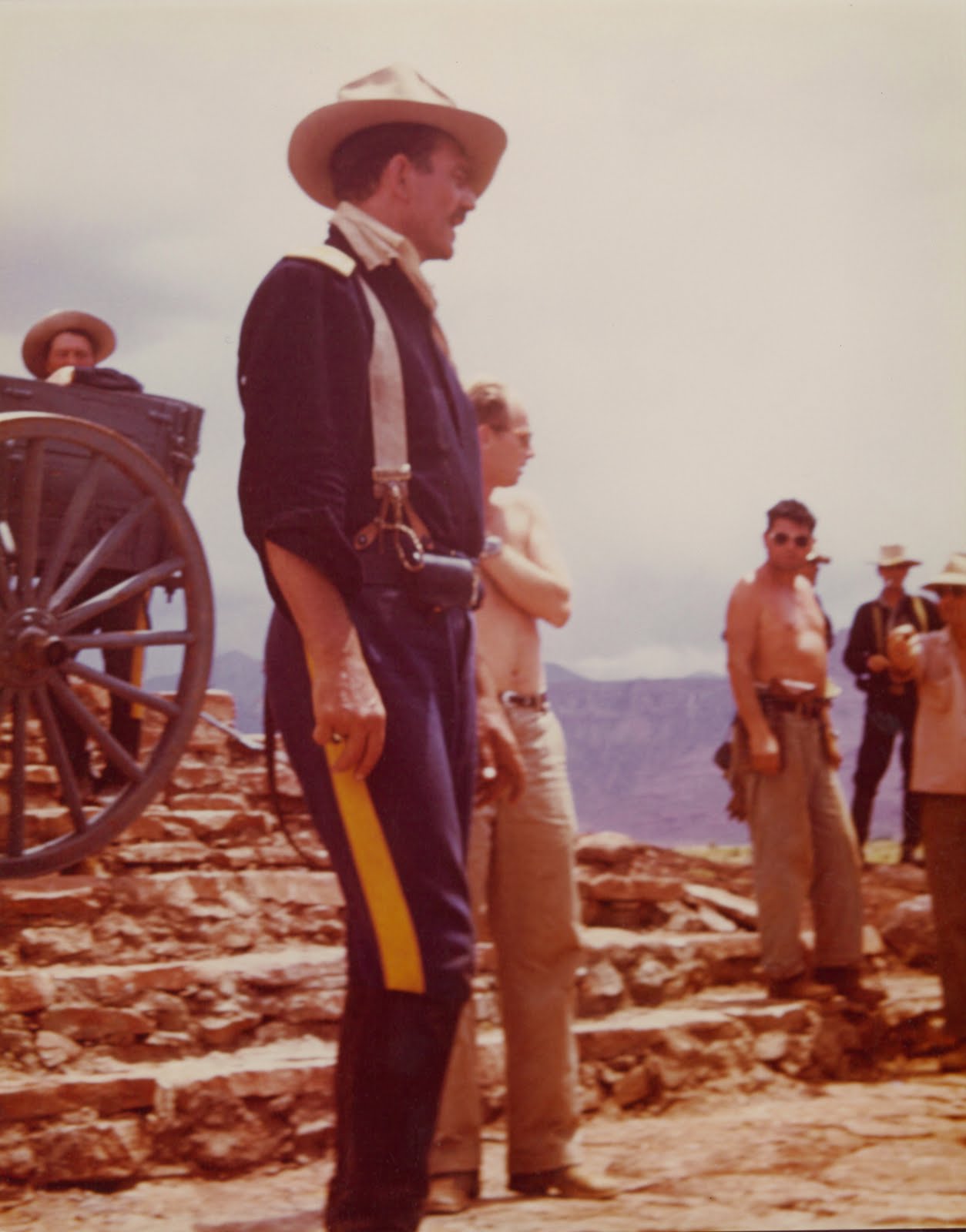
I've known some who trekked to Monument Valley. That's where John Ford practiced his art. Would seeing those towering edifices make The Searchers from then on a different experience? No doubt it would, and yet I've not gone, and probably never will (they say it's hot in deserts). Authentic western locations aren't generally visible from air-conditioned hotel balconies. Guess it needs a seasoned breed to venture there. Much as I'm curious about these places, it's enough to view them on screen from a recliner's distance, and yet I know I'm missing a lot by not toughing out a flight or long distance drive to give dimension to these places so immortalized on film. This I did not know about Fort Apache until I read Carlo Gaberscek and Kenny Steir's In Search Of Western Movie Sites column in the latest Western Clippings: It seems the fort itself was not built in Monument Valley, but was instead designed (by veteran James Basevi) from the ground up at nearer-by-Hollywood Corriganville, a ranch owned/operated by one-time screen cowboy Ray Corrigan, who made acreage available to film folk for outdoor lensing, then kept the built (and often lavish) sets for use by future renters. Turns out John Ford's company (with Merian C. Cooper) Argosy Pictures, spent a pile on Basevi's accurate-to-detail frontier fort and left a finished job from which Corrigan could profit for years to come. Think of it like someone building a carnival in your backyard, operating it for a week, then leaving the rides for which you'll charge from there on.


Lone Pine's festival has yielded printed annuals (two I've found on Amazon --- are there more?) with terrific articles about westerns shot there. Genre experts Richard Bann and Ed Hulse are among contributors. Ed's appreciation of lost-till-now Republic serial (and largely LP-shot) Daredevils Of The West inspired me to order the DVD from Serial Squadron. I'll not be writing about it here because he's covered the topic definitively, as has Bann on 1935's Westward Ho!, John Wayne's first for newly organized Republic Pictures, and happily streaming on Netflix, so I was able to read, then watch.


There's nothing of the Fort Apache set left. A guy on You Tube went there and photographed ground where it once stood, matching footage from the film with rocks still around to establish what stood where. There's a melancholy about these location crawls, though I'm glad fans are still willing to make them. Ray Corrigan himself is long departed (1976). I met him at the first western fair I ever attended and he seemed prosperous. Ray's interesting for fact he traded cowboy duds for a gorilla skin after B westerns went flat, hiring himself out as ape-menace to serial heroes and here-and-there Bowery Boys. RC even got round to donning monster attire as It!, yet another Terror From Beyond Space.
 
 
The Fort Apache set naturally got re-used for cavalry-based pics. I looked at a pair, Ambush and Escape from Fort Bravo, after umpteenth viewing of Fort Apache. It needs not repeating that cavalry westerns aren't created equal. There's ones John Ford directed ... and all the rest. My declaring that however, even if backed by ranks of the auteurist-establishment, doesn't make it right. I've a feeling lots would disagree and say Ford's patrols could have used tighter narrative and less meandering incident. Here's the difference I see between a Fort Apache and the Ambush/Fort Bravo parlay. The latter two are all about story ... conflict ...complications. On their own, both are fine, comfort westerns. Beside Fort Apache, however, they seem contrived and mechanical. But that's only by admittedly unfair comparison with John Ford at his best and backed by John Wayne, Henry Fonda, and sterling character support.
 
It's looseness and meandering I like best in Ford's cavalry. Once you're told Bravo and Ambush's story, the party's over. Fort Apache, longer than either but never seemingly so, ambles in no hurry to a blowout finish you'd think came from a movie more committed to action than this one that's so long withheld it. You know a western's great when you'd rather hear the players talk than watch them fight. Ford seemed to look for moments to distract us from Plot Point One's progression to Plot Point Two. He was ahead of most filmmakers for knowing story conventions were things better dismantled, so long as a basic premise was strong enough to withstand side-trips he'd take along the way.
 
Ambush and Escape From Fort Bravo reflect well rules others played by. What these two do best is take us far afield of studio ranches and too-familiar brush. Ambush was filmed around Gallup and Lupton, New Mexico. I wonder if kids ever played cowboy/Indians among those majestic rocks. MGM and director Sam Wood (his final outing) make most of outdoors and what crisp photography captures of it (Warner Archives' Ambush DVD is an exceptionally nice one). You could sell westerns in 1950 with the promise of fresh settings for action. Warners' Rocky Mountain did as much the same year, also on Gallup location.
 
Lowered expectations are best company to Ambush and Fort Bravo, especially if you're coming off Fort Apache, She Wore a Yellow Ribbon, or Rio Grande. Robert Taylor is Ambush's hard-bitten scout, refereeing love triangles in addition to renegade Indians. There's less adherence to period authenticity here than Ford enforced. Metro glamour would not be forfeited amidst dust swirls, thus an Arlene Dahl-ed up to studio specification. Exhibitors would complain through much of the fifties about overabundance of Indians biting said dust in westerns. Not that social/liberal impulses were aroused ... it was endless repetition of a too familiar device getting ticket-sellers down.

Much arrow extraction in evidence throughout cavalry pics that flourished during the fifties.

Escape From Fort Bravo is a 1954 MGM release unfortunately shot with Anscocolor. The process represented an economy measure. Ansco never looked very good, and otherwise satisfactory films like this and Seven Brides For Seven Brothers suffered for its being utilized. As with Ambush, there was location work at Gallup and on this occasion, Death Valley. Corriganville's Fort Apache was used again, for a first time in wide screen, Escape From Fort Bravo being released in 1:66 ratio. Trouble once more was with Indians, mass-gathered to serve as action respite to love rivalry between William Holden and John Forsythe for Eleanor Parker. Here was where resourceful direction could take onus off commonplace dramatics, as new-to-A's John Sturges demonstrates with a whale of a third-act redskin siege favorably noticed at the time and doubtless responsible for his moving further up to Bad Day at Black Rock and eventual star-studded western Gunfight At The OK Corral.


Monday, September 29, 2025

Of Transitions and More Transitions


Three Blind Mice from Dr. No, Me the Fourth Blind Mouse Till 5/27/2000

The Night Film Ended


I touched before on what happened twenty-five years ago at a Columbus show. At left is what reminded me, a flyer to promote their Chaplin Festival for those weary of dealer rooms and screenings downstairs. Couple of us stepped in momentarily to see how their print of City Lights looked. Note I said “print” because film was what shows dealt circa 2000, or so we assumed. City Lights, once eyes adjusted, was stunning, at least in comparison with 16mm seen before, me blurting Whose print is this? as though maybe it had been snatched off Chaplin’s Swiss shelves. A tabletop projector no bigger than a breadbox spoke truth to presumptions I’d had since first threading 8mm. Here all of a sudden was the future, and it was digital. Nobody’s City Lights, no matter where from, could look so good as this. My friend and I exchanged a glance, him a vet film dealer … not sure which said “It’s over” first, probably we did in unison. Ever see long-standing way of life dashed upon rocks of reality? Mine was that evening, goal going forward but to dispose of what thirty-five years had accumulated, or see it perish upon analog’s pyre. Should I have seen this coming? There'd been signs a perceptive mind might note (not mine, obviously). I had lately leaped upon a Big Reel ad where Dr. No and From Russia with Love were offered on 16mm and IB Technicolor at prices way lower than any seventies/eighties collector could expect. The seller admitted that no way would he have parted with these before, but laser discs worked plenty OK, and it was but matter of time before both Bonds would be available on that new and promising DVD format. I didn’t argue his points, preferring the films over debating their obvious-to-me superiority. So who made the wiser call? I’d say my seller. He took my money and let me have his horse-collars. I should have read the tea leaves, my gets got far too easily.

Here I Am in 1999 Telling Eugene Morgan That Digital Had No Business to Be Invented.

May 27, 2000 was when I became Georgie Minifer among a company of Eugene Morgans. They understood what my notion of filmic purity was not prepared to grasp. Talking points (mine): Technicolor could never be faithfully duplicated on disc … my original 1957 Kodak print of The Mummy, among first generated for television, cannot be approached, let alone surpassed, for depth and clarity … just let Disney try and make their Silly Symphony DVD’s look good as my IB’s. Georgie summed up my posture when he said Get a horse!, attitude more a product of sentiment than recognition of times having changed. Had years at seek and struggle come to this? Every quarry I chased now laughed back at me. The Mummy for instance. It sat years in the basement of a to-say-the-least eccentric collector in Philadelphia. Why would I otherwise travel to Philadelphia? Mike lived in a houseful of clocks, curtains all drawn, no shaft of sunlight to be had. I got my Mummy plus others that after 2000 would spell so what? The thrill was in the getting and knowing mine was possibly the cleanest 1957 print of The Mummy in Christendom. Again, so what? It would be worth asking who owns it at present, or if The Mummy over intervening twenty-five years crumbled to vinegared dust not unlike Imhotep himself. Arguing fails where logic no longer backs you up. And yet my ’57 Mummy side-by-side with even Universal’s 4K might reveal values unsuspected by modern, let alone way-back, viewership. It’s easy to say Here’s the Best when what was best before is beyond reach of comparison, my Mummy unique for what I endured to get him. Off this tack already, or I’m liable to go in search of the long-gone relic.

Nuts to Your Digital Reclaim ... My 1948 Kodak Scram! on 16mm Will Always Look Better.

There were many points of collecting pride, among them quest for the definitive print of a favorite subject, this back of my Mummy hunt, but also of Laurel-Hardy comedies initially got from Blackhawk Films and satisfactory till eyes fell upon 16mm generated during the late forties when the two-reelers were printed for non-theatrical rental purpose and to fill syndicated TV packages. Never could Blackhawk approach beauty of these. We’ve all seen Scram!, but never like I saw Scram! on 1948 stock, there being an edge code above the sprocket holes to confirm the printing date. You had to be a way out-there Laurel and Hardy enthusiast for any of this to make a difference, pride of ownership enjoyed largely by oneself and equally dedicated collectors who might venture by. My 1948 Laurel-Hardys had integrity, you see, even if few beyond myself divined it, a same way for any (extreme) collector, I suppose. Picture someone … someone you otherwise like and respect … running up excitedly to show off his 1913 Buffalo head nickel. Think hard before you react. His/her self-worth may hang in the balance (her? Doubt it, as we may assume women had better things to do than chase after Buffalo nickels). Why do you bother with this film stuff? was a question pointed often at me, so much that I began to wonder myself. A family reunion, thirty at least years back, saw me invited to explain movie collecting and what-not, accent on what-not. Others stood up to tell of their hobbies, all healthy, recognizable pursuits. Perhaps it was mood of the moment that made me meditate on why indeed did I invest so much of life so far in things so fleeting. Did I already sense a design for living soon to evaporate? Fact a mere handful of men were alive even then to repair 16mm projectors was incentive to bail, too many of us willfully blind to note it. Not quitting then was to put off the inevitable, but were we premature to give up ghost that film collecting had become?

The Only Chilly Willy I'll Watch Is the One Directed by Tex Avery ... Am I Missing Out on Good Things?

It appears, to utter surprise, that collecting 8, 16, even 35mm, is still a thing. Was I amiss to sell out? Check eBay for breathtaking prices realized, for instance these on 16mm: Thunderball ($2,000), three Hitchcocks, Dial M for Murder ($2,263), To Catch a Thief ($2,179), and North by Northwest ($1,375.00). All of foregoing were IB Technicolor prints, final bids frankly more than one would have been obliged to pay during peak years of enthusiasm. When an IB Chilly Willy cartoon from the early sixties gets $100, you know collecting survives with a vengeance. Thinking surely 8mm was a spent format, I looked for listings and found these: The Bride of Frankenstein, 400 feet with magnetic sound, $95.00, Abbott and Costello Meet Frankenstein, same, $125.00. Castle horror reels command the best money, it seems. Blackhawk prints go cheaper overall, but no matter constant availability of Chaplin, Keaton, Laurel-Hardy, they always go to somebody, this a sure indication that film is far from finished. Much comes down to modern infatuation with analog, embracing obsolete formats because they are obsolete. To rescue spent history is to ennoble the rescuer, asserting oneself against grain that is digital, celebrating grain inherent to film stock instead, doing for celluloid what listeners do for turntables. Does vinyl continue to outsell CDs? I heard recently it does. Protection of film has become messianic for many. Filmmakers have brought back Vistavision, Quentin Tarantino shot a feature on 70mm, then bought a revival house where he swore only celluloid would be presented. Are there old-timers enough to keep equipment in repair? Such machinery is far too fussy for me to cope with again, my memory lane well short of place where sprockets, loops, and antiquated amps hold sway.

You Figure Surely Cartoon Collectors Prefer Blu-Ray, Yet This Laser Disc Box Lately Sold for $450

Presentation became a critical concern once technology showed what was possible.  Seems quaint our having once sat before awful TV transmission of favorite movies bowdlerized by commercials, visuals barely better than not seeing the films at all. Video cassettes were first of stair-steps a buying public climbed toward perfection we take for granted. A lot popped corks when VHS first made movies legally available, and even better, uninterrupted. Laser disc took quality to higher levels, but these had to be turned over halfway through features and were pricey besides, LD best suited to connoisseurs who wouldn’t mind outlay and inconvenience. Fast as progress came, it was certain something even better would push laser out, ground given to satellite television and improved cable service supplying classic films shown straight through, plus titles seen after years of being inaccessible. DVD to this seemed an anticlimax, and like laser, would surrender to even better Blu-Ray. Streaming in 4K meanwhile makes discs not similarly 4K less consequential (but wait, I'm increasingly seeing 4K efforts in terms of emperors possibly without clothes, subject maybe for a future column). Obscure titles stay in yard that is physical media, a boon especially for a specialized market preferring an "Ultra" High-Def Caligari or upcoming Beau Geste where we get the keepsake disc plus extras and a program booklet. Closest to total immersion is lately wrought in Vegas where one hundred million and a staff of thousands raised a “Sphere” seating 18,600 to experience The Wizard of Oz projected upon a 516-foot-wide screen, admission average $200. Word is they are banking two million a day off a project that took five years to realize. I sound perhaps like a press rep, for I come not to bury this Caesar, but to praise his conquest. Purists please note: This attraction has nothing to do with a faithful transmission of The Wizard of Oz, nor is it meant to, Oz instead a physical space where Vegas tourism may capture magic having otherwise left the fabled town (costs up, attendance down, says analysts). A thing costing $2.3 billion to conceive, then build, must surely need time to break even, and we could wonder how much rake-off Warner Bros. is getting. My brain but barely computes at levels like this.

Why Not Do a Sherlock, Jr., Step Into this Vast Landscape, and Stay There Forever After

You Tube has numerous previews, reviews, captures off the enormous round, indoors and out. First thing we note from clips is that Sphere entirely replaced Oz music, for simple reason you can’t make ancient recording sound right in a pavilion overwhelming as this. Also they trimmed Wizard from 102 minutes down to 75, shades of CBS in gone days, though that network never dreamed of cuts this deep. You cannot enter such a circus with expectation of artistic fidelity. What’s wanted is novelty and sensation, as everyone has seen the movie to death and for $200 has a right to expect something fresh from it. I’ll not visit this Oz unless the Sphere lands locally (how about where our bowling alley burned down a few years back? --- but no, not enough room). Reality as created for Oz includes debris flying out and into the audience during the twister, apples falling upon viewers when the tree begins tossing them, for all I know a live cow landing in our laps when Dorothy spots it through her window. Historic precedent for this sort of experience would include IMAX, Cinerama long before that, Grandeur and Magnafilm when talkies barely were upon us, Sphere surpassing all for wrap-around effect akin to 360-degree spectacles staged by Disney parks, which by the way, what became of those? Research indicated that The Wizard of Oz was the most watched movie ever made. True? Anyway, it was thought a soundest commercial choice. Could Oz play the Sphere for years, or will another subject eventually take its place? What then will they do for an encore? Could any other library classic qualify? Surely nothing black-and-white. If 75 minutes is viewer limit for Oz, then forget a Ben-Hur, 2001, other outsize spectaculars. Managers must be floating possibilities … some 80’s action or sci-fi? The Titanic remake (much too long I should think, but why not start with the iceberg and cull your 75 minutes off that?). Looks like we’re all done with reverence should this model sustain, but so what … movies were always monkeyed with to suit circumstance, and if anyone wants to see The Wizard of Oz presented complete and in fact enhanced to visual brilliance it never knew before, then go get the 4K or stream it tonight off Amazon and bask in sacred glow sans guilt.


Wednesday, August 22, 2007


Bonnie and Clyde Turns Forty


There was less celebration over Bonnie and Clyde’s fortieth anniversary than might have been expected. Generational struggles the picture once represented aren’t relevant anymore, as the disapproving establishment circa 1967 is mostly gone now, and victors who claimed cultural dominance are themselves under siege by revisionist-minded youngsters in diapers (or not yet born) when Bonnie and Clyde was released. One of these wrote an interesting piece for The New York Times a few weeks ago, daring to acknowledge merit in Bosley Crowther’s scabrous review which had set off a firestorm in 1967 and led to the critic’s forced retirement after decades with the paper. A.O. Scott speaks of that epochal struggle, but not in fawnish terms agreeable to a sixties generation still flattering themselves for having pulled down a decaying critical hierarchy too mossbound and obtuse to "get" radical chic flicks like Bonnie and Clyde. Least of all would that rebel audience, grayed but clinging tenaciously to their myths, enjoy knowing they were but lemmings enticed to the sea by what I’d call a plain inspired sales plan on Warner Bros’ part. Wait --- weren’t they supposed to have bungled distribution and fought against Warren Beatty’s vision all the way to those cast-off ozoners where Bonnie and Clyde was supposedly dumped? A recent Newsday column addressed the fortieth thus: Warner Bros. thought so little of the film that they released it as a "B" movie, primarily to drive-ins and second-tier theatres. That’s a damning reference to territorial openings common at the time. What more insulting for New York critics and their acolytes than having the season’s pet movie open in Texas and across the South prior to saturation in urban markets far better able to appreciate such ground-breaking artistry? The fact that Bonnie and Clyde went wide first in the South was something camp followers would never get over. To this day, they call it a black mark against Warners.


Once again, it helps to have been there. We got Bonnie and Clyde at the Liberty on September 13, 1967. That was a month before Pauline Kael’s review in The New Yorker, which is supposed to have further stoked the tempest. Down where I lived, Bonnie and Clyde was an unknown quantity. The limited openings in New York had taken place August 13 after a Montreal film festival showing on the fourth of that month. Saturation bookings in the South and Southwest would be the public’s first wide exposure to the film. Warners based much of their campaign on positive reviews Bonnie and Clyde received after the Canada and New York bows. Naysayers like Crowther were more than offset by raves elsewhere. The pressbook was salted with laudatory quotes. Better still for exhibitors was a free package of accessories that normally would have run upwards of ten dollars for rental. I noticed that set of door panels right away when the Liberty started Bonnie and Clyde, and a bullet-hole decal on the back windshield of a parked car out front was reminiscent of ballyhoo they’d done back in 3-D and Cinemascope days. It was only when Colonel Forehand gave me the pressbook that I realized these extras were gratis by courtesy of Warner’s sales force. This wasn’t the first time they’d done a little something extra for showmen. Bookings for Chamber Of Horrors in 1966 included a free Fear Flasher/Horror Horn standee with powered lights and sound effects. There was something distinctly ahead of the curve about Warner campaigns. They had been been trend-setting and showing up the competition for over a year prior to Bonnie and Clyde. I would submit that modern movie advertising began with Warner Bros. Note sassy appeals to seen-it-all patrons encouraged to share a wink with Paul Newman’s Harper in February 1966, among the first camped-up and deliberately sarcastic ad appeals for a straightforward detective thriller. That same month saw Inside Daisy Clover and an almost confrontational tagline (thanks to all the slobs, creeps, and finks ) ideally suited to product demands of fashionably disaffected youth. Who’s Afraid Of Virginia Woolf (June 1966) could not have been marketed with more precise awareness of what its eventual impact would be. Cunning Warner salesmen had painted targets on the backs of sophisticated moviegoers nationwide by the time Bonnie and Clyde’s campaign hit the drawing board.


A plan this good would still work. They’re young … they’re in love… and they kill people. Anyone claiming Warners botched this sale must have rocks in their head. Here are samples of alternate ads to suggest what I’d consider a major reason for Bonnie and Clyde’s fantastic success. Each are knowingly hip and cutting edge. The pressbook refers to dry wit and violent punch. Advertising delivery on both is what put this show over. Stark contrast is furnished by way of Fox’s conventional effort on behalf of The St. Valentine’s Day Massacre, a not dissimilar product released within months of Bonnie and Clyde. There was nothing wrong with Roger Corman’s movie, other than its running a losing ($264,000) sack race with an arthritic sales force pushing St. Valentine’s as though it were the second coming of Little Caesar --- and what misguided staffer proposed this tie-in for George Segal’s Yama-Yama Man banjo album? Thick with irony is the fact that Bonnie and Clyde filmmakers so brilliantly utilized the same instrument to augment their soundtrack, as I well remember rushing out to buy that 45 RPM single of Foggy Mountain Breakdown. I’m betting the Bonnie and Clyde craze was no accident, despite what others have written. Warners knew it would take off in the South, and that’s why we got it early. For us, it was the second coming of Thunder Road. Dixie territorial openings have a noble history. After all, weren’t we first to get Brides Of Dracula, Ghost and Mr. Chicken and The Wild Bunch? Snobs up north accused (and maintain) Warners abandoned Bonnie and Clyde. The problem the Liberty had was retrieving this show once audience demand tied up available prints. By late Fall, they were exhibitor equivalents of Faberge Eggs. Everybody wanted Bonnie and Clyde, and bear in mind that in those days, four hundred prints in circulation was the norm, as opposed to three to four thousand we see on opening weekends now. It took Colonel Forehand until May 25 the following year to score a return booking.


My fervent embrace of Bonnie and Clyde resulted in two trips to the Liberty during the one-week engagement. I realized early on the price I’d pay in the final third for fun I’d had in the first. That may be why I didn’t revisit the DVD for an anniversary look. Forty years have past, but Estelle Parsons screeching non-stop in the back seat of that blood-soaked car is still a daunting prospect. Bonnie and Clyde may take credit for stoking the revolution, but that’s been over a long time now, and even though their side won, that still doesn’t make it easier to sit through an at-times very unpleasant show. Could this explain so few throwing birthday parties? A handful of sites rose to the challenge of explaining Bonnie and Clyde and why it matters --- or doesn’t. The younger ones come across a little doubtful. They missed going straight from University town showings to march on the Chancellor’s house back in 1967. All that’s left to them is the movie, and how likely is that to pack a wallop equal to what it did four decades back? Much of Bonnie and Clyde’s initial reception was weighted down with politics and social issues largely forgotten now. I wasn’t aware of all that when I was thirteen and seeing it new. That’s just as well, for it compels me less to defend the film now against justified revisionist criticism such as Scott’s in The Times. We’ve all had occasion to accept a film’s greatness on someone else’s authority, and that someone is usually the person who saw it brand new and can summon up memories of impact and emotion we’ll never feel. Bonnie and Clyde will not again deliver the goods as once it did, though I’m glad I was there to flinch with other first-run shocked observers, but what of great shows I missed by accident of (too late) birth? Have my perceptions of these been largely shaped by impressions my viewing elders passed down?


Sunday, October 19, 2008


Halloween Harvest For 2008


It’s October again and time for accounting another year of horror film releases on DVD. The crop’s been down, owing partly to diminished disc sales overall, and known quantity chillers having been offered up in past seasons. We’ve pretty nearly dredged the lake. Universal sat out 2008 and so failed to deliver on Lionel Atwill "B’s" and more Paula the Ape-Girl pics some had hoped for, while Warners restricts its monsters to Best Buy shelves (but never those within driving distance of me). Sony/Columbia meanwhile secured eternal gratitude of fans by rejuvenating Hammer films I’d have sworn we’d never see. Two sets emerged this year, not all horror titles per se, but each as hotly anticipated, maybe more so, than fabled classics we’d previously digested and had easier access to all along. Sony’s offered pirates, Tong terrors, and psycho thrillers so long buried that some of us wondered if they’d ever really existed at all. Some were so obscure as to be hardly represented in monster magazines back in the day. A (The) burning question with any Hammer film is whether it’s truly complete. There’s so often footage someone claims to have seen among archive holdings or on some Euro TV broadcast. I came to The Stranglers Of Bombay with head abuzz over a snake and a mongoose, which sounds like an Aesop Fable but is actually a scene frequently missing from that 1959 release. Columbia distributed Stranglers as they had Hammer’s previous The Revenge Of Frankenstein, with advance ads, such as a color one above, closer in spirit to the film itself than jokey teasers that followed (also above) when The Stranglers Of Bombay went into theatres on a double with The Electronic Monster. Would thirteen-year-olds, surely the targeted audience, be intrigued by British colonialist management problems and rivalry among ranks as depicted in this black-and-white scope feature? I wonder what those few Moms and Dads venturing inside with youngsters thought. Not to worry, as most patrons were probable drop-offs for an afternoon’s distraction while parents engaged bridge games and/or golf matching. I was five and not yet a Liberty habitué, thus The Stranglers Of Bombay came my way but these forty-nine years later and was most satisfactory for all the wait, its snake and mongoose fulfilling hopes I’d harbored for at least half that long.


The Two Faces Of Dr. Jekyll is another coveted rarity. It was nowhere for decades, other than horridly cropped and dreadfully cut, these being adjectives I’d not lightly apply as Two Faces, known alternately as House Of Fright and Jekyll’s Inferno, fell victim to censor assault and distributor mayhem that made Von Stroheim’s mutilations look by comparison like objects they’d hung in the Louvre. Hammer saw potential with Jekyll’s beginnings. It was 1959 and the little company reeling from international successes The Curse Of Frankenstein and Horror Of Dracula felt emboldened toward greater prestige for its horror subjects, thus better writers courted and bigger stars induced. Their aim was good, but targets were invariably missed. Laurence Harvey was said to have considered Jekyll, but like Cary Grant’s supposed flirtation with Hammer’s later Phantom Of The Opera, it came to naught. Insensitive stateside handler Columbia took a look at the finished Two Faces Of Dr. Jekyll and found it unsuitable for kiddies they catered to with horror films resolutely on mild setting. Hammer showed real boldness with this one, however. The finally complete (or nearly so … who knows?) Two Faces is several jumps randier than any of their stuff up to then, its language and near-nudity a welcome and thought-lost treat for Hammer cultists. As with most of their horrors I’m rediscovering, expectations are more than met. Sets no doubt smaller than they look (Chris Lee might better duck when he enters these rooms) are candy-boxes where background doorways exit into red or green pools of light and period frou-frou always engages the eye. Has any producer ever done as much with so little? I liked the long middle section more than a sluggish open and awkward end. My policy dictates that whatever is good in Hammer mitigates all that isn’t. Once done separating, you’ll generally have far more wheat than chaff. There are some who are less charitable, of course. They’d call me an apologist for hackneyed rubbish, an indiscriminate Hammer-head, if you will. Whatever merit lies in either argument, I’d submit The Two Faces Of Dr. Jekyll deserved not the beating it took. Columbia shunned a US release. American-International ended up with distribution and chopped off nearly a reel so as to head off censorial intervention here. They called the result House Of Fright and dumped it into a late Spring and Summer 1961 market dominated by Universal’s stronger Hammer offering Curse Of The Werewolf, AIP’s own larger efforts focused on hit-making Black Sunday and forthcoming Pit and The Pendulum. There were only 6,743 bookings for House Of Fright as compared with more than twice that (13,627) for Roger Corman’s Poe special. Domestic rentals tapped out at $261,000, way below averages AIP maintained on horror/sci-fi product that year.


Hammer wisely varied its program and got a hand in on flourishing genres other than horror. Somehow they’d manage tying it all with a gothic ribbon so that recognition of their name, whatever the content, assured fans of rougher play even in movies figured to be kid-friendly. Hammer tendered pirates minus sailing and the sea, but with cruelties to more than compensate. The Pirates Of Blood River and Devil-Ship Pirates seem to me in hindsight the same show I sat through twice. Both have Christopher Lee. He’s back-and-forth with a beard, eye-patch, and French accent. People who annoy him are likely to have their tongues cut out. I never knew a company so fascinated with cutting out tongues as Hammer. I still wonder at Christopher Lee being so taken for granted in his prime. Was it because only children were going to see him? That probably accounts for his roaring comeback in old age. The little ones who appreciated Chris grew up, overtook the industry, and cast him in their big pictures, a just and rightful third-act for a fine actor I never tire of. But as to Hammer pirates compared with rivals, how did chips (or doubloons) fall? Devil-Ship Pirates under-performed in the US upon Columbia’s 1964 release. There was only $120,000 in domestic rentals. That’s not a patch on what MGM realized selling Guy Williams in Captain Sindbad the previous year. That one did $1.7 million domestic. Business was generated then as now with saturation openings and drum beating on television. Columbia devoted greater energy to Jason and The Argonauts, also 1963,but seems to have done little for Hammer pirates other than cast them adrift on exhibition waters crowded with similar product. As to grown-up fare, particularly that spun off Psycho, Hammer was nothing if not prolific. I’m still not straight on the many they did or which is what. There’s buckets of these and all are twistier than a corkscrew. Consider the following titles and try sorting them out: Maniac, Paranoiac, Fanatic, Hysteria, Nightmare … let’s call the whole thing off! The one just released on DVD is Scream Of Fear. I separate it from others now because I won’t remember enough to do so next week. This has wheelchair-bound Susan Strasberg traversing patios and seashores to investigate possible murders, itself a device that can’t help slowing action. Scream Of Fear is also black-and-white. Bless Hammer, but they need color. Splashes of blood red might have contrasted better against seeming twin suspensers other British concerns turned out in the previous decade (Scream Of Fear is particularly akin to one I looked at recently, Chase A Crooked Shadow, with Richard Todd). Did Hammer favor monochrome for its thrillers in deference to Psycho?


One more horror on DVD needs mentioning, even if not strictly a Hammer. I say strictly because a civilian could easily mistake The Skull for one of theirs. It was actually a sincerest form of flattery on the part of a British firm called Amicus that figured enough money to be in gothic wells for imitators to draw upon. Gothic is the operative word for chillers as sedate in comparison with horrors today. It really was about atmosphere in lieu of violence and sex, even as companies like Amicus and Hammer appeared to push boundaries then in place. As with old Universals, creepy rooms and hallways were most of what you needed to get the job done. Actors like Lee and Peter Cushing supplied the rest. I’ll take The Skull as meditation upon excesses of collecting (in this case crime related artifacts) and how that obsession pushes Cushing to a brink, preferring to watch (and listen to) he and Lee shoot billiards and assess the problem than be faced with that titular relic biting heads off victims. You only get shocked (or repelled) once by any horror film. I went back primarily to enjoy Cushing lolling about his beautifully appointed library and bartering for that coveted skull. It was as much that way when I was twelve. What actors said and against what backgrounds they said it mattered most, not their dexterity with chopping instruments. Chillers seemed to me more congenial, and easier to digest, before they became so explicit. Certainly showmen found it so. One veteran told me of parental confidence withdrawn when things like The Texas Chainsaw Massacre came through his doors. Drop-offs dropped off, even if teenaged (and driving licensed) thrill-seekers made up the shortfall. Consider this 1965 mob above waiting to see The Skull, then note tender age of most and the managing couple standing amongst them. He’s wearing shirt with tie, and I don’t doubt there’s a suit jacket hanging just inside the entrance to be donned as youngsters are seated. The self-same exhibitor who spoke of trust also maintained dress codes strictly enforced among theatre employees (Colonel Forehand required coat and tie for ushers at the Liberty. It drew lines of demarcation between them and shirt-sleeved rowdies in the audience). So what happened when pictures like The Skull morphed into Night Of The Living Dead, Hammer’s own (R-rated) The Vampire Lovers, and finally The Exorcist? Such (demographic) lines as this for horror movies would go away and not come back again.


There was a Classic Monster Movie Con in Kingsport, Tennessee last weekend. I was intent on going even as guests dropped out and travelers changed minds and stayed home. A bad economy and folks skittish to attend and spend suddenly jinxed an enterprise so promising three months before. I drove the two hours on Friday knowing all this and still I went. How many horror fests venture so close to these mountains of North Carolina? Ann wouldn’t join me because she had a gimp knee (her excuse anyway) and didn’t relish the prospect of middle-aged men walking around in Frankenstein masks. She says I ignore household matters but am vitally interested in what Boris Karloff might have said on some street corner back in August 1933, to which I reply, Well, what did he say? Anyhow, I drove past the Tennessee line and saw changing Autumn leaves we take for granted, plus a wide azure lake. The hotel in Kingsport was vast. There was a group in their twenties gathered out front, but I didn’t bother asking if they were there for the show, as they looked too healthy to be monster fans and were probably getting ready to go climb rocks somewhere. You needed a compass to navigate that lobby so I had to ask directions. Various captains of industry were doing the same for a conference also being held, so who could blame the front desk girl for regarding me askance when I inquired as to location of The Classic Monster Movie Con? It was noon or so upon entering the hall, and there I stood alone with a handful of dealers and dialogue from The Body Snatcher echoing from behind a curtain hung nearby. Sara Karloff’s was the first face I recognized. She was set up with merchandise from her Karloff Enterprises. I was pleased to spend the next several hours talking with her. Meager attendance at the show now worked to my selfish advantage as I asked and got answers to all my questions about Boris Karloff from his daughter. Turns out she never cared for his (or anyone else’s) horror movies. That much I knew from published interviews. Being a movie star just happened to be what her father did for a living. Beyond that, she made little inquiry growing up. How many of us followed Dad to work in the mornings after all? Sara did go see The Secret Life Of Walter Mitty and Unconquered, both in 1947, as neither were monster roles and thus more palatable to her. The one time her father recommended she catch his act was the night before CBS ran How The Grinch Stole Christmas in December 1966. He knew that was something special and called to make sure she’d tune in. At one point in our conversation, I spoke of having recently watched Die, Monster, Die!, to which she simply asked Why? Not an unreasonable question if you grew up at any time other than the sixties. Sara must find fandom a baffling thing. Indeed, my spirited defense of Die, Monster, Die! only made me seem foolish. I tried to convey the miracle of Boris Karloff as I experienced him. Here was a man nearing eighty with emphysema who could barely walk, and he’s playing above-the-title leads in horror movies where he’s the scary guy. When was such a thing ever done before or since? Alas, I had to leave The Classic Monster Movie Con later that afternoon and so missed Son Of Frankenstein’s Donnie Dunagan the following day. More people came on Saturday and online discussion groups said the show was an overall success. The impressive poster for The Classic Monster Movie Con was designed by George Chastain, whose site, E-Gor's Chamber Of TV Horror Hosts, is an absolute must-see..)
grbrpix@aol.com
  • December 2005
  • January 2006
  • February 2006
  • March 2006
  • April 2006
  • May 2006
  • June 2006
  • July 2006
  • August 2006
  • September 2006
  • October 2006
  • November 2006
  • December 2006
  • January 2007
  • February 2007
  • March 2007
  • April 2007
  • May 2007
  • June 2007
  • July 2007
  • August 2007
  • September 2007
  • October 2007
  • November 2007
  • December 2007
  • January 2008
  • February 2008
  • March 2008
  • April 2008
  • May 2008
  • June 2008
  • July 2008
  • August 2008
  • September 2008
  • October 2008
  • November 2008
  • December 2008
  • January 2009
  • February 2009
  • March 2009
  • April 2009
  • May 2009
  • June 2009
  • July 2009
  • August 2009
  • September 2009
  • October 2009
  • November 2009
  • December 2009
  • January 2010
  • February 2010
  • March 2010
  • April 2010
  • May 2010
  • June 2010
  • July 2010
  • August 2010
  • September 2010
  • October 2010
  • November 2010
  • December 2010
  • January 2011
  • February 2011
  • March 2011
  • April 2011
  • May 2011
  • June 2011
  • July 2011
  • August 2011
  • September 2011
  • October 2011
  • November 2011
  • December 2011
  • January 2012
  • February 2012
  • March 2012
  • April 2012
  • May 2012
  • June 2012
  • July 2012
  • August 2012
  • September 2012
  • October 2012
  • November 2012
  • December 2012
  • January 2013
  • February 2013
  • March 2013
  • April 2013
  • May 2013
  • June 2013
  • July 2013
  • August 2013
  • September 2013
  • October 2013
  • November 2013
  • December 2013
  • January 2014
  • February 2014
  • March 2014
  • April 2014
  • May 2014
  • June 2014
  • July 2014
  • August 2014
  • September 2014
  • October 2014
  • November 2014
  • December 2014
  • January 2015
  • February 2015
  • March 2015
  • April 2015
  • May 2015
  • June 2015
  • July 2015
  • August 2015
  • September 2015
  • October 2015
  • November 2015
  • December 2015
  • January 2016
  • February 2016
  • March 2016
  • April 2016
  • May 2016
  • June 2016
  • July 2016
  • August 2016
  • September 2016
  • October 2016
  • November 2016
  • December 2016
  • January 2017
  • February 2017
  • March 2017
  • April 2017
  • May 2017
  • June 2017
  • July 2017
  • August 2017
  • September 2017
  • October 2017
  • November 2017
  • December 2017
  • January 2018
  • February 2018
  • March 2018
  • April 2018
  • May 2018
  • June 2018
  • July 2018
  • August 2018
  • September 2018
  • October 2018
  • November 2018
  • December 2018
  • January 2019
  • February 2019
  • March 2019
  • April 2019
  • May 2019
  • June 2019
  • July 2019
  • August 2019
  • September 2019
  • October 2019
  • November 2019
  • December 2019
  • January 2020
  • February 2020
  • March 2020
  • April 2020
  • May 2020
  • June 2020
  • July 2020
  • August 2020
  • September 2020
  • October 2020
  • November 2020
  • December 2020
  • January 2021
  • February 2021
  • March 2021
  • April 2021
  • May 2021
  • June 2021
  • July 2021
  • August 2021
  • September 2021
  • October 2021
  • November 2021
  • December 2021
  • January 2022
  • February 2022
  • March 2022
  • April 2022
  • May 2022
  • June 2022
  • July 2022
  • August 2022
  • September 2022
  • October 2022
  • November 2022
  • December 2022
  • January 2023
  • February 2023
  • March 2023
  • April 2023
  • May 2023
  • June 2023
  • July 2023
  • August 2023
  • September 2023
  • October 2023
  • November 2023
  • December 2023
  • January 2024
  • February 2024
  • March 2024
  • April 2024
  • May 2024
  • June 2024
  • July 2024
  • August 2024
  • September 2024
  • October 2024
  • November 2024
  • December 2024
  • January 2025
  • February 2025
  • March 2025
  • April 2025
  • May 2025
  • June 2025
  • July 2025
  • August 2025
  • September 2025
  • October 2025
  • November 2025
  • December 2025
  • January 2026
  • February 2026
  • March 2026
  • April 2026
  • May 2026
  • June 2026
  • July 2026
  • August 2026
  • September 2026